Introduction
Seismic interpretation software is a specialized class of geophysical tools used to analyze seismic data—sound waves reflected off underground rock layers—to identify geological structures such as faults, horizons, and potential fluid traps (oil, gas, or water). These tools enable geoscientists to visualize the subsurface in 3D, calculate rock properties, and build “Shared Earth” models that guide drilling and production decisions.
The importance of these tools lies in risk mitigation. Drilling a single offshore well can cost over $100 million; seismic software allows teams to simulate the subsurface environment and validate prospects before a single drill bit touches the ground. In 2026, the primary use cases have expanded beyond traditional hydrocarbon exploration to include Carbon Capture and Storage (CCS) monitoring, geothermal site selection, and identifying “critical minerals” for the energy transition. When choosing a tool, evaluators must prioritize AI-driven automation (to handle massive data volumes), cross-disciplinary integration (linking geophysics with reservoir engineering), and cloud scalability.
Best for: Exploration and Production (E&P) companies, geophysical service providers, academic researchers in earth sciences, and government regulatory bodies. It is particularly essential for multidisciplinary “asset teams” in mid-sized to large energy firms.
Not ideal for: General civil engineering projects or small-scale land surveying where shallow-surface tools (like Ground Penetrating Radar) are more appropriate. It is also not a substitute for basic CAD software for surface-level construction.
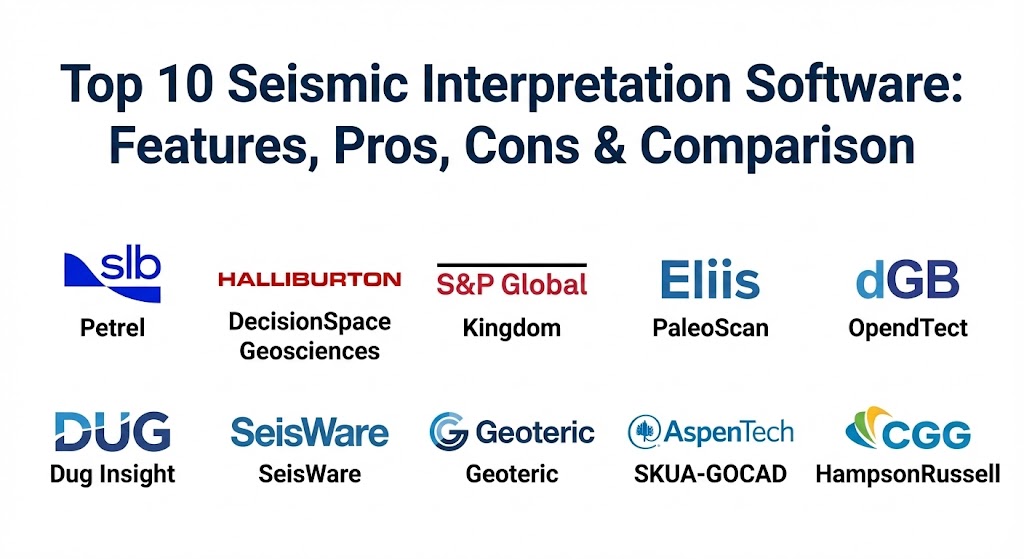
Top 10 Seismic Interpretation Software Tools
1 — Petrel (by SLB)
Petrel is the industry gold standard for E&P software. It provides a complete “Exploration to Production” platform that unifies the workflows of geophysicists, geologists, and reservoir engineers in a single environment.
- Key features:
- Shared Earth Model: Enables real-time collaboration across disciplines on a single data source.
- Automated Fault Extraction: Uses AI to identify and map complex fault networks in minutes.
- Delfi Integration: Native cloud-based processing for massive high-definition seismic volumes.
- Geostatistical Modeling: Advanced tools for predicting rock properties between wells.
- High-Resolution 3D Visualization: Industry-leading rendering of complex salt domes and stratigraphic features.
- Studio Database: Robust data management and version control for large global teams.
- Pros:
- Unrivaled integration; there is no need to export/import data between different software for modeling.
- The most extensive library of plugins and third-party extensions in the market.
- Cons:
- Extremely high licensing costs and steep annual maintenance fees.
- Requires high-end hardware or expensive cloud instances to run effectively.
- Security & compliance: SOC 2 Type II, ISO 27001, GDPR, and FedRAMP (via Delfi cloud).
- Support & community: World-class enterprise support, extensive training academies, and a massive global user base.
2 — DecisionSpace Geosciences (by Halliburton Landmark)
DecisionSpace is a high-performance enterprise platform designed to manage the entire lifecycle of a reservoir. It focuses heavily on “integrated geosciences,” ensuring that geophysical interpretations are always consistent with geological constraints.
- Key features:
- Multi-user Collaboration: Real-time “Follow the Leader” sessions for remote team interpretation.
- Dynamic Frameworks: Maps and models update automatically as new well data or picks are added.
- OpenWorks Database: One of the industry’s most powerful and stable subsurface data management systems.
- Seismic Attribute Workbench: A comprehensive suite for spectral decomposition and coherency analysis.
- Earth Modeling: Integrated 3D structural and property modeling.
- Pros:
- Superior data management for organizations with massive legacy databases.
- Excellent support for complex, large-scale international projects.
- Cons:
- The user interface is powerful but can feel cluttered and overwhelming for new users.
- Installation and initial setup often require dedicated IT/Landmark specialists.
- Security & compliance: ISO 27001, HIPAA (for relevant data), and enterprise-grade SSO.
- Support & community: Strong professional services network and comprehensive “Support Online” portal.
3 — Kingdom (by S&P Global / IHS Markit)
Kingdom is widely recognized as the most user-friendly seismic interpretation tool. It is the preferred choice for independent operators and “indies” who need to get from data to drilling as quickly as possible.
- Key features:
- Kingdom Gateway: Seamless data transfer between Kingdom and Petrel.
- VuPAK: Advanced 3D visualization and volume interpretation engine.
- Automated Predictive Analytics: AI-driven tools for reservoir characterization and sweet-spot mapping.
- Dynamic Depth Conversion: Real-time velocity modeling to convert time-based seismic to depth.
- Geosteering Integration: Direct link between seismic models and active drilling operations.
- Pros:
- Known for its speed; a skilled interpreter can generate a prospect much faster than in Petrel.
- Runs effectively on standard high-end laptops, reducing hardware overhead.
- Cons:
- While improving, its complex 3D modeling capabilities still lag behind SLB and Halliburton.
- Limited support for extremely large “Mega-Survey” datasets compared to cloud-native platforms.
- Security & compliance: Varies by deployment (On-prem vs Cloud), standard encryption, and access controls.
- Support & community: Excellent US-based support and a very large, loyal user community among independent geologists.
4 — PaleoScan (by Eliis)
PaleoScan has revolutionized the industry with its “RGT” (Relative Geological Time) technology. It is designed to interpret entire 3D volumes at once rather than picking individual horizons one by one.
- Key features:
- Semi-Automated Interpretation: Can generate thousands of horizons simultaneously.
- Sequence Stratigraphy: Automated identification of geological sequences and depositional environments.
- 3D Wheeler Diagram: Real-time conversion of seismic volumes into chronostratigraphic displays.
- Fault Network Extraction: Fast, AI-assisted fault picking and modeling.
- Interoperability: Direct links to Petrel, OpenWorks, and Kingdom.
- Pros:
- Dramatically reduces interpretation time—what takes weeks in other tools takes days here.
- Best-in-class for detailed stratigraphic analysis and finding “hidden” thin-bed reservoirs.
- Cons:
- A very specialized tool; often used alongside Petrel or Kingdom rather than as a total replacement.
- The RGT model requires high-quality, noise-free seismic data to perform optimally.
- Security & compliance: Standard enterprise security; GDPR compliant.
- Support & community: Highly specialized support from Eliis experts; strong presence in European and Asian markets.
5 — OpendTect (by dGB Earth Sciences)
OpendTect is the industry’s only major open-source seismic interpretation platform. It offers a free version for academics and a “Pro” version with commercial plugins for enterprise use.
- Key features:
- Open Architecture: Allows users to write their own attributes and plugins in C++.
- HorizonCube: Automated stratigraphic interpretation tool (commercial plugin).
- Neural Networks: Extensive AI/ML toolkit for rock property prediction and facies classification.
- RGB Color Blending: Advanced visualization for highlighting geological features like channels.
- Cross-Platform: Native support for both Windows and Linux.
- Pros:
- The most cost-effective solution for research, academia, and startups.
- Unrivaled flexibility for geoscientists who want to customize their own workflows.
- Cons:
- The “Free” version lacks essential features for production-level workflows.
- The user interface is functional but lacks the polished “commercial” feel of Petrel.
- Security & compliance: Varies / N/A (Standard local data security for the open-source version).
- Support & community: Vibrant developer community and a dedicated commercial support team for Pro users.
6 — Dug Insight (by DUG Technology)
Dug Insight is a full-featured interpretation and processing package known for its incredible speed and modern, streamlined user interface. It is built on a “single-software” philosophy where processing and interpretation happen in one place.
- Key features:
- Real-Time Attributes: Computes complex seismic attributes on the fly without pre-generating volumes.
- High-Performance Computing: Designed to leverage large-scale clusters and cloud nodes effortlessly.
- Automated Tracking: Fast and reliable horizon and fault trackers.
- Integrated Geosteering: Seamless transition from interpretation to well-placement logic.
- Visualization: Clean, 64-bit architecture for high-speed 3D rendering.
- Pros:
- Extremely fast and responsive, even with massive multi-terabyte datasets.
- Very competitive pricing model with flexible cloud-bursting options.
- Cons:
- Smaller third-party plugin ecosystem compared to Petrel.
- Less historical adoption in major NOCs (National Oil Companies).
- Security & compliance: SOC 2 compliant, ISO 27001, and secure data-shredding protocols for cloud projects.
- Support & community: Direct access to DUG geophysicists for technical support; highly personalized service.
7 — SeisWare
SeisWare is a robust, reliable tool that focuses on providing the “core” interpretation features with maximum stability. It is highly regarded for its customer service and straightforward licensing.
- Key features:
- 2D/3D Seismic Interpretation: Solid, stable horizon and fault picking tools.
- Well-Log Integration: Seamless connection between well data and seismic sections.
- Geological Modeling: Integrated cross-section and mapping capabilities.
- Data Management: Avoids the “project bloat” typical of larger enterprise systems.
- Pros:
- Outstanding customer support—often cited as the best in the industry.
- Very stable and rarely crashes, even with large projects.
- Cons:
- Lacks some of the “bleeding edge” AI and RGT features of PaleoScan or Petrel.
- Visualization tools are effective but not as immersive as modern VR-ready suites.
- Security & compliance: Standard enterprise encryption and Active Directory integration.
- Support & community: Exceptional 24/7 support and a growing user base in North America.
8 — Geoteric
Geoteric is the pioneer of “Cognitive Interpretation.” It uses AI and high-end visualization to help the human eye recognize geological patterns that traditional algorithms might miss.
- Key features:
- AI Fault Service: One of the most accurate automated fault detection systems available.
- RGB Blending: Superior spectral decomposition visualization.
- Interpretive Workflows: Designed to mimic the way a human brain perceives color and shape.
- Direct Connect: Easy integration with Petrel and DecisionSpace.
- Pros:
- The best tool for identifying subtle stratigraphic traps and complex fracture networks.
- Very intuitive; “sees” geology in the seismic data that other tools leave blurry.
- Cons:
- Primarily an “attribute and analysis” tool; you will still need Petrel or Kingdom for full modeling.
- Specialized AI modules can be expensive add-ons.
- Security & compliance: GDPR compliant; standard enterprise security protocols.
- Support & community: Strong expert-led training and specialized geophysical consulting.
9 — Paradigm Echos / SKUA-GOCAD (by AspenTech)
Now part of AspenTech, the Paradigm suite (including Echos for processing and SKUA-GOCAD for modeling) is the high-end choice for structural geologists and those dealing with complex “Salt Tectonics.”
- Key features:
- SKUA Modeling: Uses “UVT” transform to create structurally consistent 3D grids.
- Echos Processing: The industry standard for high-end seismic data processing.
- Full Waveform Inversion (FWI): Integrated tools for high-definition velocity modeling.
- Geostatistical Property Modeling: Advanced tools for reservoir simulation preparation.
- Pros:
- The most mathematically rigorous modeling tool; handles “overturned” faults better than anyone.
- Preferred by majors for complex offshore deepwater projects.
- Cons:
- High complexity; requires a specialist (often a PhD) to master the full workflow.
- User interface can feel “academic” and less polished than Petrel or Kingdom.
- Security & compliance: SOC 2, ISO 27001, and rigorous data protection standards.
- Support & community: Strong global presence with deep roots in research and development.
10 — HampsonRussell (by CGG)
HampsonRussell is the definitive choice for “Quantitative Interpretation” (QI). It focuses on predicting rock and fluid properties rather than just mapping structural shapes.
- Key features:
- Seismic Inversion: Industry-leading tools for transforming seismic into porosity/impedance maps.
- AVO Analysis: Advanced Amplitude Versus Offset analysis to identify gas/fluid presence.
- Machine Learning: Integrated ML for multi-attribute facies classification.
- Petrophysical Analysis: Strong link between well logs and seismic attributes.
- Pros:
- Unrivaled for predicting what is in the reservoir (oil vs. gas vs. water).
- Extremely accurate rock physics modeling.
- Cons:
- Very specialized; not intended for general-purpose structural picking or mapping.
- Requires high-quality, pre-stack seismic data for best results.
- Security & compliance: ISO 27001 and standard enterprise security (SSO).
- Support & community: Backed by CGG’s extensive geophysics expertise and global training centers.
Comparison Table
| Tool Name | Best For | Platform(s) Supported | Standout Feature | Rating (Gartner/G2) |
| Petrel | Large-scale Integration | Windows, Cloud (Delfi) | Full Life Cycle Ecosystem | 4.7 / 5 |
| DecisionSpace | Team Collaboration | Windows, Linux, Cloud | Shared Earth Database | 4.5 / 5 |
| Kingdom | Indies & SMBs | Windows | Speed & User Friendliness | 4.3 / 5 |
| PaleoScan | Stratigraphic Analysis | Windows | RGT Semi-Auto Picking | 4.6 / 5 |
| OpendTect | Research & Academia | Windows, Linux | Open Source / Plugins | 4.5 / 5 |
| Dug Insight | High-Speed Performance | Windows, Linux, Cloud | HPC Optimization | 4.4 / 5 |
| SeisWare | Core Interpretation | Windows | Exceptional Support | 4.8 / 5 |
| Geoteric | AI Feature Detection | Windows | Cognitive Interpretation | 4.3 / 5 |
| SKUA-GOCAD | Structural Complexity | Windows, Linux | Mathematically Rigid Grids | 4.2 / 5 |
| HampsonRussell | Quantitative / Inversion | Windows | Rock Property Prediction | 4.5 / 5 |
Evaluation & Scoring of Seismic Interpretation Software
The following rubric is used by asset managers to evaluate which software provides the best return on investment for their specific basin.
| Category | Weight | Evaluation Criteria |
| Core Features | 25% | Quality of horizon/fault picking, 3D visualization, and mapping. |
| Ease of Use | 15% | Intuitive UI, learning curve for new geologists, and workflow speed. |
| Integrations | 15% | Ability to connect with well data, engineering models, and cloud storage. |
| Security & Compliance | 10% | Data encryption, multi-factor authentication, and SOC 2 compliance. |
| Performance | 10% | Rendering speed, handling of terabyte-scale data, and multi-core use. |
| Support & Community | 10% | Documentation, training availability, and vendor responsiveness. |
| Price / Value | 15% | License cost relative to efficiency gains and prospect success rate. |
Which Seismic Interpretation Software Tool Is Right for You?
Selecting a tool requires matching your geological challenges to the software’s specific strengths.
- For Solo Consultants & Independent Geologists: Kingdom or SeisWare are usually the best fit. They offer the necessary speed and low hardware requirements to run a small shop profitably.
- For Research and University Labs: OpendTect is the clear winner. The open-source core allows students to understand the algorithms, while the Pro plugins offer a path to commercial-grade results.
- For Major Energy Corporations: Petrel or DecisionSpace are mandatory. The need for a “single source of truth” across global asset teams outweighs the high price tag.
- For Specialized Stratigraphic Analysis: If your reservoir is a complex channel system or a thin-bed play, PaleoScan or Geoteric will find features that general-purpose tools miss.
- For Reservoir Characterization (QI): If you already have your horizons mapped and need to know the porosity or fluid saturation, HampsonRussell is the industry’s specialized precision instrument.
Frequently Asked Questions (FAQs)
1. What is the difference between seismic processing and seismic interpretation? Processing involves taking raw field data and applying math to remove noise and align traces. Interpretation involves the geologist analyzing the processed data to identify rock layers and faults.
2. Can these tools run on a standard laptop? Lightweight tools like Kingdom can run on high-end laptops. However, enterprise platforms like Petrel typically require a specialized workstation with a powerful GPU or a cloud-based desktop.
3. Does AI replace the geologist in these tools? No. AI acts as an assistant by handling the tedious work of “picking” thousands of points. The geologist is still required to provide the geological context and validate the AI’s results.
4. What is SEG-Y data? SEG-Y is the industry-standard file format for seismic data. Every tool listed above can import and export SEG-Y files.
5. How much does a license cost? Prices range from $5,000 for specialized mid-market plugins to over $100,000 per year for full enterprise suites with all modules enabled.
6. Is cloud-based interpretation better than on-premise? Cloud-based (like SLB’s Delfi) is better for massive datasets and remote teams, but on-premise is often faster for low-latency, day-to-day picking if you have high-end local hardware.
7. Can these tools be used for Carbon Capture (CCS)? Yes. CCS projects use seismic interpretation to find safe underground storage reservoirs and to monitor the CO2 plume over time (4D seismic).
8. What is “4D Seismic”? 4D seismic involves comparing 3D surveys taken over the same area at different times to see how fluids (like oil or CO2) have moved within the reservoir.
9. Why is “Shared Earth” modeling important? It prevents errors. When the geologist, geophysicist, and engineer all work on the same model, the driller knows exactly where to aim based on everyone’s combined knowledge.
10. Do I need a PhD to use this software? While a background in Geophysics or Geology is essential, modern user interfaces have made the software much more accessible to general earth scientists.
Conclusion
Seismic interpretation software has transformed from a digital drawing tool into a cognitive partner for geoscientists. In 2026, the market is defined by a choice between “all-in-one” enterprise platforms like Petrel and highly specialized “niche killers” like PaleoScan or Geoteric. The best choice for your organization depends on the scale of your data and the geological complexity of your basins. As AI continues to automate the routine, the value of these tools will increasingly lie in their ability to help humans manage uncertainty and make the boldest decisions with confidence.