Introduction
Security Information & Event Management (SIEM) is a security solution that provides a “single pane of glass” for an organization’s security posture. It functions by collecting and aggregating log data generated throughout the organization’s technology infrastructure—from the network perimeter to the end-user’s device. Once collected, the SIEM identifies, categorizes, and analyzes these events to spot trends and detect threats. It combines Security Information Management (SIM), which focuses on the long-term storage and analysis of logs for compliance, with Security Event Management (SEM), which focuses on real-time monitoring and alerting.
Why It Is Important
Without a SIEM, a security team is essentially flying blind. Attackers rarely trigger a single, massive alarm; instead, they perform a series of small, seemingly unrelated actions. A SIEM uses correlation rules and machine learning to connect these dots—identifying that a login from an unusual country, followed by a sudden change in database permissions, and ending with a large outbound data transfer is actually a single coordinated attack.
Key Real-World Use Cases
- Incident Response: Accelerating the time it takes to identify and contain a breach.
- Compliance Reporting: Automatically generating reports for regulatory standards like PCI DSS, HIPAA, GDPR, and SOC 2.
- Insider Threat Detection: Identifying suspicious behavior from authorized users who may be stealing data or sabotaging systems.
- Threat Hunting: Proactively searching through historical data to find evidence of persistent attackers that went unnoticed.
Evaluation Criteria
When choosing a SIEM, you must look for ingestion flexibility (can it take data from anything?), analytical depth (does it have high-fidelity alerts?), scalability (can it handle your data growth?), and automation (can it trigger responses via SOAR integration?).
Best for: Mid-to-large enterprises, government agencies, and organizations in highly regulated sectors (Finance, Healthcare, Defense). It is the foundational tool for any Security Operations Center (SOC).
Not ideal for: Small businesses with minimal IT infrastructure or those without a dedicated security staff. For these users, a Managed Detection and Response (MDR) service or a lightweight Endpoint Detection and Response (EDR) tool is usually more effective and less complex.
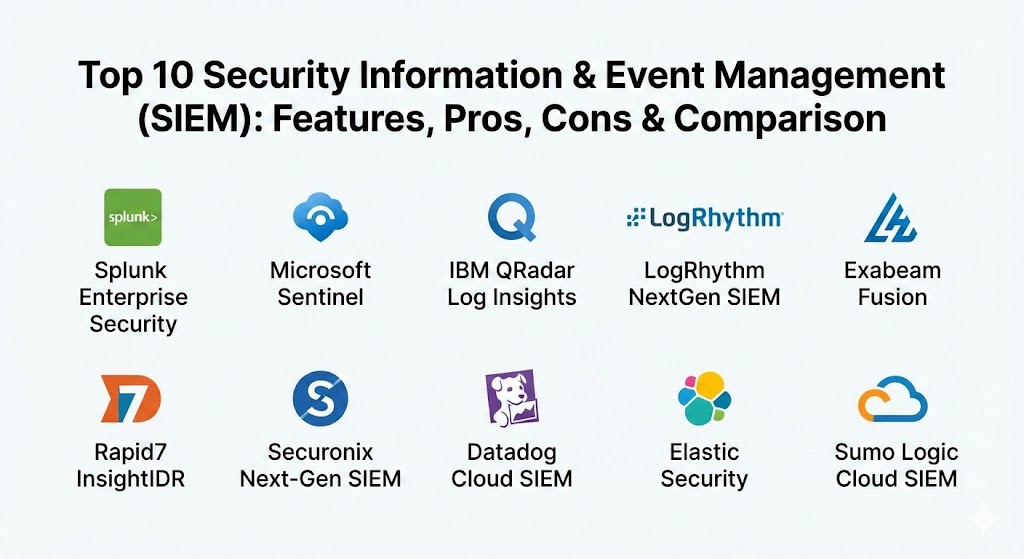
Top 10 Security Information & Event Management (SIEM) Tools
1 — Splunk Enterprise Security
Splunk is widely considered the “heavyweight champion” of the SIEM world. Known for its “Data-to-Everything” philosophy, it allows organizations to search, monitor, and analyze machine-generated data at an massive scale.
- Key Features:
- Search Processing Language (SPL): A powerful, proprietary language for performing complex data queries.
- Risk-Based Alerting: Reduces alert fatigue by prioritizing incidents based on their potential business impact.
- Integrated SOAR: Deep integration with Splunk Phantom for automated threat remediation.
- Extensive App Ecosystem: Over 2,000 apps on Splunkbase to connect to virtually any data source.
- Visual Dashboards: Highly customizable real-time visualizations for executive and technical reporting.
- Asset and User Discovery: Automatically builds profiles for everything and everyone on the network.
- Pros:
- Unmatched flexibility; if you can generate a log, Splunk can analyze it.
- One of the most mature and active user communities in the industry.
- Cons:
- High cost; the pricing model based on data ingestion volume can become prohibitively expensive.
- Requires significant expertise and specialized “Splunk Admins” to maintain.
- Security & Compliance: SOC 2 Type II, ISO 27001, HIPAA, GDPR, and FedRAMP authorized. Supports robust encryption and SSO.
- Support & Community: World-class support, extensive “Splunk Answers” forum, and the annual .conf user conference.
2 — Microsoft Sentinel
Microsoft Sentinel is the first SIEM built natively within a major public cloud (Azure). It leverages the power of the cloud to provide nearly infinite scale and AI capabilities without the need to manage infrastructure.
- Key Features:
- Cloud-Native Scalability: No servers to manage; it automatically scales to meet your ingestion needs.
- AI and Machine Learning: Uses Microsoft’s global threat intelligence to reduce noise and find “real” threats.
- Native Microsoft Integration: Near-instant ingestion from Office 365, Azure, and Entra ID (Azure AD).
- Microsoft Copilot for Security: Generative AI to help analysts write queries and summarize incidents.
- Kusto Query Language (KQL): A modern, fast query language shared with other Azure services.
- Playbooks: Logic-app based automation for rapid response to common alerts.
- Pros:
- Very cost-effective for organizations already heavily invested in the Microsoft 365 ecosystem.
- Extremely fast time-to-value; you can be up and running in minutes, not months.
- Cons:
- Costs can be difficult to predict as they are based on usage and storage.
- Not as “vendor-neutral” as some rivals; best suited for Azure/Hybrid environments.
- Security & Compliance: Complies with over 100 regulatory standards, including FedRAMP, SOC, and GDPR.
- Support & Community: Backed by Microsoft’s massive global support organization and Microsoft Learn documentation.
3 — IBM QRadar Log Insights
IBM QRadar has long been a favorite for large, traditional enterprises that require a robust on-premise or hybrid SIEM. It is particularly strong at identifying lateral movement and complex attack chains.
- Key Features:
- Sense Analytics: Correlates activities to distinguish between “normal” noise and malicious intent.
- Watson AI Integration: Leverages IBM’s AI to automate investigations and provide context to alerts.
- Network Hierarchy: Built-in understanding of your network topology to track how threats spread.
- Vulnerability Management Integration: Connects with scanners to prioritize threats targeting known weaknesses.
- App Host: Allows for third-party extensions to be run directly on the QRadar infrastructure.
- Magistrate Console: A centralized view that groups related events into a single “offense.”
- Pros:
- Excellent at reducing thousands of events into a few manageable “offenses.”
- Very stable and proven in the most demanding global financial environments.
- Cons:
- The user interface can feel dated and less intuitive than modern cloud-native tools.
- On-premise deployments can be complex to upgrade and scale.
- Security & Compliance: FIPS 140-2, Common Criteria, SOC 2, HIPAA, and GDPR compliant.
- Support & Community: High-tier enterprise support and a large network of managed security service providers (MSSPs).
4 — LogRhythm NextGen SIEM
LogRhythm focuses on the “Security Operations Maturity Model.” It is designed to help SOC teams move from reactive firefighting to proactive threat hunting through a highly guided user experience.
- Key Features:
- Case Management: Built-in tools for managing the lifecycle of a security incident.
- NetworkXDR: Advanced network monitoring built directly into the SIEM agent.
- Precision Search: High-speed search capabilities across distributed data sets.
- SmartResponse: Flexible automation that allows for scripted responses across your security stack.
- Compliance Automation: Specialized “Compliance Content Packs” for various regulatory mandates.
- Scenario-Based Modeling: Pre-built rules for common attack patterns like brute force or SQL injection.
- Pros:
- One of the most comprehensive platforms for incident management and case tracking.
- Excellent support for organizations that still have a heavy on-premise footprint.
- Cons:
- Smaller third-party app ecosystem compared to Splunk or Microsoft.
- Can be complex to configure for non-standard or custom log sources.
- Security & Compliance: SOC 2 Type II, HIPAA, GDPR, and PCI DSS compliant.
- Support & Community: Highly rated technical support and a dedicated “LogRhythm University” for training.
5 — Exabeam Fusion
Exabeam is a leader in the “Next-Gen” SIEM movement. It rose to fame by adding User and Entity Behavior Analytics (UEBA) on top of existing log data, focusing on “how people act” rather than just “what logs say.”
- Key Features:
- Smart Timelines: Automatically creates a chronological timeline of every user’s actions across all systems.
- Behavioral Baselines: Learns what “normal” looks like for every user to spot outliers.
- TDIR (Threat Detection, Investigation, and Response): A unified workflow for the entire incident lifecycle.
- Cloud-First Architecture: Modern SaaS delivery with global data residency options.
- Outcome-Based Security: Pre-built content focused on specific security goals (e.g., “detect ransomware”).
- Open Architecture: Can act as a “brain” on top of other log repositories like Splunk.
- Pros:
- The “Smart Timelines” feature is a game-changer for reducing investigation time.
- Exceptionally good at finding “Insider Threats” that traditional SIEMs miss.
- Cons:
- Pricing is generally premium and targeted at the enterprise market.
- Integration with older, legacy on-prem systems can be more challenging than cloud sources.
- Security & Compliance: SOC 2 Type II, HIPAA, and GDPR compliant.
- Support & Community: Very strong professional services and a modern, high-touch support model.
6 — Rapid7 InsightIDR
InsightIDR is a cloud-based SIEM that emphasizes simplicity and “intelligence-led” security. It is built to be used by lean security teams who need to get results quickly without a year of configuration.
- Key Features:
- Integrated Deception: Built-in “honeypots” and decoys to trick attackers into revealing themselves.
- Endpoint Visibility: Native agent to provide EDR-like visibility within the SIEM.
- User Behavior Analytics: Tracks logins and account changes to spot hijacked credentials.
- Network Traffic Analysis: Identifies anomalies in network flows without needing separate sensors.
- Centralized Dashboard: A clean, modern UI focused on the most critical threats.
- Cloud SIEM Speed: Fast ingestion and near-instant search across massive data sets.
- Pros:
- One of the easiest enterprise SIEMs to implement and manage.
- The “Deception” technology is a unique and highly effective addition for early threat detection.
- Cons:
- Less customization for extremely niche or specific correlation rules.
- Not as robust for “big data” non-security use cases compared to Splunk.
- Security & Compliance: SOC 2 Type II, HIPAA, and GDPR compliant.
- Support & Community: Excellent knowledge base and a very active community of Rapid7 users.
7 — Securonix Next-Gen SIEM
Securonix is a “SaaS-native” SIEM that was built for the cloud from day one. It is known for its heavy reliance on data science and machine learning to find threats in high-velocity cloud environments.
- Key Features:
- Cloud-Native Ingestion: Specialized connectors for AWS, Azure, GCP, and SaaS apps like Salesforce.
- Data Science Engine: Uses hundreds of ML models to detect subtle behavioral shifts.
- Autonomous Threat Hunting: AI-driven tools that proactively search for threats on your behalf.
- Multi-Tenant Architecture: Ideal for large conglomerates or MSSPs managing multiple environments.
- Zero-Trust Monitoring: Specifically designed to monitor modern zero-trust infrastructures.
- Visual Investigation: Graphical view of an attack’s progress across different users and hosts.
- Pros:
- Extremely powerful for “Modern” stacks (Cloud/SaaS/Zero Trust).
- Flexible pricing models that are often more predictable than data-volume models.
- Cons:
- Can be “overkill” for organizations with simple, static networks.
- Requires a high degree of confidence in AI-led security decisions.
- Security & Compliance: FedRAMP authorized, SOC 2, HIPAA, and GDPR compliant.
- Support & Community: High-quality technical support and a growing community of AI-ops professionals.
8 — Datadog Cloud SIEM
Datadog is a pioneer in the “DevSecOps” world. Traditionally a monitoring tool for developers, their Cloud SIEM allows teams to use the same platform for performance monitoring and security analytics.
- Key Features:
- Unified Platform: Security data lives right next to your application and infrastructure metrics.
- Out-of-the-Box Rules: Hundreds of pre-built rules for cloud vulnerabilities and misconfigurations.
- Threat Detection at Scale: Designed to handle the massive log volumes of microservices and containers.
- Security Signals: High-level alerts that summarize dozens of related events.
- Integration with Datadog Apps: Trigger performance alerts or security responses from the same console.
- Cloud Workload Security: Monitors the “insides” of your containers and virtual machines.
- Pros:
- Perfect for engineering-heavy companies where “Everyone is a Security Engineer.”
- The best tool for monitoring Kubernetes and serverless architectures.
- Cons:
- Not as strong for “Traditional IT” (e.g., managing a local Windows domain) as IBM or LogRhythm.
- The interface can be overwhelming due to the sheer volume of non-security data.
- Security & Compliance: SOC 2 Type II, ISO 27001, HIPAA, and GDPR compliant.
- Support & Community: Modern support model via chat/tickets and a massive developer following.
9 — Elastic Security
Elastic Security is the commercial evolution of the “ELK Stack” (Elasticsearch, Logstash, Kibana). It is favored by teams that want extreme search speed and the flexibility of an open-core foundation.
- Key Features:
- Elasticsearch Engine: The world’s fastest search engine optimized for security logs.
- Fleet Management: Centrally manage thousands of “Elastic Agents” across your endpoints.
- Built-in ML: Automated anomaly detection for network traffic and user behavior.
- Elastic Common Schema (ECS): A standard way to format logs so they can be compared easily.
- Hybrid Deployment: Run it in the Elastic Cloud or self-host it on your own hardware.
- Integrated EDR: Built-in protection and response capabilities for endpoints.
- Pros:
- Incredible search performance; finding a needle in a petabyte-sized haystack happens in seconds.
- Transparent pricing model that is generally more affordable for large data sets.
- Cons:
- Requires significant technical skill to tune and optimize the Elasticsearch clusters.
- The administrative overhead is higher than pure “SaaS-only” SIEMs.
- Security & Compliance: SOC 2 Type II, HIPAA, GDPR, and ISO 27001 compliant.
- Support & Community: One of the largest open-source communities in the world and 24/7 enterprise support.
10 — Sumo Logic Cloud SIEM
Sumo Logic is a pure-SaaS “Continuous Intelligence” platform. It is designed to bridge the gap between IT operations, security, and business analytics in a cloud-native way.
- Key Features:
- Cloud-to-Cloud Integration: No agents needed for many SaaS-based data sources.
- Global Intelligence Service: Benchmarks your security performance against other Sumo Logic users.
- Automatic Log Parsing: Learns the structure of your logs automatically to save time.
- Unified Logs and Metrics: View performance data alongside security data.
- SLA-Backed Search: Guaranteed performance for your security queries.
- PCI Compliance Dashboard: Specific real-time view for maintaining e-commerce security.
- Pros:
- Very easy to “set and forget”; the platform handles all the scaling and maintenance.
- Excellent for highly distributed cloud environments with no central data center.
- Cons:
- The pricing can be complex due to the “Credit-based” system they use.
- Custom rule creation is slightly less flexible than in Splunk or Elastic.
- Security & Compliance: FedRAMP, SOC 2 Type II, HIPAA, GDPR, and PCI DSS compliant.
- Support & Community: Modern SaaS support and a strong network of cloud-security partners.
Comparison Table
| Tool Name | Best For | Platform(s) Supported | Standout Feature | Rating (Gartner / TrueReview) |
| Splunk | Large Enterprises / Big Data | Hybrid / Cloud | SPL Query Power | 4.7 / 5 |
| Microsoft Sentinel | Azure-First Organizations | Cloud (Azure) | Native Microsoft Ecosystem | 4.8 / 5 |
| IBM QRadar | Traditional SOCs | On-Prem / Hybrid | Offense Management | 4.4 / 5 |
| LogRhythm | Compliance & Maturity | On-Prem / Hybrid | Integrated Case Management | 4.2 / 5 |
| Exabeam | UEBA / Insider Threats | Cloud / SaaS | Smart Timelines | 4.6 / 5 |
| Rapid7 | Lean Security Teams | Cloud / SaaS | Built-in Deception Tech | 4.5 / 5 |
| Securonix | Cloud-Native AI | Cloud / SaaS | Data Science Based UEBA | 4.6 / 5 |
| Datadog | DevOps & Containers | Cloud / SaaS | Monitoring + Security Unity | 4.5 / 5 |
| Elastic Security | Search Speed / Forensic | Hybrid / Cloud | Elasticsearch Performance | 4.7 / 5 |
| Sumo Logic | Cloud Analytics | Cloud / SaaS | Global Benchmarking | 4.3 / 5 |
Evaluation & Scoring of SIEM Platforms
We have scored these SIEM platforms based on a weighted rubric reflecting the priorities of 2026 security professionals.
| Criteria | Weight | Evaluation Logic |
| Core Features | 25% | Log ingestion, correlation, UEBA, and threat detection efficacy. |
| Ease of Use | 15% | Time to deploy, UI intuitiveness, and dashboard management. |
| Integrations | 15% | API depth, app ecosystem, and native cloud connectors. |
| Security & Compliance | 10% | Encryption, audit logs, and regulatory certifications. |
| Performance | 10% | Search speed, ingestion latency, and platform uptime. |
| Support & Community | 10% | Documentation, training, and support responsiveness. |
| Price / Value | 15% | ROI, pricing transparency, and total cost of ownership (TCO). |
Which SIEM Tool Is Right for You?
Choosing a SIEM is one of the most significant investments a security team will make.
Solo Users vs SMB vs Mid-Market vs Enterprise
- Solo Users/SMBs: You likely don’t need a SIEM. Look at Managed Sentinel services or a simpler XDR tool from CrowdStrike or SentinelOne.
- Mid-Market: Rapid7 InsightIDR or Microsoft Sentinel are the winners. They provide professional-grade detection without needing a 20-person SOC.
- Enterprise: Splunk, IBM QRadar, or Exabeam are the leaders. They have the depth and scale to manage global, high-stakes environments.
Budget-Conscious vs Premium Solutions
If budget is the primary driver, Microsoft Sentinel (if you are on M365) and Elastic Security (if you have the technical skill) offer the best “protection per dollar.” Splunk and Exabeam are the premium “Cadillacs” of the industry—you get what you pay for, but the price is high.
Feature Depth vs Ease of Use
- Depth: Splunk and Elastic. If you can imagine a query, these tools can run it.
- Ease of Use: Rapid7 and Microsoft Sentinel. These tools are designed to provide “out-of-the-box” security with minimal manual tuning.
Integration and Scalability Needs
If your future is 100% in the cloud, Securonix and Datadog are built for that world. If you still have a server room full of hardware and need to monitor local network traffic, IBM QRadar or LogRhythm are much better bridges to your legacy environment.
Frequently Asked Questions (FAQs)
1. What is the difference between SIEM and SOAR?
SIEM is about Detection (finding the needle in the haystack). SOAR (Security Orchestration, Automation, and Response) is about Action (automatically blocking an IP or locking an account once the SIEM finds it). Most modern SIEMs now include basic SOAR features.
2. Does a SIEM slow down my network?
No. A SIEM collects data from other devices; it does not sit in the middle of your traffic. However, sending high volumes of logs can consume some bandwidth and server CPU on the “source” devices.
3. Is “Cloud SIEM” better than “On-Premise”?
For 90% of organizations, yes. Cloud SIEMs (like Sentinel or Securonix) scale instantly and don’t require you to manage hardware. On-premise SIEMs are only necessary for organizations with extreme privacy or “air-gapped” requirements.
4. What is UEBA?
User and Entity Behavior Analytics. It is a feature that looks for anomalies in how users act (e.g., an accountant suddenly accessing the source code repository) rather than just looking for malware signatures.
5. How much data should I send to my SIEM?
Not everything. Sending “junk” logs (like successful firewall pings) will waste money and make it harder to find threats. Focus on security-critical logs: logins, permission changes, and suspicious network traffic.
6. Do I need a SIEM if I have an Antivirus (EDR)?
Yes. An EDR only sees what happens on the laptop. A SIEM sees the EDR logs, the firewall logs, the cloud logs, and the database logs—connecting the dots across the whole company.
7. What is “Log Ingestion”?
It is the process of getting data from a source (like a firewall) into the SIEM. This is usually done via an “Agent,” a “Collector,” or an “API.”
8. Can a SIEM be hacked?
Yes. Because a SIEM contains all your security logs, it is a high-value target for attackers who want to delete the evidence of their entry. Your SIEM must be protected with strict MFA and SSO.
9. How long should I store my SIEM logs?
Compliance standards like PCI usually require 1 year. For security purposes, many experts recommend 90 days of “hot” (searchable) data and 1 year of “cold” (archived) data.
10. How much does a SIEM cost?
Entry-level SaaS plans can start around $10,000/year. Global enterprise deployments of Splunk can easily reach $500,000 to $1,000,000+ per year.
Conclusion
The role of Security Information & Event Management (SIEM) has shifted from a “compliance box to tick” to the central nervous system of modern cybersecurity. In 2026, the question is not whether you need a SIEM, but which one can keep up with the speed and scale of your digital transformation.
If you are a cloud-native organization looking for speed, Microsoft Sentinel and Datadog are the clear winners. If you are an enterprise managing a complex, global hybrid environment, the unmatched power of Splunk and Exabeam remains the industry standard. Ultimately, the best SIEM is the one that provides the most clarity with the least amount of noise—allowing your security team to stop worrying about the data and start worrying about the threats.