Introduction
An SD-WAN Management Platform is a centralized software layer that decouples the network hardware from its control mechanism. Instead of configuring individual routers at every branch office, a management platform allows administrators to set global policies from a single dashboard. These platforms use “application-aware” routing to decide the best path for data—whether that is a high-quality private line for a critical VOIP call or a standard broadband connection for a background file sync.
The importance of these platforms lies in their ability to provide visibility, security, and cost-efficiency. In 2026, where “Software-as-a-Service” (SaaS) is the primary way we work, these tools ensure that a branch office in Tokyo has the same low-latency access to a cloud server in Virginia as the headquarters does. Key real-world use cases include zero-touch provisioning (ZTP) for new branch offices, automated failover during ISP outages, and the integration of Security Service Edge (SSE) to protect data at the network’s edge. When evaluating these platforms, users should prioritize orchestration depth, AI-driven analytics, multi-cloud integration, and integrated security (SASE).
Best for: Network architects, IT directors, and global enterprises with multiple branch offices or retail locations. It is particularly essential for industries like Finance, Healthcare, and Retail that require high availability and strict security compliance across distributed geographies.
Not ideal for: Small, single-location businesses or micro-startups where a standard business-grade router and a basic VPN are sufficient. For organizations that do not have a distributed workforce or multiple physical sites, the cost and complexity of a full-scale SD-WAN platform will likely outweigh the operational benefits.
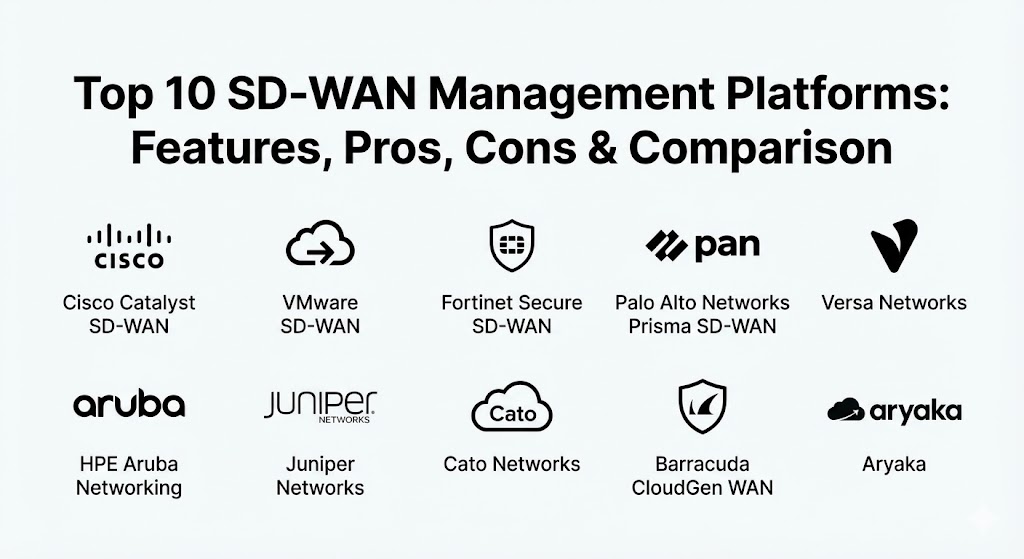
Top 10 SD-WAN Management Platforms
1 — Cisco Catalyst SD-WAN (vManage)
Cisco remains a dominant force in the networking world, and its Catalyst SD-WAN (formerly built on Viptela technology) is a robust, enterprise-grade platform designed for massive scale and complex routing requirements.
- Key features:
- vManage Dashboard: A single pane of glass for configuration, management, and monitoring.
- ThousandEyes Integration: Provides deep visibility into the internet and cloud performance beyond your own network.
- Automated Multi-cloud Networking: Seamlessly extends the SD-WAN fabric into AWS, Azure, and Google Cloud.
- Advanced Security Suite: Integrated firewall, IPS, URL filtering, and Cisco Umbrella integration.
- Predictive Path Recommendations: Uses AI to suggest optimizations before congestion occurs.
- Flexibility: Supports a wide range of hardware, from small branch routers to high-end data center platforms.
- Pros:
- Exceptional scalability, capable of managing thousands of nodes across the globe.
- The most mature ecosystem with the widest array of hardware and software options.
- Cons:
- The licensing structure is notoriously complex and can be expensive.
- Requires a high level of technical expertise to set up and manage effectively.
- Security & compliance: SOC 2, ISO 27001, and FIPS 140-2 compliant. Features robust SSO, end-to-end encryption, and comprehensive audit logs.
- Support & community: World-class enterprise support (Cisco TAC); a massive community of certified professionals and extensive documentation.
2 — VMware SD-WAN (by Broadcom)
VMware SD-WAN, originally VeloCloud, has built its reputation on simplicity and its unique “Cloud Gateway” architecture. It is designed to make the branch-to-cloud connection as seamless as possible.
- Key features:
- Global Gateway Network: Uses a network of hosted gateways to optimize traffic before it reaches the cloud provider.
- Dynamic Multi-Path Optimization (DMPO): Real-time monitoring of link health with sub-second failover.
- Edge Network Intelligence: AI-driven insights to help troubleshoot user-experience issues at the branch.
- Zero-Touch Provisioning: Deploy new sites in minutes without sending a technician to the field.
- Orchestrator Dashboard: A simplified, multi-tenant management interface.
- Pros:
- Arguably the most user-friendly interface in the SD-WAN market.
- Excellent performance over standard, “unreliable” broadband connections.
- Cons:
- Following the Broadcom acquisition, some users have expressed concerns over pricing shifts.
- Less granular routing control compared to Cisco for highly specialized edge cases.
- Security & compliance: SOC 2 Type II, HIPAA, and GDPR compliant. Features automated PKI for secure communication.
- Support & community: Strong professional support; well-established user community and extensive knowledge base.
3 — Fortinet Secure SD-WAN (FortiManager)
Fortinet has taken a “Security-First” approach, integrating SD-WAN capabilities directly into its famous FortiGate Next-Generation Firewalls (NGFW).
- Key features:
- FortiManager Centralized Management: Manage both security policies and network routing in one place.
- Application Control: Deep packet inspection for over 5,000 applications to prioritize critical traffic.
- Self-Healing WAN: Automatically senses link degradation and switches to the best available path.
- Integrated SASE: Seamless transition between on-premise security and cloud-delivered security.
- ASIC-Powered Performance: Uses specialized hardware to accelerate encryption and routing tasks.
- Pros:
- Best-in-class security integration; you don’t need a separate firewall and SD-WAN box.
- Offers the best performance-to-price ratio for security-conscious organizations.
- Cons:
- The interface can be technical and may require “Fortinet-specific” training.
- Orchestration for non-Fortinet hardware is limited.
- Security & compliance: FIPS 140-2, Common Criteria, ISO 27001, and SOC 2. Features granular RBAC and SSO.
- Support & community: Extensive global support; a very active community (Fortinet Guru) and professional training via Fortinet NSE.
4 — Palo Alto Networks (Prisma SD-WAN)
Formerly CloudGenix, Prisma SD-WAN is a “Gen 3” platform that focuses on being “Application-Defined” rather than packet-defined.
- Key features:
- App-Defined Policies: Set rules based on “Salesforce performance” or “Zoom quality” rather than just IP addresses.
- Autonomous Digital Experience Management (ADEM): Native visibility into the end-user experience for every app.
- ML-Based Analytics: Automatically identifies the root cause of network issues.
- Cloud-Blades Architecture: Simplified integration with third-party services like ServiceNow or Slack.
- Integrated Prisma Access: The gold standard for SASE (Secure Access Service Edge) integration.
- Pros:
- Completely removes the need for complex, CLI-based routing configurations.
- Exceptional visibility into exactly how applications are performing for users.
- Cons:
- Can be expensive when combined with the full Prisma security suite.
- Primarily a cloud-managed solution, which may not suit air-gapped environments.
- Security & compliance: SOC 2, ISO 27001, HIPAA, and GDPR compliant. Features enterprise-grade encryption and audit trails.
- Support & community: High-tier enterprise support; strong community presence and detailed technical playbooks.
5 — Versa SASE/SD-WAN (Versa Director)
Versa is known for its highly flexible, software-only approach that can be deployed on a variety of white-box hardware or in the cloud.
- Key features:
- Versa Director: A multi-tenant orchestration platform for configuration and monitoring.
- Unified SASE Platform: Networking, security, and analytics built into a single software stack.
- Multi-Tenancy: The preferred choice for Managed Service Providers (MSPs) due to its isolation capabilities.
- Advanced Analytics: Detailed historical reporting on every flow and security event.
- Flexible Deployment: Runs on x86 servers, virtual machines, or as a SaaS service.
- Pros:
- Offers the most flexibility for companies that want to avoid hardware vendor lock-in.
- Very strong for service providers who need to manage hundreds of separate customers.
- Cons:
- The setup can be more complex due to the sheer number of configuration knobs available.
- Documentation can be more technical and less “polished” than Cisco or VMware.
- Security & compliance: FIPS 140-2, SOC 2, and GDPR compliant. Features advanced SSO and identity integration.
- Support & community: Strong professional services; responsive support for enterprise and MSP clients.
6 — HPE Aruba Networking (EdgeConnect)
HPE Aruba’s SD-WAN platform, built on the acquisition of Silver Peak, focuses on “WAN Optimization” and high-performance throughput.
- Key features:
- Unity EdgeConnect: The core appliance (physical or virtual) for the SD-WAN fabric.
- Aruba Central Integration: Moving toward a unified cloud management platform for LAN, WLAN, and WAN.
- Boost WAN Optimization: Optional feature to accelerate data movement over long distances.
- Business Intent Overlays: Align network behavior with specific business priorities.
- Automated Orchestration: Simplifies the connection to major cloud on-ramps.
- Pros:
- Still the industry leader in WAN optimization (data deduplication and compression).
- Excellent for organizations that move large files across global sites.
- Cons:
- Integration into the broader Aruba Central platform is still a work in progress for some features.
- WAN Optimization features (Boost) require additional licensing.
- Security & compliance: ISO 27001, SOC 2, and GDPR. Features secure orchestration and audit logs.
- Support & community: Backed by HPE’s global support network; very active “Airheads” community.
7 — Juniper Networks (Session Smart / Mist AI)
Juniper has taken a unique, “tunnel-less” approach to SD-WAN, which reduces overhead and improves performance, especially for VOIP and video.
- Key features:
- Mist AI Integration: The same AI that manages Juniper Wi-Fi now manages the SD-WAN for proactive troubleshooting.
- Session Smart Routing: Routes traffic without the overhead of GRE or IPsec tunnels.
- Mist Dashboard: A modern, cloud-native interface for all networking tasks.
- Integrated Security: Features like Deny-by-Default and integrated firewall capabilities.
- App-level Visibility: Deep insights into specific application sessions.
- Pros:
- Lower bandwidth overhead due to the tunnel-less architecture.
- Mist AI is widely considered the best AI/ML engine in the networking space.
- Cons:
- The “tunnel-less” concept can be a significant shift for traditional network engineers.
- Hardware options are more limited compared to Cisco.
- Security & compliance: FIPS 140-2, SOC 2, and HIPAA compliant.
- Support & community: High-quality support; dedicated community forums and professional certifications (JNCIA-Cloud).
8 — Cato Networks (Cato Management Application)
Cato Networks is the world’s first truly cloud-native SASE platform. It doesn’t just manage the WAN; it provides the entire global backbone.
- Key features:
- Global Private Backbone: Over 80+ Points of Presence (PoPs) connected by a private global network.
- Convergence: SD-WAN, Security, and Mobile Access managed in one single dashboard.
- Elasticity: Easily scale bandwidth and security features without hardware upgrades.
- Cato Socket: Simple, ZTP appliances for connecting branch offices.
- Single Policy Engine: One set of rules for the entire global network.
- Pros:
- Simplifies global networking by removing the need for separate ISP management.
- The fastest way to deploy a global, secure network for a distributed team.
- Cons:
- You are reliant on Cato’s backbone; it is a “walled garden” approach.
- Less control over low-level hardware routing compared to on-premise solutions.
- Security & compliance: ISO 27001, SOC 2, GDPR, and HIPAA. Features a full security stack (FWaaS, SWG, CASB).
- Support & community: 24/7 global support; comprehensive documentation and a high-touch customer success model.
9 — Barracuda CloudGen WAN
Barracuda’s platform is built specifically for organizations that are heavily invested in the Microsoft Azure ecosystem.
- Key features:
- Azure Virtual WAN Integration: Built natively on top of the Microsoft Azure backbone.
- Automated Deployment: Deploy directly from the Azure Marketplace.
- Integrated Security: Includes Barracuda’s industry-leading firewall and threat protection.
- Cloud-First Orchestration: Managed entirely via the Barracuda Cloud Control portal.
- Scalability: Leverage Azure’s global presence for instant branch connectivity.
- Pros:
- The best choice for “Microsoft-centric” shops that use Azure as their primary data center.
- Very straightforward pricing and deployment model.
- Cons:
- Limited value for organizations using AWS or GCP as their primary cloud.
- Hardware performance for large, on-premise data centers is less robust than Cisco or Juniper.
- Security & compliance: SOC 2, GDPR, and HIPAA compliant.
- Support & community: Reliable 24/7 support; strong documentation and a helpful user base.
10 — Aryaka SmartServices
Aryaka is a “Network-as-a-Service” provider that combines SD-WAN management with its own private global network, focusing on the managed service experience.
- Key features:
- Fully Managed Service: Aryaka handles the deployment, monitoring, and optimization for you.
- SmartConnect: Private global core network for stable, predictable performance.
- SmartOptimize: Integrated WAN optimization and application acceleration.
- SmartCloud: Direct, private on-ramps to all major SaaS and IaaS providers.
- MyAryaka Dashboard: Provides real-time visibility into the managed network.
- Pros:
- Ideal for lean IT teams that want to “outsource” the headache of WAN management.
- Guaranteed SLAs for global application performance.
- Cons:
- Generally more expensive than a DIY SD-WAN approach.
- Less flexibility for engineers who want to “tweak” every setting manually.
- Security & compliance: ISO 27001, SOC 2, and PCI-DSS. Features integrated security and encryption.
- Support & community: Premier white-glove support; active account management and performance consulting.
Comparison Table
| Tool Name | Best For | Platform(s) Supported | Standout Feature | Rating (Gartner) |
| Cisco Catalyst | Large Enterprises | Hardware, Cloud | ThousandEyes Visibility | 4.6 / 5 |
| VMware SD-WAN | Hybrid Cloud | SaaS, Hardware | Cloud Gateway Architecture | 4.5 / 5 |
| Fortinet | Security-First | Hardware, Virtual | Integrated Firewall ASIC | 4.7 / 5 |
| Palo Alto Prisma | App-Experience | Cloud-Managed | App-Defined Orchestration | 4.7 / 5 |
| Versa SASE | MSPs / White-box | Software, Cloud | Extreme Multi-Tenancy | 4.4 / 5 |
| HPE Aruba | WAN Optimization | Hardware, Cloud | Boost Acceleration | 4.5 / 5 |
| Juniper Mist | AI-Driven Ops | Cloud, Hardware | Mist AI Orchestration | 4.5 / 5 |
| Cato Networks | Cloud-Native SASE | Cloud, Socket | Global Private Backbone | 4.8 / 5 |
| Barracuda | Azure Shops | Azure-Native | Microsoft Backbone Sync | 4.3 / 5 |
| Aryaka | Managed Service | NaaS (SaaS) | Private Global Layer 2 | 4.6 / 5 |
Evaluation & Scoring of SD-WAN Management Platforms
Choosing an SD-WAN platform is a high-stakes decision that impacts every department in your company. To evaluate these tools fairly, we use a weighted scoring rubric that prioritizes both technical capability and business value.
| Category | Weight | Evaluation Criteria |
| Core Features | 25% | Application-aware routing, link steering, and multi-cloud connectivity. |
| Ease of Use | 15% | Dashboard intuitiveness, orchestration quality, and ZTP simplicity. |
| Integrations | 15% | SASE integration, API depth, and support for third-party cloud/SaaS. |
| Security & Compliance | 10% | Encryption, integrated firewall, and certifications (SOC2/GDPR). |
| Performance | 10% | Failover speed, bandwidth overhead, and latency optimization. |
| Support & Community | 10% | Documentation quality and 24/7 technical support response times. |
| Price / Value | 15% | Total cost of ownership (TCO) including hardware and licensing. |
Which SD-WAN Management Platforms Tool Is Right for You?
The “best” tool depends on your existing technical debt, your team’s size, and your cloud strategy.
- Solo Users vs SMBs: If you have a small IT team and limited time, look at Cato Networks or Aryaka. These platforms take a “Managed” or “Cloud-Native” approach that removes the need for deep networking expertise.
- Mid-Market Companies: Fortinet and Palo Alto Networks offer the best balance. Fortinet is great if you need to refresh your firewalls at the same time, while Palo Alto is superior if you want the best visibility into application performance.
- Large Global Enterprises: Cisco Catalyst SD-WAN and VMware SD-WAN are the titans. Cisco is better for massive, heterogeneous environments with complex routing. VMware is better if you want a faster rollout with a focus on cloud gateways.
- Cloud-First Organizations: If you are “All-in” on Azure, Barracuda is the logical choice. If you are a multi-cloud shop that relies heavily on AI troubleshooting, Juniper Mist AI will save your team the most time.
- Service Providers (MSPs): Versa Networks is the gold standard for multi-tenant isolation and flexibility.
Frequently Asked Questions (FAQs)
1. Is SD-WAN better than MPLS?
SD-WAN isn’t necessarily “better” in terms of raw circuit quality, but it is much more agile. It allows you to use cheap broadband links alongside MPLS, providing better reliability and much lower costs per megabit.
2. Can I manage SD-WAN myself, or do I need a Managed Service?
You can do either. Tools like Cisco and Fortinet are great for DIY teams. Platforms like Aryaka are designed for those who want a fully managed “as-a-service” experience.
3. What is SASE, and how does it relate to SD-WAN?
SASE (Secure Access Service Edge) is the combination of SD-WAN with cloud-delivered security. Most modern SD-WAN platforms (like Cato or Prisma) are now part of a larger SASE strategy.
4. How long does it take to implement an SD-WAN platform?
With zero-touch provisioning, a single branch can be online in minutes. However, planning the global policy and migrating from MPLS typically takes 3 to 9 months for a large enterprise.
5. Do I need to buy new hardware?
In most cases, yes. You will need SD-WAN “edges” (physical or virtual). However, software-defined platforms like Versa can run on standard x86 “white-box” servers.
6. Does SD-WAN improve VOIP and Video quality?
Yes. By using real-time link steering and dynamic multi-path optimization, SD-WAN can move a VOIP call to a better link the moment it senses jitter or packet loss on the primary line.
7. Is SD-WAN secure?
Absolutely. Most platforms use AES-256 encryption for all traffic and include integrated security features like firewalls, IPS, and malware protection.
8. Can I use SD-WAN to connect to AWS or Azure?
Yes. Modern platforms have “Cloud On-ramps” that allow you to extend the SD-WAN fabric directly into your Virtual Private Cloud (VPC) in the public cloud.
9. What happens if the SD-WAN management dashboard goes down?
The network continues to run. The management dashboard (the “Control Plane”) is separate from the actual traffic (the “Data Plane”). You just won’t be able to make configuration changes until it’s back.
10. How much does SD-WAN cost?
Pricing varies wildly. Most platforms use a subscription model based on bandwidth and the number of sites. You can expect to pay anywhere from $50 to $500 per site, per month.
Conclusion
The move to an SD-WAN management platform is no longer just an “IT upgrade”—it is a strategic business move. In 2026, your network is the foundation of your customer experience and your employee productivity.
Whether you choose the massive scale of Cisco, the security-first approach of Fortinet, or the cloud-native simplicity of Cato Networks, the goal remains the same: Visibility, Agility, and Security. The “best” tool is the one that allows your team to stop worrying about routers and start focusing on the applications that drive your business forward.
