Introduction
SASE Platforms are the modern answer to the complexities of distributed computing. At its core, SASE is an architectural framework that delivers networking and security as a unified service from the cloud. Instead of backhauling traffic to a central data center for inspection—a process that introduces latency and frustrates users—SASE brings the security to the “edge,” where the user and device actually reside. This ensures that a remote employee in a coffee shop receives the same level of protection and performance as someone sitting in the corporate headquarters.
The importance of SASE lies in its ability to simplify IT infrastructure while drastically improving the security posture. Real-world use cases include securing a global workforce, protecting branch offices without expensive hardware, and providing “Zero Trust” access to private applications. When choosing a SASE platform, evaluators should prioritize the vendor’s global Point of Presence (PoP) density, the depth of their AI-driven threat intelligence, and the seamlessness of their management console. A true SASE solution should offer a “single pane of glass” to manage both the pipes (networking) and the filters (security).
Best for: Medium to large enterprises with a global footprint, companies undergoing cloud migration, and organizations with a significant remote or hybrid workforce. It is particularly beneficial for IT leaders looking to consolidate vendor sprawl and reduce operational complexity.
Not ideal for: Small businesses with a single physical location and no remote workers, or organizations that lack the technical staff to manage a sophisticated networking transformation. For these users, a simple VPN or a basic cloud-managed firewall might be more cost-effective and easier to maintain.
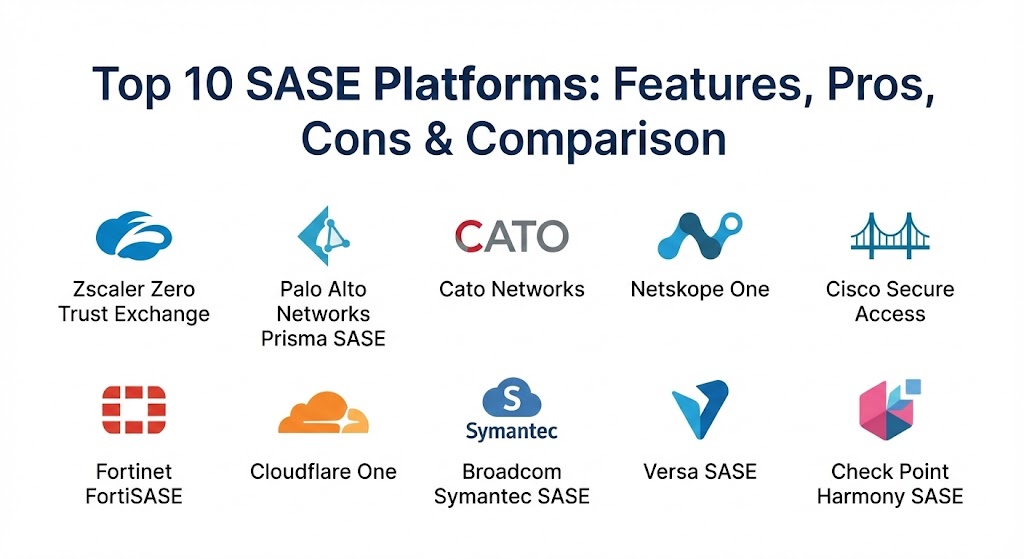
Top 10 SASE Platforms
1 — Zscaler Zero Trust Exchange
Zscaler is a cloud-native pioneer that revolutionized the security market by treating the internet itself as the corporate network. The Zscaler Zero Trust Exchange is one of the most widely deployed SASE solutions, focusing heavily on the “Security Service Edge” (SSE) component of the SASE framework.
- Key features:
- Zscaler Internet Access (ZIA): A full security stack in the cloud for all web traffic.
- Zscaler Private Access (ZPA): Industry-leading ZTNA for securing private internal apps.
- Cloud-Gen Firewall: Provides Layer 7 visibility and control across all ports.
- Direct-to-Cloud Architecture: Uses over 150 global PoPs to ensure low-latency connections.
- Data Loss Prevention (DLP): Advanced scanning for sensitive data across web and SaaS.
- Integrated AI/ML: Real-time threat detection and sandbox analysis for zero-day threats.
- Pros:
- Unmatched scalability and performance for global enterprises.
- The most mature ZTNA offering on the market, virtually eliminating the need for legacy VPNs.
- Cons:
- Can be expensive, particularly for smaller organizations.
- The initial configuration and policy setup can be complex and time-consuming.
- Security & compliance: FedRAMP High, SOC 2 Type II, ISO 27001, HIPAA, and GDPR compliant. Includes robust audit logs and end-to-end encryption.
- Support & community: World-class 24/7 enterprise support; extensive technical documentation and an active “Zscaler Community” portal for practitioners.
2 — Palo Alto Networks Prisma SASE
Palo Alto Networks has successfully transitioned its leading firewall technology into the cloud with Prisma SASE. It is widely considered one of the most complete single-vendor SASE solutions, combining top-tier SD-WAN with deep security capabilities.
- Key features:
- ZTNA 2.0: Provides continuous trust verification and deep content inspection.
- Prisma SD-WAN: An autonomous, app-defined fabric for branch connectivity.
- WildFire Integration: Advanced cloud-based sandboxing for malware prevention.
- Autonomous Digital Experience Management (ADEM): Monitors end-to-end user performance.12
- IoT Security: Specifically identifies and secures unmanaged IoT devices on the network.34
- Unified Management: One console to manag5e both SASE and on-premise6 firewalls via Panorama.
- Pros:
- Exceptional security depth; often regarded as having the best threat prevention engines.
- Native integration with existing Palo Alto hardware makes it ideal for hybrid environments.
- Cons:
- Higher total cost of ownership (TCO) compared to mid-market alternatives.
- Requires a high level of expertise to manage the advanced feature set.
- Security & compliance: FIPS 140-2, SOC 2, HIPAA, GDPR, and PCI DSS compliant. Comprehensive logging for audit readiness.
- Support & community: High-end professional services; massive global community and extensive “Beacon” learning platform for admins.
3 — Cato Networks
Cato Networks is the industry’s first “true” SASE platform, built from the ground up as a converged cloud service. It is famous for its simplicity and its global private backbone that replaces legacy MPLS.
- Key features:
- **Cato Cloud: **A global private backbone with over 80 PoPs and built-in optimization.
- Converged Management: A single “pane of glass” for both networking and security.
- Cato Client: A lightweight agent for remote users providing ZTNA and SWG.
- Built-in MFA: Native multi-factor authentication for secure access.
- Cloud-Native Architecture: All inspection engines run in parallel in the Cato Cloud.
- Direct Cloud On-Ramp: Native integration with AWS, Azure, and Google Cloud.
- Pros:
- Remarkably fast to deploy; organizations can go live in days rather than months.
- Simplifies the stack by eliminating the need for multiple point products.
- Cons:
- Security depth in specific areas (like CASB) may not be as granular as specialized vendors.
- Limited on-premise hardware options compared to legacy networking vendors.
- Security & compliance: SOC 2 Type II, ISO 27001, GDPR, and HIPAA compliant. SSAE18 certified data centers.
- Support & community: Responsive 24/7 support; straightforward documentation and a growing user base in the mid-market.
4 — Netskope One
Netskope began as a CASB leader and has evolved into a formidable SASE player. Netskope One is particularly strong for organizations that prioritize data security and granular visibility into SaaS applications.
- Key features:
- Intelligent SSE: High-performance web and cloud security via the NewEdge network.
- Cloud Confidence Index (CCI): Scores the risk levels of thousands of SaaS apps.
- Advanced DLP: Industry-leading data protection with over 3,000 file types supported.
- Remote Browser Isolation (RBI): Protects users from risky sites without impacting performance.
- Borderless SD-WAN: Unified networking for branches and remote users.78
- SkopeAI: Uses AI to automate data classification and threat hunting.910
- Pros:1112
- Unrivaled visibility into “Shadow IT” and SaaS data flows.1314
- The NewEdge network provides one of the lowest latency experiences in the industry.1516
- Cons:1718
- The SD-WAN c19ompone20nt is newer and less mature than legacy competitors.
- Licensing can be complex as it is broken down into various “Skopes.”
- Security & compliance: SOC 2, ISO 27001, HIPAA, GDPR, and FedRAMP High. Supports end-to-end AES encryption.
- Support & community: Strong emphasis on customer success; “Netskope Academy” offers detailed training for security architects.
5 — Cisco Secure Access
Cisco has converged its Umbrella (security) and Viptela/Meraki (networking) heritage into a unified SASE offering called Cisco Secure Access. It is designed to provide a seamless experience for the millions of users already using Cisco hardware.
- Key features:
- Duo Identity Integration: Native multi-factor authentication and posture checks.
- Talos Threat Intelligence: Backed by one of the largest private threat research teams.
- Cloud-Delivered Firewall: Advanced inspection across all ports and protocols.
- Zero Trust Access: Clientless and agent-based access to any application.
- Meraki/Viptela SD-WAN: Integration with the world’s most popular SD-WAN platforms.
- Resource-Specific Policies: Policies follow the user, not the network location.
- Pros:
- The logical choice for current Cisco customers; leverage existing investments.
- Massive global footprint and incredibly reliable hardware/software synergy.
- Cons:
- Integrating different legacy product lines (Umbrella + SD-WAN) can still feel fragmented.
- The management console can be daunting due to the sheer number of options.
- Security & compliance: FedRAMP, SOC 2, ISO 27001, HIPAA, and GDPR. FIPS 140-2 next-generation encryption options.
- Support & community: Industry-standard TAC support; vast global community of certified Cisco engineers (CCNP/CCIE).
6 — Fortinet FortiSASE
Fortinet is a powerhouse in the security world, and FortiSASE extends their famous “Security-Fabric” into the cloud. It is an ideal solution for organizations that want a consistent security experience across hardware and cloud.
- Key features:
- Universal ZTNA: Provides consistent access policies whether the user is on-net or off-net.
- Thin-Edge Integration: Seamlessly connects with FortiAP and FortiSwitch hardware.
- Secure SD-WAN: Built-in industry-leading SD-WAN for branch connectivity.
- AI/ML-Powered Security: Uses FortiGuard labs for real-time malware and URL filtering.
- Unified Agent: The FortiClient agent handles EPP, ZTNA, and VPN.
- Global Scalability: Uses a growing network of Fortinet-managed PoPs.
- Pros:
- Extremely cost-effective; often provides more “bang for the buck” than competitors.
- Excellent performance thanks to Fortinet’s proprietary SPU (Security Processing Unit) technology.
- Cons:
- The user interface can feel “traditional” and less “SaaS-native” than Cato or Netskope.
- Setup requires a firm understanding of the Fortinet ecosystem.
- Security & compliance: SOC 2, ISO 27001, GDPR, and HIPAA compliant. High-level AES-256 encryption.
- Support & community: Extensive partner network for local support; “Fortinet Training Institute” is world-class.
7 — Cloudflare One
Cloudflare One leverages one of the world’s largest and most performant networks to deliver SASE. It is a “developer-favorite” due to its speed, simplicity, and modern approach to Zero Trust.
- Key features:
- WARP Client: A lightweight, high-performance agent for all user devices.
- Magic WAN: Replaces legacy MPLS with Cloudflare’s global Anycast network.
- Browser Isolation: High-speed RBI that doesn’t “break” modern websites.
- Zero Trust Access: Simple, identity-based access for all internal applications.21
- Massive Edge Network: Services are delivered from over 300 cities globally.22
- DDoS Protection: Built-in world-class protection against massive attacks.23
- Pros:24
- Performance is industry-leading; Cloudflare is often faster than th25e open internet.
- Very transparent pricing and easy self-service onboarding for smaller teams.
- Cons:
- Lacks some of the deep “Enterprise SD-WAN” features (like FEC) found in Cisco or Versa.
- Support tiers can be expensive for direct access to senior engineers.
- Security & compliance: PCI-DSS, SOC 2 Type II, ISO 27001, GDPR, and HIPAA.
- Support & community: Excellent documentation; a massive “Cloudflare Community” forum and detailed developer docs.
8 — Broadcom Symantec SASE
Symantec, now a Broadcom company, remains a staple in highly regulated industries. Their SASE platform focuses on “data-centric” security for hybrid environments.
- Key features:
- Web Isolation: Pioneer in isolation technology to block browser-based threats.
- Deep Content Inspection: Advanced scanning for encrypted web traffic.
- CloudSOC CASB: High-end visibility and control for SaaS applications.
- Mirror Gateway: Provides agentless security for unmanaged devices.
- Hybrid Support: Exceptional for organizations transitioning from on-prem to cloud.26
- Global Intelligence Network: Analyzes billions of requests daily.27
- Pros:28
- Ideal for highly regulated industries (Finance/Gov) with complex proxy requirements.29
- Strongest “hybrid” capabilities for those not ready to go 100% cloud.30
- Cons:31
- Customer support has seen mixed reviews follow32ing the Broadcom acquisition.
- The platform can feel less “agile” than cloud-native competitors.
- Security & compliance: FIPS 140-2, SOC 2, HIPAA, GDPR, and ISO 27001.
- Support & community: Enterprise-focused support via Broadcom; extensive legacy documentation and partner ecosystem.
9 — Versa SASE
Versa is a pure-play SASE provider that prides itself on having a single software stack for both networking and security. It is a favorite among service providers and large enterprises with complex routing needs.
- Key features:
- Single-Stack Architecture: Networking and security run in a single software process.
- Carrier-Grade SD-WAN: Sophisticated routing and traffic engineering.
- Versa Analytics: Deep, historical visibility into every packet and session.
- Multi-Tenancy: Built-in support for multiple departments or customers.
- Advanced ZTNA: Granular posture checks and application publishing.3334
- Flexible Deployment: Can be deployed on-premise, in the cloud, or as a blended service.3536
- Pros:3738
- Unmatched flexibility in deployment; run it anywhere on any hardware.3940
- Probably the most advanced SD-WAN capabilities in the SASE market.4142
- Cons:4344
- Very high learning curve; req45uires dedicated staff to master.46
- UI is highly technical and can be overwhelming for simple use cases.47
- Security & compliance: SOC 2, ISO 27001, GDPR, an48d HIPAA compliant.
- Support & community: Strong professional services and highly technical documentation for advanced users.
10 — Check Point Harmony SASE
Check Point is a security legend, and Harmony SASE represents their vision of “prevention-first” cloud security. It focuses on providing a unified agent that secures users regardless of where they work.
- Key features:
- Zero Trust Network Access: Provides secure, identity-centric access to any app.
- Internet Access Security: Blocks malicious sites and prevents data leaks.
- Integrated SD-WAN: Connects branch offices with high-performance security.
- Unified Management: One dashboard to rule cloud, mobile, and endpoint.
- On-Device Protection: Unique ability to stop threats at the device level before they hit the cloud.
- Global Private Backbone: Optimized routing for voice and video traffic.
- Pros:
- “Prevention-First” philosophy; catches many threats that “detect-only” tools miss.
- Very easy to implementation for mid-sized organizations.
- Cons:
- The global PoP network is smaller than giants like Zscaler or Cloudflare.
- Integration with non-Check Point SD-WAN hardware can be a challenge.
- Security & compliance: SOC 2, ISO 27001, GDPR, and HIPAA. SSAE 16/18 certified PoPs.
- Support & community: Reliable 24/7 support; “Check Point UserCenter” is a great resource for admins.
Comparison Table
| Tool Name | Best For | Platform(s) Supported | Standout Feature | Rating (Gartner) |
| Zscaler | Large Enterprises | Cloud-Native | ZTNA Leadership | 4.7 / 5 |
| Palo Alto | Security Depth | Hybrid / Cloud | ZTNA 2.0 + WildFire | 4.6 / 5 |
| Cato Networks | Simplicity & Speed | Cloud-Native | Global Private Backbone | 4.8 / 5 |
| Netskope One | Data/SaaS Security | Cloud-Native | Cloud Confidence Index | 4.5 / 5 |
| Cisco Secure | Cisco Ecosystem | Hardware / Cloud | Duo Identity + Talos | 4.3 / 5 |
| Fortinet | ROI & Performance | Hardware / Cloud | Security Fabric Integration | 4.9 / 5 |
| Cloudflare One | Speed & Developers | Cloud-Native | 300+ City Edge Network | 4.6 / 5 |
| Symantec | High Compliance | Hybrid / Cloud | Web Isolation Pioneer | 4.2 / 5 |
| Versa SASE | Complex Routing | Multi-Platform | Single-Stack Architecture | 4.4 / 5 |
| Check Point | Prevention-First | Cloud-Native | On-Device Security | 4.4 / 5 |
Evaluation & Scoring of SASE Platforms
Selecting the right platform requires a balanced approach. We have evaluated these tools against a weighted rubric that reflects the priorities of the 2026 IT leader.
| Category | Weight | Evaluation Rationale |
| Core Features | 25% | Presence of ZTNA, SWG, CASB, and SD-WAN in a single stack. |
| Ease of Use | 15% | Intuitiveness of the management console and the complexity of policy creation. |
| Integrations | 15% | Compatibility with existing IdP, SIEM, and EDR ecosystems. |
| Security & Compliance | 10% | Breadth of certifications and the effectiveness of threat prevention. |
| Performance | 10% | Global PoP density and the impact on user latency for voice/video. |
| Support & Community | 10% | Quality of 24/7 technical help and depth of self-service documentation. |
| Price / Value | 15% | ROI for the specific target business size and the transparency of licensing. |
Which SASE Platform Is Right for You?
The “best” tool is entirely dependent on your organization’s current infrastructure and future business goals.
- Solo Users vs. SMBs: While SASE is generally an enterprise play, Cloudflare One offers a “Free” and “Pro” tier that is perfect for very small teams. Fortinet also offers a highly affordable entry point for smaller offices.
- Mid-Market Companies: Organizations with 500-2,000 employees often find Cato Networks to be the sweet spot. It offers enterprise-grade power without the need for a 20-person networking team to manage it.
- Large Enterprises: If you have 10,000+ users and a complex global footprint, Zscaler or Palo Alto Networks are the standard. They provide the granularity and “blast radius” protection that massive organizations require.
- Budget-Conscious vs. Premium: If budget is the primary driver, Fortinet and Cato often win. If security depth and “Zero Trust” compliance are the primary drivers, Palo Alto and Zscaler are worth the premium.
- Industry Specifics: Highly regulated sectors like banking or government should look at Symantec or Palo Alto for their deep compliance and proxy features. Tech-forward companies and developers will likely gravitate toward Cloudflare.
Frequently Asked Questions (FAQs)
1. What is the difference between SASE and SSE?
SSE (Security Service Edge) is the “security” half of SASE, including ZTNA, SWG, and CASB. SASE is the full package that also includes the “networking” half, which is SD-WAN.
2. Can SASE replace my existing VPN?
Yes, that is one of its primary goals. By using ZTNA (Zero Trust Network Access), SASE provides a more secure, faster, and more granular way for users to access internal applications.
3. Does SASE work with my existing on-premise firewalls?
Many vendors (like Palo Alto and Fortinet) offer “Hybrid SASE,” which allows you to manage both your cloud-delivered security and your physical on-premise appliances from a single console.
4. How does SASE improve user performance?
SASE uses a global network of PoPs. Instead of traffic traveling thousands of miles back to your data center, it connects to a local PoP just a few miles away, significantly reducing latency.
5. Is SASE difficult to implement?
It depends on the vendor. Cloud-native tools like Cato and Cloudflare are designed for rapid deployment, while legacy-integrated tools like Cisco or Versa may take longer to configure.
6. Do I need to change my hardware to move to SASE?
Not necessarily. Most SASE platforms use software agents (like Zscaler Client Connector or FortiClient) that run on the user’s existing laptop or mobile device.
7. How does SASE handle “Shadow IT”?
A key component of SASE is CASB (Cloud Access Security Broker), which identifies every cloud app being used by employees and allows you to block risky ones or control how data is shared within them.
8. Can SASE protect my IoT devices?
Yes, platforms like Palo Alto Prisma SASE have specific modules designed to identify IoT devices (like printers or medical equipment) and isolate them from the rest of the network.
9. What is “Single-Vendor SASE”?
This refers to buying both the networking (SD-WAN) and security (SSE) from one company. This is generally preferred by IT teams as it ensures better integration and a single point of support.
10. How much does a SASE platform cost?
Pricing is typically “per user, per year.” For enterprise-grade protection, expect to pay anywhere from $100 to $300 per user annually, depending on the features and support levels included.
Conclusion
The transition to SASE is not just a technology upgrade; it is a strategic shift toward a more agile and secure business. As we have seen, the “best” platform varies—Cato is the king of simplicity, Palo Alto is the leader in security depth, and Cloudflare is the master of speed.
When choosing your platform, don’t get distracted by “feature bloat.” Focus on your users’ experience, your team’s ability to manage the tool, and the vendor’s commitment to continuous AI innovation. SASE is a journey, not a destination, and the right partner will help you navigate the complexities of the modern digital landscape with confidence.
Top 10 SASE (Secure Access Service Edge) vendors leading for cloud-native security and networking are Zscaler, Palo Alto Networks, Cato Networks, Fortinet, Netskope, Cisco, Cloudflare, Versa Networks, Check Point, and VMware. These providers offer unified solutions combining SD-WAN with security capabilities like ZTNA, SWG, and CASB to secure hybrid workforces.