Introduction
Runtime Application Self-Protection (RASP) is a security technology that integrates directly with an application or its runtime environment to detect and block attacks in real-time. Unlike a WAF, which analyzes incoming network traffic, RASP lives inside the application, providing deep visibility into code execution, data flow, and user behavior. This “internal” perspective allows it to differentiate between legitimate user actions and malicious exploits with unprecedented accuracy.
The importance of RASP lies in its ability to defend against zero-day exploits and sophisticated injections that often bypass traditional defenses. Real-world use cases include protecting legacy applications that cannot be easily patched, securing APIs in high-traffic microservices environments, and preventing data exfiltration in highly regulated industries like finance and healthcare. When evaluating RASP tools, users should prioritize language support, performance overhead, ease of integration into DevSecOps pipelines, and the ability to distinguish between “vulnerable” and “exploitable” code.
Best for: Security engineers, DevSecOps teams, and CISO-led organizations in finance, healthcare, and e-commerce. It is ideal for companies managing complex, high-traffic applications that require continuous protection against evolving threats without slowing down the development cycle.
Not ideal for: Small businesses with static, low-risk websites or teams that lack the technical capacity to manage instrumentation agents. In these cases, a managed WAF or basic endpoint protection might be more cost-effective and easier to maintain.
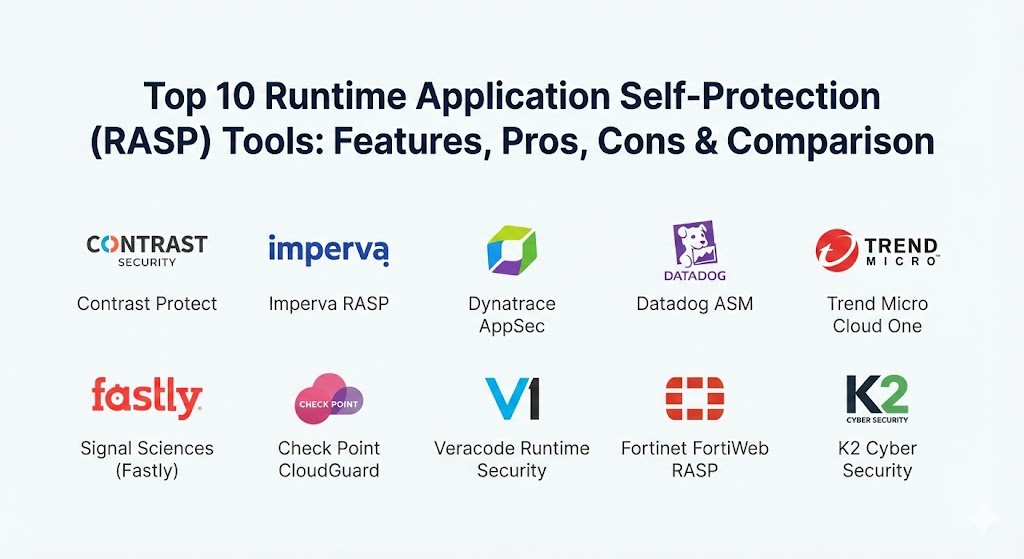
Top 10 Runtime Application Self-Protection (RASP) Tools
1 — Contrast Protect (Contrast Security)
Contrast Protect is a leader in the 2026 RASP market, known for its “Security as Code” philosophy. It uses patented instrumentation to embed security directly into the application, providing continuous monitoring and blocking without the need for traditional signatures.
- Key features:
- Patented deep security instrumentation for real-time visibility.
- Automated detection and blocking of OWASP Top 10 and zero-day threats.
- Support for Java, .NET, Node.js, Ruby, Python, and Go.
- Integration with IAST (Interactive Application Security Testing) for unified visibility.
- Intelligent alert prioritization based on exploitability context.
- Cloud-native and container-ready deployment options.
- Pros:
- Extremely low false-positive rate due to its code-level context.
- Seamlessly integrates into CI/CD pipelines, supporting a true “shift-left” strategy.
- Cons:
- Initial configuration can be complex for very large, heterogeneous environments.
- Performance overhead can be noticeable in extremely high-throughput applications if not tuned.
- Security & compliance: SOC 2 Type II, GDPR, HIPAA, and FIPS 140-2 compliant. Includes detailed audit logs and SSO integration.
- Support & community: Exceptional enterprise support with dedicated Technical Account Managers (TAMs); robust documentation and an active community of AppSec experts.
2 — Imperva RASP
Imperva RASP is a battle-tested solution that focuses on providing “autonomous” protection. It is particularly strong in protecting both modern and legacy applications without requiring any changes to the underlying source code.
- Key features:
- Comprehensive protection against SQLi, XSS, and command injection.
- Protection for third-party libraries and open-source dependencies.
- Deep visibility into database queries and file system access.
- Centralized management through the Imperva Cloud Security Console.
- Seamless integration with Imperva’s broader WAF and DDoS protection.
- Automated mitigation of unauthorized network calls.
- Pros:
- Excellent at protecting legacy applications where the original developers are no longer available.
- “Set and forget” autonomous operation reduces the burden on security teams.
- Cons:
- Primarily a “closed” ecosystem; works best when used with other Imperva products.
- Some users report that the UI can feel overwhelming for non-security specialists.
- Security & compliance: ISO 27001, SOC 2, PCI DSS, and HIPAA. Features tamper-evident logging and granular RBAC.
- Support & community: 24/7 global support with localized teams; extensive knowledge base and formal training certifications.
3 — Dynatrace Application Security
Dynatrace integrates RASP directly into its industry-leading observability platform. In 2026, this “AIOps” approach allows organizations to correlate security events with performance metrics in a single interface.
- Key features:
- Automatic discovery and instrumentation of all application components.
- AI-powered risk assessment (Davis AI) that prioritizes vulnerabilities.
- Real-time attack detection across the entire application stack.
- Native support for Kubernetes, serverless (Lambda/Fargate), and cloud-native apps.
- Continuous Software Composition Analysis (SCA) at runtime.
- Automated root-cause analysis for every detected security event.
- Pros:
- Unrivaled visibility; security events are viewed alongside performance and health signals.
- Zero-touch deployment for organizations already using the Dynatrace OneAgent.
- Cons:
- Highly dependent on the broader Dynatrace ecosystem.
- Can be a premium-priced solution compared to standalone RASP tools.
- Security & compliance: SOC 2 Type II, ISO 27001, GDPR, and FedRAMP authorized.
- Support & community: Massive global community; “Dynatrace University” provides extensive learning paths.
4 — Datadog Application Security Management (ASM)
Building on its acquisition of Sqreen and Hdiv, Datadog ASM provides a developer-friendly RASP experience integrated into its popular monitoring dashboard.
- Key features:
- Lightweight agents designed for minimal performance impact.
- Real-time blocking of malicious requests at the application layer.
- Integrated vulnerability management and dependency scanning.
- Automated “Attacker Identity” tracking across distributed traces.
- In-app behavioral analysis for anomaly detection.
- One-click remediation for common vulnerabilities.
- Pros:
- The most intuitive UI for developers and DevOps teams.
- Quickest time-to-value; can be enabled with a simple configuration change.
- Cons:
- Less granular control over deep instrumentation compared to Contrast Security.
- Security features are still maturing relative to legacy RASP specialists.
- Security & compliance: SOC 2, HIPAA, and GDPR compliant. Supports OIDC and SAML for SSO.
- Support & community: Excellent chat-based support; very active user forums and extensive public documentation.
5 — Trend Micro Cloud One – Application Security
Part of the broader Cloud One platform, this tool focuses on securing cloud-native applications, specifically targeting microservices and serverless functions.
- Key features:
- Library-based RASP that installs in minutes without code changes.
- Purpose-built protection for AWS Lambda and Azure Functions.
- Blocks injection, malicious file uploads, and unauthorized data access.
- Minimal latency impact, optimized for high-performance cloud apps.
- Centralized policy management across multi-cloud environments.
- Detailed forensics on the “Who, What, and Where” of an attack.
- Pros:
- Best-in-class for serverless environments where agents are not feasible.
- Integrates seamlessly with Trend Micro’s cloud workload protection.
- Cons:
- Limited language support compared to established players like Contrast.
- Reporting can be less detailed for complex, on-prem legacy stacks.
- Security & compliance: ISO 27001, SOC 2, and GDPR compliant.
- Support & community: Strong enterprise support; comprehensive web-based training and documentation.
6 — Fastly (Signal Sciences)
Signal Sciences (now part of Fastly) offers a unique hybrid of WAF and RASP. It uses a patented “Cloud Engine” to provide high-performance protection that scales with modern web traffic.
- Key features:
- SmartQuest technology for highly accurate attack detection.
- Ability to run in “blocking mode” with virtually zero false positives.
- Protection against account takeover (ATO) and API abuse.
- Lightweight agents that can be deployed as sidecars or modules.
- Real-time visibility into bot traffic and scraping attempts.
- Integrated with the Fastly edge cloud for global performance.
- Pros:
- Known for its ability to run in full blocking mode in production environments.
- Excellent for high-scale, modern web applications and APIs.
- Cons:
- Instrumentation is less “deep” into the code compared to “true” RASP tools like Contrast.
- Primarily focused on web-facing vulnerabilities.
- Security & compliance: PCI DSS Level 1, SOC 2 Type II, and HIPAA compliant.
- Support & community: Responsive support with a strong reputation in the DevOps community.
7 — Check Point CloudGuard AppSec
Check Point utilizes AI-powered “contextual analysis” to protect cloud applications, moving away from legacy signature-based detection.
- Key features:
- Automated “learning” of application behavior to establish a baseline.
- Prevention of zero-day attacks and the OWASP Top 10.
- Specialized API security and bot protection modules.
- Integration with CI/CD for automated security policy generation.
- Unified management across multi-cloud and hybrid environments.
- AI-driven threat intelligence from Check Point ThreatCloud.
- Pros:
- Highly effective at stopping “unknown” attacks through its adaptive learning.
- Consolidated management for organizations already in the Check Point ecosystem.
- Cons:
- The learning phase can result in “audit-only” mode for the first few days.
- Initial configuration can be daunting for smaller IT teams.
- Security & compliance: FedRAMP, SOC 2, ISO 27001, and GDPR.
- Support & community: Robust global support; extensive partner network for managed services.
8 — Veracode Runtime Security
Veracode is a heavyweight in the AppSec space. Its RASP solution is designed to complement its world-class static (SAST) and dynamic (DAST) testing tools.
- Key features:
- Real-time monitoring of application execution and data flow.
- Automated blocking of exploits targeting known vulnerabilities.
- Centralized dashboard for managing both testing and runtime security.
- Policy-based enforcement to ensure compliance with internal standards.
- Deep integration with Veracode’s vulnerability database.
- Scalable for large enterprise application portfolios.
- Pros:
- Provides a unified “cradle-to-grave” view of application security.
- Strong reporting for compliance audits (PCI, HIPAA).
- Cons:
- The UI can feel traditional and less “dynamic” than cloud-native rivals.
- Tends to be a more expensive, enterprise-focused solution.
- Security & compliance: ISO 27001, SOC 2, HIPAA, and GDPR.
- Support & community: Premier enterprise support; extensive training via Veracode University.
9 — Fortinet FortiWeb RASP
Fortinet has integrated RASP capabilities into its FortiWeb ecosystem, allowing for a “prevention-first” approach that bridges the gap between the network and the application code.
- Key features:
- Machine learning-driven threat detection for high accuracy.
- Hardware-accelerated SSL/TLS decryption for performance.
- Integration with the Fortinet Security Fabric for unified visibility.
- Protection against botnet attacks and credential stuffing.
- Built-in antivirus and IP reputation services.
- “Auto-Learn” feature for simplified policy creation.
- Pros:
- Excellent value for organizations already using Fortinet hardware or virtual appliances.
- Strong performance metrics for high-bandwidth enterprise environments.
- Cons:
- Less “developer-centric” compared to tools like Datadog or Snyk.
- High-availability setup can be complex.
- Security & compliance: FIPS 140-2, PCI DSS, and HIPAA.
- Support & community: Extensive documentation; global support centers with 24/7 availability.
10 — K2 Cyber Security
K2 is an innovative player in 2026, focusing on a unique “Deterministic Security” model that maps the execution flow of an application to identify deviations.
- Key features:
- Zero-day attack detection without relying on signatures or ML baselines.
- Protection against memory-based attacks and buffer overflows.
- Real-time vulnerability detection with minimal false positives.
- Low performance overhead (<1ms latency impact).
- Integrated workload protection for containers and VMs.
- Forensic data captures the exact line of code being exploited.
- Pros:
- Extremely high accuracy for zero-day threats through deterministic mapping.
- Provides deep forensic details that are invaluable for developers during remediation.
- Cons:
- Smaller community and ecosystem compared to the industry giants.
- Documentation is still catching up to the product’s rapid innovation.
- Security & compliance: SOC 2, GDPR, and HIPAA compliant.
- Support & community: High-touch startup-style support; rapidly growing knowledge base.
Comparison Table
| Tool Name | Best For | Platform(s) Supported | Standout Feature | Rating (Gartner) |
| Contrast Protect | DevSecOps & Shift-Left | Java, .NET, Node, Py, Go | Security as Code / IAST Integration | 4.7 / 5 |
| Imperva RASP | Legacy Apps & Compliance | Multi-platform, Cloud | Autonomous, No-Code Protection | 4.5 / 5 |
| Dynatrace AppSec | Full-Stack Observability | K8s, Cloud-native, Hybrid | AI-powered Davis Engine | 4.6 / 5 |
| Datadog ASM | Developer Experience | Cloud-native, Distributed | Trace-Integrated Attack ID | 4.5 / 5 |
| Trend Micro | Serverless & Microservices | AWS Lambda, Azure, K8s | Library-based Fast Deploy | 4.4 / 5 |
| Signal Sciences | High-Traffic Web/APIs | Cloud, Hybrid, Edge | WAF/RASP Hybrid Flexibility | 4.6 / 5 |
| Check Point | AI-Driven Cloud Security | Multi-Cloud, Containers | Contextual AI Learning | 4.3 / 5 |
| Veracode | Enterprise Risk Mgmt | Java, .NET, Multi-lang | Unified Testing & Runtime | 4.4 / 5 |
| Fortinet FortiWeb | Fabric Integration | On-prem, Cloud, Virtual | Fabric-wide Threat Intelligence | 4.3 / 5 |
| K2 Cyber Security | Zero-Day/Memory Attack | Linux, K8s, VMs | Deterministic Code Mapping | 4.6 / 5 |
Evaluation & Scoring of Runtime Application Self-Protection (RASP)
To help you prioritize, we have evaluated the general RASP category based on the following weighted scoring rubric.
| Criteria | Weight | Evaluation Notes |
| Core Features | 25% | OWASP Top 10 coverage, zero-day protection, and language support. |
| Ease of Use | 15% | Deployment speed, UI quality, and alert clarity. |
| Integrations | 15% | Compatibility with CI/CD, SIEM, and cloud-native stacks (K8s). |
| Security & Compliance | 10% | Certifications (SOC 2, GDPR) and audit readiness. |
| Performance | 10% | Latency impact and resource overhead on the application. |
| Support & Community | 10% | Quality of documentation, enterprise SLAs, and user forums. |
| Price / Value | 15% | Licensing transparency and ROI (protection vs. cost). |
Which RASP Tool Is Right for You?
Choosing the right RASP tool is about matching the tool’s “depth” with your team’s “breadth.”
- Solo Users & Small Startups: RASP might be overkill. Focus on Datadog ASM or Snyk for basic protection.
- Mid-Market Companies: If you use Datadog for monitoring, enabling Datadog ASM is the most frictionless path. If you are cloud-only, Signal Sciences offers a great balance of WAF and RASP.
- Enterprise & Regulated Sectors: Contrast Security and Imperva are the gold standards. Contrast is better for modern DevSecOps, while Imperva is superior for a mix of modern and legacy systems.
- Budget-Conscious Teams: Fortinet offers significant value if you are already invested in their Security Fabric.
- High-Security / Tech-First Teams: K2 Cyber Security is ideal for those who need deep forensic data and protection against memory-level zero-day attacks.
Frequently Asked Questions (FAQs)
1. Is RASP a replacement for a WAF? No. They are complementary. A WAF blocks broad, high-volume attacks at the edge, while RASP stops targeted exploits that manage to slip through to the application code.
2. Does RASP slow down the application? While RASP lives inside the application, modern tools (like Datadog or Signal Sciences) are designed to add less than 2-5ms of latency, which is unnoticeable for most users.
3. Does RASP require code changes? Most enterprise RASP tools use “instrumentation” or “library wrappers” that require zero changes to your actual source code. You simply include the agent in your build process.
4. How does RASP handle zero-day attacks? Because RASP understands how an application should behave (e.g., “this code should never execute a file system delete”), it can block unusual behavior even if the specific exploit has never been seen before.
5. Is RASP difficult to maintain? Modern RASP tools are increasingly autonomous. Once configured, they primarily require attention only when a real attack is detected or a significant code change occurs.
6. Can RASP protect APIs? Yes. RASP is actually one of the most effective ways to secure APIs and microservices because it monitors the data flow within the service itself.
7. Does RASP work for serverless like AWS Lambda? Yes, but you need a tool specifically designed for it, such as Trend Micro Cloud One or Contrast Security, which offer library-based versions of their agents.
8. What is the difference between IAST and RASP? IAST is used during the testing phase to find vulnerabilities. RASP is used during the production phase to block attacks. Many vendors (like Contrast) offer both in a single platform.
9. Can RASP help with PCI DSS compliance? Yes. RASP meets several PCI requirements for application-layer protection and provides the detailed logging needed for compliance audits.
10. Why isn’t RASP more widely used? In the past, RASP was difficult to deploy and had performance issues. In 2026, those hurdles have largely been overcome, leading to rapid adoption across all industries.
Conclusion
The evolution of RASP in 2026 has transformed it from an “experimental” security layer into a cornerstone of modern application defense. Whether you choose the observability-integrated approach of Dynatrace, the developer-centric UI of Datadog, or the deep code protection of Contrast Security, the goal remains the same: making your applications resilient from the inside out. In the end, the “best” tool is the one that fits your existing technology stack while empowering your developers to build safely.
RASP now uses automated, real-time detection to catch attacks from inside the application during execution. The contrast between Snyk’s developer-first approach and specialized RASP engines highlights the “shift left” security trend. This guide is a solid resource for maintaining strict protection without slowing down the CI/CD pipeline.