Introduction
A Robotics Fleet Management Tool is a centralized software platform that acts as the “mission control” for a collection of mobile robots. These platforms handle task allocation, traffic management, battery monitoring, and real-time observability. Without a robust RFM, a fleet of robots would suffer from “gridlock”—colliding in narrow aisles, depleting batteries simultaneously, or failing to prioritize high-value tasks. In essence, these tools provide the air traffic control necessary for autonomous systems to operate safely and efficiently at scale.
Key real-world use cases include warehouse logistics (optimizing picking paths), hospital delivery (managing linens and meals), last-mile delivery hubs, and large-scale agriculture (coordinating drone swarms or automated tractors). When evaluating these tools, users should prioritize interoperability (the ability to manage robots from different manufacturers), latency (how fast the system reacts to obstacles), and VDA 5050 compliance (the industry-standard communication protocol).
Best for:
- Logistics & Warehouse Managers: Dealing with high-volume throughput and multi-vendor AMRs.
- Logistics CTOs: Looking to integrate robotics into existing Warehouse Management Systems (WMS) or ERPs.
- Robotics Startups: Needing a ready-made infrastructure to manage their first commercial deployments.
- Hospitality & Healthcare: Managing service robots across complex indoor environments.
Not ideal for:
- Single-Robot Operators: If you only have one stationary robot arm or a single vacuuming unit, the overhead of a fleet manager is unnecessary.
- Fixed Automation: Assembly lines that use hard-wired conveyors rather than mobile agents.
- Bespoke R&D Labs: Teams building unique, non-commercial hardware that requires highly custom, low-level control systems.
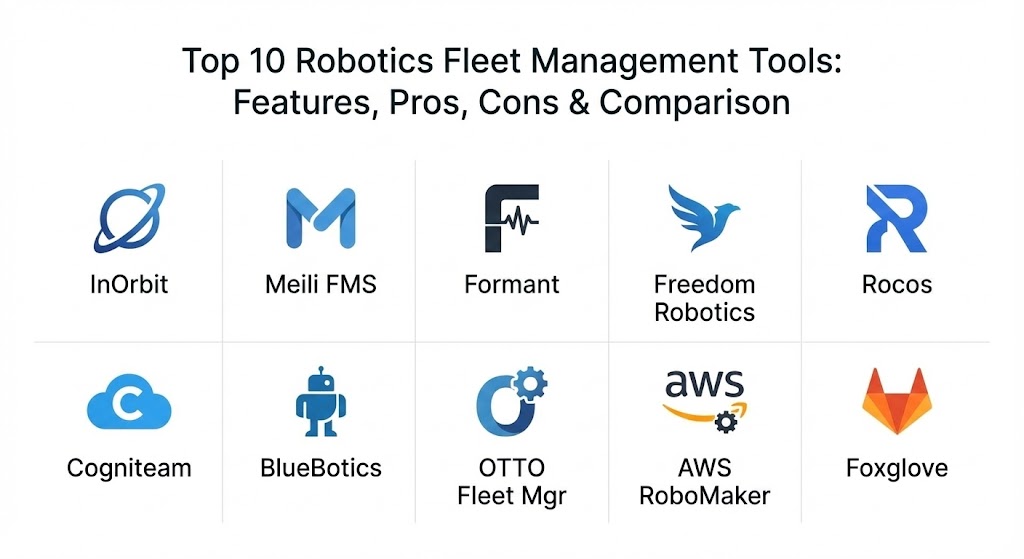
Top 10 Robotics Fleet Management Tools
1 — InOrbit
InOrbit is a cloud-based, vendor-agnostic robotics operations (RobOps) platform designed to help companies scale their fleets from five to five thousand robots. It focuses heavily on observability and “incident management.”
- Key features:
- Time Capsule: A powerful logging feature that allows users to “rewind” and visualize what a robot saw during a failure.
- Agnostic Integration: Supports any ROS-based or proprietary robot through a lightweight agent.
- Incident Response: Automated alerts and a dashboard for remote troubleshooting.
- Fleet-wide Analytics: Detailed reporting on robot utilization and “Mean Time Between Interventions.”
- Configuration Management: Remotely update software or parameters across the entire fleet.
- InOrbit Connect: A directory of pre-integrated robot vendors for faster setup.
- Pros:
- Exceptional “Time Capsule” feature makes debugging edge cases significantly faster.
- Highly scalable cloud architecture that handles massive amounts of telemetry data.
- Cons:
- As a cloud-first platform, it may face challenges in environments with spotty internet connectivity.
- Can be more expensive than open-source alternatives for very small fleets.
- Security & compliance: SOC 2 Type II compliant, SSO integration, end-to-end encryption for telemetry data, and GDPR adherence.
- Support & community: Extensive developer documentation, dedicated enterprise support teams, and an active blog/webinar series focused on RobOps best practices.
2 — Meili Robots (Meili FMS)
Meili FMS is a specialized fleet management system that prioritizes interoperability. It is one of the leading advocates for the VDA 5050 standard, making it a top choice for multi-vendor fleets.
- Key features:
- Multi-Vendor Support: Manage robots from different manufacturers in one map.
- Traffic Management: Advanced path planning to prevent bottlenecks and deadlocks.
- Task Allocation: Intelligent dispatching based on robot proximity and battery level.
- VDA 5050 Compliance: Built specifically to support the European AGV/AMR standard.
- Unified Mapping: Merge different robot maps into a single global coordination space.
- ERP/WMS Integration: Open APIs for connecting to warehouse software.
- Pros:
- Best-in-class traffic control logic for narrow warehouse aisles.
- Strong focus on interoperability helps avoid “vendor lock-in.”
- Cons:
- Requires more configuration for robots that do not natively support VDA 5050.
- UI is functional but less polished than Formant or InOrbit.
- Security & compliance: SSO, role-based access control (RBAC), and encryption; follows ISO 27001 guidelines.
- Support & community: Strong European presence, excellent onboarding support for industrial clients, and a clear technical roadmap.
3 — Formant
Formant is a data-heavy RobOps platform that excels in teleoperation and high-resolution data capture. It is designed for companies that need deep visibility into their robot’s physical performance.
- Key features:
- High-Speed Teleoperation: Low-latency remote control over the cloud for manual interventions.
- Data Lake: Automatically stores and indexes all robot sensor data for later analysis.
- Custom Observability Dashboards: Highly flexible UI that can be tailored to specific hardware.
- Cloud API: Extensive integration capabilities for custom applications.
- Edge Processing: Manage what data is sent to the cloud to save on bandwidth.
- Fleet Health Monitoring: Real-time health checks for motors, batteries, and sensors.
- Pros:
- The industry standard for remote teleoperation and manual “rescue” missions.
- Visual dashboards are incredibly intuitive and professional.
- Cons:
- The focus on high-fidelity data can lead to high cloud storage costs if not managed.
- Less focus on “traffic orchestration” compared to Meili or BlueBotics.
- Security & compliance: SOC 2 Type II, HIPAA (for medical robots), ISO 27001, and robust audit logging.
- Support & community: Premium enterprise support, frequent product updates, and a very responsive technical team.
4 — Freedom Robotics
Freedom Robotics provides an end-to-end platform for monitoring, managing, and controlling robots. It is particularly strong in the agriculture and last-mile delivery sectors.
- Key features:
- Pilot: A secure, web-based teleop interface for remote driving.
- Mission Control: Manage complex sequences of tasks across multiple robots.
- Remote SSH: Directly access the robot’s onboard computer via a secure tunnel.
- Event Triggering: Automate actions based on specific telemetry (e.g., return to base if battery < 10%).
- Video Streaming: Optimized multi-camera streaming for remote situational awareness.
- Pros:
- Remote SSH access is a lifesaver for engineers needing to fix code in the field.
- Very easy to install with a simple one-line script for ROS-based robots.
- Cons:
- The platform can feel “developer-centric,” making it harder for non-technical warehouse staff.
- Pricing can be opaque for larger enterprise deployments.
- Security & compliance: SSO, end-to-end TLS encryption, and SOC 2 compliance.
- Support & community: Solid technical documentation and an active Slack community for developers.
5 — Rocos (by Mov.ai)
Now part of the Mov.ai ecosystem, Rocos is a cloud-native platform that provides mission control and visualization for fleets of varied robots.
- Key features:
- Global Map View: See your entire global fleet on a map with real-time status updates.
- Mission Dispatcher: Drag-and-drop mission planning for non-technical users.
- Digital Twin Integration: Visualize robot performance against a digital model of the facility.
- Unified Telemetry: Collect and normalize data from diverse robot types.
- Edge Gateway: Local processing to ensure missions continue even if the cloud disconnects.
- Pros:
- Excellent for global companies managing multiple sites through a single pane of glass.
- Strong focus on “Mission” logic rather than just individual robot health.
- Cons:
- Integration with older, non-ROS legacy robots can be difficult.
- The UI can be heavy and requires a modern browser/high bandwidth.
- Security & compliance: ISO 27001, GDPR, and enterprise-grade SSO.
- Support & community: High-quality professional services for enterprise setup and integration.
6 — Cogniteam (Nimbus)
Nimbus is a “low-code” cloud platform for robotics. It focuses on the entire lifecycle, from building the robot’s software to managing the fleet in production.
- Key features:
- Drag-and-Drop Building Blocks: Build robot behaviors without deep coding knowledge.
- Cloud Simulator: Test fleet behaviors in a virtual environment before deploying.
- Auto-scaling Fleet Management: Add new robots to the fleet by simply scanning a QR code.
- Remote Updates (OTA): Push new software versions to the whole fleet simultaneously.
- Resource Monitoring: Track CPU, GPU, and memory usage across the fleet.
- Pros:
- The fastest platform for moving from a prototype to a managed fleet.
- Simulator integration allows for safe testing of traffic algorithms.
- Cons:
- Advanced developers might find the “low-code” approach restrictive for complex logic.
- Primarily focused on ROS/ROS2 environments.
- Security & compliance: Secure boot support, encrypted communication, and RBAC.
- Support & community: Good documentation and a focus on educational and startup partnerships.
7 — BlueBotics (ANT server)
BlueBotics is an industrial heavyweight. Their ANT (Autonomous Navigation Technology) server is the gold standard for high-precision AGV/AMR coordination in manufacturing.
- Key features:
- High-Precision Traffic Control: Manages complex intersections and priority lanes with sub-centimeter accuracy.
- Interoperability (ANT ecosystem): Any robot using ANT navigation can be managed by the server.
- Battery Management: Advanced charging logic to ensure 24/7 fleet availability.
- Safety Integration: Direct connection to industrial safety PLC systems.
- API for WMS/MES: Seamlessly connects to Manufacturing Execution Systems.
- Pros:
- Unrivaled reliability in high-stakes industrial environments like car manufacturing.
- Very low latency and high local performance (not cloud-dependent).
- Cons:
- Vendor lock-in: Primarily works with “ANT-driven” robots.
- Expensive, high-end solution tailored for large factories.
- Security & compliance: Industrial-grade security standards; compliant with safety regulations like ISO 3691-4.
- Support & community: World-class engineering support and on-site integration services.
8 — OTTO Motors (OTTO Fleet Manager)
While OTTO Motors sells their own robots, their Fleet Manager is widely regarded as one of the best software stacks in the industry for large-scale material handling.
- Key features:
- Intelligent Traffic Management: Dynamic re-routing based on floor congestion.
- Fleet-wide Status Dashboard: High-level overview of productivity and downtime.
- Smart Charging: Robots automatically find chargers when idle or low on power.
- VDA 5050 Support: Now supporting third-party AGVs through the standard protocol.
- Comprehensive API: Integration with REST and Websocket for custom dashboards.
- Pros:
- Extremely robust; tested in the world’s largest Fortune 500 warehouses.
- One of the best user interfaces for “floor supervisors” rather than just engineers.
- Cons:
- Historically closed; third-party robot support is a newer, less mature feature.
- Premium pricing reflects its enterprise positioning.
- Security & compliance: SOC 2 Type II, ISO 27001, and extensive safety certifications.
- Support & community: Dedicated account managers and 24/7 technical support for mission-critical operations.
9 — AWS RoboMaker (Fleet Management)
AWS RoboMaker provides the cloud infrastructure for managing fleets. It is less a “standalone tool” and more a set of building blocks for companies that want to build their own custom fleet manager on AWS.
- Key features:
- Fleet Monitoring: Integrated with AWS IoT Greengrass for robot-to-cloud communication.
- OTA Deployment: Seamlessly deploy ROS bags and software updates via AWS.
- Simulation WorldForge: Create thousands of indoor worlds to test fleet orchestration.
- Integration with AWS Lambda: Trigger business logic (e.g., ordering parts) based on robot telemetry.
- CloudWatch Logs: Industry-standard monitoring and alerting.
- Pros:
- Virtually infinite scalability.
- Seamlessly integrates with the rest of your AWS data pipeline and AI services.
- Cons:
- Not a “turnkey” solution; requires significant AWS engineering expertise to set up.
- Lack of a specialized “robotics-first” dashboard compared to Formant or InOrbit.
- Security & compliance: The full AWS security suite (IAM, KMS, VPC, FedRAMP).
- Support & community: Massive AWS documentation library and global partner network.
10 — Foxglove
Foxglove is unique on this list. While it started as a visualization tool, in 2026 it has become an essential part of the fleet management stack for data observability and analysis.
- Key features:
- Custom Visualization Layouts: Build specific views for lidar, camera, and state data.
- Foxglove Data Platform: A centralized hub to store and search through fleet logs.
- Instant Playback: View robot data in real-time or from historical recordings.
- Team Collaboration: Share data “scenarios” with teammates for collaborative debugging.
- Extension API: Build custom plugins to support proprietary data formats.
- Pros:
- The best visualization tool for ROS and ROS2 developers.
- Allows teams to find “needle in a haystack” failure events across a large fleet.
- Cons:
- Not a “traffic manager” or “mission dispatcher.”
- Requires integration with another tool (like InOrbit or a custom backend) for full fleet control.
- Security & compliance: SSO, data encryption, and SOC 2 Type II.
- Support & community: Highly active Discord and GitHub community; very popular with the modern robotics dev crowd.
Comparison Table
| Tool Name | Best For | Platform(s) Supported | Standout Feature | Rating (Gartner/TrueReview) |
| InOrbit | Scalable RobOps | Cloud / ROS / Agnostic | Time Capsule (Rewind) | 4.8 / 5.0 |
| Meili FMS | Multi-vendor Fleets | Cloud / VDA 5050 | VDA 5050 Interoperability | 4.5 / 5.0 |
| Formant | High-fidelity Teleop | Cloud / Agnostic | Low-latency Teleoperation | 4.7 / 5.0 |
| Freedom Robotics | Agriculture & Last-Mile | Cloud / ROS | Remote SSH Access | 4.4 / 5.0 |
| Rocos | Global Mission Control | Cloud / Agnostic | Digital Twin Visualization | 4.3 / 5.0 |
| Cogniteam | Rapid Dev to Fleet | Cloud / ROS2 | Low-code Drag-and-Drop | 4.5 / 5.0 |
| BlueBotics | Industrial Precision | Local / ANT Server | Sub-cm Traffic Control | 4.9 / 5.0 |
| OTTO Fleet Mgr | Large-scale Material | On-Prem / Cloud | Industrial-grade Reliability | 4.7 / 5.0 |
| AWS RoboMaker | AWS-native Teams | AWS Cloud | Infinite Scale / Simulation | 4.2 / 5.0 |
| Foxglove | Data Observability | SaaS / Desktop | High-end 3D Visualization | 4.8 / 5.0 |
Evaluation & Scoring of Robotics Fleet Management Tools
The following scoring is based on a weighted rubric designed to reflect the needs of a typical enterprise moving from pilot to production.
| Criteria | Weight | InOrbit | Meili FMS | BlueBotics | Formant |
| Core Features | 25% | 9/10 | 9/10 | 10/10 | 8/10 |
| Ease of Use | 15% | 9/10 | 8/10 | 7/10 | 10/10 |
| Integrations | 15% | 10/10 | 10/10 | 6/10 | 9/10 |
| Security & Compliance | 10% | 10/10 | 8/10 | 9/10 | 10/10 |
| Perf & Reliability | 10% | 8/10 | 9/10 | 10/10 | 9/10 |
| Support & Community | 10% | 9/10 | 8/10 | 9/10 | 9/10 |
| Price / Value | 15% | 8/10 | 9/10 | 7/10 | 8/10 |
| TOTAL SCORE | 100% | 9.05 | 8.85 | 8.35 | 8.95 |
Which Robotics Fleet Management Tool Is Right for You?
Selecting an RFM tool is a high-stakes decision. The “best” choice depends on your fleet’s diversity, your technical resources, and your environment.
1. Solo Users vs. SMBs vs. Mid-Market vs. Enterprise
- Solo Users/Early Startups: Look at Foxglove for visualization and Freedom Robotics or Cogniteam for easy management. You need tools that get you up and running without a massive engineering lift.
- SMBs: InOrbit is often the best fit, offering a professional platform that scales as you grow without requiring on-prem servers.
- Mid-Market to Enterprise: Meili FMS or Formant are strong contenders. If you have a multi-vendor fleet, Meili’s VDA 5050 focus is essential.
- Large-Scale Industrial: If you are running a 24/7 factory, BlueBotics or OTTO Motors offer the reliability and safety certifications that “pure cloud” tools might lack.
2. Budget-Conscious vs. Premium Solutions
If budget is a primary concern, building on AWS RoboMaker or using Foxglove’s free tier combined with custom scripts is an option, though it increases “people cost.” Premium solutions like Formant or InOrbit may have a higher monthly fee, but they drastically reduce the number of DevOps engineers you need to hire.
3. Feature Depth vs. Ease of Use
If you need teleoperation, Formant is the clear winner. If you need traffic coordination in a crowded warehouse, Meili FMS or BlueBotics are superior. For a general, easy-to-use “daily driver,” InOrbit strikes the best balance.
4. Integration and Scalability Needs
For those heavily invested in the ROS/ROS2 ecosystem, Foxglove, InOrbit, and Freedom Robotics provide the best “native” experience. If you need to integrate with a custom ERP, look for tools with robust, well-documented REST APIs.
5. Security and Compliance Requirements
In healthcare or high-security manufacturing, Formant and InOrbit lead the pack with SOC 2 compliance. If you require on-premises data storage (no cloud), BlueBotics or OTTO Motors are your primary choices.
Frequently Asked Questions (FAQs)
1. What is VDA 5050 and why does it matter?
VDA 5050 is a standardized communication protocol between AGVs and a master control. It allows you to buy a robot from Vendor A and a robot from Vendor B and have them both managed by the same software, preventing vendor lock-in.
2. Can I use these tools with non-ROS robots?
Yes. Most professional platforms (InOrbit, Formant, Rocos) provide SDKs or APIs to connect proprietary robot operating systems, though ROS-based robots are usually “plug-and-play.”
3. Do these tools work without internet (offline)?
Some do. BlueBotics and OTTO are primarily on-prem/local. Cloud-native tools like InOrbit and Formant usually require an “Edge Gateway” to handle mission-critical tasks if the internet drops.
4. How do these tools handle robot collisions?
They don’t just “detect” collisions; they prevent them through path planning. The software assigns “segments” of the floor to specific robots, ensuring no two robots are ever planned to be in the same space at the same time.
5. Is teleoperation safe over the cloud?
Yes, if using a tool like Formant or Freedom Robotics. They use low-latency WebRTC streams and secure tunnels, often including “dead-man switches” that stop the robot if the connection lags.
6. What is the typical pricing model?
Most use a “Per Robot, Per Month” SaaS model. This can range from $50/robot/month for basic monitoring to $500+/robot/month for high-end teleop and data analysis.
7. Can I manage drones and ground robots in the same tool?
Yes. Platforms like Rocos and InOrbit are designed to be agnostic to the form factor, provided the robot can send telemetry and receive commands.
8. Do I need a fleet manager for only 3 robots?
Probably not for the “traffic control,” but you might still want it for remote observability. It’s much easier to check a dashboard than to physically walk to the robot when it gets stuck.
9. How long does implementation take?
For a ROS-based robot on a cloud platform, you can see data in minutes. Full fleet-wide orchestration and ERP integration typically takes 4 to 12 weeks.
10. What is the “Mean Time Between Interventions” (MTBI)?
It is a key KPI in robotics fleet management. It measures how long a fleet runs on average before a human must step in to help a robot. The goal of an RFM tool is to maximize this number.
Conclusion
The transition from “robotics as an experiment” to “robotics as an infrastructure” is now complete. As we look at the landscape in 2026, it is clear that the success of a robotics program is no longer defined by the hardware, but by the software that manages it.
Choosing a Robotics Fleet Management tool requires a careful balance. If you prioritize interoperability, Meili FMS is your best friend. If you need remote teleoperation, Formant is the gold standard. For cloud-native scalability, InOrbit is the market leader. Ultimately, the best tool is the one that allows your robots to become invisible—silently and efficiently doing their jobs without requiring constant human oversight.