Introduction
Review management platforms are specialized software solutions designed to aggregate, monitor, and manage customer feedback across multiple online directories—such as Google Business Profile, Yelp, Facebook, and industry-specific sites like TripAdvisor or Healthgrades. These platforms centralize disparate data streams into a single dashboard, allowing business owners and marketing teams to respond to reviews in real-time and automate the process of requesting new feedback via SMS and email.
The importance of these tools lies in their dual impact on Search Engine Optimization (SEO) and Consumer Trust. Google’s local search algorithm prioritizes businesses with high ratings and frequent, recent reviews. Beyond SEO, these platforms provide valuable sentiment analysis, helping organizations identify operational blind spots—such as a specific store location with long wait times or a recurring product defect. When choosing a platform, users should evaluate criteria such as the number of integrations, the sophistication of AI response templates, sentiment analysis depth, and the ease of multi-location management.
Best for: Multi-location enterprises (franchises, retail chains), local service providers (HVAC, plumbing, legal), and e-commerce brands that need to automate social proof. It is also essential for agencies managing the digital presence of multiple clients.
Not ideal for: Solo hobbyists or micro-businesses with zero online presence, or companies that rely entirely on word-of-mouth referrals without any digital footprint. In these cases, manual monitoring of a single Google profile may suffice.
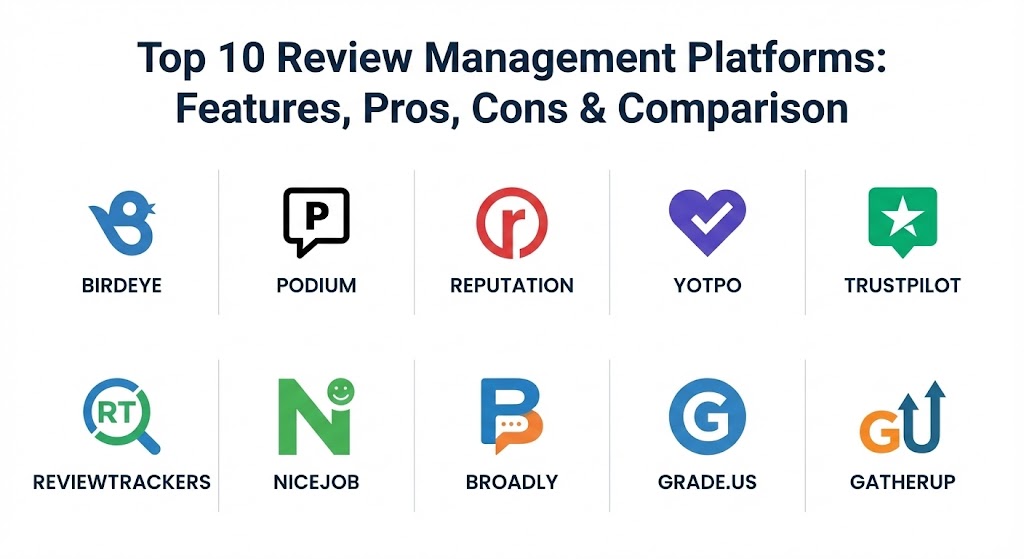
Top 10 Review Management Platforms
1 — Birdeye
Birdeye is widely considered the industry leader in the “Experience Management” space. It offers a comprehensive suite of tools that goes beyond simple review monitoring to include listings management, social publishing, and AI-driven customer surveys.
- Key features:
- Automated review generation via text, email, and in-store kiosks.
- AI-powered “Review Response” assistant that drafts personalized replies.
- Integrated “Webchat” that converts website visitors into leads via SMS.
- Detailed sentiment analysis to track customer mood over time.
- Cross-platform social media management and review marketing.
- Robust listing management to ensure NAP (Name, Address, Phone) consistency.
- Pros:
- The most feature-complete platform on the market, serving as an all-in-one marketing hub.
- Excellent for large enterprises managing hundreds or thousands of locations.
- Cons:
- Higher price point compared to entry-level competitors.
- The sheer number of features can create a steep learning curve for small teams.
- Security & compliance: SOC 2 Type II, HIPAA (for healthcare), GDPR, and ISO 27001.
- Support & community: 24/7 global support, dedicated account managers for enterprise tiers, and a massive library of webinars and training guides.
2 — Podium
Podium revolutionized the local business market by focusing on the power of “Text-to-Review.” It treats every customer interaction as a conversation, making it incredibly easy for businesses to capture leads and reviews through SMS.
- Key features:
- Centralized “Inbox” for all customer communications (SMS, Webchat, Social).
- Automated review invitations sent directly through text message.
- “Text-to-Pay” feature to close sales and request reviews in one workflow.
- AI lead-capture tools that convert missed calls into text conversations.
- Bulk messaging for targeted promotional campaigns.
- Pros:
- Unmatched ease of use for local service-based businesses.
- Very high conversion rates for review requests due to the focus on SMS.
- Cons:
- Can become expensive if you require multiple add-on modules.
- Less focus on deep data analytics compared to enterprise-grade platforms.
- Security & compliance: SOC 2, PCI DSS (for payments), and GDPR compliant.
- Support & community: High-quality phone and chat support; strong presence in local business communities.
3 — Reputation
Formerly known as Reputation.com, this platform is the “heavyweight” choice for large-scale corporations in highly regulated industries like healthcare, automotive, and finance.
- Key features:
- “Reputation Score” — a proprietary metric used to benchmark brand health.
- Advanced competitive intelligence to see how you stack up against rivals.
- Deep-dive “CX” (Customer Experience) analytics for operational insights.
- Managed services for businesses that want to outsource review responses.
- Integration with complex CRM systems like Salesforce and Oracle.
- Pros:
- Best-in-class for managing massive volumes of feedback across complex hierarchies.
- Deep industry-specific focus (e.g., specialized tools for hospital networks).
- Cons:
- Pricing is generally opaque and tailored toward large budgets.
- Can feel overly complex for a single-location small business.
- Security & compliance: HIPAA, SOC 2, GDPR, and ISO 27001.
- Support & community: Professional service teams available for strategy and implementation.
4 — Yotpo
Yotpo is the gold standard for e-commerce brands. It focuses on turning user-generated content (reviews, photos, videos) into high-converting marketing assets for online stores.
- Key features:
- Seamless integration with Shopify, Magento, and BigCommerce.
- “Visual Reviews” that allow customers to upload photos and videos of products.
- Syndication of reviews directly to Google Shopping and social media.
- Integrated loyalty and referral program modules.
- SMS marketing tools designed to drive repeat purchases.
- Pros:
- Specifically built for e-commerce; the “Visual Reviews” are a major conversion driver.
- Strong Google partnership ensures reviews appear in search and shopping ads.
- Cons:
- Not designed for service-based local businesses (like dentists or law firms).
- Lower-tier plans can be restrictive for growing brands.
- Security & compliance: SOC 2, GDPR, and CCPA compliant.
- Support & community: Strong community for e-commerce founders and specialized Shopify support.
5 — Trustpilot Business
Trustpilot is one of the most recognized public review platforms in the world. Its “Business” platform allows companies to claim their profiles and use the Trustpilot brand to build instant credibility.
- Key features:
- High-authority public profile that ranks extremely well in search results.
- Automated review collection via email and API integrations.
- Verification system that ensures reviews come from real customers.
- Analytics to monitor star-rating trends over time.
- Integration with Google Seller Ratings for better PPC performance.
- Pros:
- Brand recognition is massive; customers trust the “Trustpilot Star” logo.
- The public nature of the platform forces transparency and builds consumer confidence.
- Cons:
- You have less control over the “gatekeeping” of negative reviews.
- The platform is a “walled garden”—it focuses on Trustpilot reviews rather than Google/Yelp.
- Security & compliance: ISO 27001, GDPR, and SOC 2.
- Support & community: Large international support team and localized documentation.
6 — ReviewTrackers
ReviewTrackers focuses on mid-market brands that need a balance of powerful analytics and a clean, intuitive user interface. It is particularly strong in the restaurant and retail sectors.
- Key features:
- Real-time monitoring of over 100+ review sites.
- “Smart Response” templates to speed up engagement.
- Advanced keyword tracking to see what specific words customers use most.
- Mobile app for managing reputation on-the-go.
- Local SEO insights and performance benchmarking.
- Pros:
- The interface is one of the most user-friendly in the enterprise space.
- Highly accurate sentiment analysis that categorizes feedback into specific themes.
- Cons:
- Lacks some of the native “Payment” or “Webchat” tools found in Podium/Birdeye.
- Integration ecosystem is slightly smaller than some of the top-tier competitors.
- Security & compliance: SOC 2, GDPR, and SSO support.
- Support & community: Excellent onboarding program and a dedicated “Customer Success” model.
7 — NiceJob
NiceJob is designed for small businesses that want “social proof on autopilot.” Its primary differentiator is its focus on automated social sharing and storytelling.
- Key features:
- “Stories” feature that automatically turns reviews into social media posts.
- Intelligent funnel that reminds customers to leave feedback without being annoying.
- Review widget for websites that highlights recent positive feedback.
- Leaderboards for staff to encourage review collection across the team.
- SMS and email review invitations.
- Pros:
- Extremely easy to set up; perfect for teams with no dedicated marketer.
- Very affordable for single-location businesses.
- Cons:
- Not built for enterprise-scale reporting or multi-location management.
- Limited depth in terms of sentiment analysis and advanced data science.
- Security & compliance: Varies / Standard encryption for data in transit.
- Support & community: Friendly, small-business focused support team and active Facebook group.
8 — Broadly
Broadly focuses on the local professional services market (HVAC, Auto Repair, Legal) and emphasizes the “human” aspect of review management and customer engagement.
- Key features:
- Modern webchat that allows for direct texting with customers.
- Automated “Review Request” campaigns triggered by your CRM.
- Team collaboration tools to assign review responses to specific employees.
- Professional website builder services tailored for local SEO.
- Consolidated inbox for Google, Facebook, and Webchat.
- Pros:
- Strong focus on improving the end-to-end customer experience, not just reviews.
- Great for teams that want to collaborate on customer communication.
- Cons:
- Dashboard can feel limited if you are looking for deep competitive data.
- Higher price point than “budget” alternatives like NiceJob.
- Security & compliance: SOC 2 and GDPR.
- Support & community: High-touch customer service with dedicated success managers.
9 — Grade.us (by Traject)
Grade.us is the premier choice for marketing agencies. It offers a “white-label” platform that allows agencies to provide review management services under their own brand.
- Key features:
- Fully white-labelable dashboard and reports.
- “Multi-Step” email and SMS drip campaigns for review requests.
- Review monitoring across dozens of industry-specific sites.
- Automated PDF reporting to prove ROI to clients.
- “In-platform” response capability for many major sites.
- Pros:
- The best option for agencies looking to resell review management.
- High degree of customization for review landing pages and funnels.
- Cons:
- The UI feels a bit more “technical” than Podium or NiceJob.
- Setting up the white-label environment requires some technical configuration.
- Security & compliance: SOC 2 and GDPR.
- Support & community: Strong support for agency owners and resellers.
10 — GatherUp
GatherUp takes a “Listening First” approach to reputation management. It focuses on gathering internal feedback first to resolve issues privately before asking for a public review.
- Key features:
- Net Promoter Score (NPS) and survey integration.
- “Feedback First” funnel that catches unhappy customers before they post online.
- Auto-tagging of reviews for easy categorization.
- “Review Social Sharing” to turn feedback into graphic images for marketing.
- Support for video testimonials.
- Pros:
- Excellent for brands that are afraid of negative public reviews.
- Provides deep qualitative data through surveys.
- Cons:
- Can lead to lower review volume because of the extra step (the survey).
- UI is functional but not as visually modern as some competitors.
- Security & compliance: SOC 2 and GDPR.
- Support & community: Known for high-quality education and “Reputation Management” thought leadership.
Comparison Table
| Tool Name | Best For | Platform(s) Supported | Standout Feature | Rating (Approx. Avg) |
| Birdeye | Multi-location Enterprise | Web, iOS, Android | AI Response Assistant | 4.8 / 5 |
| Podium | Local Lead Gen | Web, iOS, Android | SMS-Centric Inbox | 4.6 / 5 |
| Reputation | Large Corporations | Web, Enterprise Cloud | Reputation Score Metric | 4.5 / 5 |
| Yotpo | E-commerce Stores | SaaS (Shopify/Magento) | Visual/Photo Reviews | 4.7 / 5 |
| Trustpilot | Brand Credibility | Web-based | Public High-Authority Profile | 4.2 / 5 |
| ReviewTrackers | Mid-market CX | Web, iOS, Android | Deep Sentiment Analysis | 4.6 / 5 |
| NiceJob | Small Business | Web, iOS, Android | Review-to-Social Stories | 4.7 / 5 |
| Broadly | Prof. Services | Web, iOS, Android | CRM-Triggered Requests | 4.5 / 5 |
| Grade.us | Agencies (White-label) | Web-based | White-label Reseller Tools | 4.4 / 5 |
| GatherUp | NPS & Surveys | Web-based | “Listening First” Funnel | 4.6 / 5 |
Evaluation & Scoring of Review Management Platforms
When choosing a platform, we evaluate based on a weighted rubric that balances immediate ROI with long-term scalability.
| Category | Weight | Evaluation Criteria |
| Core Features | 25% | Multi-site monitoring, automated requests, and centralized response. |
| Ease of Use | 15% | Dashboard intuitiveness, mobile accessibility, and onboarding speed. |
| Integrations | 15% | Compatibility with CRMs (Salesforce), E-commerce (Shopify), and Social. |
| Security & Compliance | 10% | SOC 2 status, HIPAA availability, and GDPR data handling. |
| Performance | 10% | Speed of sync with Google/Yelp and platform uptime. |
| Support | 10% | Quality of human support, documentation, and account management. |
| Price / Value | 15% | ROI potential vs. monthly subscription costs. |
Which Review Management Platform Is Right for You?
Solo Users vs SMB vs Enterprise
- Solo Users: If you are a single person (e.g., a real estate agent), NiceJob is your best friend. It’s affordable and handles the social media aspect for you.
- SMB (1-5 locations): Podium or Broadly are the winners here. Their focus on SMS communication fits perfectly into the fast-paced nature of local service businesses.
- Enterprise (50+ locations): Birdeye or Reputation are non-negotiable. You need the hierarchy management, permission settings, and massive data analytics they provide.
Budget-Conscious vs Premium
- Budget: NiceJob or GatherUp offer entry-level plans that are highly effective.
- Premium: Birdeye and Reputation command premium prices but provide a total “Experience Cloud” that justifies the cost through increased local SEO rankings and lead capture.
Feature Depth vs Ease of Use
- If you want a tool you can learn in 20 minutes, choose Podium.
- If you want a tool that can analyze the sentiment of 10,000 reviews across 500 cities, choose Reputation.
Frequently Asked Questions (FAQs)
1. Can these platforms delete negative reviews for me?
No. Legitimate platforms cannot delete reviews unless they violate a site’s terms of service (e.g., hate speech). Instead, these tools help you respond professionally and generate more positive reviews to bury the negative ones.
2. How do these platforms help with local SEO?
Google considers review frequency, quality, and your response rate as major ranking factors. By automating these tasks, these platforms signal to Google that your business is active and trustworthy.
3. Is sentiment analysis actually accurate?
In 2026, AI sentiment analysis is highly accurate. It uses Natural Language Processing (NLP) to understand not just “good/bad,” but specific emotions like “frustrated” or “delighted” and categorizes them by topic.
4. Can I manage multiple Google Business Profiles from one dashboard?
Yes. All the top 10 tools on this list allow you to link multiple profiles and see all your reviews in one centralized “Smart Inbox.”
5. Are these platforms GDPR and HIPAA compliant?
Most enterprise-level tools (Birdeye, Reputation) are fully compliant. If you are in healthcare, it is critical to ensure the tool offers HIPAA-compliant review response features.
6. What is the difference between “Review Generation” and “Review Management”?
Review generation is the act of asking for reviews (via SMS/email). Review management is the act of monitoring and responding to reviews that already exist.
7. Can I automate responses to positive reviews?
Yes, tools like Birdeye and Podium allow you to set up AI-assisted auto-replies for 5-star reviews to ensure no customer is left unacknowledged.
8. How do I know which sites I should be monitoring?
A good platform will tell you. While Google and Facebook are universal, tools like ReviewTrackers monitor 100+ industry-specific sites (like Angi or Zocdoc) to find mentions you didn’t know existed.
9. Do I need a different tool for SMS marketing and reviews?
Not if you use Podium or Birdeye. They consolidate review requests and promotional SMS marketing into a single platform.
10. What is a “Review Request Funnel”?
It is the sequence of messages (Email 1 -> SMS 1 -> Reminder) that a customer receives after a purchase to encourage them to leave a review.
Conclusion
Selecting the right review management platform in 2026 comes down to matching the tool’s architecture with your business model. If you are an e-commerce giant, Yotpo is the clear choice; if you are a multi-location healthcare provider, Reputation is built for your needs. The most successful businesses don’t just “buy a tool”—they integrate it into their daily operations to ensure that every customer feels heard. In a world of infinite choices, your reputation is the only thing that separates you from the competition.