Introduction
Restaurant menu engineering is the data-driven process of analyzing the profitability and popularity of menu items to influence which dishes customers order. By categorizing items into “Stars” (high profit, high popularity), “Plowhorses” (low profit, high popularity), “Puzzles” (high profit, low popularity), and “Dogs” (low profit, low popularity), operators can make strategic decisions about pricing, placement, and portioning.
Modern menu engineering tools automate this complex analysis. Instead of manual spreadsheets, these platforms sync with Point of Sale (POS) systems and inventory databases to provide real-time insights into theoretical versus actual food costs. This allows owners to identify “margin killers” instantly and pivot their offerings based on shifting ingredient prices. Key evaluation criteria for these tools include the depth of recipe costing, seamlessness of POS integration, ease of use for non-technical chefs, and the ability to run “what-if” pricing scenarios.
Best for: Multi-unit restaurant groups, high-volume independent eateries, and executive chefs who need granular control over COGS (Cost of Goods Sold). It is also ideal for operations aiming to increase their bottom line by 10–15% through scientific pricing.
Not ideal for: Micro-businesses like small coffee carts or pop-up stalls with extremely limited menus (under 10 items), where manual calculation is faster, or businesses that do not track inventory or sales data digitally.
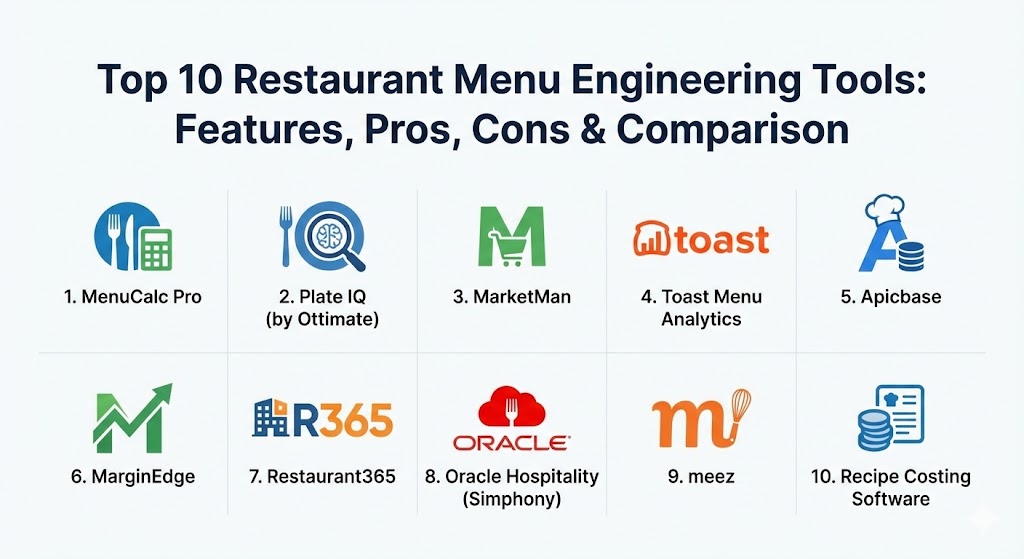
Top 10 Restaurant Menu Engineering Tools
1 — MenuCalc Pro
MenuCalc is a leading cloud-based platform specifically designed for nutritional analysis and menu engineering. It is widely used by chains to ensure FDA compliance while simultaneously optimizing recipe profitability.
- Key features:
- Automated nutritional labeling and allergen tracking.
- Real-time recipe costing linked to supplier pricing.
- Visual menu engineering matrix (Star/Plowhorse/Puzzle/Dog).
- Integrated “What-If” pricing analysis tool.
- Multi-location recipe standardization and version control.
- Database of over 300,000 industry-standard ingredients.
- Pros:
- Excellent for ensuring legal compliance with calorie count mandates.
- High accuracy in recipe cost calculations due to deep ingredient database.
- Cons:
- User interface can feel slightly academic/technical for some users.
- Primarily focused on the US market and FDA regulations.
- Security & compliance: SOC 2 compliant, GDPR compliant, and uses 256-bit SSL encryption for data protection.
- Support & community: Offers dedicated onboarding specialists, an extensive library of webinars, and 24/7 technical support.
2 — Plate IQ (by Ottimate)
Plate IQ, now under the Ottimate brand, revolutionizes menu engineering by focusing on the “input” side of the business. It uses AI to digitize every invoice, providing real-time price fluctuation alerts that impact menu margins.
- Key features:
- AI-powered invoice processing and automatic GL coding.
- Real-time ingredient price tracking across all vendors.
- Recipe costing that updates automatically as invoice prices change.
- High-level profitability dashboards with “margin at risk” alerts.
- Direct integrations with accounting and POS software.
- Vendor price comparison across different locations.
- Pros:
- Eliminates manual data entry, which is the biggest hurdle to menu engineering.
- Provides immediate visibility into “hidden” price hikes from suppliers.
- Cons:
- Can be expensive for single-unit independent restaurants.
- Setup requires a clean vendor list and initial mapping time.
- Security & compliance: SOC 2 Type II certified, SSO support, and robust audit trails for all financial data.
- Support & community: High-touch customer success teams and a comprehensive help center with video tutorials.
3 — MarketMan
MarketMan is an all-in-one back-of-house solution that bridges the gap between inventory management and menu engineering. It is designed for operators who want a holistic view of how waste impacts menu performance.
- Key features:
- Real-time inventory tracking and automated ordering.
- Theoretical vs. Actual (TvA) food cost analysis.
- Digital cookbook for consistent recipe execution.
- Menu profitability reporting based on actual sales and waste.
- Mobile app for inventory counts and invoice scanning.
- Automated “PAR” levels for optimized purchasing.
- Pros:
- Highly intuitive mobile interface makes it easy for kitchen staff to use.
- Strong emphasis on waste tracking, which is critical for true menu engineering.
- Cons:
- Recipe management can be time-consuming to set up initially.
- Occasional syncing lag with certain legacy POS systems.
- Security & compliance: ISO 27001 certified, GDPR compliant, and uses encrypted cloud storage.
- Support & community: Features a robust “MarketMan Academy” for user training and responsive live-chat support.
4 — Toast Menu Analytics
For restaurants already in the Toast ecosystem, their native Menu Analytics tool offers a “single pane of glass” view. It leverages the platform’s native sales data to provide instant performance metrics without the need for external integrations.
- Key features:
- Native integration with Toast POS sales and modifier data.
- Category-level performance tracking (Appetizers vs. Mains).
- Modifier analysis to see which “add-ons” drive the most profit.
- Real-time sales heatmaps and menu item rankings.
- Automatic classification of Star and Dog menu items.
- Seamless sync with Toast Inventory for recipe costing.
- Pros:
- Zero setup required if you are already using Toast POS.
- Real-time data updates mean you can see menu performance by the hour.
- Cons:
- Locked into the Toast hardware and software ecosystem.
- Lacks some of the deep vendor-integration features of standalone tools.
- Security & compliance: PCI DSS compliant, SOC 2, and advanced user permission controls.
- Support & community: Massive user community and 24/7 US-based phone support.
5 — Apicbase
Apicbase is a high-end F&B management platform favored by hotel chains and large restaurant groups. It excels in the “science” of food, offering unparalleled depth in recipe development and menu planning.
- Key features:
- Centralized recipe management with step-by-step visual guides.
- Advanced menu engineering matrix with historical trend lines.
- Multi-unit menu syncing and brand consistency tools.
- Automated allergen and nutritional value calculations.
- Production planning modules to reduce kitchen waste.
- Sales analytics that map popularity vs. margin over time.
- Pros:
- The most robust tool for complex, multi-location menu management.
- Beautifully designed interface that appeals to professional chefs.
- Cons:
- Premium pricing reflects its enterprise-grade feature set.
- Extensive feature list results in a longer onboarding process.
- Security & compliance: GDPR compliant, ISO 27001, and SSO integration for enterprise teams.
- Support & community: Provides a dedicated implementation manager and regular “Best Practice” workshops.
6 — MarginEdge
MarginEdge focuses on “connecting the dots” between the back office and the front of house. It is praised for its “operator-first” design, created by actual restaurant owners to solve daily profitability headaches.
- Key features:
- Daily P&L reporting including “real-time” food costs.
- Dynamic recipe costing that updates with every scanned invoice.
- POS-integrated sales reporting and menu performance analysis.
- “Price Movers” chart showing ingredient cost volatility.
- Commissary management for multi-unit prep kitchens.
- Theoretical vs. Actual usage tracking.
- Pros:
- The “Price Movers” feature is invaluable for proactive menu engineering.
- Very high accuracy in invoice digitizing (human-verified).
- Cons:
- Flat monthly fee may be higher than percentage-based competitors.
- Reporting can be “data-heavy,” requiring some time to digest.
- Security & compliance: Standard encryption protocols; SOC 1 & 2 compliant processing.
- Support & community: Known for world-class hospitality-focused support and local user meetups.
7 — Restaurant365
Restaurant365 is a comprehensive enterprise resource planning (ERP) platform. While it handles everything from accounting to labor, its menu engineering module is among the most powerful for large-scale operations.
- Key features:
- Fully integrated accounting, inventory, and scheduling.
- Granular menu item profitability based on “True Cost.”
- Multi-location consolidated reporting and benchmarking.
- Automated data flows from POS, vendors, and banks.
- Predictive forecasting for menu demand.
- Customizable dashboards for different roles (Owner, GM, Chef).
- Pros:
- Provides a “Total Business” view that no other standalone tool can match.
- Powerful for franchises needing to compare menu performance across units.
- Cons:
- High complexity; usually requires a dedicated administrator or accountant.
- Long implementation window (can take 3–6 months for full setup).
- Security & compliance: SOC 1 & SOC 2 Type II certified, GDPR compliant, and SSO ready.
- Support & community: Extensive online training university and professional consulting services.
8 — Oracle Hospitality (Simphony)
Oracle Simphony is the “gold standard” for global enterprise hospitality. Its menu engineering capabilities are designed for massive scale, such as stadiums, resorts, and international chains.
- Key features:
- Global menu management with regional pricing overrides.
- Real-time inventory and supply chain integration.
- AI-driven pricing recommendations based on guest demand.
- Multi-language and multi-currency support.
- Deep integration with loyalty and guest engagement data.
- Highly customizable reporting engine.
- Pros:
- Unmatched scalability for the world’s largest restaurant brands.
- Powerful AI features that predict how price changes will affect volume.
- Cons:
- The interface can feel cumbersome and dated compared to modern SaaS.
- Requires significant IT resources to deploy and maintain.
- Security & compliance: ISO 27001, PCI DSS, GDPR, and globally compliant data centers.
- Support & community: Global enterprise-level support with local offices in most countries.
9 — meez
Meez is a modern, chef-centric tool that focuses on the “craft” of recipe management. It has quickly become a favorite for its elegant design and focus on culinary education as a path to profitability.
- Key features:
- Collaborative recipe editor with version history.
- Scaling and yield conversion tools for prep teams.
- Visual menu engineering dashboards with item popularity rankings.
- Costing that accounts for “trim loss” and prep time.
- Digital training docs for kitchen staff.
- Integration with major POS systems for sales data.
- Pros:
- The most “chef-friendly” UI in the industry; very little training required.
- Excellent for managing the creative process of menu development.
- Cons:
- Less focus on inventory and vendor management than tools like MarketMan.
- Advanced analytics are reserved for higher-tier plans.
- Security & compliance: Standard SSL encryption; GDPR compliant data handling.
- Support & community: Very active community of professional chefs and high-quality “Meez Masterclasses.”
10 — Recipe Costing Software
This tool does exactly what it says on the tin. It is a streamlined, cost-effective solution for independent restaurants that need a dedicated tool for recipe management without the “bloat” of a full ERP.
- Key features:
- Easy-to-use recipe costing and menu analysis.
- Inventory tracking with low-stock alerts.
- Nutritional analysis and label generation.
- POS integration for sales-based profitability.
- Supplier price tracking and variance alerts.
- Production and prep sheet management.
- Pros:
- Highly affordable for single-unit operators.
- Focuses purely on the essentials of menu engineering.
- Cons:
- Lacks the deep automation (like AI invoice scanning) of premium tools.
- Support is primarily digital-only (email/tickets).
- Security & compliance: Varies; uses standard cloud security measures and encryption.
- Support & community: Good knowledge base and email-based customer support.
Comparison Table
| Tool Name | Best For | Platform(s) Supported | Standout Feature | Rating (Gartner / TrueReview) |
| MenuCalc Pro | Nutritional Compliance | Web-based | Deep Ingredient Database | 4.5 / 5 |
| Plate IQ | Automated Invoicing | Web, iOS, Android | AI Invoice Digitization | 4.6 / 5 |
| MarketMan | Inventory Management | Web, iOS, Android | Theoretical vs. Actual Tracking | 4.7 / 5 |
| Toast Analytics | Toast POS Users | Toast Native / Web | Real-time POS Integration | 4.8 / 5 |
| Apicbase | High-End Multi-Unit | Web, Tablet | Professional Chef Interface | 4.7 / 5 |
| MarginEdge | Independent Operators | Web, iOS, Android | “Price Movers” Chart | 4.6 / 5 |
| Restaurant365 | Enterprise Back-Office | Web-based | Full Accounting/ERP Integration | 4.4 / 5 |
| Oracle Simphony | Global Enterprises | On-Prem / Cloud | AI Demand Prediction | N/A |
| meez | Chef-Led Design | Web, iOS, Android | Collaborative Recipe Editor | 4.9 / 5 |
| Recipe Costing | Budget-Conscious SMBs | Web-based | Simplified Costing Focus | 4.3 / 5 |
Evaluation & Scoring of Restaurant Menu Engineering Tools
To help you decide, we have evaluated these tools across seven critical dimensions using a weighted scoring system based on the needs of a modern restaurant operator.
| Criteria | Weight | Description |
| Core Features | 25% | Recipe costing, Star/Dog categorization, and “What-if” analysis. |
| Ease of Use | 15% | Intuitive UI and minimal learning curve for busy kitchen staff. |
| Integrations | 15% | Compatibility with existing POS, Accounting, and Vendor platforms. |
| Security | 10% | Data encryption, user permissions, and regulatory compliance. |
| Performance | 10% | Speed of data processing and reliability of cloud sync. |
| Support | 10% | Availability of training, onboarding, and 24/7 technical help. |
| Price / Value | 15% | Overall return on investment (ROI) relative to subscription costs. |
Which Restaurant Menu Engineering Tool Is Right for You?
Solo Users vs SMB vs Mid-Market vs Enterprise
If you are a solo chef or a small cafe, look for tools like meez or Recipe Costing Software. They provide the essential math without overwhelming you with accounting features. Mid-market groups (5–20 units) thrive with MarginEdge or MarketMan, as these tools offer the perfect balance of inventory control and menu analysis. Large Enterprises and franchises require the robust consolidation offered by Restaurant365 or Oracle Hospitality.
Budget-Conscious vs Premium Solutions
Recipe Costing Software and Toast Menu Analytics (if you already have the POS) are the most budget-friendly. On the premium side, Apicbase and Plate IQ justify their costs through massive time savings in data entry and superior professional-grade features.
Feature Depth vs Ease of Use
If you want the deepest data possible, be prepared for a learning curve with Restaurant365. If you want a tool your Sous Chef can start using today with zero training, meez is the clear winner.
Integration and Scalability Needs
Never choose a tool that doesn’t talk to your POS. For Toast users, Toast Analytics is native; for others, MarketMan and MarginEdge offer the widest range of “hooks” into various third-party systems.
Security and Compliance Requirements
If you are a publicly-traded company or a large chain, SOC 2 compliance is non-negotiable. Look toward MenuCalc, Restaurant365, and Oracle for the highest levels of enterprise-grade security.
Frequently Asked Questions (FAQs)
1. What exactly is a “Dog” in menu engineering?
A “Dog” is a menu item with low popularity and low profitability. These are the prime candidates for removal from the menu or a complete recipe overhaul to either lower costs or increase appeal.
2. How often should I run a menu engineering analysis?
Ideally, once per quarter. However, in times of high inflation, you should use real-time tools to monitor “Price Movers” weekly so you can adjust daily specials to maintain margins.
3. Do I need to enter every single ingredient into the software?
Yes, for accuracy. However, modern tools like Plate IQ automate this by “reading” your invoices and creating the ingredient database for you.
4. Can menu engineering tools help with food waste?
Absolutely. Tools like MarketMan compare “Theoretical Usage” (what you should have used based on sales) vs. “Actual Usage” (what is actually gone from the shelf), highlighting waste and theft.
5. How much does menu engineering software typically cost?
Prices range from $50/month for basic recipe costing to over $500/month for enterprise-grade inventory and engineering platforms.
6. Will menu engineering make my menu look like a “corporate” chain?
Not at all. The analysis happens in the background. You can still maintain your brand’s unique aesthetic while using the data to decide which items to highlight or remove.
7. Can these tools handle seasonal menu changes?
Yes. Most allow you to create “Draft” menus or seasonal versions, allowing you to cost out your summer menu while your spring menu is still live.
8. What is “Theoretical Food Cost”?
It is the cost of your food if every portion was perfect, nothing was wasted, and nothing was stolen. It serves as the “perfect benchmark” to measure your real-world performance against.
9. Do I need to change my POS system to use these tools?
Not usually. Most top-tier tools integrate with major POS systems like Square, Clover, Micros, and NCR Aloha.
10. What is the “Golden Triangle” in menu design?
It’s a psychological theory that a customer’s eye first looks at the middle of a menu, then moves to the top right, and finally to the top left. High-profit “Stars” should be placed in these areas.
Conclusion
Menu engineering is no longer an optional “extra” for restaurants—it is a survival skill. In an industry where profit margins are famously thin (often between 3% and 5%), the ability to scientifically identify your most profitable items can double your take-home income.
The “best” tool is not the one with the most features, but the one that fits your specific operational workflow. Whether you choose the chef-centric elegance of meez, the automation-heavy Plate IQ, or the enterprise power of Restaurant365, the most important step is simply to start. By turning your menu from a list of food into a strategic financial asset, you ensure your restaurant is built to last.