Introduction
Restaurant Delivery Dispatch Tools are specialized software platforms designed to manage the logistics of food delivery. At their core, these solutions automate the assignment of orders to drivers, provide real-time GPS tracking, and optimize delivery routes to ensure maximum efficiency. In an industry where a five-minute delay can mean the difference between a satisfied customer and a one-star review, these tools are essential for maintaining operational control. They allow restaurants to move beyond manual dispatching—where a manager might shout orders to drivers—into an era of AI-driven orchestration that reduces fuel costs, minimizes idle time, and provides the “Amazon-like” tracking experience that customers now demand.
Key real-world use cases for these tools include managing an in-house fleet of drivers, “overflowing” orders to third-party couriers like DoorDash Drive during peak hours, and providing customers with branded tracking pages that increase brand loyalty. When evaluating these tools, users should look for seamless POS integration, the robustness of the driver mobile app, the accuracy of the route optimization algorithms, and the level of data privacy and security provided.
Best for: Multi-location restaurant chains, high-volume local eateries, “ghost” or “cloud” kitchens, and catering businesses that manage their own delivery staff or a hybrid fleet. It is particularly valuable for operations managers and logistics coordinators who need to monitor hundreds of moving parts from a single dashboard.
Not ideal for: Very small, single-location cafes with low delivery volume who rely exclusively on platforms like UberEats or Grubhub for both orders and couriers. In such cases, the native aggregator tablet is often sufficient, and a dedicated dispatch tool may introduce unnecessary complexity and cost.
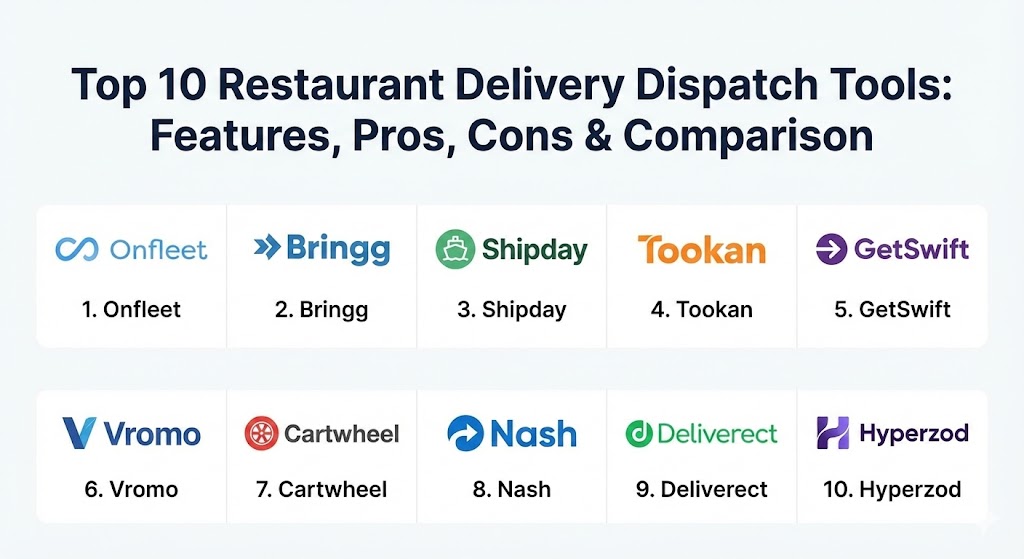
Top 10 Restaurant Delivery Dispatch Tools
1 — Onfleet
Onfleet is widely regarded as one of the most sophisticated delivery management platforms on the market. While it serves various industries, its specialized features for food and beverage make it a favorite for high-growth restaurant brands that prioritize data and analytics.
- Key features:
- Advanced AI-powered route optimization engine.
- Real-time driver tracking with predictive ETAs.
- Automated customer SMS notifications and tracking links.
- In-app driver chat and communication hub.
- Proof of delivery via photos, signatures, or barcodes.
- Comprehensive analytics dashboard for fleet performance.
- Pros:
- Extremely intuitive user interface for both dispatchers and drivers.
- Highly reliable performance even during peak high-volume periods.
- Cons:
- Pricing can be significantly higher than competitors for small fleets.
- The setup process for complex custom integrations may require technical expertise.
- Security & compliance: SOC 2 Type II compliant, end-to-end data encryption, and GDPR-ready data handling protocols.
- Support & community: Offers 24/7 technical support, a deep knowledge base, and an active developer community for API integrations.
2 — Bringg
Bringg is an enterprise-grade delivery orchestration platform that focuses on helping large restaurant chains scale their operations through complex multi-fleet management and automation.
- Key features:
- Multi-fleet orchestration (manage in-house and 3PD fleets simultaneously).
- Dynamic driver routing and load balancing.
- Automated “overflow” logic to send orders to external couriers.
- Customer-centric branded tracking and feedback loops.
- Advanced inventory and order status visibility.
- Enterprise-level reporting and business intelligence.
- Pros:
- Unmatched scalability for global restaurant chains.
- Superior flexibility in managing diverse delivery networks.
- Cons:
- The platform is highly complex and has a steep learning curve.
- Implementation times can be long, often requiring dedicated project managers.
- Security & compliance: ISO 27001 certified, SOC 2 compliant, and HIPAA-ready for specialized food/health deliveries.
- Support & community: Enterprise-tier support with dedicated account managers and global on-site training availability.
3 — Shipday
Shipday is a modern, user-friendly tool specifically designed for small and medium-sized restaurants that want to launch or optimize their delivery service with minimal overhead.
- Key features:
- Quick-start dashboard that can be set up in under 10 minutes.
- Real-time GPS tracking for customers and managers.
- Automated dispatching based on driver proximity.
- Native integration with popular POS systems like Toast and Square.
- Driver mobile app with built-in navigation.
- Basic route optimization for multi-order trips.
- Pros:
- One of the most affordable options for SMBs, including a free tier for beginners.
- Minimal training is required for staff to become proficient.
- Cons:
- Lacks the deep enterprise analytics found in Onfleet or Bringg.
- Limited customization options for the customer-facing tracking page.
- Security & compliance: Standard SSL encryption, GDPR compliance, and secure data storage on AWS.
- Support & community: Email and chat support with a library of video tutorials and FAQ documentation.
4 — Tookan
Tookan is a highly customizable delivery management solution that offers a wide array of “extensions,” making it a versatile choice for restaurants that have non-standard operational needs.
- Key features:
- Extensive library of add-ons (extensions) for various business logic.
- Geofencing and zone-based driver assignment.
- Automated task scheduling and recurring order management.
- White-labeling options for customer and driver apps.
- Integrated wallet system for driver earnings and payouts.
- Real-time field force tracking and analytics.
- Pros:
- Highly flexible; can be adapted to almost any delivery workflow.
- Strong global presence with multi-language support.
- Cons:
- The vast number of features can make the initial configuration overwhelming.
- Some essential features for restaurants are hidden behind paid add-ons.
- Security & compliance: HIPAA and GDPR compliant, with robust audit logs and SSO (Single Sign-On) capabilities.
- Support & community: 24/7 support availability via various channels and an extensive global partner network.
5 — GetSwift
GetSwift focuses on “smart dispatching,” using a proprietary algorithm to automate the decision-making process for dispatchers, which is critical for high-volume urban environments.
- Key features:
- Smart dispatch engine that selects the best driver for every job.
- Live GPS tracking with millisecond-level updates.
- Automated customer alerts and feedback collection.
- Enterprise-level scalability for multi-brand operations.
- Detailed driver performance and mileage tracking.
- API-first design for seamless custom integrations.
- Pros:
- Excellent at handling high concurrency and sudden spikes in order volume.
- Strong emphasis on reducing “where is my order” support calls.
- Cons:
- Occasional technical bugs reported by users regarding legacy integrations.
- The interface can feel dense and data-heavy for smaller operators.
- Security & compliance: SOC 2 compliant, AES-256 encryption, and strict data privacy standards.
- Support & community: Dedicated onboarding specialists and 24/7 technical assistance for enterprise clients.
6 — Vromo
Vromo is unique because it was built specifically for the restaurant industry. It focuses on the “hybrid” delivery model, allowing restaurants to switch seamlessly between their own drivers and marketplace couriers.
- Key features:
- “Smart Send” logic to choose between in-house or 3rd party drivers.
- Real-time order stacking to maximize driver efficiency.
- Branded driver and customer experiences.
- Direct integrations with Olo, Deliverect, and major POS systems.
- Driver chat and communication tools.
- Performance insights specifically tuned for food delivery metrics.
- Pros:
- Built for food; the terminology and workflows are restaurant-friendly.
- Seamlessly manages the “overflow” to third-party delivery services.
- Cons:
- More focused on the “front-end” of delivery than the deep logistics of large fleets.
- Integration ecosystem is more niche compared to broader tools like Tookan.
- Security & compliance: ISO 27001, GDPR, and secure API architecture.
- Support & community: Personalized onboarding and a responsive customer success team.
7 — Cartwheel
Cartwheel is a specialist in “Hybrid Delivery.” It is the preferred choice for major US brands that want to maintain their brand identity while leveraging external driver networks for scale.
- Key features:
- Sophisticated hybrid dispatching (in-house + DoorDash Drive/Uber Direct).
- Custom-branded customer tracking pages with promo banners.
- Google Reviews integration to boost restaurant ratings.
- Advanced driver app with turn-by-turn navigation.
- Driver management and shift scheduling tools.
- High-tier analytics for cost-per-delivery tracking.
- Pros:
- The marketing suite helps drive repeat orders via the tracking page.
- Exceptional customer support and consultative onboarding.
- Cons:
- Does not source drivers; you must already have a fleet or 3PD accounts.
- Pricing is geared toward mid-market and enterprise users.
- Security & compliance: SOC 2 Type I compliant, secure data isolation, and SSO support.
- Support & community: Highly rated support with quick response times and proactive account management.
8 — Nash
Nash is a “delivery orchestration” platform that connects restaurants to hundreds of local and national delivery providers through a single API or dashboard.
- Key features:
- Access to a massive network of external couriers through one integration.
- Automated carrier selection based on price, speed, or reliability.
- Unified tracking and support for all deliveries.
- White-label tracking pages for a consistent customer experience.
- Automated re-dispatching if a courier cancels.
- Flexible pricing models based on delivery volume.
- Pros:
- Best-in-class for restaurants that don’t want to manage their own fleet.
- Rapidly scales a delivery program to new cities with zero local hiring.
- Cons:
- Less control over the actual driver behavior compared to in-house fleets.
- API-heavy; may require developer resources for full integration.
- Security & compliance: SOC 2 compliant, GDPR ready, and secure credential vaulting.
- Support & community: Strong technical documentation and a responsive developer support team.
9 — Deliverect Dispatch
Deliverect is known for POS-aggregator syncing, but their Dispatch module specifically helps restaurants manage the transition from an online order to a delivery driver.
- Key features:
- Unified view of orders from all channels (UberEats, Deliveroo, Web).
- Seamless hand-off from kitchen to driver.
- Direct connection to in-house delivery apps or 3PDs.
- Real-time driver status updates within the POS.
- Automated printing of delivery-specific labels and receipts.
- Consolidated reporting on delivery times across all providers.
- Pros:
- Reduces “tablet hell” by consolidating everything into one screen.
- Excellent for multi-brand and dark kitchen operations.
- Cons:
- Best used as part of the wider Deliverect ecosystem; less effective standalone.
- Dispatch features are not as deep as specialized logistics tools like Onfleet.
- Security & compliance: ISO 27001, GDPR, and secure data multi-tenancy.
- Support & community: 24/7 global support and an extensive library of POS integration guides.
10 — Hyperzod
Hyperzod is an AI-first, white-label delivery operating system that empowers entrepreneurs and restaurant groups to own their entire delivery infrastructure.
- Key features:
- White-label apps for customers, drivers, and restaurant admins.
- “Autozod” intelligent dispatch engine.
- Hyperlocal geofencing and zone management.
- Support for multi-vendor marketplaces and single restaurants.
- Advanced analytics and heat maps for demand prediction.
- Integrated marketing and loyalty tools.
- Pros:
- Provides total brand ownership and control of customer data.
- Built for scale and long-term business growth.
- Cons:
- The comprehensive nature of the platform results in a longer setup time.
- May be too feature-rich for simple, one-off delivery needs.
- Security & compliance: Cloud-native security architecture, GDPR, and secure payment integrations.
- Support & community: Dedicated support specialists and a comprehensive onboarding program for startups.
Comparison Table
| Tool Name | Best For | Platform(s) Supported | Standout Feature | Rating (Gartner / TrueReview) |
| Onfleet | Logistics Optimization | Web, iOS, Android | Predictive ETAs | 4.7 / 5 |
| Bringg | Global Enterprise | Cloud, Mobile | Multi-Fleet Orchestration | 4.5 / 5 |
| Shipday | Small Restaurants | Web, Mobile | 10-Minute Setup | 4.8 / 5 |
| Tookan | Custom Workflows | Web, iOS, Android | Extensions Marketplace | 4.4 / 5 |
| GetSwift | High-Volume Dispatch | Cloud, Mobile | Smart Dispatch Engine | 4.3 / 5 |
| Vromo | Food-Specific Hybrid | Web, Mobile | “Smart Send” Logic | 4.6 / 5 |
| Cartwheel | Brand/Marketing Suite | Web, iOS, Android | Google Reviews Sync | 4.9 / 5 |
| Nash | 3rd Party Orchestration | API, Web | Multi-Carrier Access | 4.7 / 5 |
| Deliverect | POS Integration | Cloud, Tablet | Aggregator Syncing | 4.5 / 5 |
| Hyperzod | Brand Owners / Startups | White-label SaaS | Autozod AI Engine | 4.8 / 5 |
Evaluation & Scoring of Restaurant Delivery Dispatch Tools
The following rubric provides a weighted scoring system to help you evaluate these tools based on their impact on a typical restaurant operation.
| Criteria | Weight | Evaluation Notes |
| Core Features | 25% | Includes route optimization, auto-dispatch, and driver apps. |
| Ease of Use | 15% | Measured by staff training time and UI clarity. |
| Integrations | 15% | Connectivity with Toast, Square, Olo, and 3rd party couriers. |
| Security & Compliance | 10% | Data encryption, GDPR, and SOC 2 certifications. |
| Performance | 10% | Uptime reliability and accuracy of GPS/ETA tracking. |
| Support | 10% | Quality of documentation and response speed of technical teams. |
| Price / Value | 15% | The ROI generated through fuel savings and repeat business. |
Which Restaurant Delivery Dispatch Tool Is Right for You?
Selecting a dispatch tool is not a “one size fits all” decision. The right choice depends on your current fleet size, technical resources, and growth plans.
Solo Users vs SMB vs Mid-Market vs Enterprise
- SMBs: If you have 1–5 drivers, look at Shipday. It is low-cost and extremely easy to use.
- Mid-Market: If you have a growing fleet and want to boost your brand, Cartwheel or Vromo are excellent for their “hybrid” capabilities and marketing focus.
- Enterprise: For massive chains, Bringg or Onfleet are the standard for their deep analytics and high scalability.
Budget-Conscious vs Premium Solutions
- Budget: Shipday and Tookan offer very competitive entry-level pricing.
- Premium: Onfleet and Bringg are premium products, but the efficiency gains (20–40% better routing) often pay for the software many times over.
Feature Depth vs Ease of Use
- If you want deep customization, Tookan is the winner.
- If you want “it just works” simplicity, Shipday or Deliverect are better choices.
Integration and Scalability Needs
- If your priority is POS syncing, Deliverect is mandatory.
- If you want to scale without hiring drivers, Nash is the ultimate shortcut.
Frequently Asked Questions (FAQs)
1. What exactly is “Auto-Dispatch” in these tools?
Auto-dispatch uses algorithms to automatically assign an order to the “best” available driver based on proximity, current load, and delivery route, removing the need for a manual dispatcher.
2. Can these tools work if I don’t have my own drivers?
Yes. Tools like Nash and Cartwheel allow you to connect directly to third-party fleets like DoorDash Drive or Uber Direct to fulfill orders on-demand.
3. Do these tools integrate with my POS (Point of Sale)?
Most do. Leading tools have “native” integrations with Toast, Square, and Revel. For others, platforms like Deliverect act as a bridge to connect the dispatch tool to the POS.
4. How does route optimization save money?
It sequences multiple deliveries in the most efficient order, reducing total miles driven, lowering fuel costs, and allowing each driver to complete more deliveries per hour.
5. Is my customer data safe with these tools?
Top-tier tools are SOC 2 compliant and use encryption. Choosing a tool with strong security ensures that sensitive customer contact and address data is not leaked.
6. Do drivers need special equipment?
No. Almost all dispatch tools provide a mobile app that drivers can install on their own iOS or Android smartphones to receive orders and navigate.
7. Can I white-label the tracking experience?
Yes. Tools like Hyperzod and Cartwheel allow you to put your own logo, colors, and marketing banners on the tracking link sent to customers.
8. What happens if a driver loses internet connection?
Most driver apps have an “offline mode” that queues updates and pushes them to the server once the connection is restored, ensuring data integrity.
9. Are there hidden fees?
Some tools charge per delivery, while others have a flat monthly fee. Always check for “add-on” costs like SMS notification fees or premium integration fees.
10. How long does it take to implement these systems?
It ranges from 10 minutes for simple tools like Shipday to several months for complex enterprise deployments like Bringg.
Conclusion
In 2026, delivery is no longer an optional “extra” for restaurants—it is a core component of the business model. Choosing the right dispatch tool is about finding the balance between logistical efficiency and the customer experience. While Onfleet leads in analytics and Shipday leads in SMB accessibility, the “best” tool for your restaurant will be the one that integrates most smoothly with your existing kitchen workflow. Prioritize visibility, reliability, and ease of use to ensure your delivery operation becomes a driver of profit rather than a source of stress.