Introduction
RegTech Monitoring Tools are specialized software solutions designed to automate the tracking and management of regulatory requirements. These tools provide continuous oversight of transactions, communications, client identities, and changing laws. By replacing periodic audits with “always-on” monitoring, these platforms help firms detect anomalies—such as money laundering patterns or market abuse—as they happen. In 2026, the convergence of generative AI and predictive analytics has allowed these tools to not only flag past violations but also predict potential compliance breaches before they occur.
The importance of these tools lies in their ability to handle massive volumes of data with surgical precision. Key real-world use cases include real-time transaction monitoring for neobanks, automated KYC (Know Your Customer) screening for crypto exchanges, and regulatory change tracking for multinational corporations. When choosing a tool, users should prioritize automation depth, false positive reduction rates, multi-jurisdictional coverage, and integration agility.
Best for: Large banks, fintech startups, insurance companies, and crypto-asset service providers (CASPs). It is particularly vital for Compliance Officers, Risk Managers, and MLROs (Money Laundering Reporting Officers) who need to manage high-stakes risk at scale.
Not ideal for: Small local businesses with low-risk profiles or very low transaction volumes. For such entities, basic manual checks or standard accounting software may still be more cost-effective than an enterprise-grade RegTech suite.
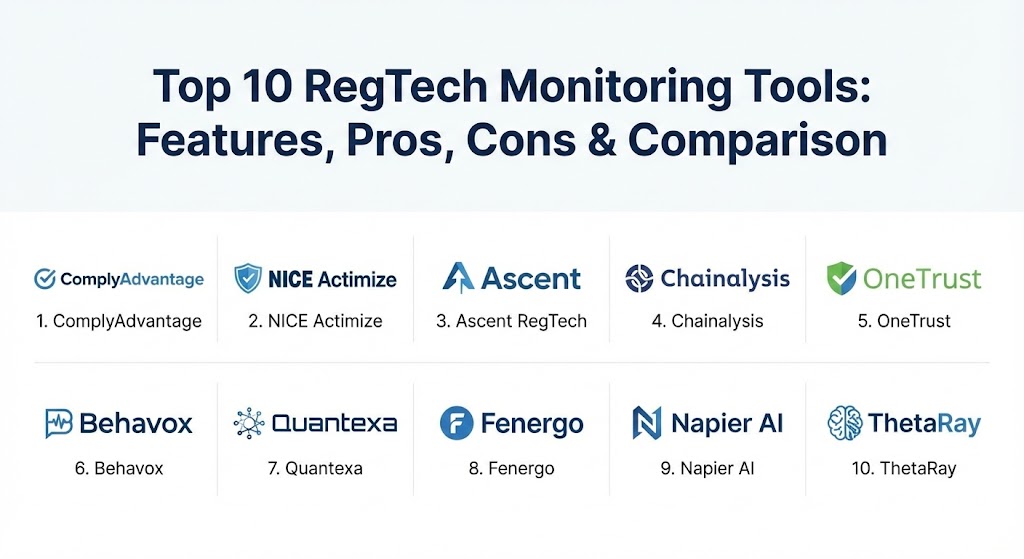
Top 10 RegTech Monitoring Tools
1 — ComplyAdvantage
ComplyAdvantage is a leader in AI-driven financial crime detection. It provides real-time risk intelligence, helping firms identify and monitor money laundering and terrorism financing risks across their customer base.
- Key features:
- Real-time AML (Anti-Money Laundering) transaction monitoring.
- Dynamic risk scoring based on real-time global data updates.
- AI-powered sanctions, PEP (Politically Exposed Persons), and adverse media screening.
- Automated case management with intelligent alert prioritization.
- API-first architecture for seamless integration into fintech apps.
- Knowledge graph visualization for entity relationship mapping.
- Pros:
- Significantly lower false-positive rates compared to legacy screening systems.
- Extremely fast deployment and easy-to-use API for developers.
- Cons:
- The depth of news data can sometimes lead to noise if not carefully tuned.
- Can be expensive for very early-stage startups as they scale.
- Security & compliance: SOC 2 Type II, GDPR, and ISO 27001 compliant. End-to-end data encryption and SSO support.
- Support & community: High-quality technical documentation, 24/7 global support, and an active community of compliance professionals.
2 — NICE Actimize
NICE Actimize is the industry titan for enterprise-scale financial crime, risk, and compliance. It is the go-to solution for the world’s largest Tier 1 banks that require heavy-duty surveillance and trade monitoring.
- Key features:
- Enterprise-wide transaction monitoring with advanced typologies.
- Integrated fraud management and trade surveillance.
- Behavioral analytics to detect sophisticated insider trading and market abuse.
- Unified case management for complex, cross-border investigations.
- Automated regulatory reporting (SAR/STR) workflows.
- Marketplace for pre-built compliance and risk models.
- Pros:
- Unparalleled scalability for institutions processing millions of transactions daily.
- Deeply mature analytics engine with a decades-long track record.
- Cons:
- Long implementation cycles that can take months to fully calibrate.
- The user interface can feel complex and “legacy” compared to modern SaaS startups.
- Security & compliance: FIPS-compliant, SOC 2, ISO 27001, and rigorous global regulatory alignment (FINRA, MiFID II).
- Support & community: Enterprise-grade support with dedicated account managers and a massive global network of certified partners.
3 — Ascent RegTech
Ascent specializes in regulatory change management. It uses AI to ingest thousands of pages of regulatory text and distill them into specific, actionable obligations for a firm.
- Key features:
- Automated regulatory change tracking across 100+ jurisdictions.
- “Obligation Mapping” that links specific laws to internal controls.
- Policy and procedure monitoring to ensure alignment with new rules.
- Impact assessment workflows for new or modified regulations.
- Generative AI for summarizing complex legal documents.
- Centralized compliance dashboard for executive oversight.
- Pros:
- Reduces the need for manual legal research by up to 90%.
- High precision in pinpointing “what matters” specifically for your firm type.
- Cons:
- Highly specialized for regulatory text; not a transaction monitoring tool.
- Requires a baseline understanding of legal frameworks to set up correctly.
- Security & compliance: GDPR, HIPAA (for relevant modules), and SOC 2. Advanced audit logs for all data changes.
- Support & community: Robust knowledge base, on-demand training webinars, and professional consulting services.
4 — Chainalysis
Chainalysis is the undisputed leader in blockchain monitoring. It helps banks, government agencies, and crypto exchanges track the flow of funds across decentralized networks to stop illicit activity.
- Key features:
- KYT (Know Your Transaction) real-time crypto transaction monitoring.
- Reactor tool for deep visual investigation of blockchain paths.
- Continuous risk scoring of crypto addresses and entities.
- Sanctions screening for wallets associated with high-risk regimes.
- Automated alert system for suspicious on-chain behavior.
- Market intelligence data on global crypto adoption and trends.
- Pros:
- The most comprehensive data set of labeled crypto addresses in the world.
- Critical for any firm looking to engage with digital assets or DeFi.
- Cons:
- Purely focused on crypto; lacks coverage for traditional fiat monitoring.
- Pricing can be very high for small crypto-native businesses.
- Security & compliance: SOC 2, GDPR, and ISO 27001. Trusted by government agencies like the FBI and IRS.
- Support & community: Extensive certification programs (Chainalysis University) and dedicated investigation support teams.
5 — OneTrust
OneTrust is a massive platform for GRC (Governance, Risk, and Compliance) and privacy management. In 2026, it has become the standard for firms managing global data privacy monitoring.
- Key features:
- Automated privacy impact assessments (PIA/DPIA).
- Continuous monitoring of data privacy compliance (GDPR, CCPA).
- Third-party and vendor risk management monitoring.
- Integrated ESG (Environmental, Social, and Governance) tracking.
- Consent and preference management monitoring.
- Incident and breach response automation.
- Pros:
- Extremely broad platform that can handle almost any GRC requirement.
- Highly scalable for multi-national corporations with varying regional laws.
- Cons:
- The modular nature can lead to “platform bloat” if not managed strictly.
- Steep learning curve due to the sheer number of features.
- Security & compliance: SOC 2 Type II, ISO 27001, GDPR, and CCPA. Extensive encryption and role-based access controls.
- Support & community: Large user community, global partner ecosystem, and highly responsive customer success teams.
6 — Behavox
Behavox is a specialized monitoring tool that focuses on conduct risk and internal communications. It uses AI to analyze voice, chat, and email to detect market abuse or employee misconduct.
- Key features:
- Multi-channel communication monitoring (Zoom, Slack, WhatsApp, Email).
- Sentiment and contextual analysis to detect “hidden” intent.
- Market abuse detection (insider trading, collusion, front-running).
- Behavioral profiling to identify high-risk employees.
- Automated alert triage with “human-in-the-loop” verification.
- Data lake integration for long-term audit storage.
- Pros:
- Advanced NLP (Natural Language Processing) that understands nuanced financial slang.
- Strong at identifying risks that occur in “silos” across different platforms.
- Cons:
- Can raise privacy concerns among staff if not implemented with clear policies.
- Focused strictly on conduct; does not monitor external transaction flows.
- Security & compliance: SOC 2, GDPR, and FINRA/SEC alignment. Deployed on secure private clouds or on-premise.
- Support & community: White-glove implementation support and a dedicated research team for emerging conduct risks.
7 — Quantexa
Quantexa uses Decision Intelligence to provide a contextual view of risk. By connecting disparate data points into a network graph, it uncovers hidden relationships that traditional tools miss.
- Key features:
- Contextual entity resolution to unify messy data from multiple sources.
- Graph-based network analysis for detecting organized crime rings.
- Real-time transaction monitoring with contextual risk signals.
- Automated KYC/CDD (Customer Due Diligence) remediation.
- Dynamic scoring that considers the “who you know” factor of risk.
- High-performance big data processing for billions of records.
- Pros:
- Unrivaled at detecting sophisticated money laundering through shell companies.
- Significantly reduces false alerts by providing the “full picture” of a customer.
- Cons:
- Requires high-quality underlying data to be truly effective.
- Highly complex; usually requires a team of data scientists to maintain.
- Security & compliance: ISO 27001, SOC 2, and GDPR compliant. Robust data lineage and auditability.
- Support & community: Strong professional services arm and a focused community for data-driven compliance.
8 — Fenergo
Fenergo focuses on Client Lifecycle Management (CLM). It monitors the compliance status of corporate clients from onboarding through the entire relationship.
- Key features:
- End-to-end KYC and KYB (Know Your Business) monitoring.
- Regulatory rules engine covering over 100 jurisdictions.
- Automated perpetual KYC (pKYC) for continuous due diligence.
- Centralized client data repository for a “Single View of the Client.”
- UBO (Ultimate Beneficial Owner) monitoring and mapping.
- Integrated document management and verification.
- Pros:
- Excellent for institutional banking where client structures are highly complex.
- Automates the “re-papering” process when regulations change.
- Cons:
- Heavy focus on onboarding and client data; less on real-time transaction flows.
- Can be a significant upfront investment for mid-sized firms.
- Security & compliance: SOC 2, ISO 27001, and GDPR. Built for highly regulated banking environments.
- Support & community: Dedicated client success managers and an active global user group for regulatory exchange.
9 — Napier AI
Napier AI is a modern, cloud-native monitoring suite known for its agility and “Sandbox” feature that allows compliance teams to test new rules without risking production systems.
- Key features:
- Intelligent transaction monitoring with a user-friendly rule builder.
- Sandbox environment for rule optimization and back-testing.
- Real-time client screening and perpetual risk monitoring.
- AI Advisor tool for generating natural language case narratives.
- Scalable microservices architecture for fast deployment.
- Integrated case management and audit trails.
- Pros:
- The “Sandbox” is a game-changer for reducing false positives safely.
- Extremely modern UI that reduces the training burden on compliance analysts.
- Cons:
- Relatively newer company compared to giants like Actimize or SAS.
- May have fewer pre-built connectors for legacy on-premise banking cores.
- Security & compliance: SOC 2 Type II and GDPR compliant. High-level AES-256 encryption.
- Support & community: Agile support team, extensive video tutorials, and a modern help portal.
10 — ThetaRay
ThetaRay specializes in AI-driven monitoring for cross-border and correspondent banking. It uses unsupervised machine learning to detect “unknown-unknowns” in complex payment corridors.
- Key features:
- AI-driven detection for cross-border payments and high-risk corridors.
- Anomaly detection that identifies emerging threats without predefined rules.
- Intuitive “Trust Score” for transactions to speed up clearing.
- Unified dashboard for global payment flows and investigations.
- SaaS deployment for rapid scaling across global branches.
- Automated alert narratives for easier regulatory filing.
- Pros:
- Superior at detecting new, unseen fraud patterns that rule-based tools miss.
- Critical for banks managing complex international correspondent networks.
- Cons:
- Unsupervised AI can sometimes be a “black box” that requires explanation to regulators.
- Primary focus is transaction flows; lacks a deep client onboarding (KYC) module.
- Security & compliance: SOC 2, GDPR, and ISO 27001. Highly focused on AML/CFT global standards.
- Support & community: High-touch implementation and a dedicated team of financial crime experts.
Comparison Table
| Tool Name | Best For | Platform(s) Supported | Standout Feature | Rating (G2 / Gartner) |
| ComplyAdvantage | Fintechs & Digital Banks | Cloud, API | Real-time Risk Intel | 4.7 / 5 |
| NICE Actimize | Tier 1 Global Banks | Cloud, On-Premise | Enterprise Surveillance | 4.4 / 5 |
| Ascent RegTech | Reg Change Management | Cloud | Obligation Mapping | 4.5 / 5 |
| Chainalysis | Crypto & Blockchain | Cloud | Blockchain Reactor | 4.8 / 5 |
| OneTrust | Data Privacy & GRC | Cloud | Global Privacy Suite | 4.6 / 5 |
| Behavox | Internal Conduct Risk | Cloud, Private Cloud | Comm. NLP Analysis | 4.5 / 5 |
| Quantexa | Network / Shell Cos. | Cloud, On-Premise | Network Graph Analytics | 4.4 / 5 |
| Fenergo | Client Lifecycle / KYC | Cloud | Perpetual KYC (pKYC) | 4.3 / 5 |
| Napier AI | Agile Rule Testing | Cloud, Hybrid | Rule Testing Sandbox | 4.6 / 5 |
| ThetaRay | Cross-border Payments | Cloud (SaaS) | Unsupervised Anomaly Detection | 4.5 / 5 |
Evaluation & Scoring of RegTech Monitoring Tools
To help organizations weigh their options, we have evaluated the general performance of high-tier RegTech monitoring solutions using the following weighted rubric:
| Criteria | Weight | Evaluation Notes |
| Core Features | 25% | Transaction monitoring, screening, and reporting depth. |
| Ease of Use | 15% | Dashboard intuitiveness and rule-building complexity. |
| Integrations | 15% | API availability and legacy system compatibility. |
| Security & Compliance | 10% | Encryption standards and regulatory certifications. |
| Performance | 10% | Scalability and false-positive reduction efficacy. |
| Support & Community | 10% | Technical documentation and response times. |
| Price / Value | 15% | Total cost of ownership vs. risk reduction ROI. |
Total Score Calculation:
$$Score = (F \times 0.25) + (U \times 0.15) + (I \times 0.15) + (S \times 0.10) + (P \times 0.10) + (C \times 0.10) + (V \times 0.15)$$
Which RegTech Monitoring Tool Is Right for You?
Selecting a RegTech monitoring tool is not a “one size fits all” process. It requires matching the tool’s specific superpower to your organization’s specific risk profile.
- Solo Users vs SMB vs Mid-Market vs Enterprise:
- SMBs/Fintechs: Start with ComplyAdvantage or Napier AI. They offer the easiest onboarding and “pay-as-you-grow” models.
- Mid-Market: Fenergo or Ascent are ideal for firms that have grown beyond basic checks and need better lifecycle management or regulatory change tracking.
- Enterprise: Only the heavyweights like NICE Actimize or Quantexa can handle the data volumes of global banking giants.
- Budget-conscious vs Premium Solutions:
- Budget: Look for API-first, SaaS-only tools with transparent pricing like Napier AI.
- Premium: Behavox and Quantexa are high-investment tools, but the cost is justified by the massive fines they prevent for large-scale trading firms.
- Feature Depth vs Ease of Use:
- If you need a tool your analysts can learn in a day, Lucinity (noted for UX) or ComplyAdvantage are winners.
- If you need deep, complex “detect anything” power, be prepared for the steeper learning curve of SAS Anti-Money Laundering or NICE Actimize.
- Integration and Scalability Needs:
- Cloud-native startups should prioritize API-first tools.
- Firms with massive on-premise infrastructure must ensure their chosen tool (like Actimize) supports hybrid deployments.
- Security and Compliance Requirements:
- Always ensure the vendor is SOC 2 Type II certified.
- If you operate in the EU, prioritize vendors with strong GDPR local data residency options like Nexi or Nexthink.
Frequently Asked Questions (FAQs)
1. What is the difference between RegTech and traditional compliance software?
Traditional software is often a static checklist or database used for manual reporting. RegTech monitoring is dynamic, using real-time automation and AI to continuously track data and regulations.
2. How do these tools reduce false positives?
Modern RegTech uses machine learning to “learn” what normal behavior looks like. Instead of flagging every $\$10,000$ transaction, it looks at the customer’s history and the context of the network to only flag true anomalies.
3. Is cloud-based RegTech safe for banking data?
Yes. In 2026, cloud-based RegTech is often safer than on-premise due to massive investments in cybersecurity, SOC 2 compliance, and military-grade encryption by providers.
4. How long does implementation typically take?
Agile SaaS tools can be integrated via API in a few weeks. Large-scale enterprise suites often require 6 to 12 months for full calibration and integration with legacy cores.
5. Can one tool handle all types of regulatory monitoring?
Usually no. Most firms use a “stack.” For example, you might use ComplyAdvantage for AML, Ascent for regulatory change, and OneTrust for data privacy.
6. Do I need a data scientist to run these tools?
Not necessarily. Many tools (like Napier AI) are “no-code” and designed for compliance officers. However, complex tools like Quantexa do require data engineering resources to maximize value.
7. How do RegTech tools help with cryptocurrency regulations?
Tools like Chainalysis provide the ability to “follow the money” on-chain, mapping anonymous wallets to real-world entities to ensure compliance with the “Travel Rule” and sanctions.
8. Are RegTech monitoring tools a replacement for compliance staff?
No. They are an “augmented intelligence” tool. They automate the boring work of data collection and sorting, allowing your human experts to focus on complex investigation and strategic risk choices.
9. What is the most common mistake when buying RegTech?
“Bloat.” Many firms buy massive suites and only use 10% of the features. It is better to start with a specific problem (like transaction monitoring) and scale out modularly.
10. Do regulators actually like these tools?
Yes. Many regulators (like the FCA and SEC) now encourage the use of RegTech as it provides them with more accurate, transparent, and timely data during audits.
Conclusion
RegTech monitoring is no longer a luxury for the technologically advanced; it is the fundamental infrastructure for any firm looking to survive in the digital era. As we have seen, the “best” tool depends entirely on your context. Whether it is the real-time agility of ComplyAdvantage, the blockchain expertise of Chainalysis, or the enterprise-wide surveillance of NICE Actimize, these platforms provide the security and speed needed to turn compliance from a cost center into a competitive advantage. In 2026, the most successful firms will be those that integrate monitoring directly into their business DNA, ensuring that every growth step is as compliant as it is innovative.