Introduction
A Recommendation Engine is a data-filtering system that uses machine learning and algorithms to suggest items or content to specific users. By analyzing historical behavior—such as past purchases, search queries, clicks, and even time spent on a page—these tools build a profile of user preferences. They then compare this data against broader trends (collaborative filtering) or the specific attributes of items (content-based filtering) to deliver hyper-relevant suggestions.
The importance of these tools cannot be overstated. For businesses, they represent a significant lever for increasing Average Order Value (AOV), boosting Customer Lifetime Value (CLV), and reducing bounce rates. Key real-world use cases include product cross-selling in retail, content discovery in media and publishing, personalized banking offers, and dynamic travel itineraries. When choosing a tool, users should evaluate the latency (speed of delivery), accuracy of the ML models, scalability to handle traffic spikes, and the ease of integration with their existing tech stack.
Best for: Large-scale e-commerce retailers, media and streaming giants, SaaS platforms, and high-traffic news publishers. It is ideal for Data Scientists, Product Managers, and Growth Marketers at mid-to-large enterprises who need to automate personalization at scale.
Not ideal for: Small businesses with a very limited catalog (e.g., selling only 5 products) or local service providers where personalized discovery is not a factor in the buying journey. For these users, manual “Featured Products” sections are often sufficient.
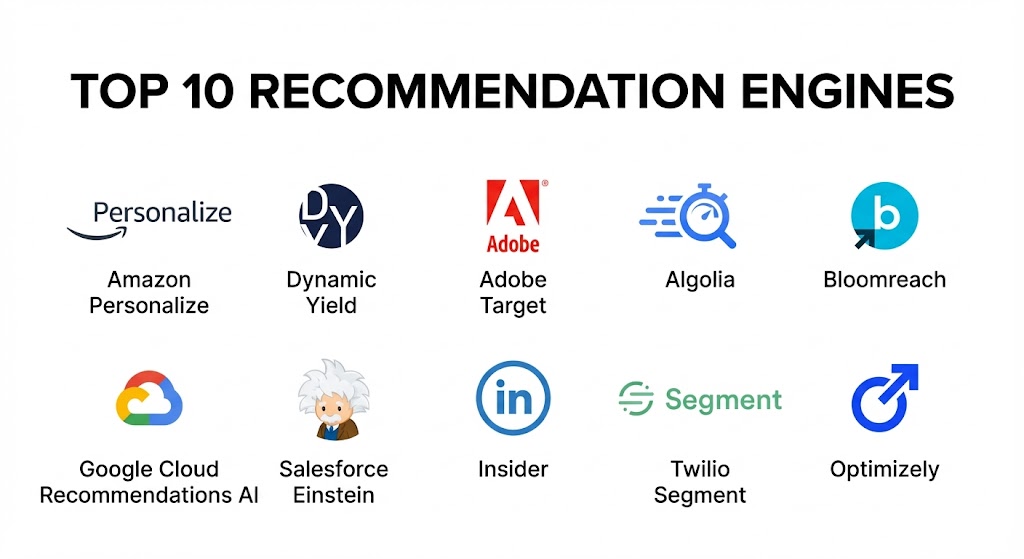
Top 10 Recommendation Engines Tools
1 — Amazon Personalize
Amazon Personalize allows developers to build applications with the same machine learning technology used by Amazon.com for real-time personalized recommendations. It is part of the AWS ecosystem and is designed to handle massive datasets without requiring users to have deep ML expertise.
- Key features:
- Pre-built Recipes: Specific ML models for “User Personalization,” “Similar Items,” and “Personalized Ranking.”
- Real-time API: Updates recommendations instantly as user behavior changes during a session.
- Batch Processing: Ability to generate millions of recommendations at once for email campaigns.
- Automated ML Pipeline: Handles the heavy lifting of data processing, feature selection, and model training.
- Cold Start Support: Specialized algorithms to recommend new items with no prior interaction history.
- Event Tracking: Simple SDKs to feed real-time clickstream data back into the engine.
- Pros:
- Leverages decades of Amazon’s internal research and expertise in retail behavior.
- Extremely scalable; it grows effortlessly with your traffic.
- Cons:
- Pricing can be complex and difficult to predict for high-volume users.
- Deeply tied to the AWS ecosystem, which may not suit companies on Azure or GCP.
- Security & compliance: KMS encryption, IAM roles, SOC 1/2/3, GDPR, HIPAA, and ISO 27001 compliant.
- Support & community: Extensive AWS documentation, global partner network, and 24/7 enterprise support for paid AWS tiers.
2 — Dynamic Yield (by Mastercard)
Dynamic Yield is an “Experience Optimization” platform that provides a unified data layer to deliver personalized, optimized, and synchronized experiences across web, apps, and email. It is highly favored by retailers for its agility and visual interface.
- Key features:
- Omnichannel Logic: Syncs recommendations across web, mobile apps, and kiosks.
- Deep Learning Models: Uses advanced neural networks to predict next-best-actions.
- A/B Testing for Recommendations: Test different recommendation strategies against each other.
- Affinity Profiles: Build deep profiles based on user brand, color, and price preferences.
- Contextual Triggers: Adjust recommendations based on local weather, location, or referral source.
- Social Proof: Dynamically add labels like “Top Seller” or “Trending” to recommended items.
- Pros:
- Exceptionally user-friendly for marketing teams who are not data scientists.
- Very fast implementation and time-to-value compared to building in-house.
- Cons:
- Premium pricing reflects its status as an enterprise-grade solution.
- Can be “over-featured” for teams that only need basic product suggestions.
- Security & compliance: ISO 27001, SOC 2 Type II, and GDPR compliant.
- Support & community: Dedicated success managers, high-quality onboarding, and a robust “Knowledge Hub.”
3 — Adobe Target
Adobe Target is the experimentation and personalization arm of the Adobe Experience Cloud. It uses “Adobe Sensei” (their AI engine) to automate recommendations across massive enterprise digital footprints.
- Key features:
- Automated Personalization: Scales 1:1 experiences using a random forest algorithm.
- Visual Experience Composer: Drag-and-drop interface for marketers to place recommendation blocks.
- Shared Audiences: Seamlessly use segments created in Adobe Analytics or Audience Manager.
- Category-based Filtering: Ensure recommendations stay within specific business constraints.
- Server-side & Client-side: Flexible implementation options for performance-minded teams.
- Multi-variate Testing: Test how different recommendation layouts affect overall conversion.
- Pros:
- Unmatched integration for organizations already using the Adobe stack.
- High enterprise reliability and sophisticated user permissions for global teams.
- Cons:
- Extremely steep learning curve and high cost of entry.
- Implementation often requires specialized Adobe consultants.
- Security & compliance: FedRAMP, HIPAA, SOC 2, and GDPR compliant.
- Support & community: Global enterprise support, extensive “Adobe Experience League” documentation, and a massive user community.
4 — Algolia (Personalization & Recommend)
Algolia, once just a search engine, has evolved into a “Discovery” platform. Its recommendation product is unique because it integrates search intent with behavioral discovery to provide highly accurate results.
- Key features:
- NeuralSearch: Combines keyword matching with vector-based semantic understanding.
- Frequently Bought Together: Logic specifically designed for e-commerce “Add to Cart” optimization.
- Related Products: Connects similar items based on content attributes and user clicks.
- API-first Architecture: Built for developers to integrate into custom frontend frameworks (React, Vue, etc.).
- A/B Testing for Search & Recommend: See exactly how new algorithms affect click-through rates.
- Visual Merchandising: Manually “boost” or “bury” specific items within recommendation results.
- Pros:
- Sub-millisecond latency; it is arguably the fastest engine on this list.
- Best-in-class for teams who want to unify their search and recommendation strategies.
- Cons:
- Requires developer resources to set up; it’s not a “plug-and-play” marketing tool.
- Pricing is based on “records” and “searches,” which can scale quickly for large catalogs.
- Security & compliance: ISO 27001, SOC 3, HIPAA, and GDPR compliant.
- Support & community: Active Discord community, extensive developer documentation, and 24/7 support for enterprise.
5 — Bloomreach
Bloomreach is a “Commerce Experience Cloud” that combines a headless CMS, a discovery engine, and marketing automation. Its recommendations are deeply rooted in e-commerce specific AI called “Loomi.”
- Key features:
- Loomi AI: A specialized e-commerce AI that understands product data and user intent.
- Semantic Search & Recommend: Understands the “why” behind a query to deliver relevant items.
- Real-time CDP: Connects behavioral data from web, app, and email.
- Pathways: Automated logic to guide users through the buying journey.
- Visual Merchandising: Powerful controls for e-commerce teams to manage ranking logic.
- Segment-specific Rules: Show different recommendations to “First-time visitors” vs. “VIPs.”
- Pros:
- Deeply specialized for the retail and B2B commerce sectors.
- The headless-first approach is perfect for modern, fast-loading web architectures.
- Cons:
- Can be complex to set up if your data structure is not well-organized.
- Targeted primarily at high-end enterprise clients.
- Security & compliance: ISO 27001, SOC 2, and GDPR compliant.
- Support & community: Professional onboarding, dedicated account managers, and “Bloomreach Academy” for training.
6 — Google Cloud Recommendations AI
Google Cloud Recommendations AI allows businesses to deliver highly personalized suggestions by leveraging Google’s internal advances in machine learning and data processing.
- Key features:
- One-click Integration: Easy connection with BigQuery and Google Analytics 4 data.
- Omnichannel Support: Consistent recommendations across web, mobile, and offline channels.
- Advanced ML Models: Uses the same technology that powers YouTube and Google Search.
- Real-time Model Training: Constantly updates recommendations based on the latest traffic.
- Custom Business Goals: Optimize for “Conversion Rate,” “Revenue,” or “Engagement.”
- Automatic Data Preprocessing: Cleans and formats your catalog data using Google’s AI.
- Pros:
- Access to the world’s most advanced machine learning infrastructure.
- Very cost-effective for companies already utilizing the Google Cloud Platform (GCP).
- Cons:
- The administrative console is geared toward technical users (Cloud Architects/Devs).
- Not as “marketing-friendly” as Dynamic Yield or Insider.
- Security & compliance: ISO 27001, SOC 2/3, HIPAA, and GDPR compliant.
- Support & community: Standard Google Cloud support infrastructure and extensive technical documentation.
7 — Salesforce Einstein (for Commerce)
Salesforce Einstein is the AI layer that powers the entire Salesforce ecosystem. For retailers using Salesforce Commerce Cloud, Einstein provides built-in, predictive product recommendations.
- Key features:
- Predictive Sort: Automatically re-ranks products based on an individual’s likelihood to buy.
- Einstein Search: Integrated personalized search and suggestion capabilities.
- Commerce Insights: Visual dashboard showing which products are most often purchased together.
- Automated Merchandising: Replaces manual “Featured Items” with AI-driven suggestions.
- Cross-Cloud Data: Use data from Service Cloud or Marketing Cloud to inform suggestions.
- Headless APIs: Deliver Einstein recommendations to custom apps or IoT devices.
- Pros:
- Deeply embedded in the Salesforce CRM; no extra “integration” needed for Commerce Cloud users.
- Powerful for B2B use cases involving complex price books and customer catalogs.
- Cons:
- It is a “closed garden”—you generally need to be a Salesforce customer to use it effectively.
- Can feel slow to update compared to more agile, cloud-native startups.
- Security & compliance: FedRAMP, HIPAA, SOC 2, and GDPR compliant.
- Support & community: Massive “Trailblazer” community, global support, and extensive partner network.
8 — Insider (Growth Management Platform)
Insider is a platform that focuses on “individualized” cross-channel experiences. It is particularly strong in mobile app and messaging-based recommendations (WhatsApp, SMS, Push).
- Key features:
- Individualized Product Discovery: AI-powered search and recommendations.
- Predictive Segmentation: Target users based on their “Likelihood to Purchase.”
- Messaging Personalization: Send personalized product carousels via WhatsApp or SMS.
- Web Push Recommendations: Bring users back to the site with personalized alerts.
- A/B Testing & Optimization: Test entire customer journeys, not just single items.
- Unified CDP: Builds 360-degree profiles of every user across touchpoints.
- Pros:
- The best option for mobile-first brands and social commerce.
- Rapid implementation with “low-code” tools for marketing teams.
- Cons:
- Some of the analytics features are less granular than specialized data platforms.
- High-frequency updates to the platform can sometimes be hard to keep up with.
- Security & compliance: SOC 2, ISO 27001, and GDPR compliant.
- Support & community: High-touch support with dedicated “Growth Experts” for every account.
9 — Twilio Segment (Personas & Recommendations)
Segment is a Customer Data Platform (CDP), but its “Personas” and “Profiles” features act as the foundation for a recommendation engine by unifying and pushing data to execution tools.
- Key features:
- Unified Profile: Connects data from every source to build a “Golden Record” of the user.
- Computed Traits: Real-time calculation of “Favorite Category” or “Last 30-day Spend.”
- Audience Builder: Create segments that update instantly based on behavioral triggers.
- Predictive Traits: AI that predicts churn or future purchase value.
- Standardized Schema: Ensures that data from different sources is compatible.
- Reverse ETL: Send computed recommendation data back to your production database.
- Pros:
- Unrivaled for data quality and “cleanliness.”
- Gives you the flexibility to build your own engine or feed data into multiple engines.
- Cons:
- Not a standalone recommendation engine; it requires other tools to “deliver” the suggestion.
- Pricing is based on “Monthly Tracked Users,” which can be expensive for high-traffic sites.
- Security & compliance: ISO 27001, SOC 2, HIPAA, and GDPR compliant.
- Support & community: Professional documentation, active community, and enterprise support SLAs.
10 — Optimizely (Configured Recommendations)
Optimizely is a leader in A/B testing, but their recommendation engine (leveraging the Episerver acquisition) is a powerful tool for organizations that want to “test” their way to better suggestions.
- Key features:
- Personalization Campaigns: Deliver targeted content based on user affinities.
- Stats Engine: Rigorous mathematical models to prove the ROI of recommendations.
- Visual Editor: No-code interface to place recommendation blocks on the site.
- Adaptive Acceleration: Uses AI to optimize site performance alongside personalization.
- Content Recommendations: Specifically optimized for news and media publishers.
- A/B/n Testing: Test multiple recommendation algorithms simultaneously.
- Pros:
- The most reliable tool for proving that recommendations actually lead to “lift.”
- Strongest for companies that prioritize experimentation as their core strategy.
- Cons:
- Some of the “advanced” recommendation features require significant technical setup.
- The platform can feel “heavy” for teams that only want simple product carousels.
- Security & compliance: SOC 2 Type II, GDPR, HIPAA, and ISO 27001 compliant.
- Support & community: Extensive documentation, “Optimizely Academy,” and a dedicated global support team.
Comparison Table
| Tool Name | Best For | Platform(s) Supported | Standout Feature | Rating (Gartner) |
| Amazon Personalize | Scalable AWS Power | Cloud (AWS) | Cold Start Support | 4.6 / 5 |
| Dynamic Yield | Omnichannel Agility | Web, Mobile, App | A/B Test for Recs | 4.7 / 5 |
| Adobe Target | Adobe Ecosystem | Hybrid | Sensei AI Integration | 4.3 / 5 |
| Algolia | Search + Discovery | API (Any) | Sub-1ms Latency | 4.5 / 5 |
| Bloomreach | Headless Commerce | Web, App, CMS | Loomi E-com AI | 4.4 / 5 |
| Google Cloud Recs | GCP Developers | Cloud (GCP) | BigQuery Native Sync | 4.4 / 5 |
| Salesforce Einstein | Salesforce Users | Salesforce Cloud | Predictive Sort | 4.1 / 5 |
| Insider | Mobile & Messaging | Web, App, WhatsApp | Multi-channel CDP | 4.8 / 5 |
| Twilio Segment | Data Cleanliness | API / Cloud | Unified Golden Record | 4.5 / 5 |
| Optimizely | Experimentation | Web, Mobile, App | Stats Engine | 4.5 / 5 |
Evaluation & Scoring of Recommendation Engines
To help you objectively compare these platforms, we have evaluated them using a weighted scoring rubric. While features are important, the ease of integration and the accuracy of the underlying AI are the biggest drivers of long-term success.
| Criteria | Weight | Evaluation Rationale |
| Core Features | 25% | Presence of ML models, real-time updates, and cold-start logic. |
| Ease of Use | 15% | Intuitiveness for marketing teams vs. requirement for developers. |
| Integrations | 15% | Ability to connect with CMS, CRM, and Analytics stacks. |
| Security & Compliance | 10% | Global certifications (SOC 2, GDPR, HIPAA) and data encryption. |
| Performance | 10% | Latency speed and uptime reliability during traffic spikes. |
| Support & Community | 10% | Documentation quality and accessibility of technical experts. |
| Price / Value | 15% | ROI potential vs. total cost of ownership (TCO). |
Which Recommendation Engines Tool Is Right for You?
Solo Users vs SMB vs Mid-Market vs Enterprise
If you are a solo user or a very small operation, a recommendation engine is likely overkill. Focus on manual merchandising. For SMBs (under 100 employees), Insider or Algolia offer the most accessible starting points. Mid-Market firms looking for a “plug-and-play” experience will find high ROI in Dynamic Yield. Enterprises with complex data needs should choose Amazon Personalize, Adobe Target, or Bloomreach depending on their existing infrastructure.
Budget-Conscious vs Premium Solutions
If budget is a concern, Google Cloud Recommendations AI and Amazon Personalize offer competitive pay-as-you-go pricing. If you are looking for a Premium solution where the vendor handles the strategy and design, Dynamic Yield and Adobe Target provide “white-glove” services that justify their high costs.
Feature Depth vs Ease of Use
If you need absolute feature depth (e.g., custom neural networks), Amazon Personalize and Google Cloud are the winners. If you want ease of use so your marketing team can set up a “Holiday Sale” carousel in minutes, Dynamic Yield or Insider are much more appropriate.
Integration and Scalability Needs
If your stack is already AWS-centric or Google-centric, the decision is almost made for you. For those using Headless architecture, Algolia and Bloomreach offer the most flexible API-first approaches that won’t lock you into a specific frontend.
Frequently Asked Questions (FAQs)
1. What is the “Cold Start Problem”?
This is a common challenge where the engine has no data for a new user or a new product. High-end engines like Amazon Personalize use “metadata-based” filtering to recommend items based on attributes (category, color, price) until enough behavior data is collected.
2. Does a recommendation engine slow down my website?
If implemented poorly, yes. This is why “Latency” is a critical criterion. Modern engines like Algolia deliver results in milliseconds via CDN-based delivery, ensuring the user experience remains fast.
3. What is the difference between a Recommendation Engine and a Personalization Engine?
They are related but different. A Recommendation Engine focuses specifically on suggesting items (products, videos). A Personalization Engine focuses on changing the experience (changing a banner, text, or layout) based on the user.
4. How much do these tools cost?
Pricing varies widely. Cloud tools often charge per “Query” or “Prediction” (e.g., $0.10 per 1,000 recommendations). Enterprise SaaS platforms often have a base fee ($2,000–$10,000/month) plus volume fees.
5. Can I use a recommendation engine for B2B?
Yes. In B2B, these engines are used to suggest relevant “Case Studies,” “White Papers,” or “Replenishment Orders” based on the business type and past purchasing patterns.
6. Is my data safe with a cloud-based engine?
Yes, provided you choose a provider with SOC 2 Type II and encryption at rest. Most enterprise engines are designed to index your data without ever actually seeing the content themselves.
7. Can it recommend items to anonymous users?
Yes. Professional engines can personalize based on “Session Data”—the items the user is clicking on right now—even if they have never visited your site before.
8. Do I need a Data Scientist to run these?
For “Managed SaaS” like Dynamic Yield, no. For “Infrastructure” tools like Amazon Personalize or Google Cloud, you will definitely need someone who understands data pipelines.
9. What is “Collaborative Filtering”?
This is the logic of “People who liked X also liked Y.” It compares your behavior to thousands of other similar users to predict what you might like next.
10. Why is ROI so high on these tools?
Because they target users who are already on your site and ready to buy. By showing them a more relevant product, you significantly increase the chances of an “Impulse Purchase” or an “Upsell.”
Conclusion
The “best” recommendation engine is the one that successfully bridges the gap between your massive catalog and your customer’s specific needs. For organizations that live and die by their technical data, the depth of Amazon Personalize and Google Cloud is essential. For modern, fast-moving marketing teams that want a “visual” experience, Dynamic Yield and Insider have redefined the market.
Before you buy, perform a “Data Audit.” Ask yourself: Do we have clean event data? Do we have a well-structured product catalog? A recommendation engine is only as good as the data you feed it. The right tool will turn your company’s choice overload into its greatest competitive edge.