Introduction
Quote-to-Cash (Q2C) is an end-to-end business process that encompasses the entire lifecycle of a sale. It starts the moment a salesperson configures a quote for a prospect and ends only when the payment is received and revenue is recognized. A Q2C platform is a unified software suite that automates every step in between, including configuration, pricing, quoting, contract management, order fulfillment, billing, and renewals.+2
The importance of these tools lies in their ability to eliminate the “silo effect.” By centralizing data, Q2C platforms ensure that what the salesperson promised in the quote is exactly what the finance team invoices. Key real-world use cases include managing complex tiered pricing in SaaS, coordinating global multi-currency contracts, and automating the renewal process for subscription-based services. When evaluating tools, users should look for native CRM integration, robust Configure-Price-Quote (CPQ) logic, and advanced revenue recognition capabilities that comply with standards like ASC 606.
Best for: Large-scale B2B enterprises, high-growth SaaS companies, and manufacturing firms with complex product configurations. It is ideal for Sales Operations, Revenue Operations (RevOps), and Finance teams who need a single source of truth for revenue data.
Not ideal for: Small businesses with simple, static pricing or low transaction volumes. If you only send one or two basic invoices a month, a standard accounting tool or a simple invoice generator is a more cost-effective alternative.
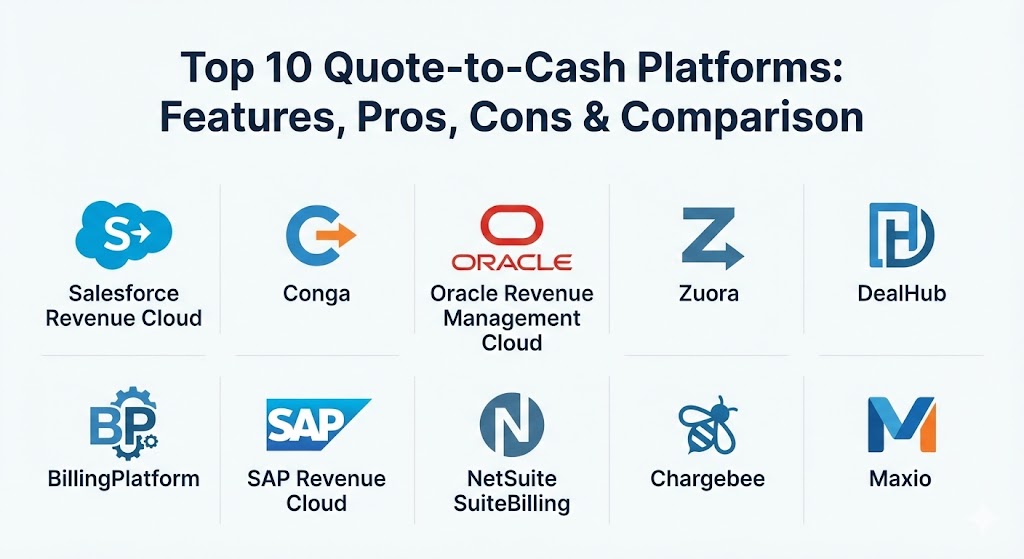
Top 10 Quote-to-Cash Platforms
1 — Salesforce Revenue Cloud
Salesforce Revenue Cloud is the industry heavyweight, combining Salesforce CPQ and Salesforce Billing into a single, cohesive platform. Built natively on the world’s #1 CRM, it provides a seamless transition from a lead to a paid invoice.
- Key features:
- Native integration with Salesforce CRM for a 360-degree customer view.
- Guided selling and rule-based product configurator (CPQ).
- Automated invoice generation and payment processing.
- Advanced revenue recognition and ASC 606 compliance.
- Multi-layered approval workflows for discounts and terms.
- Robust analytics and forecasting via Tableau integration.
- Pros:
- Zero data sync issues since everything lives within the Salesforce ecosystem.
- Immense scalability; can handle thousands of product line items effortlessly.
- Cons:
- High administrative overhead; usually requires a dedicated Salesforce Admin.
- Implementation is a major project that often requires expensive outside consultants.
- Security & compliance: SOC 1/2, ISO 27001, HIPAA, GDPR, and FedRAMP compliant.
- Support & community: Massive global ecosystem of developers, consultants, and “Trailhead” learning modules.
2 — Conga (formerly Apttus)
Conga is a leader in the Q2C space, particularly famous for its deep expertise in Contract Lifecycle Management (CLM). It is designed for companies where the legal contract is just as complex as the pricing.
- Key features:
- Integrated CPQ and CLM (Contract Lifecycle Management).
- Automated document generation with dynamic templates.
- AI-driven contract analysis to identify risky clauses.
- Flexible pricing models including usage-based and hybrid.
- Digital commerce capabilities for self-service buying.
- Grid-based interface for mass updating quotes and contracts.
- Pros:
- The best-in-class tool for heavy legal and compliance industries.
- Highly flexible document templates that look professional and brand-aligned.
- Cons:
- The user interface can feel more technical and less “modern” than SaaS-native rivals.
- Requires significant setup time to get the AI and CLM rules aligned.
- Security & compliance: SOC 2 Type II, HIPAA, GDPR, and ISO 27001.
- Support & community: Extensive documentation and a dedicated support portal for enterprise clients.
3 — Oracle Revenue Management Cloud
Oracle’s solution is built for the global enterprise that needs rigorous financial controls and deep integration with an ERP (Enterprise Resource Planning) system.
- Key features:
- Finance-first approach to revenue recognition and compliance.
- Seamless integration with Oracle Fusion Cloud ERP.
- Support for extremely high-volume transaction processing.
- Global tax and multi-currency handling out of the box.
- Advanced modeling for performance obligations and standalone selling price (SSP).
- Pros:
- Unmatched at handling the complex “back-end” accounting of the Q2C process.
- Ideal for multi-entity, global organizations with different regional rules.
- Cons:
- Can feel overly rigid for agile sales teams who want to move fast.
- Very high cost of entry; strictly an enterprise-tier solution.
- Security & compliance: Military-grade security, FedRAMP, SOC 1/2, and global ISO certifications.
- Support & community: World-class enterprise support; a vast network of Oracle-certified partners.
4 — Zuora
Zuora is the pioneer of the “Subscription Economy.” While many tools handle one-time sales well, Zuora is optimized for the ongoing relationship of recurring revenue.
- Key features:
- Specialized “Subscription Management” engine.
- Ability to launch, price, and bundle products in minutes.
- Automated dunning and collections workflows.
- Built-in “Zuora Revenue” for complex revenue recognition.
- Over 50 pre-built subscription pricing models (tiered, volume, etc.).
- Pros:
- The best tool for businesses that are 100% subscription or usage-based.
- Excellent visibility into subscription metrics like MRR, Churn, and LTV.
- Cons:
- Not the strongest for traditional, one-time physical product sales.
- Integration with non-Salesforce CRMs can require custom API work.
- Security & compliance: PCI DSS Level 1, SOC 1/2, GDPR, and HIPAA.
- Support & community: Active user community (Zuora Community) and extensive “Zuora University” training.
5 — DealHub
DealHub is a “next-gen” Q2C platform that focuses on the buyer experience. It replaces static PDFs with a collaborative “DealRoom” where buyers and sellers work together.
- Key features:
- Collaborative digital DealRoom for buyers.
- No-code CPQ engine that is very fast to set up.
- Integrated e-signature and document tracking.
- Native integration with HubSpot, Salesforce, and Microsoft Dynamics.
- Real-time buyer engagement analytics.
- Pros:
- Fastest implementation time among the enterprise-grade tools.
- Buyers love the interactive DealRoom, which often speeds up the sales cycle.
- Cons:
- Less depth in “back-office” billing and accounting than Oracle or SAP.
- Advanced customizations are limited compared to the Salesforce platform.
- Security & compliance: SOC 2 Type II, GDPR, and HIPAA compliant.
- Support & community: Highly praised for its hands-on onboarding and responsive support team.
6 — BillingPlatform
BillingPlatform is a highly configurable cloud-based monetization platform that excels in complex billing scenarios, especially usage-based and hybrid models.
- Key features:
- Complete flexibility to define any pricing or billing logic.
- Automated invoicing, payments, and AR management.
- Built-in revenue recognition engine.
- Multi-currency and multi-language support.
- High-volume mediation engine to process raw usage data.
- Pros:
- If you can dream of a pricing model, BillingPlatform can likely bill for it.
- Extremely powerful for “mediating” usage data (e.g., billing by the gigabyte or minute).
- Cons:
- Complexity can be high due to the sheer amount of configuration options.
- Smaller teams may find it more “platform” than they actually need.
- Security & compliance: PCI DSS Level 1, SOC 1/2, GDPR, and ISO 27001.
- Support & community: Detailed knowledge base and strong 1-on-1 enterprise support.
7 — SAP Revenue Cloud
SAP is the backbone of many of the world’s largest companies. Their Revenue Cloud brings the Q2C process into the SAP S/4HANA ecosystem.
- Key features:
- Direct integration with SAP ERP and S/4HANA.
- Advanced product configuration for complex manufacturing.
- Support for “everything-as-a-service” (XaaS) models.
- Global compliance across hundreds of tax jurisdictions.
- Intelligent lead-to-cash process orchestration.
- Pros:
- The logical choice if your company already runs on SAP.
- Incredible depth in supply chain and order fulfillment integration.
- Cons:
- Known for a steep learning curve and a “corporate” user experience.
- Licensing and implementation costs are among the highest in the market.
- Security & compliance: Top-tier global compliance (SOC, ISO, HIPAA, FedRAMP).
- Support & community: Largest enterprise software support network in the world.
8 — NetSuite SuiteBilling
NetSuite SuiteBilling is the billing module within the NetSuite ERP. It is specifically designed for mid-market companies that want their Q2C process inside their accounting system.
- Key features:
- Unified ERP, CRM, and Billing in one database.
- Support for subscriptions, usage, and one-time items on one invoice.
- Automated revenue recognition (ASC 606).
- Robust “Renewals Manager” to prevent churn.
- Real-time financial dashboards and reporting.
- Pros:
- The most integrated experience for the finance team.
- Eliminates the need for “connectors” between sales and accounting.
- Cons:
- The CPQ capabilities are not as advanced as Salesforce or Conga.
- Customizing the UI for sales reps can be difficult.
- Security & compliance: SOC 1/2, PCI DSS, ISO 27001, and HIPAA.
- Support & community: Large “SuiteAnswers” knowledge base and a huge network of NetSuite partners.
9 — Chargebee
Chargebee is a “SaaS-first” billing and Q2C tool that focuses on high-growth companies. It is known for its speed and modern API-first approach.
- Key features:
- Specialized in subscription lifecycle management.
- Integrated “Chargebee Receivables” for automated collections.
- “Chargebee RevRec” for automated revenue recognition.
- One-click integrations with HubSpot, Salesforce, and Zendesk.
- Smart dunning to recover failed credit card payments.
- Pros:
- Very easy for developers to work with via robust APIs.
- Excellent for startups moving into the “mid-market” space.
- Cons:
- Not designed for physical goods or complex manufacturing configurations.
- Can get expensive as your revenue scales (percentage-based pricing).
- Security & compliance: PCI DSS Level 1, SOC 1/2, GDPR, and ISO 27001.
- Support & community: Highly responsive chat and email support with a strong SaaS founder community.
10 — Maxio (formerly SaaSOptics & Chargify)
Maxio is built specifically for B2B SaaS companies. It focuses on the “metrics” side of Q2C, ensuring that finance teams have perfect data for board meetings.
- Key features:
- Specialized B2B SaaS billing and collections.
- Automated GAAP/IFRS revenue recognition.
- In-depth SaaS metrics (LTV, CAC, Churn, Retention).
- Integrated customer management and renewals.
- Strong integration with QuickBooks, Xero, and Sage Intacct.
- Pros:
- The best tool for a CFO who needs “investor-ready” financial reports.
- Very strong focus on the specific needs of B2B subscription companies.
- Cons:
- The “Quote” side is weaker than pure-play CPQ tools like DealHub.
- Limited usefulness for industries outside of software/SaaS.
- Security & compliance: SOC 2 Type II, HIPAA, and GDPR.
- Support & community: High-touch onboarding and excellent educational webinars.
Comparison Table
| Tool Name | Best For | Platform(s) Supported | Standout Feature | Rating (Gartner/TrueReview) |
| Salesforce Revenue Cloud | Large Salesforce Users | Cloud / SaaS | Native CRM Ecosystem | 4.5 / 5 |
| Conga | Legal-Heavy Contracts | Cloud / Hybrid | AI Contract Analytics | 4.3 / 5 |
| Oracle Revenue Mgmt | Giant Global Enterprises | Oracle Cloud / ERP | High-Scale Accounting | 4.4 / 5 |
| Zuora | Subscription Models | Cloud / SaaS | Pricing Model Flexibility | 4.4 / 5 |
| DealHub | Modern Sales Teams | Cloud / SaaS | Collaborative DealRoom | 4.7 / 5 |
| BillingPlatform | Usage-Based Billing | Cloud / SaaS | Complete Logic Flexibility | 4.6 / 5 |
| SAP Revenue Cloud | SAP-Led Enterprises | SAP / Cloud | ERP Orchestration | 4.2 / 5 |
| NetSuite SuiteBilling | Mid-Market Finance | NetSuite ERP | Unified ERP Database | 4.3 / 5 |
| Chargebee | High-Growth SaaS | Cloud / API-First | Smart Dunning/Recovery | 4.6 / 5 |
| Maxio | B2B SaaS Metrics | Cloud / SaaS | Investor-Ready Metrics | 4.5 / 5 |
Evaluation & Scoring of Quote-to-Cash Platforms
| Category | Weight | Evaluation Criteria |
| Core Features | 25% | CPQ depth, contract management, and billing automation. |
| Ease of Use | 15% | Sales rep adoption, UI modernness, and mobile accessibility. |
| Integrations | 15% | How well it talks to your CRM (HubSpot/Salesforce) and ERP. |
| Security & Compliance | 10% | ASC 606 readiness, SOC 2, and data encryption. |
| Performance | 10% | Speed of quote generation and system uptime. |
| Support & Community | 10% | Documentation, onboarding, and partner ecosystem. |
| Price / Value | 15% | ROI relative to licensing and implementation costs. |
Which Quote-to-Cash Platform Is Right for You?
Choosing a Q2C platform is a long-term commitment that affects every department in your company. Here is how to navigate the decision:
- SMBs and Early-Stage Startups: You likely don’t need a full Q2C suite. Start with a solid CRM and an integrated billing tool like Chargebee or PandaDoc.
- Mid-Market SaaS: If you are a B2B subscription company, Maxio or Chargebee are excellent. If you want a more “sales-friendly” experience with interactive quotes, DealHub is the winner.
- Enterprise Companies: If you are already on Salesforce, Salesforce Revenue Cloud is the path of least resistance. If you have extreme contract complexity, Conga is the specialist.
- Complex Billing Needs: If you bill by the megabyte, minute, or transaction, look at BillingPlatform or Zuora. They have the “mediation” engines required to turn raw usage data into a clean invoice.
- Finance-Led Organizations: If you want your Q2C process to live inside your financial system to ensure perfect audits, NetSuite SuiteBilling or Oracle are the strongest contenders.
Frequently Asked Questions (FAQs)
1. What is the difference between CPQ and Quote-to-Cash? CPQ (Configure, Price, Quote) is a subset of Q2C. CPQ stops once the quote is generated. Q2C continues through contracting, invoicing, and revenue recognition.
2. Can Q2C platforms work with any CRM? While many are flexible, some (like Salesforce Revenue Cloud) are native to one CRM. Tools like DealHub and Conga offer connectors for multiple CRMs like HubSpot and Microsoft Dynamics.
3. Do these tools handle global taxes? Most enterprise-level Q2C tools integrate with tax engines like Avalara or Vertex to calculate VAT, GST, and sales tax automatically based on the customer’s location.
4. How do Q2C platforms help with ASC 606? ASC 606 is a complex accounting standard for revenue recognition. Q2C platforms automate the “splitting” of revenue over time, ensuring your books are GAAP/IFRS compliant.
5. What is “Dunning,” and why does it matter? Dunning is the process of automatically following up on failed payments. Good Q2C tools (like Chargebee) can recover 10-15% of “lost” revenue through smart retries and automated emails.
6. Is implementation really as hard as people say? For enterprise tools (Salesforce, SAP), yes. It can take 6 months. However, modern tools like DealHub or Chargebee can be live in a few weeks for simpler use cases.
7. Can I use these tools for physical goods? Yes. Tools like SAP and Oracle are excellent at linking the quote to the actual warehouse/inventory for shipping physical products.
8. What is a “DealRoom”? Popularized by DealHub, a DealRoom is a secure web page where a buyer can view their quote, sign the contract, and chat with the seller all in one place.
9. Do I need a Q2C platform if I have an ERP? Most ERPs have basic billing, but they often lack the “guided selling” and complex product configuration that sales teams need to be effective.
10. How much do these platforms cost? Pricing is rarely public. It usually involves a base platform fee (starting at $5k–$50k/year) plus a per-user fee or a percentage of the revenue managed.
Conclusion
The “Quote-to-Cash” journey is the most important workflow in any business—it is the process of turning a promise into profit. While the “best” tool depends on your specific tech stack and pricing model, the most important factor is alignment. Choose a tool that your sales team will actually use and your finance team will actually trust. By automating the friction out of the sales cycle, you’re not just buying software; you’re buying speed.