Introduction
Puzzle and brain training apps are digital platforms that offer a suite of gamified exercises aimed at improving various mental functions. Based on the principle of neuroplasticity—the brain’s ability to reorganize itself by forming new neural connections throughout life—these apps provide structured “workouts” for the mind. They have moved from simple hobbies to essential tools for millions of users worldwide, including students preparing for exams, professionals aiming to boost productivity, and seniors looking to maintain cognitive health.
The importance of these apps lies in their accessibility and data-driven approach. Unlike traditional puzzles like crosswords or Sudoku, these tools track your performance over time, identify your cognitive strengths and weaknesses, and adapt the difficulty level to keep you consistently challenged. Key real-world use cases include improving focus in distractible work environments, enhancing mental math skills for daily transactions, and strengthening “fluid intelligence”—the ability to solve new problems independently of acquired knowledge. When choosing a tool, users should evaluate the scientific validity of the games, the variety of exercises, the quality of progress tracking, and the user experience.
Best for: Individuals seeking to improve cognitive performance, students needing focus, professionals looking for a mental edge, and the aging population aiming for cognitive longevity. These tools are also great for corporate wellness programs and educational environments.
Not ideal for: Those looking for deep, immersive narrative-based gaming experiences or individuals who are highly skeptical of gamified learning. If you have a clinical neurological condition, these apps should supplement, not replace, professional medical advice or therapy.
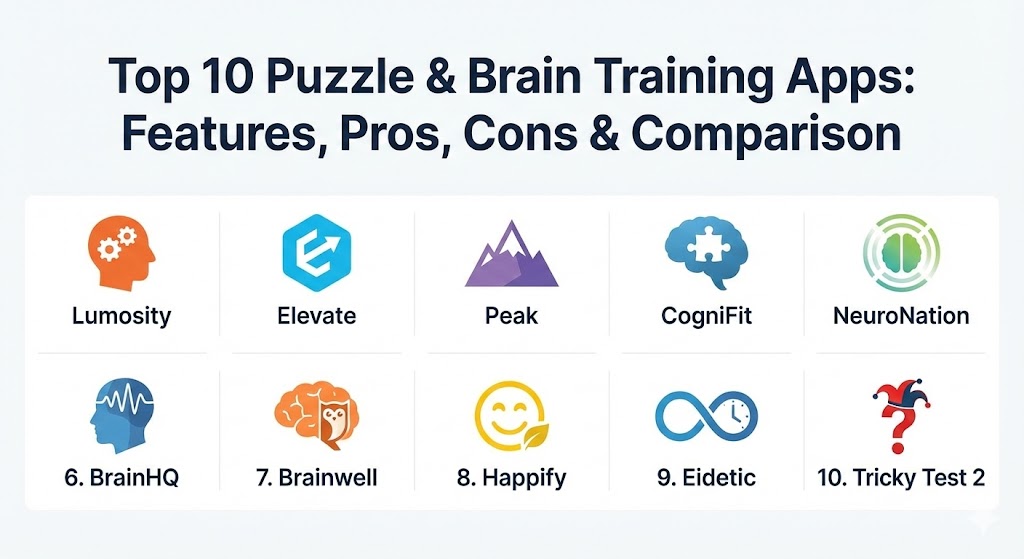
Top 10 Puzzle & Brain Training Apps
1 — Lumosity
Lumosity is widely regarded as the pioneer of the brain training industry. Designed by a team of neuroscientists, it transforms neuropsychological tasks into engaging games that target memory, attention, speed, flexibility, and problem-solving.
- Key features:
- Personalized daily workouts based on an initial “Fit Test.”
- A library of over 50 scientifically-validated games.
- Detailed performance insights and comparisons with other users.
- “Insight” reports that show how you compare to your age group.
- Cross-device synchronization for training on the go.
- Specific “Mindfulness” features to help with stress reduction.
- Pros:
- Exceptionally high production value and polished game design.
- One of the largest research bases in the industry (The Human Cognition Project).
- Cons:
- The free version is quite limited, offering only three games per day.
- Requires a consistent daily commitment to see measurable results.
- Security & compliance: GDPR and HIPAA compliant; uses end-to-end encryption for user performance data. SSO options available for enterprise users.
- Support & community: Extensive online help center, dedicated customer support email, and a large global community of over 100 million users.
2 — Elevate
Elevate is an award-winning app that takes a practical approach to brain training. Rather than abstract puzzles, it focuses on critical real-world skills like writing, speaking, reading, and mental math.
- Key features:
- Over 40 games focusing on practical cognitive skills.
- Performance tracking via the Elevate Proficiency Quotient (EPQ).
- Adaptive difficulty that scales with your skill level.
- Weekly reports and progress charts to track growth.
- Detailed grammar and vocabulary training tools.
- Mental math exercises designed for speed and accuracy.
- Pros:
- Highly relevant for professionals and students (e.g., focus on grammar and math).
- Sleek, modern interface that makes training feel like a premium experience.
- Cons:
- Less focus on “pure” logic or spatial reasoning compared to other apps.
- Subscription costs are relatively high for a single-user license.
- Security & compliance: GDPR and CCPA compliant; regular security audits are performed. Multi-factor authentication is supported.
- Support & community: High-quality documentation and an active social media presence where users share “streaks” and achievements.
3 — Peak
Peak offers a more personalized “coach” experience, using a diverse range of games to challenge memory, attention, problem-solving, mental agility, language, coordination, and emotion.
- Key features:
- “Peak Coach” provides personalized game recommendations.
- “Pro Training” modules designed in collaboration with universities.
- Comprehensive performance analytics and “Brain Map” visualizations.
- Competitive features to challenge friends and compare scores globally.
- Offline mode for training without an internet connection.
- Advanced “Emotion” category to train social and emotional skills.
- Pros:
- The “Coach” feature keeps users motivated and accountable.
- Excellent variety of games that prevent the routine from feeling repetitive.
- Cons:
- The free tier has frequent ads and restricts access to many features.
- Some users find the interface slightly cluttered compared to Lumosity.
- Security & compliance: SOC 2 Type II compliant; data is encrypted at rest and in transit. Standard GDPR protections.
- Support & community: Fast-response customer support and a robust in-app tutorial system for every game.
4 — CogniFit
CogniFit is a medical-grade cognitive training and assessment tool. It is often used by researchers and healthcare professionals due to its high level of scientific rigor and patented technology.
- Key features:
- Scientific assessment of over 20 cognitive skills.
- Patented Individualized Training System (ITS) technology.
- Specific training programs for conditions like ADHD or insomnia.
- Ability to compare “Cognitive Age” with your chronological age.
- Comprehensive data export features for researchers.
- Multi-user management for families or healthcare providers.
- Pros:
- Extremely high scientific credibility and validated by clinical studies.
- Offers a deeper level of cognitive assessment than most competitors.
- Cons:
- The games are less “fun” and more clinical in appearance.
- The subscription price is among the highest in the category.
- Security & compliance: ISO 27001 certified; fully HIPAA compliant for medical data handling. SOC 2 compliant.
- Support & community: Enterprise-grade support for medical institutions; extensive scientific documentation available.
5 — NeuroNation
NeuroNation is a German-developed app that has won various awards for its focus on concentration and memory. It works closely with research institutes to develop its “mental fitness” programs.
- Key features:
- 30+ exercises tailored to individual cognitive goals.
- Scientific advisory board from the Free University of Berlin.
- Progress tracking against the NeuroNation community.
- “Personalized Strengths & Weaknesses” analysis.
- Integration with health tracking platforms (optional).
- Regular updates with new research-backed challenges.
- Pros:
- Known for being particularly effective for improving focus and concentration.
- The app offers a “low-pressure” experience that is great for beginners.
- Cons:
- Some games lack the visual polish of Lumosity or Elevate.
- Limited language support compared to larger global competitors.
- Security & compliance: GDPR compliant; data privacy is a core focus given its European headquarters. Encryption in transit.
- Support & community: Active support forum and high-quality onboarding tutorials.
6 — BrainHQ
Developed by Posit Science, BrainHQ is led by Dr. Michael Merzenich, one of the co-discoverers of neuroplasticity. It is often cited in peer-reviewed journals as one of the most effective tools for cognitive improvement.
- Key features:
- Exercises based on decades of rigorous scientific research.
- Adaptive algorithms that change speed and difficulty in real-time.
- Focus on “brain speed” and high-level attention.
- Performance comparisons with people of the same age and gender.
- Personal trainer feature to guide you through the curriculum.
- Evidence-based results for safe driving and memory retention.
- Pros:
- Generally considered the “gold standard” for clinical scientific backing.
- Proven to produce long-term cognitive benefits in multiple studies.
- Cons:
- The interface is utilitarian and lacks the modern “gamified” feel.
- Can feel repetitive as the focus is on intensive repetition for neural change.
- Security & compliance: HIPAA and GDPR compliant; rigorous data protection protocols for clinical data.
- Support & community: Excellent documentation for researchers and individual users; 24/7 technical support for institutions.
7 — Brainwell
Brainwell is an all-around brain training app that offers a massive library of games targeting memory, attention, critical thinking, language, visual skills, and problem-solving.
- Key features:
- Over 50 games designed in collaboration with neuropsychologists.
- Daily recommended training session with three selected games.
- “Brain Encyclopedia” with explanations of neuroscience terms.
- Comparisons of scores against normative age groups.
- Color-blind mode for improved accessibility.
- Reminders and “Streak” tracking to build training habits.
- Pros:
- One of the largest game libraries, offering great variety.
- Good for families due to simple, easy-to-understand game mechanics.
- Cons:
- The scientific depth is not as pronounced as BrainHQ or CogniFit.
- Some users report bugs during the synchronization process across devices.
- Security & compliance: GDPR and CCPA compliant; standard encryption for account credentials.
- Support & community: Standard email support and a helpful FAQ section on their website.
8 — Happify
While many apps focus on “IQ,” Happify focuses on “EQ” (Emotional Quotient) and mental well-being. It uses games and activities based on positive psychology and cognitive behavioral therapy (CBT).
- Key features:
- “Tracks” focused on specific life goals (e.g., reducing stress).
- AI Coach named Anna to guide users through activities.
- Games designed to build mindfulness, optimism, and confidence.
- Resilience scores to track your emotional well-being over time.
- Community “Hubs” to share experiences and gratitude.
- Periodic assessments to measure your happiness levels.
- Pros:
- Unique focus on emotional health and stress reduction.
- Very easy to integrate into a daily wellness routine (most games under 15 mins).
- Cons:
- Not a traditional “brain trainer” for logic or math.
- Some users find the happiness-focused games a bit “soft” or unscientific.
- Security & compliance: HIPAA compliant for its enterprise/wellness programs. SOC 2 compliant; robust audit logs.
- Support & community: Large, supportive community and enterprise-level support for HR departments.
9 — Eidetic
Eidetic uses a technique called “spaced repetition” to help you memorize anything from phone numbers to interesting facts or quotes. It is a highly specialized tool for memory mastery.
- Key features:
- Personalized memory challenges based on your own information.
- Notifications scheduled using the “spaced repetition” method.
- Different intensity levels for urgent vs. long-term memorization.
- Survival mode for testing memory under pressure.
- Integration with device contacts for practicing names and numbers.
- Simple, distraction-free interface.
- Pros:
- Extremely effective for long-term retention of specific facts.
- Very low time commitment needed to see results.
- Cons:
- Very narrow focus; does not train attention, logic, or speed.
- The interface is quite basic compared to more “gamified” apps.
- Security & compliance: GDPR compliant; data is kept locally on the device for many features. Standard encryption for cloud sync.
- Support & community: Small but dedicated user community; direct support via email.
10 — Tricky Test 2
For those who prefer pure puzzles over “clinical” training, Tricky Test 2 offers a series of brain teasers that challenge your logic, creative thinking, and out-of-the-box problem-solving.
- Key features:
- 111 unique and mind-blowing puzzles.
- “Test Your Friends” mode to compare IQ scores.
- Multi-modal puzzles that use device sensors (shaking, tilting).
- Real-time feedback on your “Genius Quotient.”
- Clean graphics and humorous puzzle solutions.
- Regular updates with seasonal puzzle packs.
- Pros:
- Very fun and engaging; less like “work” and more like a game.
- Challenges lateral thinking in ways that traditional logic apps don’t.
- Cons:
- Limited scientific tracking or long-term cognitive assessment.
- Puzzles can be frustratingly difficult without hints (which often cost money).
- Security & compliance: Standard mobile app data protections; GDPR compliant. Minimal data collection.
- Support & community: Active social media community for sharing solutions; in-app hint system.
Comparison Table
| Tool Name | Best For | Platform(s) Supported | Standout Feature | Rating (TrueReviewnow / Gartner) |
| Lumosity | General Cognitive Fitness | Web, iOS, Android | Fit Test & Insights | 4.7 / 5 |
| Elevate | Practical Real-World Skills | iOS, Android | EPQ Mastery Tracking | 4.8 / 5 |
| Peak | Personalized Coaching | iOS, Android | Peak Coach & Brain Map | 4.6 / 5 |
| CogniFit | Clinical Assessment | Web, iOS, Android | Individualized Training (ITS) | 4.4 / 5 |
| NeuroNation | Concentration & Focus | Web, iOS, Android | Research-Based “Fitness” | 4.5 / 5 |
| BrainHQ | Scientific Rigor | Web, iOS, Android | Real-Time Adaptive Logic | 4.9 / 5 |
| Brainwell | Family Variety | iOS, Android | Large 50+ Game Library | 4.3 / 5 |
| Happify | Emotional Well-being | Web, iOS, Android | AI Emotional Coach (Anna) | 4.5 / 5 |
| Eidetic | Rote Memorization | iOS, Android | Spaced Repetition Tech | 4.2 / 5 |
| Tricky Test 2 | Fun Logic Puzzles | iOS, Android | IQ-style Creative Riddles | 4.1 / 5 |
Evaluation & Scoring of Puzzle & Brain Training Apps
When selecting the right application, we have used a weighted scoring rubric to ensure that the tools are evaluated across multiple critical dimensions.
| Rubric Category | Weight (%) | Description of Evaluation |
| Core Features | 25% | Variety of games, scientific backing, and personalization level. |
| Ease of Use | 15% | Interface design, onboarding speed, and overall user enjoyment. |
| Integrations | 15% | Cross-device syncing and compatibility with health or work ecosystems. |
| Security & Compliance | 10% | Encryption, privacy policies, and compliance (GDPR, HIPAA). |
| Performance | 10% | App stability, load times, and adaptive difficulty responsiveness. |
| Support & Community | 10% | Quality of documentation and responsiveness of customer care. |
| Price / Value | 15% | Cost-effectiveness of the subscription relative to the features. |
Which Puzzle & Brain Training App Is Right for You?
The “perfect” app depends largely on your goals, your budget, and how you prefer to learn. Use the guide below to narrow down your choices.
Solo Users vs SMB vs Mid-Market vs Enterprise
- Solo Users: Most of these apps are designed for individuals. If you want the most “fun” experience, go for Elevate or Peak. If you are serious about science, choose BrainHQ.
- SMB & Mid-Market: Companies often use Happify or Elevate as part of employee perks to boost morale and mental clarity.
- Enterprise: Large organizations looking for rigorous wellness data and HIPAA-compliant reporting for thousands of employees should prioritize CogniFit or Lumosity for Business.
Budget-Conscious vs Premium Solutions
- Budget-Conscious: Tricky Test 2 and Eidetic are the most affordable, offering significant free content. Among the big names, Inoreader (for news) or Peak often have the most generous free daily rotations.
- Premium: BrainHQ and CogniFit are premium investments for those who want clinically-backed results and are willing to pay for the expertise of neuroscientists.
Feature Depth vs Ease of Use
- Feature Depth: CogniFit and Lumosity offer thousands of data points on your brain’s performance. They are “deep” but require time to understand the metrics.
- Ease of Use: Elevate is the winner here. Its interface is so intuitive that you can start a workout within seconds of opening the app, and the skills it teaches are immediately recognizable.
Integration and Scalability Needs
If you plan to switch between your laptop at work and your phone on the train, Lumosity and Happify have the most robust web-to-mobile synchronization. For teams, ensure the platform supports SSO (Single Sign-On) to make onboarding easier for IT departments.
Security and Compliance Requirements
If you are handling medical data or are in a highly regulated industry (like healthcare or finance), CogniFit is the standout choice due to its ISO 27001 and HIPAA certifications.
Frequently Asked Questions (FAQs)
1. Do brain training apps actually make you smarter?
While the “transferability” of these skills is debated, research shows they improve performance on the specific tasks trained. Many users report better focus, faster mental math, and improved memory in daily life.
2. How much time should I spend on these apps daily?
Most experts recommend 10 to 15 minutes a day. Consistency is more important than duration; training every day for a short period is more effective than a two-hour session once a week.
3. Are these apps suitable for children?
Yes, though apps like Brainwell and Lumosity have specific settings for different age groups. Elevate is also excellent for students looking to improve their reading and math scores.
4. Can I use these apps for free?
Most use a “freemium” model. You can play a limited number of games each day for free, but a subscription is required to unlock the full library and advanced analytics.
5. How do these apps track my progress?
They use internal scoring systems (like Lumosity’s LPI or Elevate’s EPQ) that compare your current performance to your past performance and your peers’ averages.
6. What is the difference between a puzzle app and a brain training app?
A puzzle app (like Tricky Test) is designed for entertainment and lateral thinking, while a brain training app (like CogniFit) is designed to systematically exercise specific neural pathways.
7. Is my data safe with these apps?
Leading apps use standard encryption and comply with GDPR. However, if privacy is a concern, check if the app allows for data deletion or local-only storage.
8. Do these apps work for the elderly?
Absolutely. Many apps, specifically CogniFit and NeuroNation, have programs tailored for seniors to help maintain cognitive function and memory.
9. Why do some people say brain training is a myth?
Critics often point out that getting good at a “game” doesn’t always translate to real-world intelligence. However, the industry has responded by creating more “practical” games (like those in Elevate).
10. Which app is best for anxiety?
Happify is the best choice here. It is specifically built using positive psychology to help users break negative thought patterns and reduce stress.
Conclusion
In 2026, the market for brain training has matured into a sophisticated ecosystem of scientifically-backed tools and engaging puzzles. Choosing the “best” app is a personal journey. If you value practical skills like grammar and math, Elevate is your best bet. If you want the most rigorous scientific evidence, BrainHQ stands alone. For those who simply want to keep their minds sharp while having fun, Peak and Lumosity offer the most balanced experience.
Ultimately, the best tool is the one you will actually use. Brain training is most effective when it becomes a habit, like brushing your teeth or exercising. By selecting an app that aligns with your personal goals and lifestyle, you can turn your daily screen time into a powerful investment in your cognitive future.