Introduction
Computer-Aided Dispatch (CAD) systems are mission-critical software platforms used by 911 dispatchers, call-takers, and emergency services to initiate, prioritize, and manage emergency incidents. At its core, a CAD system automates the workflow of receiving a call, identifying the caller’s location, recommending the nearest and most appropriate units (police, fire, or EMS), and tracking those units via GPS until the incident is resolved.
The importance of CAD systems lies in their ability to reduce “response time latency.” In an environment where staffing shortages and rising call volumes are the norm, these tools provide the automation necessary to handle multiple crises simultaneously without human error. Key real-world use cases include managing multi-agency responses to large-scale disasters, tracking officer safety through real-time “status timers,” and providing field responders with building pre-plans and hazard alerts before they arrive on the scene. When evaluating CAD tools, agencies look for geographic information system (GIS) accuracy, multi-jurisdictional interoperability, and the resilience of cloud vs. on-premises architecture.
Best for: Municipal emergency communications centers (PSAPs), county sheriff’s offices, state police, and integrated fire/EMS departments that require a centralized hub for resource coordination and legal record-keeping.
Not ideal for: Small, private security firms with minimal dispatch needs or organizations that only require simple “push-to-talk” radio communication without the need for detailed incident logging and resource tracking.
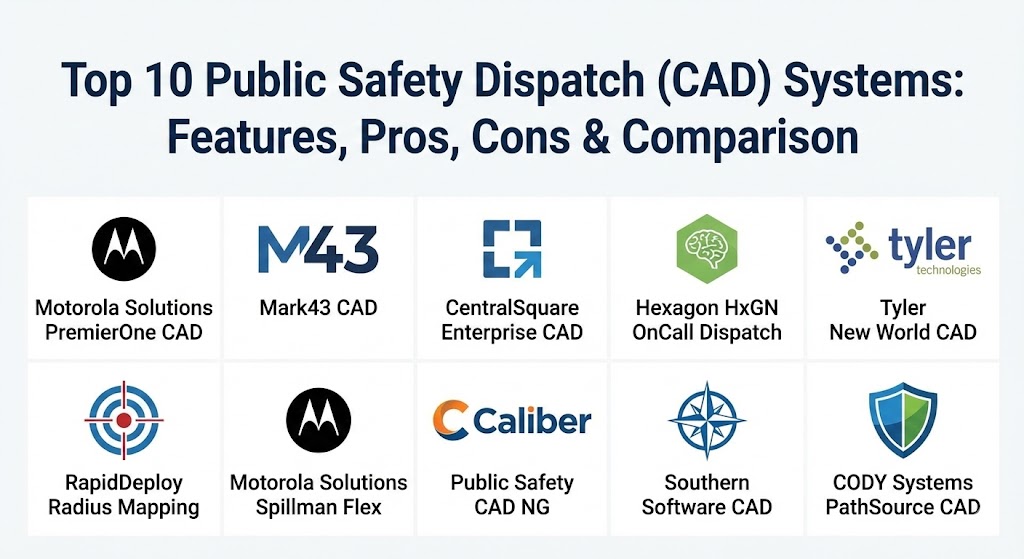
Top 10 Public Safety Dispatch (CAD) Systems
1 — Motorola Solutions PremierOne CAD
PremierOne CAD is a high-tier, enterprise-grade solution designed to transform complex data into actionable intelligence. It is part of Motorola’s extensive “CommandCentral” suite, offering deep integration with radio and video systems.
- Key features:
- Unified operational view of voice, data, and live video feeds.
- Advanced GIS engine built on the Esri ArcGIS platform.
- Seamless integration with Motorola data-equipped radios.
- Dynamic “Work Assist” area that prevents pop-up disruptions.
- Multi-agency support with autonomous business rules for each.
- Real-time distribution of suspect photos and building plans to field units.
- Pros:
- Exceptionally robust for large-scale, high-volume metropolitan agencies.
- The integration with physical hardware (radios, body cams) is unmatched.
- Cons:
- High total cost of ownership (TCO) compared to modular rivals.
- Significant training requirements due to the platform’s complexity.
- Security & compliance: CJIS, FIPS 140-2, and high-availability fault tolerance.
- Support & community: Extensive global support network; comprehensive training programs and “Motorola Solutions Community” for peer advice.
2 — Mark43 CAD
Mark43 is a modern, cloud-native public safety platform that focuses on user experience (UX) and data fluidity. It is designed to be “built for people, not just screens,” reducing the cognitive load on dispatchers.
- Key features:
- Cloud-native architecture with 99.95% uptime and zero-IT burden.
- Automated response engine with “human-in-the-loop” controls.
- Native integration with Esri maps and real-time routing.
- Mobile-first design allowing dispatching from any browser or device.
- Predictive impact modeling for response plan changes.
- Deep, two-way integration with Mark43 RMS (Records Management).
- Pros:
- Frequent, seamless updates that don’t require system downtime.
- Highly intuitive UI that drastically reduces training time for new hires.
- Cons:
- Requires a stable internet connection (though offline modes exist).
- Younger ecosystem compared to decades-old legacy vendors.
- Security & compliance: AWS GovCloud hosted, CJIS compliant, SOC 2 Type II, and HIPAA.
- Support & community: Highly rated proactive support; dedicated customer success managers and an active online knowledge base.
3 — CentralSquare Enterprise CAD
Formed through the merger of industry giants (TriTech, Zuercher, etc.), CentralSquare Enterprise CAD offers one of the most comprehensive and scalable portfolios in North America, serving 3 in 4 citizens.
- Key features:
- Patented CAD-to-CAD interoperability for regional coordination.
- Multi-discipline support for law, fire, EMS, and mobile crisis teams.
- Proximity-based unit recommendations for faster arrival times.
- Integrated 911 call handling and Next-Gen 911 (NG911) support.
- Powerful mapping with global changes applied in seconds.
- Citizen engagement portals for non-emergency reporting.
- Pros:
- Unrivaled ability to connect neighboring jurisdictions on different systems.
- Extremely scalable, from small towns to the largest metro areas.
- Cons:
- Merging different product lines has led to some UI inconsistencies.
- Users sometimes report slower support response times during peak periods.
- Security & compliance: CJIS, NENA i3 standards, and ISO 27001.
- Support & community: Massive user base; annual “CentralSquare ENGAGE” conference and a large library of self-service resources.
4 — Hexagon HxGN OnCall Dispatch
Hexagon is a global leader in sensor and map technology, and their OnCall Dispatch suite reflects this expertise by focusing on “Advantage” through situational awareness and workflow optimization.
- Key features:
- Browser-based and mobile clients for on-the-go dispatching.
- HxGN OnCall Analytics for dynamic visual summaries of workloads.
- Unified interface that can replace multiple separate control room UIs.
- Flexible licensing for agencies of different sizes (Essentials vs. Advantage).
- Integrated Standard Operating Procedures (SOPs) within the workflow.
- Support for SMS, video, and instant messaging from citizens.
- Pros:
- Superior 3D rendering and real-time traffic routing capabilities.
- The most flexible deployment options (on-prem, cloud, or hybrid).
- Cons:
- Can be overly complex for agencies with very basic needs.
- Global focus means localized US-specific nuances sometimes lag.
- Security & compliance: GDPR, CJIS, and ISO 27001.
- Support & community: High-tier professional services; extensive global documentation and regional user groups.
5 — Tyler Technologies New World CAD
New World CAD is a staple in the public sector, known for its deep integration into municipal ERP systems and its focus on “silent dispatching” to reduce radio congestion.
- Key features:
- Enterprise-wide data access across CAD, RMS, and Mobile.
- Integrated Automatic Vehicle Location (AVL) and proximity routing.
- Automated “Run Cards” and fire-specific recommendations.
- Rapid data sharing between disciplines and across borders.
- Real-time situational awareness updates for field responders.
- Proximity-based “Silent Dispatch” via mobile data terminals (MDTs).
- Pros:
- Excellent for agencies that want a single-vendor “full suite” (CAD/RMS/Jail).
- Strong focus on officer safety with automated status timers.
- Cons:
- The UI can feel more traditional/less “modern” than cloud-native rivals.
- Updates can be more involved compared to SaaS solutions.
- Security & compliance: CJIS compliant and NENA i3 ready.
- Support & community: Large user community; strong training programs and the “Tyler Connect” annual event.
6 — RapidDeploy Radius Mapping
RapidDeploy is a disruptor in the space, focusing on “Next-Gen 911” location intelligence. While often used alongside traditional CAD, their Radius platform acts as a powerful primary or supplemental dispatch map.
- Key features:
- Real-time mobile location data (iOS/Android) visualized on one map.
- RapidVideo for live-streaming video directly from a caller’s phone.
- 2-way text messaging with AI-powered translation in 60+ languages.
- Integration of “what3words” and lat/long location identification.
- Cloud-based “single pane of glass” for siloed agency data.
- Live tracking “breadcrumbs” of a caller’s movements.
- Pros:
- Incredibly fast to deploy with zero hardware footprint.
- Provides significantly better caller location accuracy than legacy systems.
- Cons:
- Primarily a mapping/call-taking layer; lacks full RMS/Jail management.
- Heavy reliance on cellular/cloud connectivity for advanced features.
- Security & compliance: SOC 2, CJIS, and FedRAMP authorized.
- Support & community: Dedicated training and service teams; strong partner network.
7 — Motorola Solutions Spillman Flex
Spillman Flex is a legendary name in public safety, known for its “Integrated Hub” architecture that allows for unparalleled data sharing across multiple jurisdictions.
- Key features:
- Single Integrated Hub where all data is stored in a master file.
- Command-line or mouse-driven operation for veteran dispatchers.
- Customizable screen features (colors, icons, fonts) per user.
- One-login access to CAD, RMS, Jail, and Civil process.
- Superior multi-jurisdictional data-sharing capabilities.
- Mobile-optimized records for officers in the field.
- Pros:
- The most stable and battle-tested data integrity in the industry.
- Excellent ROI for regional consortia that share a single system.
- Cons:
- The “all-in-one” hub approach can lead to slower performance if not properly resourced.
- The interface reflects its long history and may feel “old-school” to new users.
- Security & compliance: CJIS, HIPAA, and FIPS 140-2.
- Support & community: Famous for its “Spillman User Group” (SUG) and deep-seated customer loyalty.
8 — Caliber Public Safety CAD NG
Caliber focuses on “software for life,” providing reliable, streamlined tools for agencies that want to spend more time on patrol and less time on data entry.
- Key features:
- CAD NG (Next Generation) built for ease of use and speed.
- Integrated GPS/AVL and smart dispatch logic.
- “Software for Life” guarantee ensures no forced end-of-life migrations.
- Seamless interoperability with CIS and state databases.
- Automated reporting and analytics dashboards.
- Native fire/EMS responder training and scheduling modules.
- Pros:
- Highly praised customer support that is often described as “partners.”
- Extremely intuitive; users report being able to “self-train” on many features.
- Cons:
- Lacks some of the “high-tech” AI features of more expensive systems.
- The reporting engine can require a learning curve for complex queries.
- Security & compliance: CJIS, NIST, and HIPAA compliant.
- Support & community: Nearly half of the staff are former public safety professionals, offering unparalleled domain expertise.
9 — Southern Software CAD
Southern Software is a regional powerhouse known for its user-friendly interface and exceptional customer support, particularly among small to medium-sized agencies.
- Key features:
- Multi-Geo lookup control for address and landmark verification.
- Full integration with Southern Software RMS and Mobile (MDIS).
- Command-line or mouse operation for major dispatch functions.
- Detailed audit trails for every call for service (CFS).
- Interfaces with APCO-Intellicomm and ProQA for medical dispatch.
- Pre-planned event notifications and unit recommendations.
- Pros:
- Best-in-class support; users often speak to the same support tech for years.
- Cost-effective for agencies that don’t need “big city” enterprise bloat.
- Cons:
- Primarily focused on the US market; limited international scalability.
- Lacks the deep AI predictive modeling of cloud-native competitors.
- Security & compliance: CJIS and HIPAA compliant.
- Support & community: High user satisfaction; frequent training seminars and a dedicated client portal.
10 — CODY Systems PathSource CAD
CODY Systems focuses on data-driven public safety, offering a CAD solution that is deeply rooted in investigative and information-sharing capabilities.
- Key features:
- Real-time “cross-state” data sharing through the CODY platform.
- Incident-based dispatch management with integrated records.
- Mobile officer access with real-time incident updates.
- Automated BOLO (Be On the Look Out) alerts and notifications.
- Searchable historical data tools for pattern identification.
- Browser-based interface for flexibility and easy updates.
- Pros:
- Excellent for agencies that prioritize intelligence-led policing.
- Streamlined for law enforcement workflows with less clutter.
- Cons:
- Not as specialized in fire/EMS-specific “run card” logic as others.
- Smaller market share compared to the “Big Three” (Motorola, CentralSquare, Tyler).
- Security & compliance: CJIS compliant and SOC 2.
- Support & community: Strong emphasis on “partnering” with agencies for custom feature requests.
Comparison Table
| Tool Name | Best For | Platform(s) Supported | Standout Feature | Rating (Gartner Peer Insights) |
| Motorola PremierOne | Large Metro Agencies | On-Prem / Cloud | Hardware/Radio Integration | 4.4 / 5 |
| Mark43 CAD | Cloud-Native / UX | Cloud / SaaS | Automation Response Engine | 4.8 / 5 |
| CentralSquare Enterprise | Interoperability | Cloud / Hybrid | CAD-to-CAD Networking | 4.2 / 5 |
| Hexagon OnCall | GIS & Situational Awareness | Cloud / On-Prem | 3D Mapping & Traffic Routing | 4.5 / 5 |
| Tyler New World | Municipal Integration | On-Prem / Cloud | Silent Dispatching | 4.3 / 5 |
| RapidDeploy Radius | NG911 / Call Mapping | Cloud-Native | Live Caller Video / Location | 4.7 / 5 |
| Spillman Flex | Multi-Agency Consortia | On-Prem / Hybrid | Integrated Hub Architecture | 4.6 / 5 |
| Caliber Public Safety | Ease of Use / SMBs | Cloud / On-Prem | “Software for Life” Guarantee | 4.5 / 5 |
| Southern Software | Small/Mid-Sized Agencies | On-Prem | Personalized Tech Support | 4.6 / 5 |
| CODY Systems | Intel-Led Policing | Cloud / Hybrid | Cross-State Data Sharing | 4.2 / 5 |
Evaluation & Scoring of Public Safety Dispatch (CAD) Systems
The selection of a CAD system is usually a 10-15 year commitment. Agencies use a weighted rubric to ensure the tool meets both operational and technical requirements.
| Category | Weight | Evaluation Criteria |
| Core Features | 25% | Mapping accuracy (GIS), unit recommendations, and dispatch workflow efficiency. |
| Ease of Use | 15% | Dispatcher “speed-to-input,” UI clarity under stress, and command-line options. |
| Integrations | 15% | Ease of connecting to RMS, 911 phone systems, radio consoles, and mobile apps. |
| Security & Compliance | 10% | CJIS compliance, encryption, audit logging, and redundancy/uptime. |
| Performance | 10% | System latency during high-volume events and “time-to-first-unit” dispatch. |
| Support | 10% | Training quality, 24/7 emergency support, and frequency of software updates. |
| Price / Value | 15% | Licensing costs vs. operational efficiencies and reduced liability risk. |
Which Public Safety Dispatch (CAD) System Is Right for You?
The right CAD choice is dictated by your geography, budget, and agency size.
- Solo Users & Private Security: Most traditional CAD systems are over-engineered for you. Look for lightweight “dispatch as a service” apps or specialized security guard management software.
- Small Agencies (1-5 dispatchers): Prioritize support and ease of use. Southern Software or Caliber Public Safety are built for your scale and offer a more personalized support experience.
- Medium to Large Agencies: Look for deep data integration. Tyler Technologies and Spillman Flex are excellent if you want a single system that handles everything from dispatch to the jail.
- Next-Gen Tech Seekers: If your agency is struggling with locating 911 callers, adding a layer like RapidDeploy can be a game-changer. For those who want to ditch servers entirely, Mark43 is the industry leader in cloud-native CAD.
- Regional & Multi-Agency Projects: If you need to share resources across city or county lines, CentralSquare‘s CAD-to-CAD technology is the industry benchmark.
Frequently Asked Questions (FAQs)
1. What is the difference between CAD and RMS? CAD (Computer-Aided Dispatch) is for “live” incident management—getting help to the scene. RMS (Records Management System) is for “post-incident” documentation—writing the police report, managing evidence, and tracking investigations.
2. Can I use a cloud-based CAD system if our internet is unreliable? Yes, modern cloud CADs like Mark43 often include “edge” devices or local offline modes that allow basic dispatching to continue even during a wide-area network outage.
3. What is NG911 (Next-Generation 911)? NG911 refers to the upgrade of 911 infrastructure to handle digital information like photos, videos, and precise GPS data from smartphones, which legacy “analog” systems cannot handle.
4. How does “Unit Recommendation” work? The CAD system uses AVL (Automatic Vehicle Location) and GIS data to calculate travel time. It then suggests the closest available unit with the correct equipment (e.g., an ALS ambulance for a cardiac arrest).
5. Is CAD software compliant with FBI/CJIS standards? Yes, any reputable CAD vendor in the US must meet Criminal Justice Information Services (CJIS) standards for data security, access control, and auditing.
6. Does CAD software integrate with 911 phone systems? Most do. This integration allows the CAD to “pop” a new incident screen automatically with the caller’s phone number and location as soon as the dispatcher answers the call.
7. Can one CAD system handle Police, Fire, and EMS at once? Yes, these are called “multi-discipline” systems. They allow different dispatchers to work on the same call while using different “run cards” or protocols specific to their branch of service.
8. What is a “CAD-to-CAD” interface? It is a bridge that allows two different CAD systems from different vendors or jurisdictions to talk to each other, allowing one city to see the location of a neighboring city’s ambulances in real-time.
9. How much does a CAD system cost? Costs range from $50,000 for a small town to several million for a large county. Pricing usually includes a large upfront implementation fee plus an annual maintenance or SaaS subscription fee.
10. How long is the typical implementation for a new CAD? For small agencies, 4-6 months. For large, multi-agency metropolitan regions, the process can take 18-24 months due to GIS data cleanup and user training requirements.
Conclusion
Selecting a Public Safety Dispatch system is one of the most significant decisions an agency head can make. The “best” tool isn’t necessarily the one with the most features, but the one that ensures your dispatchers remain calm, your officers remain safe, and your citizens receive help in their moment of greatest need. Whether you choose the battle-tested resilience of Motorola or the cloud-native agility of Mark43, the goal remains the same: making every second count.