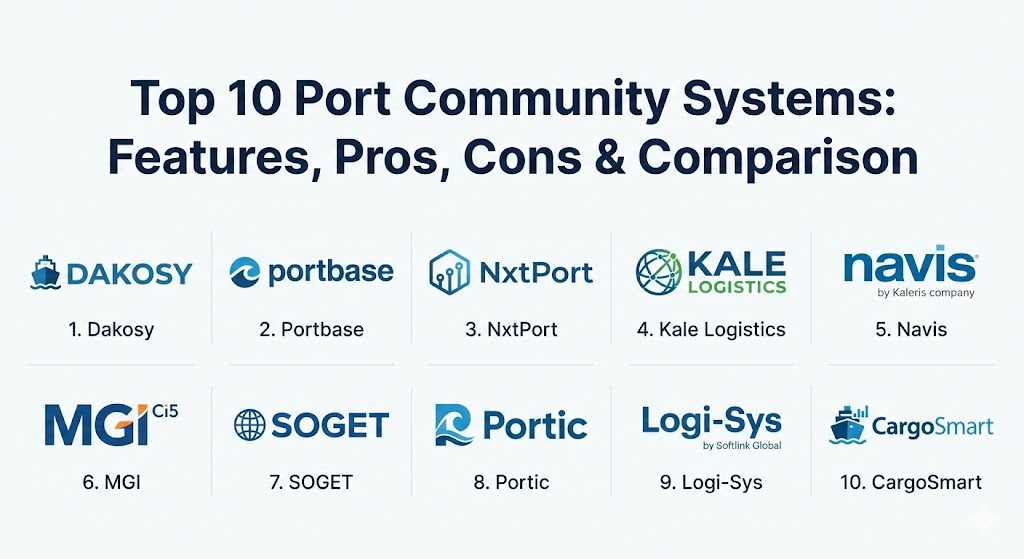
Introduction
A Port Community System is a neutral and open electronic platform that enables the intelligent and secure exchange of information between public and private stakeholders. It serves as a digital “single window,” allowing parties involved in trade and transport to lodge standardized information and documents at a single entry point to fulfill all import, export, and transit-related regulatory requirements. By automating smooth port and logistics processes through a single submission of data, a PCS connects entire transport and logistics chains, transforming a physical harbor into a “Smart Port.”
The importance of a PCS lies in its ability to optimize the “ship-to-shore” interface. In an era of mega-vessels and just-in-time delivery, even a few hours of data latency can result in millions of dollars in demurrage and detention costs. Key real-world use cases include electronic manifest filing, automated customs clearance, real-time container tracking, and terminal slot booking. When evaluating a PCS, organizations must look for high interoperability (API and EDI capabilities), robust cybersecurity frameworks, multi-modal support (rail, road, and sea), and a proven track record in high-volume environments.
Best for: Port authorities, terminal operators, customs agencies, shipping lines, and large-scale freight forwarders. It is particularly beneficial for national governments aiming to improve their country’s “Ease of Doing Business” index and maritime hubs looking to maintain a competitive edge through digitalization.
Not ideal for: Small, localized private marinas or individual independent truck drivers who only operate in a single niche. While these players interact with a PCS, they rarely need to own or implement the system themselves; instead, they act as end-users of a larger community’s infrastructure.
Top 10 Port Community Systems Tools
1 — Dakosy
Dakosy is a premier European Port Community System operator based in Hamburg. It provides a highly stable and mature platform that has been the digital heart of the Port of Hamburg for decades, facilitating seamless communication between thousands of logistics partners.
- Key features:
- ZODIAK GE: A comprehensive customs software for European cross-border trade.
- IMPORT/EXPORT Portal: Automated processing of releases and orders.
- Hazardous Goods Management: Specialized module for the safe handling and reporting of dangerous materials.
- Air Cargo Integration: One of the few platforms that bridges sea and air cargo (FAIR@Link).
- Direct EDI Interfaces: High-speed data exchange for large-scale enterprise systems.
- Pros:
- Exceptional reliability and uptime record in high-volume maritime environments.
- Strong compliance with complex European Union customs regulations.
- Cons:
- The user interface can feel traditional compared to modern web-native SaaS startups.
- Primarily optimized for the European regulatory landscape, which may require heavy customization elsewhere.
- Security & compliance: ISO 27001 certified, GDPR compliant, and features advanced encryption for all EDIFACT and XML messages.
- Support & community: High-tier enterprise support; regular user group meetings and a deep technical knowledge base.
2 — Portbase
Portbase is the national Port Community System of the Netherlands, connecting all Dutch ports. It is renowned for its “Logistics Single Window” approach, significantly reducing the administrative burden for the Port of Rotterdam and beyond.
- Key features:
- Hinterland Container Tracking: End-to-end visibility from the terminal to the warehouse.
- Vessel Notification: Automated reporting of ship arrivals and departures to authorities.
- Terminal Appointment System: Real-time slot booking for truckers to reduce congestion.
- Brexit-Ready Modules: Specialized tools for managing trade with non-EU entities.
- Public-Private Governance: A unique model that ensures the platform serves the public interest.
- Pros:
- Highly user-centric design with constant feedback loops from the port community.
- Successfully handles millions of messages daily with minimal latency.
- Cons:
- High barrier to entry for small firms due to strict participation requirements.
- Revenue models can be complex for occasional users.
- Security & compliance: SOC 2 Type II, GDPR compliant, and regular independent security audits.
- Support & community: 24/7 customer service; working groups from the business community guide the development of new features.
3 — NxtPort
NxtPort is a data-sharing platform for the Port of Antwerp-Bruges. It differentiates itself by acting as a “Data Utility,” focusing on unblocking the potential of data through APIs and innovative applications like “Certified Pick up.”
- Key features:
- Certified Pick up (CPu): A biometric/digital token system for secure container release.
- Bulk and Breakbulk Solutions: Beyond containers, it handles diverse cargo types.
- API First Architecture: Designed for easy integration with modern logistics software.
- Data Access Control: Granular permissions that allow users to monetize their own data.
- Customs Dashboard: Real-time status of customs holds and releases.
- Pros:
- Extremely forward-thinking architecture that leverages blockchain and biometric security.
- Encourages an ecosystem of third-party developers to build apps on top of the data.
- Cons:
- Requires a high level of digital maturity from the participants.
- The “Data Utility” model is still evolving in terms of global standardization.
- Security & compliance: ISO 27001 certified, biometric authentication support, and GDPR compliant.
- Support & community: Active developer portal and community-led innovation workshops.
4 — Kale Logistics (PCS 3.0)
Kale Logistics is a global provider known for its “PCS 3.0” vision. They offer cloud-native, award-winning solutions that prioritize AI and blockchain to solve inefficiencies in both sea and air ports worldwide.
- Key features:
- Next-Gen Automation: Uses AI/ML to predict truck congestion and optimize terminal slots.
- e-DO (Electronic Delivery Order): Fully digital release of negotiable instruments.
- VGM (Verified Gross Mass): Integrated module for SOLAS compliance.
- Cloud-Native Deployment: Can be hosted on AWS, Azure, or private clouds.
- Multi-Modal Integration: Seamlessly connects sea, air, and land transport.
- Pros:
- One of the most modern and visually intuitive interfaces in the PCS market.
- Highly scalable; suitable for both small emerging ports and large established hubs.
- Cons:
- The “all-in-one” nature can lead to feature overlap with existing TMS systems.
- Implementation in very legacy-heavy environments requires significant change management.
- Security & compliance: SOC 2, HIPAA (for medical cargo), GDPR, and FIPS 140-2 compatibility.
- Support & community: Global 24/7 support; recognized by the UN for its innovative trade facilitation.
5 — Navis (by Kaleris)
Navis is a world leader in terminal operating systems (TOS) and has expanded its footprint into the PCS space. Its platform focuses on the “Inland to Port” visibility, ensuring that the terminal is no longer a “black box” for the rest of the community.
- Key features:
- N4 Terminal Integration: Native connection to the world’s most used TOS.
- Slot Management: Sophisticated truck and rail appointment scheduling.
- Predictive ETAs: High-accuracy vessel arrival predictions based on real-time data.
- Empty Container Management: Specialized tools for optimizing the return of empties.
- Reefer Monitoring: Remote tracking of refrigerated containers through the port.
- Pros:
- The deepest possible integration with terminal operations on the market.
- Excellent at reducing “truck turn times” and port-side congestion.
- Cons:
- Best suited for ports already using Navis N4; less flexible for non-Navis sites.
- Premium pricing reflects its status as an industry leader.
- Security & compliance: ISO 27001, SOC 2, and high-tier encryption for sensitive terminal data.
- Support & community: Extensive training through Navis University; global annual user conferences.
6 — MGI (Ci5)
MGI, based in Marseille, developed the Ci5 (Cargo Intelligence 5) platform. Ci5 is a “fifth-generation” PCS that moves beyond simple data exchange to predictive logistics and “smart” tracking.
- Key features:
- Ci5 Dashboard: A real-time overview of the entire cargo journey.
- Predictive Notifications: Alerts users to potential disruptions before they happen.
- Process Automation: Automated retrieval of info into the user’s local TMS.
- Customs Connectivity: Deep integration with French and European customs systems.
- Hazardous Goods Tracking: Specialized module for regulatory safety compliance.
- Pros:
- Strong focus on “Cargo Intelligence” rather than just “data movement.”
- Highly adaptable to both maritime and inland port environments.
- Cons:
- Strongest presence is in French-speaking regions; global support is expanding but localized.
- Advanced AI features require a clean data input from all community members.
- Security & compliance: GDPR compliant, ISO 27001, and secure API gateways.
- Support & community: 35+ years of industry experience; personalized onboarding and technical training.
7 — SOGET (S.ynegy)
SOGET is a global leader in Port Community Systems, with a presence on four continents. Their S.ynegy platform is an “all-French” software designed for resilience and interoperability in diverse international markets.
- Key features:
- S.ynegy Ecosystem: A suite of interoperable tools for port authorities and warehouse operators.
- National Single Window Integration: Designed to act as a country’s primary trade portal.
- Financial Document Submission: Automated handling of invoices and regulatory payments.
- Performance Measurement: Built-in KPIs for port efficiency and throughput.
- Mobile Accessibility: Real-time status checks for logistics operators on the go.
- Pros:
- Highly flexible and tailored solutions for diverse geographical needs.
- Proven track record in developing nations looking to modernize trade.
- Cons:
- The wide range of modules can be complex to configure for smaller ports.
- Transitioning from older SOGET versions to S.ynegy requires a strategic update.
- Security & compliance: ISO 27001, GDPR, and rigorous data trust frameworks.
- Support & community: Strong international presence with localized support teams in Africa, Asia, and Europe.
8 — Portic
Portic is the Port Community System of Barcelona, serving as a strategic partner for one of the Mediterranean’s most important hubs. It focuses on digitalization, sustainability, and “unlimited connectivity.”
- Key features:
- Smart Connections: Facilitates communication across the entire logistics community.
- Environmental Impact Tracking: Unique features to help ports achieve sustainability goals.
- Identity Verification: Advanced security to ensure only authorized users access cargo data.
- Real-time Queries: Instant access to berth schedules, delivery statuses, and SPeso.
- Document Digitalization: Eliminates paper flows for nearly all operational processes.
- Pros:
- Excellent balance between operational efficiency and environmental sustainability.
- Very strong community “buy-in” in the Mediterranean region.
- Cons:
- Primarily focused on the Port of Barcelona ecosystem; limited “out-of-the-box” global use.
- Documentation is strongest in Spanish and Catalan, though English is supported.
- Security & compliance: Advanced encryption, identity verification, and GDPR compliance.
- Support & community: Strategic partnership approach with high-touch customer involvement.
9 — Logi-Sys (by Softlink Global)
Logi-Sys is an end-to-end cloud-based platform that serves as a PCS and Cargo Community System. It is designed to manage the entire lifecycle of a shipment, making it popular for communities that want to integrate freight forwarding and port operations.
- Key features:
- Multi-Modal Management: Unified handling of sea, air, and land freight.
- Automated Manifest Filing: Direct links to global customs authorities.
- Financial Management: Integrated billing, accounting, and tax compliance.
- Mobile App: Real-time visibility for field workers and drivers.
- Customer Portal: Self-service tracking for shippers and consignees.
- Pros:
- Covers the entire supply chain, not just the port stay.
- Very cost-effective for growing logistics hubs in Asia and the Middle East.
- Cons:
- Less specialized in terminal-specific automation compared to Navis.
- The interface can be cluttered due to the wide range of features.
- Security & compliance: ISO 27001, GDPR, and secure cloud hosting on Azure/AWS.
- Support & community: 24/7 global support and a large training academy for users.
10 — CargoSmart
CargoSmart is a visibility-focused platform that provides global shipment management. It acts as a community hub for shippers, carriers, and port operators to collaborate on shipment execution and compliance.
- Key features:
- Sailing Schedules: Comprehensive database of global carrier schedules.
- Vessel Tracking: Real-time AIS data integrated with port milestones.
- Predictive Analytics: Uses Big Data to forecast ETAs and potential delays.
- Compliance Manager: Automated documentation for international trade regulations.
- Carrier Booking: Direct electronic booking with multiple global carriers.
- Pros:
- Unmatched global visibility data for tracking cargo outside of the port.
- Excellent predictive tools for managing supply chain disruptions.
- Cons:
- More of a “visibility platform” than a traditional local PCS with terminal control.
- Data accuracy depends heavily on the quality of carrier-provided info.
- Security & compliance: SOC 2, GDPR, and rigorous carrier-grade data security.
- Support & community: Professional customer success teams and global offices for local support.
Comparison Table
| Tool Name | Best For | Platform(s) Supported | Standout Feature | Rating (Avg Insights) |
| Dakosy | EU Compliance | Web, EDI, Desktop | Sea-Air Hybrid (FAIR@Link) | 4.6 / 5 |
| Portbase | National Systems | Web, API, EDI | Logistics Single Window | 4.7 / 5 |
| NxtPort | Modern Data Sharing | Web, API | Certified Pick up (CPu) | 4.5 / 5 |
| Kale Logistics | Next-Gen Automation | Cloud, Web, Mobile | PCS 3.0 AI/Blockchain | 4.8 / 5 |
| Navis | Terminal-Centric | Web, On-Prem, Cloud | N4 TOS Native Sync | 4.4 / 5 |
| MGI Ci5 | Cargo Intelligence | Web, SaaS | Predictive Disruption Alerts | 4.5 / 5 |
| SOGET | Global Modernization | Web, Mobile, Cloud | National Single Window Model | 4.3 / 5 |
| Portic | Sustainability | Web, Web Services | Green Impact Tracking | 4.4 / 5 |
| Logi-Sys | End-to-End Logistics | Cloud, Mobile | Integrated Accounting/TMS | 4.6 / 5 |
| CargoSmart | Global Visibility | Web, API | Big Data Predictive ETAs | 4.5 / 5 |
Evaluation & Scoring of Port Community Systems
Selecting a PCS is a long-term strategic commitment. The following table evaluates the standard performance metrics of top-tier systems.
| Category | Weight | Evaluation Criteria |
| Core Features | 25% | Multi-modal support, manifest filing, terminal slot booking, and tracking. |
| Ease of Use | 15% | UI design, mobile accessibility, and onboarding speed. |
| Integrations | 15% | API maturity, EDI standards (EDIFACT/XML), and TOS/TMS connectivity. |
| Security & Compliance | 10% | ISO 27001, GDPR, encryption, and audit trail depth. |
| Performance | 10% | Latency in message exchange, system uptime, and concurrency handling. |
| Support & Community | 10% | Training availability, 24/7 helpdesk, and user group activity. |
| Price / Value | 15% | TCO vs. efficiency gains (reduced truck turn times, lower demurrage). |
Which Port Community Systems Tool Is Right for You?
Choosing a PCS is not about finding the tool with the most features; it is about finding the one that aligns with your port’s digital maturity and community needs.
- Solo Terminals & SMB Ports: If you are a single terminal looking to digitize your interface with truckers and forwarders, Kale Logistics or Logi-Sys offer cloud-based, scalable entry points that don’t require massive on-premise infrastructure.
- Mid-Market & Regional Hubs: For ports that act as regional gateways, MGI Ci5 or SOGET provide a robust balance of authority-level control and private-sector visibility.
- Large Enterprise & Global Hubs: For the world’s largest ports, Portbase, Dakosy, and Navis are the standard. These systems are designed to handle millions of TEUs (Twenty-foot Equivalent Units) and provide the stability required for national critical infrastructure.
- Innovation & Data-Driven Ports: If your goal is to lead in the “Industrial 4.0” maritime space, NxtPort and Kale Logistics PCS 3.0 offer the most advanced architectures for data monetization and blockchain security.
- Security & Compliance Priorities: In regions with strict data residency and customs laws (like the EU), Dakosy and Portbase offer the most “peace of mind” due to their deep alignment with local regulations.
Frequently Asked Questions (FAQs)
1. What is the difference between a PCS and a Terminal Operating System (TOS)?
A TOS (like Navis N4) manages the internal operations of a single terminal (cranes, yard planning). A PCS (like Portbase) connects all stakeholders outside that terminal, including customs, shipping lines, and trucking companies.
2. Can a PCS act as a National Single Window (NSW)?
Yes, many modern PCS platforms are designed to integrate with or even serve as the National Single Window for trade, allowing a country to consolidate all its regulatory filings into one portal.
3. Does a PCS help with sustainability?
Absolutely. By reducing truck congestion through slot booking and optimizing vessel turn-around times, a PCS significantly lowers the carbon footprint of port operations.
4. How much does a Port Community System cost?
Costs vary wildly based on the number of modules and users. Most operate on a mix of annual subscriptions and transaction fees (e.g., a fee per electronic delivery order).
5. Is my data safe on a shared community platform?
Security is a primary concern. Enterprise PCS platforms use bank-level encryption, ISO 27001 standards, and granular data permissions to ensure that a company only sees its own cargo data.
6. Can small freight forwarders use a PCS?
Yes. In fact, one of the biggest benefits of a PCS is giving small and medium enterprises (SMEs) the same digital tools and visibility as global giants, leveling the playing field.
7. Do I need special hardware to run a PCS?
Most modern PCS platforms are cloud-native or web-based, meaning you only need a browser or a standard API connection from your existing software.
8. What is “PCS 3.0”?
PCS 3.0 refers to the next generation of systems that incorporate AI for predictive analytics, blockchain for document trust, and IoT for real-time asset monitoring.
9. How long does it take to implement a PCS?
A full community rollout can take 12 to 24 months, as it involves significant stakeholder collaboration and technical integration. Small modules can be deployed much faster.
10. What is the biggest challenge in implementing a PCS?
The technology is often the easy part. The biggest challenge is “community buy-in”—getting different stakeholders (who are often competitors) to agree on data standards and sharing protocols.
Conclusion
The maritime industry is no longer just about moving physical goods; it is about moving the data that governs those goods. A Port Community System is the only way to achieve the level of synchronization required for a modern global economy. Whether you choose the battle-tested stability of Dakosy, the innovative data-sharing of NxtPort, or the AI-driven future of Kale Logistics, your choice will define your port’s competitiveness for the next decade.
Ultimately, the best PCS is the one that your community trusts. Technology can provide the pipes, but the community provides the water. Choose a tool that encourages collaboration, prioritizes security, and scales with the ever-growing demands of international trade.