Introduction
Pipeline Integrity Management Software (PIMS) is a specialized class of asset management software designed to consolidate, analyze, and visualize data related to the physical health of pipeline networks. These platforms integrate disparate data sources—such as In-Line Inspection (ILI) or “smart pig” runs, Geographic Information Systems (GIS), corrosion surveys, and historical maintenance records—into a single, auditable “source of truth.” By applying advanced risk algorithms, PIMS allows operators to predict where a pipe is most likely to fail before it actually does.
The importance of these tools lies in their ability to transform raw data into actionable risk profiles. Key real-world use cases include identifying High Consequence Areas (HCAs), modeling corrosion growth rates to set safe re-inspection intervals, and automating the complex regulatory reporting required by agencies like PHMSA (USA) or the NEB (Canada). When evaluating PIMS, users must look for robust data alignment capabilities, vendor-neutral ILI data ingestion, and the ability to perform “what-if” scenario modeling for risk mitigation.
Best for: Midstream oil and gas companies, water utilities, and chemical plant operators. It is essential for Integrity Engineers, Compliance Managers, and GIS Professionals who need to manage thousands of miles of linear assets.
Not ideal for: Small local distributors with very limited, non-hazardous piping or manufacturing facilities that only manage “inside the fence” discrete assets (where traditional CMMS/EAM tools are often sufficient).
Top 10 Pipeline Integrity Management Software Tools
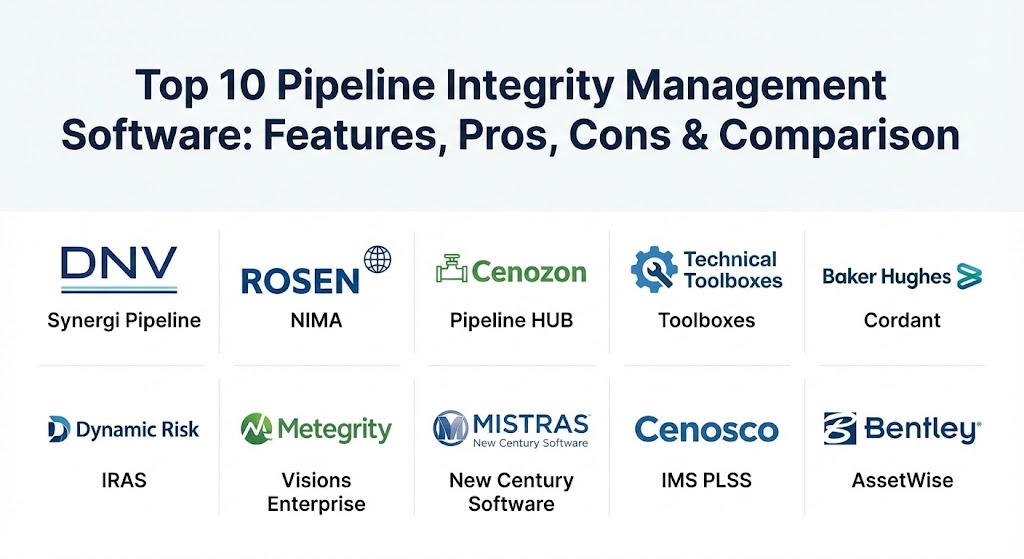
1 — DNV (Synergi Pipeline)
Synergi Pipeline is widely considered the industry standard for comprehensive integrity management. It supports the entire “Plan-Do-Check-Act” lifecycle, helping operators stay compliant with global standards like API RP 1173.
- Key features:
- Integrated risk assessment for both onshore and offshore assets.
- Advanced anomaly management with automated priority boards.
- Support for multi-vendor ILI data and GIS integration (Esri).
- Built-in “What-If” analysis for evaluating mitigation strategies.
- Regulatory compliance dashboards for PHMSA and other global bodies.
- Automated tracking of activity status and compliance dates.
- Pros:
- Unmatched depth in engineering analysis and defect modeling.
- Extensive global track record and strong alignment with industry codes.
- Cons:
- Highly complex; requires a dedicated team of engineers to maintain.
- Implementation can be a lengthy and expensive multi-month process.
- Security & compliance: SOC 2 Type II, ISO 27001, and role-based access control (RBAC).
- Support & community: World-class consulting services and a large global user network with frequent technical webinars.
2 — ROSEN Group (NIMA)
NIMA is a modern, web-based integrity management platform that focuses on breaking down data silos. It uses “Process Templates” to provide transparency into how risk is calculated, moving away from “black box” algorithms.
- Key features:
- Open and customizable process templates for integrity assessments.
- Vendor-agnostic data ingestion (SQL, Esri, flat files).
- Integrated Integrity Data Warehouse (IDW) for predictive analytics.
- Qualitative and Quantitative Risk Assessment (QRA) modules.
- Real-time dashboards for executive-level asset health visibility.
- High-performance GIS visualization within a browser.
- Pros:
- Very transparent; users can see and edit the logic behind the risk models.
- SaaS-native architecture allows for 24/7 access without local server lag.
- Cons:
- Best utilized by organizations that also use ROSEN’s inspection services.
- Advanced customization requires significant initial configuration time.
- Security & compliance: Advanced encryption, multi-factor authentication (MFA), and GDPR compliance.
- Support & community: High-touch customer success and a “deep bench” of data experts for ETL support.
3 — Cenozon (Pipeline HUB)
Pipeline HUB (PHUB) is a cloud-based solution that excels in data centralization and regulatory compliance, particularly for the North American market. It is designed to be the single source of truth for all pipeline data.
- Key features:
- Automated regulatory reporting for AER, BCER, and PHMSA.
- Integrated HCA (High Consequence Area) and class location analysis.
- Risk-based inspection (RBI) planning and optimization.
- Field data collection via mobile apps for instant synchronization.
- Document linking for easy audit retrieval.
- Collaborative workflows for integrity and operations teams.
- Pros:
- The most approachable UI among the major enterprise PIMS.
- Excellent for automating the “boring but critical” paperwork of compliance.
- Cons:
- May lack some of the deeper “physics-based” failure simulations found in DNV.
- Focused heavily on the North American regulatory environment.
- Security & compliance: SOC 2 Type II compliant with end-to-end data encryption.
- Support & community: Highly responsive technical support and comprehensive user training.
4 — Technical Toolboxes (Performance Solution)
Technical Toolboxes provides a suite of engineering-heavy tools designed specifically for the “hands-on” integrity engineer. Their platform focuses on the math and physics of pipeline health.
- Key features:
- Encompasses 230+ engineering calculators (RSTRENG, etc.).
- Advanced IMU (Inertial Measurement Unit) data visualization.
- On-demand strain calculation and screening.
- Cross-comparison of current vs. baseline ILI datasets.
- Risk-based strain growth forecasting.
- Automated conversion of vendor-specific data to consistent signs.
- Pros:
- The “one-stop shop” for the actual engineering calculations.
- Simplifies the complex task of vendor data alignment and normalization.
- Cons:
- The interface can feel more like a technical workbench than a modern dashboard.
- Less focused on high-level “enterprise workflow” than tools like NIMA.
- Security & compliance: Varies by deployment; generally follows ISO 27001 benchmarks.
- Support & community: Extensive library of engineering training and professional development credits.
5 — Baker Hughes (Cordant Asset Integrity)
As part of the Cordant suite, this tool leverages Baker Hughes’ deep expertise in hardware and sensing to provide a “Digital Twin” approach to pipeline management.
- Key features:
- Integration with real-time IoT sensors and SCADA data.
- AI-driven predictive maintenance for degradation modeling.
- Visual asset health monitoring across global fleets.
- Integrated leak detection and alarm management.
- Sustainability metrics for tracking emissions and energy efficiency.
- Deep connection to Baker Hughes inspection hardware.
- Pros:
- Excellent for operators moving toward a “Digital Twin” strategy.
- Strong “real-time” monitoring capabilities that go beyond static data.
- Cons:
- Can be very expensive for small to mid-sized operators.
- Heavily optimized for the broader Baker Hughes ecosystem.
- Security & compliance: Enterprise-grade security with advanced audit logs and SSO.
- Support & community: Global enterprise support with 24/7 technical assistance.
6 — Dynamic Risk (IRAS)
The Integrity Risk Assessment Suite (IRAS) is built around a “Risk Informed” decision-making philosophy. It focuses on helping companies allocate their maintenance budgets where they will have the most impact.
- Key features:
- Quantitative risk modeling based on industry-leading algorithms.
- Lifecycle management from design and construction to abandonment.
- Automated HCA and MCA (Moderate Consequence Area) identification.
- Corrosion management framework and anomaly tracking.
- Cost-benefit analysis for various mitigation scenarios.
- Scalable architecture for small regional lines to trans-continental networks.
- Pros:
- The consulting arm behind the software provides excellent domain expertise.
- Very strong for “Long-Range Planning” and budgetary forecasting.
- Cons:
- The UI is functional but lacks some of the modern “drag-and-drop” feel.
- High level of expertise required to configure the risk models correctly.
- Security & compliance: SOC 2 compliant; adheres to PHMSA and CSA Z662 standards.
- Support & community: Excellent consulting services and a dedicated customer success portal.
7 — Metegrity (Visions Enterprise)
Visions Enterprise is a robust Asset Integrity Management (AIM) platform that is particularly strong for facilities that manage both “inside the fence” piping and long-haul pipelines.
- Key features:
- Unified management of pipelines, pressure vessels, and tanks.
- Risk-Based Inspection (RBI) following API 580/581.
- Corrosion management and thickness monitoring (TML) tracking.
- Mobile inspection app for offline field data entry.
- Integration with major ERP systems like SAP and IBM Maximo.
- Detailed audit trails for every change in asset data.
- Pros:
- Ideal for refineries or chemical plants that need one tool for all assets.
- Very strong integration with daily maintenance workflows (Work Orders).
- Cons:
- Can be “over-featured” if you only manage linear pipeline segments.
- Implementation requires significant data cleanup and mapping.
- Security & compliance: ISO certified, supports SSO, and provides deep audit logs.
- Support & community: Strong North American presence with professional implementation services.
8 — MISTRAS Group (New Century Software)
MISTRAS, through their New Century Software brand, provides a GIS-centric approach to integrity. It is the go-to for operators who view their pipelines through a spatial lens.
- Key features:
- Gas HCA / Liquid HCA Analyst for geographic consequence modeling.
- SheetCutter Pro for automated alignment sheet generation.
- InTrack for ILI data ingestion and anomaly management.
- Spatial Synchronizer for keeping GIS and PODS databases in sync.
- Traceable, Verifiable, and Complete (TVC) data management.
- Pros:
- The industry leader for GIS data management and alignment sheets.
- Essential for meeting “TVC” regulatory requirements for records.
- Cons:
- More of a “modular” suite than a single unified “all-in-one” platform.
- Requires a strong underlying GIS infrastructure (Esri ArcGIS).
- Security & compliance: Follows ArcGIS security standards including SSO and secure hosting.
- Support & community: Very large community of GIS professionals in the energy sector.
9 — Cenosco (IMS PLSS)
IMS PLSS (Pipeline and Subsea Systems) is a cloud-based software that focuses on optimizing inspection costs while ensuring maximum safety for onshore and subsea assets.
- Key features:
- Corrosion management framework linked to data historians.
- Automated anomaly management with “Traffic Light” status.
- Scenario-based risk simulations for remedial action planning.
- Native integration with SAP, JDE, and Maximo.
- Specific modules for subsea integrity and offshore risers.
- Pros:
- Very practical for real-world budgeting and “What-If” planning.
- Excellent for offshore and subsea operators.
- Cons:
- Less brand recognition in the North American onshore market compared to DNV.
- Primarily a cloud-first solution; may not appeal to “air-gapped” data centers.
- Security & compliance: ISO 27001 certified and GDPR compliant.
- Support & community: Growing online knowledge base and responsive European-based support.
10 — Bentley Systems (AssetWise for Pipelines)
Bentley is a giant in infrastructure software, and AssetWise brings that “civil engineering” scale to pipeline integrity, focusing heavily on linear asset visualization.
- Key features:
- Best-in-class GIS integration and 3D visualization.
- Configuration-driven risk and compliance engine.
- Operational analytics for tracking degradation over time.
- Integration with engineering design models (OpenRoads/OpenPlant).
- Comprehensive document and record management.
- Pros:
- Superior at managing the “entire infrastructure” (Bridges, Roads, Pipes).
- Excellent for very large, state-owned or multi-national operators.
- Cons:
- Not as specialized in “Piping Physics” (e.g., ILI anomaly math) as ROSEN or DNV.
- High cost of entry and complex enterprise deployment.
- Security & compliance: FedRAMP authorized (specific versions), ISO 27001, and SOC 2.
- Support & community: Massive global support network and extensive online training (Bentley Institute).
Comparison Table
| Tool Name | Best For | Platform(s) Supported | Standout Feature | Rating (Gartner/TrueReview) |
| DNV Synergi | Global Enterprises | On-Prem / Cloud | PDCA Cycle Support | 4.7 / 5 |
| ROSEN NIMA | Transparent Risk | Cloud (SaaS) | Open Process Templates | 4.6 / 5 |
| Cenozon PHUB | Regulatory Compliance | Cloud (SaaS) | Automated Reporting | 4.5 / 5 |
| Technical Toolboxes | Integrity Engineers | Desktop / Cloud | IMU Data Analysis | 4.4 / 5 |
| Baker Hughes | Digital Twins | Cloud / IoT | Real-time Sensor Sync | 4.3 / 5 |
| Dynamic Risk | Financial Planning | On-Prem / Cloud | Risk-Informed Planning | 4.5 / 5 |
| Metegrity Visions | Facility + Pipeline | On-Prem / Cloud | Unified Asset Management | 4.4 / 5 |
| New Century | GIS Professionals | ArcGIS-integrated | Alignment Sheet Automation | 4.6 / 5 |
| Cenosco IMS | Subsea & Offshore | Cloud (SaaS) | “What-If” Remediation | 4.3 / 5 |
| Bentley AssetWise | Large Infrastructure | Cloud / On-Prem | 3D GIS Visualization | 4.2 / 5 |
Evaluation & Scoring of Pipeline Integrity Management Software
Evaluating PIMS requires a shift from looking at “features” to looking at “data outcomes.” A tool is only useful if it can accurately predict the remaining life of a asset based on dirty, real-world data.
| Category | Weight | Evaluation Criteria |
| Core Features | 25% | ILI data ingestion, risk modeling (RBI), anomaly management, and GIS sync. |
| Ease of Use | 15% | Intuitiveness for field users and the clarity of executive dashboards. |
| Integrations | 15% | Native connectivity with Esri, SAP, Maximo, and various ILI vendor formats. |
| Security & Compliance | 10% | SOC 2/ISO status, data residency options, and regulatory report automation. |
| Performance | 10% | Processing speed for massive ILI datasets and GIS rendering speed. |
| Support & Community | 10% | Availability of domain-expert consulting and user training programs. |
| Price / Value | 15% | Total cost of ownership vs. the reduction in unplanned downtime and risk. |
Which Pipeline Integrity Management Tool Is Right for You?
The right choice depends on your organization’s “Integrity Maturity” and existing tech stack.
- Solo Users vs SMBs: Most small operators don’t need a full DNV or ROSEN suite. Cenozon or JSCAPE (see our other post) are often more approachable. If you just need the math, Technical Toolboxes is the best bang-for-your-buck for a single engineer.
- Budget-Conscious vs Premium: DNV and ROSEN are premium investments. If budget is tight, look for modular solutions where you can buy only the risk module you need today and add the HCA or ILI modules later.
- Feature Depth vs Ease of Use: If you have a team of Ph.D. integrity engineers, they will want the “black box” flexibility of DNV. If your goal is to let your general maintenance manager see a “Red/Yellow/Green” status on a map, Cenozon or New Century are better.
- Integration Needs: If your company is “all-in” on Esri ArcGIS, New Century Software is the natural extension. If you use SAP for everything, Metegrity or Cenosco have pre-built connectors that will save months of IT work.
Frequently Asked Questions (FAQs)
1. What is the main goal of PIMS? To prevent pipeline failures by centralizing data, assessing risks (corrosion, cracking, etc.), and prioritizing maintenance where it is most needed.
2. Can PIMS handle In-Line Inspection (ILI) data? Yes, most top-tier PIMS can ingest data from “smart pigs” (MFL, UT, etc.) and align it with previous runs to calculate corrosion growth rates.
3. Is cloud-based PIMS safe for sensitive infrastructure? Modern SaaS PIMS use government-grade encryption (SOC 2) and often offer private cloud options for companies with strict data residency requirements.
4. What is HCA Analysis? High Consequence Area analysis identifies regions where a pipeline failure would have the greatest impact on people or the environment (e.g., populated areas or water sources).
5. How long does implementation take? A basic cloud setup can take 4–8 weeks, but a full enterprise migration with historical data cleanup can take 6–12 months.
6. Does PIMS replace GIS? No. PIMS integrates with GIS. While PIMS might have a map view, it relies on the GIS (like Esri) to manage the spatial “source of truth.”
7. Can it manage offshore/subsea assets? Yes, tools like DNV Synergi and Cenosco IMS have specific modules for the unique threats faced by subsea pipelines and risers.
8. Is PIMS mandatory? While the software isn’t always legally required, the integrity management plan (IMP) is often mandated by law, and PIMS is the only practical way to manage one at scale.
9. What is “TVC” data? Traceable, Verifiable, and Complete. It is a regulatory standard (PHMSA) that requires operators to prove the history and properties of their pipeline materials.
10. How does AI help in PIMS? AI is used to “clean” noisy ILI data, predict future corrosion hotspots, and automate the identification of anomalies that a human might miss.
Conclusion
Choosing a Pipeline Integrity Management Software is a multi-year commitment that affects every level of your organization. While the engineering math is crucial, the “best” tool is ultimately the one that your team will actually use. A platform that provides deep insights but sits unused because it’s too complex is a failed investment. Prioritize data transparency, regulatory alignment, and a vendor that understands your specific geography—because at the end of the day, these tools are what stand between safe operations and the next major headline.