Introduction
A Personalization Engine is a specialized software solution that uses data, artificial intelligence (AI), and machine learning (ML) to tailor digital experiences to individual users in real-time. Unlike traditional marketing tools that rely on static “if-then” logic, these engines analyze vast amounts of behavioral data—such as browsing history, purchase patterns, geographic location, and device type—to predict what a user wants next. By automating this process at scale, companies can create hyper-relevant touchpoints across websites, mobile apps, emails, and even physical kiosks.
The importance of these platforms lies in their direct impact on business performance. They increase conversion rates, boost average order value (AOV), and significantly improve customer lifetime value (CLV) by fostering deeper brand loyalty. Key real-world use cases include dynamic content blocks that change based on a user’s interests, personalized product recommendations that drive cross-selling, and behavioral triggers that send a discount code the moment a user shows intent to abandon their cart. When choosing a tool, users should evaluate the depth of AI capabilities, omnichannel support, ease of integration, and data latency (the speed at which the engine reacts to a user’s action).
Best for: Large e-commerce retailers, global B2B enterprises, media streaming services, and financial institutions. It is a must-have for Chief Marketing Officers (CMOs) and Digital Product Managers who are tasked with scaling customer engagement and optimizing the digital funnel.
Not ideal for: Small local businesses with a single, static web page or blogs that do not sell products or services. If your primary goal is simply to provide information rather than drive specific user actions, a full-scale personalization engine may provide more complexity and cost than the potential return justifies.
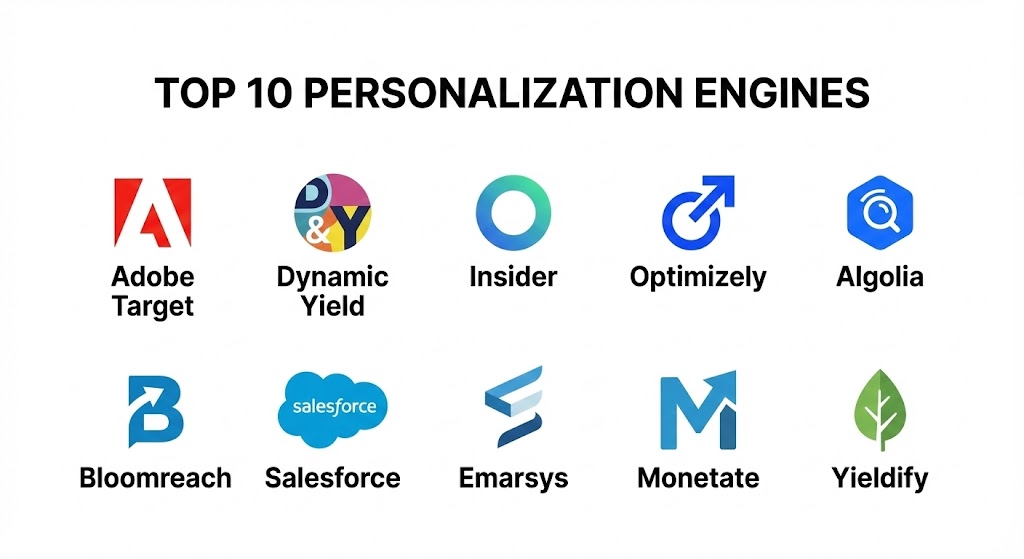
Top 10 Personalization Engines Tools
1 — Adobe Target
Adobe Target is arguably the most recognized name in the enterprise personalization space. Part of the Adobe Experience Cloud, it is a robust, rule-based, and AI-driven platform that excels at A/B testing, multivariate testing, and automated personalization at a massive scale.
- Key features:
- Auto-Target: Uses machine learning to identify the best experience for each individual user.
- Automated Personalization: Scales 1:1 experiences across millions of visitors simultaneously.
- Visual Experience Composer: Allows non-technical marketers to create tests and personalized content without writing code.
- Adobe Sensei Integration: Leverages Adobe’s overarching AI to predict customer behavior.
- Recommendations: Sophisticated algorithms for product, content, and category suggestions.
- Server-side & Client-side delivery: Flexible implementation options for performance-minded teams.
- Pros:
- Unrivaled integration with Adobe Analytics and Adobe Experience Manager.
- Extremely powerful for complex, high-traffic enterprise environments.
- Cons:
- High cost of entry makes it inaccessible for small to mid-sized businesses.
- The learning curve can be steep, often requiring specialized training or consultants.
- Security & compliance: SSO, 256-bit encryption, SOC 2 Type II, GDPR, HIPAA, and ISO 27001 compliant.
- Support & community: Extensive documentation, global community forums, and dedicated customer success managers for enterprise tiers.
2 — Dynamic Yield (by Mastercard)
Dynamic Yield, now owned by Mastercard, is a leader in agility and speed. It is an “Experience Optimization” platform that provides a unified data layer to deliver personalized, optimized, and synchronized experiences across web, apps, and email.
- Key features:
- Experience OS: A modular framework that allows teams to build their own personalization logic.
- A/B Testing & Optimization: Built-in experimentation for every personalized element.
- Omnichannel Personalization: Syncs user profiles across different devices in real-time.
- Deep Learning Recommendations: Advanced algorithms that go beyond simple “frequently bought together” logic.
- Predictive Targeting: Segments users based on their likelihood to buy or churn.
- Content Personalization: Changes banners, text, and layouts based on user affinity.
- Pros:
- Known for a very intuitive user interface that empowers marketers to move fast.
- Highly flexible and integrates well with a variety of e-commerce platforms.
- Cons:
- Can become quite expensive as traffic volumes and the number of experiences grow.
- Reporting can occasionally be complex to navigate for very granular data sets.
- Security & compliance: ISO 27001, SOC 2 Type II, GDPR, and PCI DSS compliant.
- Support & community: High-quality onboarding, responsive technical support, and an active user community.
3 — Insider
Insider is an “Integrated Growth Management Platform” that focuses heavily on the mobile and multi-channel customer journey. It is widely used by retailers and travel companies to connect data across disparate channels to drive growth.
- Key features:
- Unified Customer Data Platform (CDP): Connects data from web, app, email, and SMS.
- Predictive Segmentation: Uses AI to identify users with high lifetime value or high intent.
- Web Push & Mobile App Push: Personalized notifications that drive users back to the platform.
- WhatsApp Business Integration: One of the leaders in personalized messaging for social commerce.
- Individualized Product Discovery: AI search and recommendations tailored to the user’s intent.
- Journey Planner: Visual tool to map out complex, multi-step customer experiences.
- Pros:
- Excellent for mobile-first brands that rely heavily on messaging and push notifications.
- Very fast implementation and “time to value” compared to other enterprise suites.
- Cons:
- The platform is massive; it’s easy to get overwhelmed by the sheer number of features.
- Integration with legacy, on-premise systems can sometimes require more custom work.
- Security & compliance: SOC 2, ISO 27001, HIPAA, and GDPR compliant.
- Support & community: Dedicated growth experts for account management and extensive documentation.
4 — Optimizely (Experimentation & Personalization)
Optimizely is a powerhouse in the world of A/B testing that has evolved into a sophisticated personalization engine. It is built for teams that prioritize experimentation as the foundation of their personalization strategy.
- Key features:
- Personalization Campaigns: Deliver targeted experiences based on user attributes and behavior.
- Full Stack Experimentation: Allows developers to test features and logic on the server side.
- Adaptive Acceleration: Uses AI to optimize site performance alongside personalization.
- Stats Engine: Provides mathematically rigorous results that minimize the risk of false positives.
- Visual Editor: No-code editor for rapid marketing changes.
- Audience Builder: Drag-and-drop segmentation based on real-time data.
- Pros:
- The absolute gold standard for teams that want to prove the ROI of every personalized element through testing.
- Extremely stable and reliable for high-traffic environments.
- Cons:
- The pricing model can be aggressive for businesses scaling their traffic.
- Some of the more advanced personalization features require significant technical setup.
- Security & compliance: SOC 2 Type II, GDPR, HIPAA, and ISO 27001 compliant.
- Support & community: Massive global community, “Optimizely Academy” training, and 24/7 technical support.
5 — Algolia (Personalized Search & Discovery)
Algolia is traditionally known for search, but its personalization engine is what sets it apart in 2025. It focuses on the “Discovery” phase, ensuring that when a user searches or browses, the results are tailored to their specific affinities.
- Key features:
- NeuralSearch: Combines keyword matching with vector-based semantic understanding.
- Dynamic Re-ranking: Automatically moves results up or down based on individual user behavior.
- Affinities & Preferences: Builds a profile of what brands, colors, or categories a user prefers.
- API-First Architecture: Built for developers to integrate personalization into any custom frontend.
- Merchandising Console: Allows marketers to “boost” specific items while the AI handles the rest.
- A/B Testing for Search: Test different ranking algorithms to see what drives the most clicks.
- Pros:
- Unmatched speed; results are delivered in milliseconds.
- Best-in-class for retailers where search is the primary way users find products.
- Cons:
- Focuses primarily on search and discovery; less of a “full-site” layout tool like Adobe Target.
- Requires developer resources for initial implementation and custom UI work.
- Security & compliance: ISO 27001, SOC 3, HIPAA, and GDPR compliant.
- Support & community: Extensive developer documentation, active Discord community, and high-tier enterprise support.
6 — Bloomreach
Bloomreach is a “Commerce Experience Cloud” that combines a headless CMS, a discovery engine (search/merchandising), and a marketing automation platform. It is designed specifically for the complexities of e-commerce.
- Key features:
- Loomi AI: A specialized e-commerce AI that understands product data and user intent.
- Semantic Search: Understands the “why” behind a user’s search query to deliver relevant results.
- Real-time CDP: Unifies customer data to power personalized emails, SMS, and web content.
- Pathways & Recommendations: Automates the “next best action” for every shopper.
- Visual Merchandising: Powerful controls for e-commerce teams to manage product ranking.
- Headless CMS integration: Personalized content delivery to any device or frontend.
- Pros:
- One of the few platforms that truly bridges the gap between “Content” and “Commerce.”
- Deeply specialized for the retail sector with built-in e-commerce logic.
- Cons:
- Can be complex to set up if you are not already using a headless or modern architecture.
- The cost is high, reflecting its status as an enterprise-grade solution.
- Security & compliance: ISO 27001, SOC 2, and GDPR compliant.
- Support & community: Robust training via “Bloomreach Academy” and dedicated customer success.
7 — Salesforce Marketing Cloud Personalization
Formerly known as Interaction Studio, this is Salesforce’s answer to real-time personalization. It is an integral part of the Salesforce ecosystem, making it the default choice for companies already using Salesforce CRM.
- Key features:
- Einstein AI: Powers predictive modeling and automated decision-making.
- Real-time Interaction Management (RTIM): Reacts to user actions in milliseconds across channels.
- Customer Profile Cloud: Builds a 360-degree view of every customer in the CRM.
- Cross-channel Coordination: Ensures the message on the website matches the one in the call center.
- Next-Best-Action: Recommends the specific product or service a user is most likely to need next.
- A/B Testing: Built-in experimentation for all personalization campaigns.
- Pros:
- The most powerful tool for businesses where the CRM is the center of the universe.
- Unrivaled for B2B use cases and complex lead nurturing.
- Cons:
- Can feel “bloated” and slow to configure if you are not fully invested in Salesforce.
- Licensing is complex and can become extremely expensive for large datasets.
- Security & compliance: FedRAMP, HIPAA, SOC 2, and GDPR compliant.
- Support & community: Massive “Trailblazer” community, extensive documentation, and global support.
8 — Emarsys (by SAP)
Emarsys is an omnichannel customer engagement platform that was acquired by SAP. It focuses on automating personalization to drive business outcomes like revenue and customer retention.
- Key features:
- Vertical-specific AI: Pre-built models for Retail, Travel, and E-commerce.
- Loyalty Management: Integrated tools to personalize loyalty rewards and tiers.
- Automated Product Recommendations: Scales 1:1 suggestions across email and web.
- Unified Data Layer: Consolidates behavioral and transactional data.
- Strategy Node: A visual interface to build “If/Then” customer journeys at scale.
- Predictive Analytics: Identifies customers at risk of churning before they leave.
- Pros:
- Highly effective for brands that want “Ready-to-use” strategies for specific industries.
- Excellent balance between marketing automation and personalization.
- Cons:
- Reporting can be less flexible than standalone analytics platforms.
- Integration with non-SAP systems can sometimes be a multi-step process.
- Security & compliance: ISO 27001, SOC 2, and GDPR compliant.
- Support & community: Global SAP support infrastructure and dedicated customer success managers.
9 — Monetate
Monetate is one of the “original” personalization platforms that has consistently evolved. It is highly regarded in the retail industry for its focus on the “shoppability” of a website and its powerful segmentation engine.
- Key features:
- Contextual Personalization: Uses weather, location, and referral source to trigger content.
- Automated Personalization Engine: Decides which experience to show based on ML.
- Dynamic Bundling: Creates personalized product sets to increase AOV.
- Badging & Social Proof: Dynamically adds labels like “Top Seller” or “Low Stock” based on real-time data.
- Testing & Targeting: Robust A/B and multivariate testing.
- Action Builder: Allows marketers to create complex UI changes without IT.
- Pros:
- Strong history of reliability and high-quality customer service.
- Exceptional at handling the nuances of retail seasonality and promotional cycles.
- Cons:
- The UI can sometimes feel a bit “legacy” compared to newer startups like Insider.
- Deployment of complex server-side tests can be more involved than client-side changes.
- Security & compliance: SOC 2 Type II, GDPR, and HIPAA compliant.
- Support & community: High-touch support model and a solid library of case studies and guides.
10 — Yieldify (by Publicis Sapient)
Yieldify is a “Website Personalization” tool that focuses on the conversion end of the funnel. It is designed to be easier to use and more accessible than the massive enterprise suites like Adobe.
- Key features:
- In-page Content: Swap out banners and text based on the user’s intent.
- Exit-intent Overlays: Targeted pop-ups to stop users from leaving the site.
- Social Proof & Urgency: Dynamic messaging like “10 people are looking at this right now.”
- CRM Sync: Feeds lead data directly into your marketing stack.
- A/B Testing: Simple tools to test every overlay and message.
- Audience Segmentation: Intuitive builder for targeting specific user groups.
- Pros:
- Great “Time to Value”—you can have it running and driving revenue in days.
- Very cost-effective for mid-market retailers who aren’t ready for a six-figure contract.
- Cons:
- Less powerful in terms of “Deep Learning” compared to Dynamic Yield or Adobe.
- Primarily focused on the website; less omnichannel breadth than Salesforce.
- Security & compliance: GDPR compliant and SOC 2 (varies by tier).
- Support & community: Known for excellent account management and “managed services” options.
Comparison Table
| Tool Name | Best For | Platform(s) Supported | Standout Feature | Rating (Gartner) |
| Adobe Target | Large Enterprises | Web, App, Email | Adobe Sensei AI | 4.6 / 5 |
| Dynamic Yield | Agility & Retail | Web, App, Email | Experience OS | 4.7 / 5 |
| Insider | Mobile-first Growth | Web, App, WhatsApp | Multi-channel CDP | 4.8 / 5 |
| Optimizely | Testing-led Teams | Web, App, Server | Rigorous Stats Engine | 4.5 / 5 |
| Algolia | Search & Discovery | Web, App, API | NeuralSearch AI | 4.5 / 5 |
| Bloomreach | Headless Commerce | Web, App, CMS | E-com specific AI | 4.4 / 5 |
| Salesforce | Salesforce Users | Web, App, CRM | Deep CRM Data Sync | 4.1 / 5 |
| Emarsys | Marketing Automation | Web, Email, SMS | Vertical-specific AI | 4.3 / 5 |
| Monetate | High-end Retail | Web, Mobile | Contextual Triggers | 4.4 / 5 |
| Yieldify | Conversion / SMB | Web, Mobile | Exit-intent logic | 4.3 / 5 |
Evaluation & Scoring of Personalization Engines
Selecting the right engine requires a balanced look at technical capability versus the ease of management. We use the following weighted scoring rubric to evaluate these platforms for modern business needs:
| Criteria | Weight | Evaluation Rationale |
| Core Features | 25% | Presence of AI/ML, omnichannel support, and real-time data sync. |
| Ease of Use | 15% | The quality of the UI and the ability for marketers to act without IT. |
| Integrations | 15% | Depth of the ecosystem (CMS, CRM, Analytics). |
| Security & Compliance | 10% | Global certifications (SOC 2, GDPR, HIPAA). |
| Performance | 10% | Latency of the engine and impact on page load times. |
| Support & Community | 10% | Onboarding quality and the availability of external expertise. |
| Price / Value | 15% | ROI potential relative to the total cost of ownership. |
Which Personalization Engines Tool Is Right for You?
Solo Users vs SMB vs Mid-market vs Enterprise
If you are a solo user or a very small operation, a personalization engine is likely overkill. Focus instead on simple email segmentation. SMBs (Small to Mid-sized Businesses) will find the best value in Yieldify or the starter plans of Insider. Mid-market companies that need a balance of power and speed should look toward Dynamic Yield or Optimizely. Enterprise organizations with complex data structures and high traffic must choose from the “Big Three”: Adobe Target, Salesforce, or Bloomreach.
Budget-conscious vs Premium Solutions
For those on a tight budget, look for tools that offer a “pay-as-you-grow” model or focused conversion tools like Yieldify. If you are looking for a Premium solution where the investment is backed by deep AI and global infrastructure, Adobe Target and Dynamic Yield provide the highest ceiling for growth, provided you have the team to manage them.
Feature Depth vs Ease of Use
If you need Feature Depth—such as testing new algorithms on the server side or complex B2B lead scoring—Optimizely and Salesforce are the leaders. If you prioritize Ease of Use so that your marketing team can launch a “Halloween Sale” campaign in 15 minutes, Insider and Dynamic Yield are significantly more intuitive.
Integration and Scalability Needs
If your stack is already Adobe-centric or Salesforce-centric, the decision is almost made for you. These platforms offer “out-of-the-box” synchronization that third-party tools can’t match. For those using a Headless architecture, Algolia and Bloomreach offer the most flexible API-first approaches that won’t lock you into a specific frontend.
Frequently Asked Questions (FAQs)
1. Is a personalization engine the same as a CDP?
No. A Customer Data Platform (CDP) collects and organizes your data. A personalization engine acts on that data in real-time. Many modern engines (like Insider) have a built-in CDP, but they are technically separate functions.
2. Does personalization slow down my website?
It can if the tool is not optimized. This is called “flicker” or “latency.” Modern engines use server-side delivery or “asynchronous” scripts to ensure that the personalization happens so fast that the user never notices a delay.
3. How much do these tools cost?
Enterprise solutions like Adobe Target can cost upwards of $100,000 per year. Mid-market solutions may start at $1,000 to $5,000 per month. Most pricing is based on the volume of monthly visitors or “impressions.”
4. Can I use a personalization engine for B2B?
Absolutely. In B2B, personalization is used for “Account-Based Marketing” (ABM). You can show different content to visitors based on the company they work for or their stage in the buying cycle.
5. How long does it take to see an ROI?
Most companies see a “lift” in conversion rates within the first 30 to 60 days of implementation, provided they have enough traffic to run valid tests.
6. Do I need a developer to run these?
Most modern engines have a “Visual Composer” for simple changes. However, for deep personalization (like changing the underlying logic of your pricing), you will definitely need a developer’s help.
7. Is personalization a privacy risk?
If not handled correctly, yes. However, all the tools on this list are designed to be GDPR and HIPAA compliant. They use “Anonymized IDs” to track users without ever knowing their real-world identity.
8. What is “Next Best Action” (NBA)?
NBA is a feature where the AI predicts the most logical thing a user should do next—whether that’s reading a specific article, signing up for a newsletter, or buying a specific product—and then serves that exact experience.
9. Can I personalize experiences for anonymous users?
Yes. Even if a user hasn’t logged in, the engine can personalize based on their location, the ad they clicked to get there, and their behavior during the current session.
10. What is a common mistake when starting?
Over-personalizing too fast. Start with a single “win”—like a personalized homepage banner—and then slowly add complexity as you learn what your audience responds to.
Conclusion
Personalization is no longer a futuristic concept; it is the current battleground for digital survival. Choosing the right Personalization Engine is a decision that impacts every stage of the customer journey, from the first search result to the final checkout.
The “best” tool is not necessarily the one with the most features, but the one that aligns with your technical maturity and business goals. If you are a mobile-first retailer, Insider is your best bet. If you are a global brand that lives and dies by data, Adobe Target remains the benchmark. Regardless of the choice, the goal remains the same: treat your customers like individuals, and they will reward you with their loyalty.