Introduction
Observability Platforms are comprehensive software solutions that unify the “three pillars” of telemetry: metrics, logs, and distributed traces. Unlike legacy monitoring tools that rely on pre-defined dashboards for “known-unknowns,” observability platforms allow engineers to explore “unknown-unknowns”—complex, emergent failure modes that haven’t been seen before. These platforms leverage high-cardinality data and AI-powered analytics to correlate signals across the entire stack, from the frontend user experience down to the underlying cloud infrastructure.
In 2026, the importance of these platforms has reached a fever pitch due to the sheer volume of telemetry data. Without a centralized platform, teams suffer from “tool sprawl,” alert fatigue, and siloed data that makes root-cause analysis nearly impossible. Key real-world use cases include incident response optimization, cloud cost management (FinOps), and software supply chain security. When choosing a tool, users should evaluate OpenTelemetry (OTel) native support, data cardinality handling, AI-assisted root cause analysis, and pricing transparency.
Best for: DevOps engineers, Site Reliability Engineers (SREs), and software architects in mid-market to enterprise-level organizations. It is essential for companies running high-scale microservices, e-commerce platforms, or mission-critical fintech applications where downtime directly translates to revenue loss.
Not ideal for: Small businesses with static websites, solo developers with simple monolithic apps, or organizations with predictable, low-traffic environments. For these users, basic infrastructure monitoring or free open-source tools like self-hosted Prometheus may be more cost-effective.
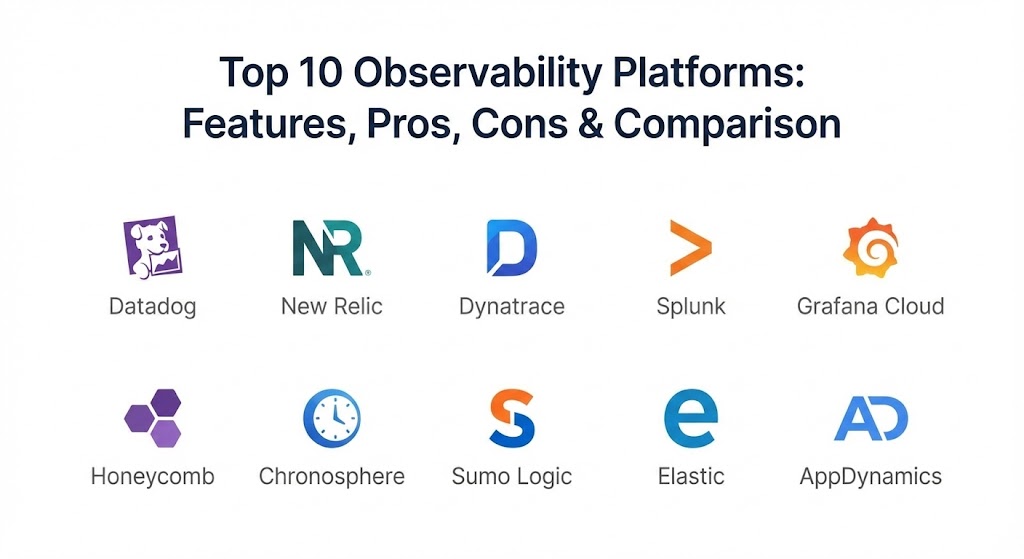
Top 10 Observability Platforms
1 — Datadog
Datadog remains the dominant force in the 2026 observability market, offering a unified SaaS platform that integrates monitoring, security, and analytics for every layer of the modern cloud stack.
- Key Features:
- Watchdog AI: Proactively detects anomalies and outliers across metrics and logs without manual configuration.
- Service Map: Automatically visualizes dependencies between microservices and databases in real-time.
- Unified Security: Correlates observability data with security threats to provide a “DevSecOps” view.
- Sensitive Data Scanner: Automatically identifies and masks PII within logs and traces.
- Serverless Monitoring: Deep, low-latency visibility into AWS Lambda, Azure Functions, and GCP Cloud Functions.
- Log Management: High-performance indexing and “Log Rehydration” from cold storage.
- Pros:
- Unrivaled breadth of 600+ integrations makes it a true “one-stop-shop” for observability.
- The most intuitive and polished user interface in the industry, significantly reducing onboarding time.
- Cons:
- Pricing is notoriously complex and can become astronomical as data volume scales.
- Proprietary agent-heavy architecture can lead to perceived vendor lock-in.
- Security & Compliance: SOC 2 Type II, HIPAA, ISO 27001, GDPR, and FedRAMP compliant. Supports SSO (SAML/Okta).
- Support & Community: Comprehensive documentation, 24/7 technical support, and a massive community-driven library of dashboards.
2 — New Relic
New Relic has repositioned itself as the “Developer-First” platform, emphasizing an all-in-one data model and a consumption-based pricing structure that appeals to high-velocity engineering teams.
- Key Features:
- NRDB: A high-performance, purpose-built database for storing and querying billions of telemetry events.
- New Relic Grok: A generative AI assistant that allows users to query their system using natural language.
- OTel-Native: First-class support for OpenTelemetry, allowing teams to move away from proprietary agents.
- Vulnerability Management: Automatically surfaces security risks within application dependencies.
- Unified Query Language (NRQL): A SQL-like language that allows for complex correlation across logs and metrics.
- Pros:
- Generous free tier (100GB/month) makes it an excellent entry point for growing startups.
- The usage-based pricing model is more predictable than the per-host models used by competitors.
- Cons:
- Advanced analysis requires a steep learning curve for mastering NRQL.
- The UI can occasionally feel cluttered due to the sheer number of features.
- Security & Compliance: SOC 2, HIPAA, ISO 27001, and GDPR compliant. Data encryption at rest and in transit.
- Support & Community: Active user forums, extensive “New Relic University” training, and professional enterprise support.
3 — Dynatrace
Dynatrace is the enterprise choice for high-automation environments, relying heavily on its “Davis” AI engine to perform automated root-cause analysis and problem remediation.
- Key Features:
- Davis AI: A causal AI engine that pinpoints the precise root cause of an issue rather than just correlating events.
- OneAgent: A single binary that automatically discovers and instruments every process on a host.
- Grail Data Lakehouse: A unified data store that eliminates data silos for logs, traces, and metrics.
- Smartscape Topology: A dynamic map that shows the vertical and horizontal relationships across the entire stack.
- PurePath Technology: Captures every single transaction, end-to-end, with no sampling.
- Pros:
- “Zero-effort” setup; OneAgent handles almost all instrumentation automatically.
- Unmatched at reducing “Mean Time to Repair” (MTTR) through automated problem detection.
- Cons:
- Extremely high premium pricing makes it difficult for smaller budgets to justify.
- The “black box” nature of its AI can sometimes make deep, manual exploratory analysis difficult.
- Security & Compliance: FedRAMP, SOC 2, HIPAA, and GDPR compliant. Includes built-in AppSec features.
- Support & Community: Premium enterprise support with dedicated account managers and a robust technical community.
4 — Splunk Observability Cloud
Following Cisco’s acquisition, Splunk has unified its world-class log analytics with the SignalFx infrastructure and APM suite to create a powerful platform for large-scale data analysis.
- Key Features:
- No-Sample Tracing: Captures 100% of traces to ensure that rare “edge case” bugs are never missed.
- Real-Time Streaming: Metrics are processed and alerted upon in seconds, not minutes.
- Splunk Log Observer: A streamlined interface for developers to explore logs without needing complex SPL.
- Network Performance Monitoring: Real-time visibility into hybrid and multi-cloud network traffic.
- IT Service Intelligence (ITSI): Uses machine learning to correlate observability data with business KPIs.
- Pros:
- The most powerful log search and analytics capabilities on the market.
- Excellent for large organizations that need to correlate technical data with business outcomes.
- Cons:
- High operational complexity; requires significant expertise to manage at scale.
- Fragmented UI history (Splunk vs. SignalFx) still shows in some areas.
- Security & Compliance: SOC 2, HIPAA, PCI DSS, and ISO 27001 compliant. Robust audit logging.
- Support & Community: Global enterprise support network and a very large, mature user base.
5 — Grafana Cloud
Grafana Labs has evolved the world’s favorite visualization tool into a fully managed, “composable” observability platform based on the popular “LGTM” stack (Loki, Grafana, Tempo, Mimir).
- Key Features:
- Mimir: An incredibly scalable metrics store that can handle billions of active series.
- Loki: A cost-efficient, log-aggregation system that indexes only metadata.
- Tempo: A high-scale, distributed tracing backend that integrates with OTel.
- Grafana On-Call: An integrated incident response and paging system.
- Enterprise Data Plugins: Connect to dozens of data sources (Splunk, Datadog, SQL) to create a single pane of glass.
- Pros:
- Best-in-class visualization; Grafana dashboards are the industry standard.
- Prevents vendor lock-in by sticking to open-source standards and “bring-your-own-data” models.
- Cons:
- “DIY” feel; requires more assembly and configuration than turnkey solutions like Datadog.
- Managing high-cardinality metrics in the Mimir backend requires deep expertise.
- Security & Compliance: SOC 2 Type II and GDPR compliant. Cloud instances are highly secure.
- Support & Community: The largest open-source community in the space; professional support from Grafana Labs.
6 — Honeycomb
Honeycomb is the “rebel” of the observability world, eschewing traditional metrics for a focus on raw, high-cardinality events that empower developers to ask unpredictable questions of their systems.
- Key Features:
- BubbleUp: Visually highlights the differences between “normal” and “error” traffic to identify the cause of issues.
- High-Cardinality Support: Handles data with millions of unique values (e.g., specific User IDs) without performance loss.
- Query Engine: Extremely fast ad-hoc queries that return results in seconds across trillions of rows.
- Service Level Objectives (SLOs): Focuses alerts on user-impacting trends rather than individual errors.
- Secure Tenancy: Allows users to encrypt data on-premise before sending it to the Honeycomb cloud.
- Pros:
- The absolute best tool for debugging complex, intermittent issues in distributed systems.
- Excellent developer experience; built by engineers, for engineers.
- Cons:
- Not a full infrastructure monitoring suite; doesn’t focus on CPU/RAM metrics as much as others.
- Requires a significant shift in “observability mindset” away from traditional dashboards.
- Security & Compliance: SOC 2 Type II compliant. Advanced privacy-preserving options for regulated industries.
- Support & Community: Very technical and responsive support; high-quality blog and educational content.
7 — Chronosphere
Chronosphere is designed specifically for organizations facing “metrics explosions”—teams with massive Kubernetes footprints and millions of active time-series that break traditional tools.
- Key Features:
- Control Plane: Allows users to shape, aggregate, and drop data at the point of ingestion to control costs.
- Prometheus-Compatible: Native support for PromQL and existing Prometheus configurations.
- Lens: Automatically creates service-centric views from raw telemetry data.
- High-Availability: Purpose-built for 99.99% uptime in mission-critical environments.
- Query Mapping: Optimizes complex queries to run significantly faster than standard Prometheus.
- Pros:
- Drastically reduces observability costs by eliminating “worthless” data at the ingest layer.
- Built for extreme scale; used by companies like Uber to manage petabytes of data.
- Cons:
- Niche focus on metrics and tracing; log management is not the primary strength.
- Primarily aimed at very large, technologically mature engineering organizations.
- Security & Compliance: SOC 2 Type II compliant. High-grade data encryption and audit logs.
- Support & Community: Professional enterprise support; focused on “Cloud-Native” community leadership.
8 — Sumo Logic
Sumo Logic is a cloud-native platform that specializes in log analytics and “DevSecOps,” offering a powerful unified view of operational health and security posture.
- Key Features:
- LogReduce & LogCompare: Uses AI to find patterns in millions of log lines and highlight differences between time periods.
- Cloud SIEM: Integrated security information and event management.
- Root Cause Explorer: A visual timeline that correlates infrastructure changes with error spikes.
- SLA/SLO Monitoring: Built-in tools for tracking and alerting on service level objectives.
- Multi-Cloud Visibility: Native collectors for AWS, Azure, and GCP that can be set up in minutes.
- Pros:
- Exceptional log management capabilities; arguably the best SaaS alternative to self-hosted ELK.
- Strong integration of security and operations in a single dashboard.
- Cons:
- The query language (similar to SQL but proprietary) takes time to master.
- Tracing capabilities are not as deep as those offered by Honeycomb or Dynatrace.
- Security & Compliance: PCI DSS, HIPAA, SOC 2 Type II, ISO 27001, and FedRAMP authorized.
- Support & Community: Extensive training certifications and professional global support.
9 — Elastic Observability
Built on the legendary ELK Stack (Elasticsearch, Logstash, Kibana), Elastic Observability provides a search-powered platform for metrics, logs, and APM.
- Key Features:
- Elasticsearch Engine: The world’s leading search engine powers the data retrieval and analytics.
- Machine Learning: Unsupervised anomaly detection that identifies unusual behavior in logs and metrics.
- Elastic Agent: A single agent for collecting logs, metrics, and security data.
- Kibana Dashboards: Highly flexible and powerful visualization layer.
- RUM & Synthetics: Comprehensive real-user and synthetic monitoring for front-end health.
- Pros:
- If you already use the ELK stack for search, adding observability is a natural and cost-effective extension.
- Unrivaled text-search performance across petabytes of log data.
- Cons:
- Self-hosting the stack is notoriously difficult to manage and scale at an enterprise level.
- Higher memory and storage requirements compared to lighter, metric-first platforms.
- Security & Compliance: SOC 2, HIPAA, and GDPR compliant. Robust RBAC and encryption.
- Support & Community: Massive global community; professional support available through Elastic Cloud.
10 — Cisco AppDynamics
AppDynamics has evolved into a “Business Observability” platform, focusing on correlating application performance with bottom-line business metrics like checkout revenue and user conversion.
- Key Features:
- Business iQ: Maps technical performance directly to business outcomes in real-time.
- Cognition Engine: AI-driven anomaly detection and automated problem diagnosis.
- SAP Monitoring: Specialized visibility into complex enterprise SAP environments.
- Secure Application: Native runtime application self-protection (RASP) within the monitoring agent.
- ThousandEyes Integration: Provides visibility into the internet and network performance between the user and the app.
- Pros:
- The best platform for non-technical stakeholders to understand system health via business impact.
- Excellent for large enterprises with complex legacy and SAP integrations.
- Cons:
- Setup and instrumentation can be heavy compared to modern “OneAgent” or OTel approaches.
- Pricing is at the highest end of the market and can be prohibitive for non-enterprise users.
- Security & Compliance: FedRAMP, SOC 2, and HIPAA compliant. Strong focus on enterprise security.
- Support & Community: High-tier professional services and 24/7 global support.
Comparison Table
| Tool Name | Best For | Platform(s) Supported | Standout Feature | Rating (Gartner / True) |
| Datadog | Unified SaaS / Multi-Cloud | All (SaaS-first) | 600+ Native Integrations | 4.5 / 5 |
| New Relic | Dev-First / Cost Control | All (Cloud) | Consumption-based pricing | 4.3 / 5 |
| Dynatrace | Automated Root Cause | Hybrid / Enterprise | Davis AI Causal Engine | 4.6 / 5 |
| Splunk | Log-Heavy Enterprise | Hybrid / Multi-Cloud | No-Sample Distributed Tracing | 4.4 / 5 |
| Grafana Cloud | Visualization / No-Lock-in | Any (OSS-native) | Composable LGTM Stack | 4.7 / 5 |
| Honeycomb | Debugging “Unknowns” | All (Cloud) | High-Cardinality Exploratory Query | 4.8 / 5 |
| Chronosphere | High-Scale Metrics | K8s / Multi-Cloud | Control Plane Data Shaping | 4.5 / 5 |
| Sumo Logic | DevSecOps / Log Analytics | Cloud-Native | LogReduce Pattern Analysis | 4.3 / 5 |
| Elastic | Search-Centric Teams | Any (Cloud/On-prem) | Search-Powered Analytics | 4.2 / 5 |
| AppDynamics | Business-Impact Focus | Enterprise / SAP | Business iQ Revenue Mapping | 4.1 / 5 |
Evaluation & Scoring of Observability Platforms
To determine the final rankings, we evaluated the platforms across seven critical dimensions using a weighted scoring model.
| Category | Weight | Evaluation Criteria |
| Core Features | 25% | Presence of the 3 Pillars (Metrics, Logs, Traces), APM, and RUM. |
| Ease of Use | 15% | UI responsiveness, query language complexity, and dashboard creation. |
| Integrations | 15% | Breadth of native connectors and OpenTelemetry support. |
| Security | 10% | PII masking, SSO, encryption, and regulatory certifications. |
| Performance | 10% | Ingest latency, query speed at scale, and agent overhead. |
| Support | 10% | Quality of documentation, community activity, and support SLAs. |
| Value | 15% | Pricing transparency, free tier quality, and total cost of ownership. |
Which Observability Platforms Tool Is Right for You?
Solo Users vs SMB vs Mid-Market vs Enterprise
If you are a solo user or a small startup, Grafana Cloud (Free Tier) or New Relic are the most logical choices; they provide high-end features with zero or low initial cost. SMBs should look at Datadog for its “all-in-one” simplicity. Enterprises with complex, mission-critical needs should prioritize Dynatrace or AppDynamics for their automation and business correlation features.
Budget-conscious vs Premium Solutions
For the budget-conscious, sticking to an open-source-first approach with Grafana Cloud or Chronosphere (for cost shaping) is the best way to keep bills predictable. If you are looking for a Premium Solution where saving developer hours is more important than the software license fee, Dynatrace is the leader in automated productivity.
Feature Depth vs Ease of Use
If you prioritize Ease of Use, Datadog is the undisputed champion; it is the “iPhone” of observability. If you require Feature Depth and the ability to perform deep, forensic debugging of rare system events, Honeycomb offers a level of insight that simpler tools cannot reach.
Frequently Asked Questions (FAQs)
1. What is the difference between monitoring and observability?
Monitoring is the act of collecting data and alerting on “known” failure modes (e.g., CPU > 90%). Observability is the capability of a system to provide enough context for you to explain why something happened, even if you never anticipated the failure.
2. What are the “Three Pillars” of observability?
They are Metrics (numbers over time), Logs (textual records of events), and Traces (the journey of a single request across services).
3. Do I really need distributed tracing?
If you are running microservices, yes. Without tracing, it is impossible to see where a request is slowing down or failing as it moves through multiple services and databases.
4. Is OpenTelemetry (OTel) important?
Absolutely. OTel is the industry standard for collecting telemetry data. Choosing an OTel-native platform ensures that you can switch vendors in the future without having to rewrite your code’s instrumentation.
5. How much should observability cost?
Industry consensus suggests that observability should ideally cost between $10\%$ and $20\%$ of your total infrastructure spend. If it exceeds that, you may need a tool like Chronosphere to shape your data.
6. Can I build my own observability stack?
Yes, using the “LGTM” stack (Loki, Grafana, Tempo, Mimir) or ELK stack. However, the “hidden” costs of managing and scaling these systems often exceed the cost of a managed SaaS platform.
7. What is “high-cardinality” data?
It refers to data with many unique values, such as a “User ID” or “Order ID.” High-cardinality observability is critical for finding the specific users or transactions affected by a bug.
8. Why is AI/ML important in these platforms?
Modern systems generate too much data for humans to watch. AI (like Davis or Watchdog) acts as a force multiplier by filtering noise and highlighting the $1\%$ of data that actually represents a problem.
9. Can observability help with security?
Yes. In 2026, many platforms (Datadog, Dynatrace, Sumo Logic) integrate “Cloud Security” to catch threats using the same telemetry data used for performance monitoring.
10. Do I need to instrument my code manually?
Most modern platforms offer “Auto-Instrumentation” agents. However, for the best results, developers should add custom spans and attributes to their code to capture business-specific context.
Conclusion
The observability market of 2026 has moved beyond simple data collection and into the realm of actionable intelligence. While Datadog remains the most popular turnkey solution, platforms like Dynatrace (for automation), Honeycomb (for debugging), and Grafana Cloud (for open standards) have defined specialized niches that solve specific engineering pain points.
The “best” platform is not the one with the most features, but the one that aligns with your team’s technical maturity and your organization’s business goals. By moving away from siloed monitoring and toward a unified observability platform, you empower your developers to spend less time “firefighting” and more time building the features that drive your company forward.