Introduction
Music streaming apps are digital platforms that provide on-demand access to massive libraries of licensed audio content, including songs, podcasts, and audiobooks. Unlike the digital downloads of the past, these services rely on a subscription-based model—or ad-supported tiers—to deliver content directly to your devices via the internet. These tools are important because they have democratized global music access, allowing a listener in Tokyo to discover an indie artist in Nashville within seconds.
Key real-world use cases range from personalized mood curation (e.g., focus music for deep work) to social listening (e.g., collaborative playlists for parties) and high-fidelity home theater integration. When choosing a tool in this category, users should evaluate the audio bitrate (quality), the breadth of the library, algorithm accuracy, and how well the app integrates with their existing hardware—be it a smartphone, smart speaker, or car dashboard.
Best for: Casual listeners who enjoy AI-curated discovery, audiophiles with high-end audio gear, families looking for cost-effective shared plans, and independent artists seeking to discover underground talent. It is also essential for smart home enthusiasts who rely on voice-controlled music playback.
Not ideal for: Users in areas with extremely limited internet connectivity who cannot download music for offline use, or purists who only prefer physical media (vinyl/CDs) for the tactile experience and ownership. It may also be redundant for people who only listen to local terrestrial radio.
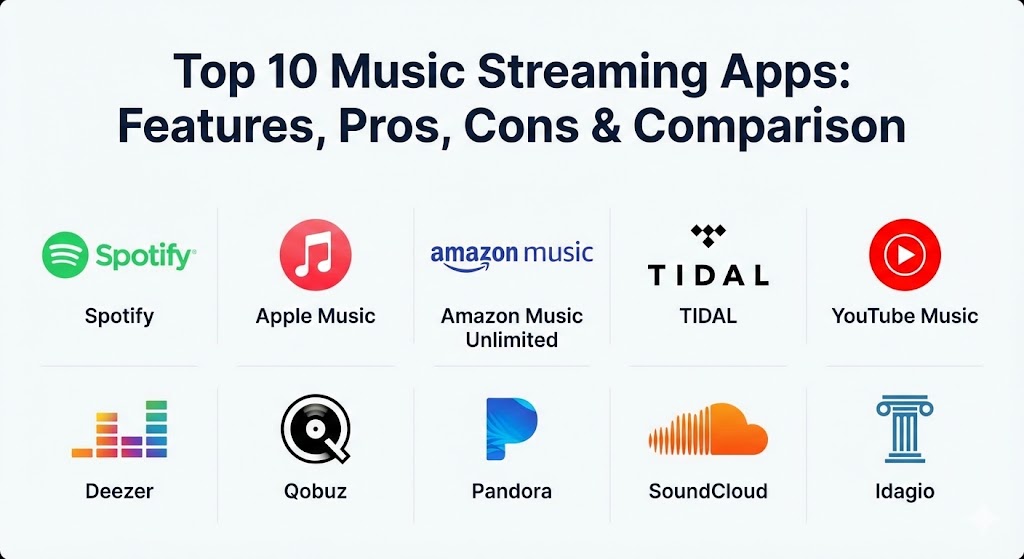
Top 10 Music Streaming Apps
1 — Spotify
Spotify remains the most recognizable name in the industry, dominating the market through a “discovery-first” approach. It has evolved into a comprehensive audio hub, integrating podcasts and audiobooks alongside its core music catalog.
- Key features:
- AI-Powered Discovery: Features like “Discover Weekly” and the “Spotify DJ” use advanced machine learning to predict your taste.
- Spotify Connect: Seamlessly switch playback between your phone, computer, smart speakers, and even gaming consoles.
- Collaborative Playlists: Real-time shared playlist editing and “Blends” with friends.
- Canvas & Clips: Short-form video content integrated into the listening experience.
- Massive Library: Over 100 million tracks and 5 million podcast titles.
- Pros:
- The best cross-platform compatibility in the industry.
- Unmatched social features and community-driven content.
- Cons:
- Still lacks a true “Hi-Fi” or lossless audio tier in many regions compared to rivals.
- The app interface can feel cluttered due to the aggressive push of podcasts and audiobooks.
- Security & compliance: GDPR and CCPA compliant; uses AES-256 for data encryption; supports SSO through various social platforms.
- Support & community: Excellent documentation; massive community forums; highly responsive social media support.
2 — Apple Music
Apple Music is the premier choice for those within the Apple ecosystem, offering a high-premium experience that prioritizes audio quality and editorial curation. It famously offers high-resolution lossless audio at no additional cost.
- Key features:
- Spatial Audio: Integration with Dolby Atmos for a 360-degree immersive sound experience.
- Apple Music Sing: A built-in karaoke feature with adjustable vocals and real-time lyrics.
- Live Radio: 24/7 global radio stations like Apple Music 1, hosted by professional DJs.
- Classical Music App: A dedicated standalone app for classical music enthusiasts included in the sub.
- iTunes Library Integration: Seamlessly merges your old local MP3 collection with the streaming cloud.
- Pros:
- Exceptional audio quality (Lossless and Hi-Res) included in the base price.
- Deep integration with Siri and the HomePod ecosystem.
- Cons:
- No free ad-supported tier; only offers a trial period.
- The Android version, while functional, lacks the polished smoothness of the iOS app.
- Security & compliance: Strict adherence to Apple’s Privacy Policy; end-to-end encryption for synced data; GDPR compliant.
- Support & community: Integrated with Apple Support; extensive Genius Bar and online technical guides.
3 — Amazon Music Unlimited
Amazon Music Unlimited has carved a niche by being the most convenient and cost-effective option for Amazon Prime members and Alexa users. It offers a massive catalog of HD and Ultra HD audio.
- Key features:
- Alexa Voice Control: Deeply optimized for hands-free control on Echo devices.
- Ultra HD Audio: Streams at up to 24-bit/192kHz, rivaling specialty audiophile services.
- X-Ray Lyrics: Scrolling lyrics that include “behind the scenes” trivia about the songs.
- Prime Integration: Discounted pricing for existing Prime members.
- Car Mode: A simplified UI specifically for use while driving.
- Pros:
- Significant value for money for those already paying for Amazon Prime.
- One of the largest libraries of high-resolution “Ultra HD” tracks.
- Cons:
- The user interface on both mobile and desktop feels less intuitive than Spotify or Apple.
- Algorithm-based recommendations are generally considered less accurate than competitors.
- Security & compliance: ISO 27001; SOC 2; GDPR; uses standard Amazon security protocols (SSO/2FA).
- Support & community: 24/7 customer chat support; extensive help documentation within the Amazon ecosystem.
4 — Tidal
Tidal positions itself as the “artist-first” streaming service, known for its commitment to high-fidelity sound and a unique payment model that directs more revenue to the musicians you listen to.
- Key features:
- Master Quality Authenticated (MQA): Provides studio-grade sound through advanced audio codecs.
- Tidal Rising: A dedicated platform for discovering and supporting emerging global artists.
- Direct Artist Payouts: A portion of your subscription goes directly to your most-played artist.
- Tidal Connect: Similar to Spotify Connect, it allows high-quality streaming to networked hi-fi systems.
- Exclusive Video Content: Access to high-definition music videos, documentaries, and live-streamed concerts.
- Pros:
- Best-in-class audio quality for serious audiophiles.
- Ethical branding that appeals to users who want to support creators fairly.
- Cons:
- The “HiFi Plus” tier is among the most expensive on the market.
- Smaller library for niche podcasts compared to Spotify.
- Security & compliance: GDPR and CCPA compliant; secure payment processing through third-party gateways.
- Support & community: Solid technical support; focus on editorial content rather than a large user forum.
5 — YouTube Music
YouTube Music is Google’s primary entry into the space, leveraging the world’s largest video library to provide content that simply cannot be found anywhere else, such as live performances and rare remixes.
- Key features:
- Video/Audio Toggle: Seamlessly switch between a music video and its audio-only version with one tap.
- YouTube Premium Bundle: Often bundled with YouTube Premium, removing ads from the entire YouTube site.
- Smart Search: Find songs by describing them (e.g., “that song that goes ‘da da da’ in the supermarket”).
- Unrivaled Catalog: Includes official tracks plus everything uploaded to YouTube (covers, live sets, bootlegs).
- Location-Based Playlists: Suggests music based on where you are (e.g., “Gym Mix” when at the fitness center).
- Pros:
- The best app for finding “unreleased” content and rare versions of songs.
- Incredible value if you are already a frequent YouTube video viewer.
- Cons:
- Audio quality (max 256kbps AAC) is lower than almost all other top-tier rivals.
- The desktop experience is a web-based app rather than a dedicated native program.
- Security & compliance: Google Cloud Security standards; SOC 2; GDPR; robust 2FA through Google accounts.
- Support & community: Extensive Google Help Center; active community of users on YouTube and Reddit.
6 — Deezer
Deezer is a French-founded service that is particularly popular in Europe and South America. It is best known for its “Flow” feature, which acts as a personalized, endless AI radio station.
- Key features:
- Flow: A unique AI that learns what you like and don’t like to create a never-ending mix.
- SongCatcher: A built-in Shazam-like tool that identifies music playing around you and adds it to your library.
- Hi-Fi Tier: Offers 16-bit FLAC (CD-quality) streaming.
- Music Quizzes: Gamified features that allow you to test your music knowledge within the app.
- Liner Notes: Deep dives into the credits and history of albums.
- Pros:
- Excellent global music selection, especially for non-English language tracks.
- Fun, interactive features that make listening more engaging.
- Cons:
- Not as widely integrated with third-party smart home devices as Amazon or Spotify.
- The high-fidelity plan is somewhat limited in its “Ultra HD” offerings.
- Security & compliance: GDPR compliant; data encryption in transit and at rest.
- Support & community: Known as the “Deezer Community,” they have a very active forum where users suggest features.
7 — Qobuz
Qobuz is the “luxury” option for music lovers. While others focus on social features or videos, Qobuz focuses entirely on Studio Quality audio and high-end editorial content like digital liner notes.
- Key features:
- Hi-Res Everything: Nearly the entire catalog is available in at least CD quality or 24-bit Hi-Res.
- Digital Booklet: Provides access to original album artwork and liner notes in PDF form.
- Human Curation: Avoids the “algorithm trap” by using professional music critics to curate playlists.
- Integrated Store: Allows you to buy and download high-res files to keep forever.
- Hardware Partnerships: Partnered with nearly every high-end Hi-Fi brand (Roon, Naim, Linn).
- Pros:
- The highest average audio quality across its entire library.
- Respects the “album” format, making it a favorite for traditional music fans.
- Cons:
- Very weak discovery algorithms; if you don’t know what you’re looking for, it’s hard to start.
- No free version and no social/sharing features to speak of.
- Security & compliance: Varies by region; generally compliant with EU data protection laws (GDPR).
- Support & community: High-touch customer service aimed at a professional/audiophile clientele.
8 — Pandora
Pandora is the survivor of the original “Internet Radio” era. It uses the Music Genome Project—a massive database of musical attributes—to create highly accurate radio stations.
- Key features:
- Music Genome Project: Every song is analyzed by a human on over 400 musical traits.
- Modes: Allows you to customize your station (e.g., “Crowd Faves,” “Deep Cuts,” or “Discovery”).
- Pandora Premium: An on-demand tier that competes with Spotify, allowing you to search for specific songs.
- Podcast Genome: Applies the same “Genome” logic to podcast recommendations.
- Thumb Up/Down: Simple feedback loop that quickly refines your station’s accuracy.
- Pros:
- The best “lean back” experience; perfect for those who don’t want to manage playlists.
- Exceptionally accurate at finding “similar” music you’ve never heard before.
- Cons:
- Limited availability outside of the United States.
- Lower audio quality compared to modern lossless competitors.
- Security & compliance: GDPR and CCPA compliant; uses standard web security protocols.
- Support & community: Massive help center and long-standing user base with extensive FAQs.
9 — SoundCloud
SoundCloud is the home of the independent and underground. It is unique because it allows anyone to upload music, making it the epicenter for DJs, electronic music, and emerging rap scenes.
- Key features:
- User Uploads: Millions of tracks that aren’t available on any other platform.
- SoundCloud Go+: A premium tier that includes the full catalog of major label hits alongside indie uploads.
- DJ Software Integration: Directly connects to Serato, Rekordbox, and VirtualDJ for live mixing.
- Commenting System: Users can leave comments on specific timestamps of a song waveform.
- Fan-Powered Royalties: Subscription money goes directly to the artists you actually listen to.
- Pros:
- The best place to find the “next big thing” before they hit the mainstream.
- Essential for electronic music fans and bedroom producers.
- Cons:
- The interface can be messy and full of “spam” uploads.
- Audio quality is inconsistent because it depends on the quality of the file the artist uploaded.
- Security & compliance: Standard web security; copyright protection systems (Content ID).
- Support & community: Very active creator community; extensive artist-focused support docs.
10 — Idagio
Idagio is a specialist app designed solely for Classical Music. While other apps struggle with the complex metadata of classical music (composer vs. conductor vs. soloist), Idagio was built for it.
- Key features:
- Classical-Specific Search: Search by composer, work, conductor, orchestra, or solo instrument.
- Lossless Audio: All tracks available in FLAC (CD quality).
- Exclusive Recordings: Partnerships with major orchestras for exclusive live recordings.
- Idagio Global Concert Hall: A video platform for streaming live classical concerts.
- Expert Curation: Playlists curated by musicologists and professional musicians.
- Pros:
- The only app that correctly organizes classical music metadata.
- Superior sound quality for orchestral dynamics.
- Cons:
- Extremely niche; zero support for pop, rock, or any other genre.
- Higher subscription cost for a smaller total song count.
- Security & compliance: GDPR compliant; secure data handling for high-tier subscribers.
- Support & community: Dedicated support for classical fans; editorial content is high-quality.
Comparison Table
| Tool Name | Best For | Platform(s) Supported | Standout Feature | Rating (TrueReviewnow) |
| Spotify | Discovery & Social | All (2000+ devices) | AI DJ & Wrapped | 4.8 / 5 |
| Apple Music | Apple Ecosystem | iOS, Mac, Android | Lossless + Spatial Audio | 4.7 / 5 |
| Amazon Music | Prime/Alexa Users | Android, iOS, Alexa | Alexa Integration | 4.5 / 5 |
| Tidal | High-Fidelity | Android, iOS, Hi-Fi | Artist-First Payouts | 4.6 / 5 |
| YouTube Music | Video & Rarity | Web, iOS, Android | Audio/Video Toggle | 4.4 / 5 |
| Deezer | Personalized Mixes | Android, iOS, Web | Flow AI Assistant | 4.3 / 5 |
| Qobuz | Pure Audiophiles | Hi-Fi Gear, iOS, PC | Digital Liner Notes | 4.2 / 5 |
| Pandora | Lean-back Radio | Web, iOS, Android | Music Genome Project | 4.5 / 5 |
| SoundCloud | Indie & Remixes | Web, iOS, Android | DJ Software Links | 4.4 / 5 |
| Idagio | Classical Fans | Web, iOS, Android | Meta-data Accuracy | 4.1 / 5 |
Evaluation & Scoring of Music Streaming Apps
To provide a truly objective look at these apps, we have evaluated them across seven key metrics, weighted by their importance to the average user in 2026.
| Category | Weight | Evaluation Criteria |
| Core Features | 25% | Library size, offline mode, and audio quality (bitrate). |
| Ease of Use | 15% | UI/UX design, search speed, and playlist management. |
| Integrations | 15% | Ecosystem support (Apple/Google/Amazon/Smart Home). |
| Security | 10% | Data privacy (GDPR), account security (2FA), and encryption. |
| Performance | 10% | App stability, buffer speed, and battery consumption. |
| Support | 10% | Documentation, customer service response, and community. |
| Price / Value | 15% | Cost of family plans, student discounts, and free tiers. |
Which Music Streaming App Is Right for You?
The “streaming wars” are no longer about who has the most songs—everyone has the hits. It is now about your lifestyle and hardware.
The Casual Solo Listener
If you just want music to follow you throughout your day, Spotify is the undisputed champion. Its ability to “hand off” music from your phone to your computer to your car is unmatched. If you want to put in zero effort and let the app choose for you, Pandora remains the best choice.
The Audiophile & Collector
If you own high-end headphones or a dedicated home audio system, Tidal or Qobuz are your only real options. They provide the “Master” quality audio that other services compress. If you prefer to own your music, Qobuz‘s integrated store makes it the best choice.
The Family & Ecosystem User
If every member of your house has an iPhone, Apple Music‘s Family Plan is the most frictionless option. Conversely, if your house is filled with Echo Dots and you pay for Amazon Prime, Amazon Music Unlimited will save you the most money while providing high-res audio.
The Explorer & Creative
If you are a DJ or someone who finds mainstream pop boring, SoundCloud is your home. It’s the only place where the community’s uploads matter as much as the labels. For those who consume music through “the eyes,” YouTube Music‘s integration with music videos is essential.
Security and Compliance Needs
In 2026, data privacy is a major concern. All top 10 apps listed here are GDPR compliant. However, if you are extremely privacy-conscious, Apple Music tends to lead the pack due to Apple’s company-wide stance on data privacy and lack of an ad-supported tier that “sells” your habits to advertisers.
Frequently Asked Questions (FAQs)
1. Is lossless audio really worth the extra bandwidth?
For most people using Bluetooth earbuds, the answer is no. Bluetooth compresses audio anyway. However, if you use wired studio headphones or a high-end speaker system, the clarity and “soundstage” of lossless audio are significantly better.
2. Can I transfer my playlists between these apps?
Yes. While the apps themselves don’t offer this, there are several third-party services (like Soundiiz or FreeYourMusic) that can migrate your entire library from one service to another in minutes.
3. Why do some songs disappear from my library?
This is usually due to licensing agreements. If a record label’s contract with a streaming service expires or a song changes owners, it may be temporarily “grayed out” until a new deal is signed.
4. Which app pays artists the most per stream?
Tidal and Qobuz traditionally have the highest payout rates per stream. SoundCloud has also introduced “fan-powered” royalties, which ensures your subscription fee goes directly to the artists you personally listen to.
5. Do any of these apps work without an internet connection?
Yes, all “Premium” versions of these apps allow you to download songs, albums, and podcasts directly to your device for offline playback. The free tiers usually do not allow this.
6. Can I use these apps on my smart TV or game console?
Spotify and YouTube Music have the best support for non-mobile devices like PlayStation, Xbox, and smart TVs. Apple Music is available on many modern smart TVs and high-end consoles as well.
7. Are there still student discounts in 2026?
Yes. Nearly all of the top 10 (except for specialist apps like Qobuz or Idagio) offer a “Student” tier that is roughly 50% off the standard monthly price, usually requiring verification through a service like SheerID.
8. What is “Spatial Audio” and do I need special headphones?
Spatial Audio (like Dolby Atmos) creates a “3D” sound experience. You don’t need special headphones, but the effect is significantly more pronounced on hardware designed for it, like Apple’s AirPods Pro/Max or Sony’s 360 Reality Audio gear.
9. Can I upload my own MP3s to these services?
Apple Music, YouTube Music, and Spotify (local files only) allow you to upload or integrate your own digital files so you can listen to rare songs that aren’t available on the streaming platforms.
10. Is a “Family Plan” really a good deal?
Absolutely. Most family plans cost about 1.5x a single subscription but allow up to 6 people to have their own private, individual accounts. It is the most cost-effective way to use these services.
Conclusion
The “best” music streaming app in 2026 isn’t a universal winner; it’s a reflection of your personal priorities. If you value social connection and discovery, Spotify is your home. If you prioritize sonic perfection, Tidal or Qobuz will serve you best. For those deeply embedded in a tech ecosystem, Apple and Amazon offer the most value. As AI continues to refine our listening habits, the gap between these services will only close further, making the user experience and artist-support models the true differentiators.