Introduction
Music distribution platforms are specialized service providers that act as intermediaries between recording artists and digital streaming services. Their primary function is to aggregate audio files, metadata, and artwork, ensuring they meet the technical specifications of global storefronts. Beyond mere delivery, these tools manage royalty collection, provide performance analytics, and offer promotional tools to help artists grow their fanbases.
Selecting the right distributor is one of the most significant business decisions an independent artist will make. The “best” choice depends on your release frequency, budget, and long-term career goals. Key evaluation criteria include the pricing model (subscription vs. per-release), royalty commission rates, speed of delivery, quality of customer support, and value-added services like sync licensing or automated royalty splits for collaborators.
Best for: Independent musicians, songwriters, bedroom producers, and boutique record labels looking to monetize their music globally while retaining ownership of their masters.
Not ideal for: Artists already signed to major labels (who handle distribution internally) or casual hobbyists who only intend to share music for free via platforms like SoundCloud or YouTube without seeking professional monetization.
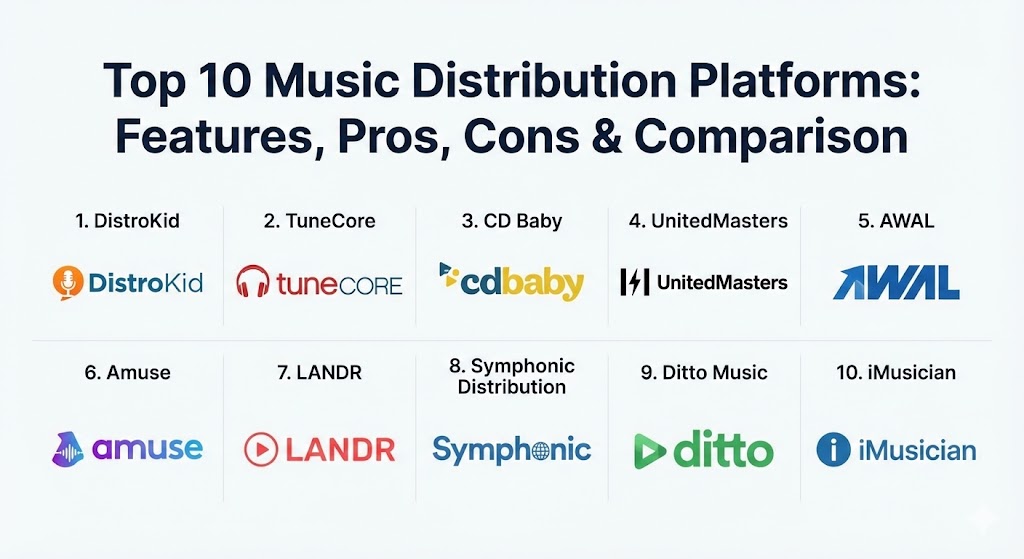
Top 10 Music Distribution Platforms
1 — DistroKid
DistroKid is arguably the most popular choice for modern DIY artists. It revolutionized the industry with a flat-fee model for unlimited uploads, making it the “workhorse” for prolific creators who release singles frequently.
- Key features:
- Unlimited song and album uploads for one annual price.
- 100% royalty payout to the artist.
- Automatic royalty splits for collaborators (e.g., band members or producers).
- Instant Spotify for Artists verification and “HyperFollow” pre-save pages.
- Spotify Canvas generator and synchronized lyrics support.
- “Leave a Legacy” option to keep music online even if the subscription lapses.
- Pros:
- Exceptionally fast delivery to stores (often within 24–48 hours).
- Best value for artists releasing more than two or three projects per year.
- Cons:
- Many essential features (like YouTube Content ID or Shazam) require extra annual fees.
- Customer support is largely automated and can be slow for complex issues.
- Security & compliance: SSO, SSL encryption, GDPR compliant, and strict anti-fraud streaming monitoring.
- Support & community: Extensive FAQ, AI-driven chatbot, and a massive community of users across Reddit and social media.
2 — TuneCore
A veteran in the space, TuneCore has evolved from a per-release model to offering competitive unlimited subscription plans. It is known for its robust global reach and additional “Artist Pro” services.
- Key features:
- Unlimited release plans starting at a low entry price point.
- Publishing administration to collect global songwriter royalties.
- “TuneCore Accelerator” for early access to experimental store features.
- Comprehensive sales data and social media analytics.
- Integrated “Store Automator” to send music to new platforms automatically.
- High-quality sync licensing opportunities for TV, film, and games.
- Pros:
- Excellent reporting tools that offer deeper insights than basic distributors.
- Reliable legacy platform with strong ties to major global DSPs.
- Cons:
- The interface can feel a bit cluttered and overwhelming for absolute beginners.
- Higher-tier features are locked behind more expensive “Professional” plans.
- Security & compliance: PCI DSS for payments, GDPR, and secure data handling.
- Support & community: Dedicated email support with tiered response times based on plan level.
3 — CD Baby
CD Baby remains the top choice for artists who prefer a “pay-once-and-forget-it” model. It is one of the few distributors that still offers physical distribution for CDs and vinyl.
- Key features:
- One-time fee per single or album; no recurring annual subscription.
- Distribution to 150+ digital stores and streaming platforms.
- Physical distribution services for CDs and Vinyl records.
- Integrated Pro Publishing to collect mechanical royalties.
- YouTube Content ID and Facebook/Instagram monetization included.
- Legacy “forever” distribution with no risk of takedown if you stop paying.
- Pros:
- Ideal for artists with an irregular release schedule who want zero ongoing costs.
- Highly reputable customer service and physical goods infrastructure.
- Cons:
- Takes a 9% commission on all streaming royalties.
- Upfront costs are higher than annual subscriptions if you release music often.
- Security & compliance: SOC 2 compliant, HIPAA (where applicable), and secure royalty escrow.
- Support & community: Strong knowledge base, video tutorials, and highly-rated human support.
4 — UnitedMasters
UnitedMasters focuses on the “cultural” side of music, leveraging partnerships with massive brands like the NBA, ESPN, and Apple to provide unique exposure opportunities.
- Key features:
- Mobile-first app design for managing releases from a smartphone.
- Brand partnership opportunities for sync and marketing.
- “Select” plan offers 100% royalties and unlimited distribution.
- Real-time royalty payouts through the “Select” tier.
- Integrated fan-engagement tools and audience insights.
- Advanced AI release planning via “Blueprint AI.”
- Pros:
- Unrivaled for artists looking to bridge the gap between music and brand deals.
- The mobile app is widely considered the best in the industry.
- Cons:
- The free tier takes a significant 10% commission on royalties.
- Primarily focused on the US market and urban/pop genres.
- Security & compliance: ISO 27001 standards, GDPR, and secure payment processing.
- Support & community: In-app support and a growing community of “Select” artists.
5 — AWAL (Artists Without A Label)
Now owned by Sony Music, AWAL is an invite-only or submission-based platform. It functions as a “hybrid” between a distributor and a label, offering premium services to high-growth artists.
- Key features:
- Curated entry; artists must submit their music for review.
- Global distribution with a focus on editorial playlist pitching.
- Advanced data analytics through the AWAL Work app.
- Dedicated marketing and funding support for successful artists.
- No upfront fees for distribution.
- 100% ownership retention for the artist.
- Pros:
- Provides “label-level” support without taking away your rights.
- Excellent for artists who already have significant streaming traction.
- Cons:
- Takes a 15% commission on all royalties earned.
- Very difficult to get accepted; not an option for absolute beginners.
- Security & compliance: Enterprise-grade security protocols (Sony-backed), GDPR, and CCPA.
- Support & community: High-touch artist support and professional A&R feedback for members.
6 — Amuse
Amuse started as a mobile-only “free” distributor and has grown into a sophisticated platform with “Pro” tiers that offer some of the fastest release times in the market.
- Key features:
- Free distribution tier with limited store reach.
- Amuse Pro/Boost tiers for 100% royalties and faster delivery.
- Automated royalty splits and team management tools.
- Advanced analytics and audience demographics.
- Integrated “fast-forward” royalty advances for eligible artists.
- Multi-artist profile management on paid plans.
- Pros:
- Great “entry-level” option with the ability to scale as your career grows.
- Simple, modern interface that is very easy to navigate.
- Cons:
- The free version has become increasingly limited over time.
- Store reach is smaller than giants like CD Baby or TuneCore.
- Security & compliance: GDPR, PCI DSS, and encrypted payout systems.
- Support & community: Chat-based support and a helpful “help center” for independent artists.
7 — LANDR
Originally known for its AI mastering software, LANDR has built a comprehensive ecosystem that includes distribution, collaboration tools, and a samples library.
- Key features:
- Integrated AI mastering for every release.
- Unlimited distribution included in “Studio” and “Pro” plans.
- Collaboration tools like “LANDR Sessions” for remote production.
- 100% royalty ownership for the artist.
- Access to a massive library of royalty-free samples and loops.
- Promotion and landing page tools for every release.
- Pros:
- The best “all-in-one” platform for producers who master their own music.
- Excellent bundle value if you already use their mastering or plugin services.
- Cons:
- Can be expensive if you only need basic distribution and not the other tools.
- The distribution-only plan is less competitive than DistroKid or Ditto.
- Security & compliance: SOC 2 Type II, GDPR, and ISO 27001.
- Support & community: Strong technical support and a library of educational content for producers.
8 — Symphonic Distribution
Symphonic is a selective, high-touch distributor that offers professional-grade tools for serious independent artists and small labels.
- Key features:
- Highly selective “Partner” tier for established artists.
- 100% royalty plans for “Starter” users with a low annual fee.
- Advanced sync licensing and video distribution (Vevo).
- Robust piracy protection and rights management.
- Specialized distribution to niche stores like Beatport and Traxsource.
- Dedicated playlist pitching for eligible releases.
- Pros:
- Exceptional for electronic music artists who need Beatport access.
- High-quality customer support from real industry experts.
- Cons:
- The “Partner” application process is competitive.
- Video distribution and some marketing tools incur additional costs.
- Security & compliance: GDPR, CCPA, and advanced rights management auditing.
- Support & community: Highly rated personalized support and professional development webinars.
9 — Ditto Music
Ditto Music is a UK-based distributor that offers a straightforward unlimited model with some unique “label-in-a-box” services for aspiring industry moguls.
- Key features:
- Unlimited distribution for a flat annual fee.
- 100% royalties to the artist.
- “Ditto Plus” for registering your own record label.
- Integrated “Music Publishing” to collect mechanical royalties.
- Free pre-save links and SmartLink promotional tools.
- Chart registration support (Billboard, Official UK Charts).
- Pros:
- One of the most affordable ways to start your own indie label.
- Broad store reach, including many regional platforms in Asia and Africa.
- Cons:
- Mixed reviews regarding the speed of their customer support team.
- The website and dashboard can occasionally feel sluggish.
- Security & compliance: PCI DSS, GDPR, and standard encryption protocols.
- Support & community: 24/7 email support and a massive “Indie Advice” blog.
10 — iMusician
Based in Switzerland, iMusician is built on a philosophy of flexibility and “forever” security, offering both subscription and one-time payment models.
- Key features:
- “Forever Online” guarantee—no recurring fees to keep your music up.
- Flexible pricing: choose between pay-per-release or unlimited subscriptions.
- Distribution to 200+ shops, including niche electronic stores.
- Human, multilingual support in 6+ languages.
- Integrated YouTube Content ID and library music pitching.
- Advanced analytics and easy-to-read sales reports.
- Pros:
- Excellent for European artists due to regional expertise and language support.
- The most flexible pricing architecture in the top 10 list.
- Cons:
- Unlimited plans are slightly more expensive than DistroKid.
- The payout threshold can be higher than competitors.
- Security & compliance: Strict Swiss data privacy standards (DSG), GDPR, and secure escrow.
- Support & community: High-rated human support and a dedicated YouTube channel for music business tips.
Comparison Table
| Tool Name | Best For | Platform(s) Supported | Standout Feature | Rating (Gartner/Trustpilot) |
| DistroKid | Prolific Solo Artists | 150+ Stores | Automatic Royalty Splits | 4.6 / 5 |
| TuneCore | All-Rounder / Labels | 150+ Stores | Publishing Admin | 4.4 / 5 |
| CD Baby | Occasional / Physical | 150+ Stores | One-Time Fee (Lifetime) | 4.5 / 5 |
| UnitedMasters | Brand Deals / Mobile | 30+ Stores | Brand Sponsorships | 4.3 / 5 |
| AWAL | High-Growth / Selective | 200+ Stores | Label-Style Pitching | 4.5 / 5 |
| Amuse | Mobile Management | 20+ Stores | Royalty Advances | 4.2 / 5 |
| LANDR | Producers / Mastering | 150+ Stores | AI Mastering Bundle | 4.4 / 5 |
| Symphonic | Electronic / Pro Indies | 200+ Stores | Beatport / Vevo Support | 4.4 / 5 |
| Ditto Music | Aspiring Indie Labels | 200+ Stores | Record Label Registration | 4.1 / 5 |
| iMusician | Security / Flexibility | 200+ Stores | “Forever Online” Guarantee | 4.6 / 5 |
Evaluation & Scoring of Music Distribution Platforms
The following rubric shows how these platforms are weighted in the professional industry to ensure they meet the needs of a career-focused musician.
| Category | Weight | Evaluation Criteria |
| Core Features | 25% | Store reach, royalty ownership, and distribution speed. |
| Ease of Use | 15% | Dashboard intuitiveness, mobile accessibility, and upload process. |
| Integrations | 15% | Spotify for Artists, Apple Music for Artists, and TikTok integration. |
| Security & Compliance | 10% | Data privacy, payment security, and royalty protection. |
| Performance | 10% | Uptime of platform and accuracy of analytics reporting. |
| Support | 10% | Speed and quality of customer service (Human vs. Bot). |
| Price / Value | 15% | Transparent pricing without hidden “add-on” fees. |
Which Music Distribution Tool Is Right for You?
Selecting the right partner is about aligning the software with your output.
- Solo Artists & Prolific Producers: If you release a single every month, DistroKid or TuneCore‘s unlimited plans will save you hundreds of dollars.
- Occasional / Legacy Artists: If you only release an album every few years, CD Baby or iMusician‘s one-time fee model is the safest bet to ensure your music stays online forever without an annual bill.
- Producers & Beatmakers: LANDR is the superior choice if you want to integrate your distribution into your production workflow (Mastering + Samples + Distro).
- Growing Artists with Traction: If you already have 100k+ monthly listeners, AWAL or Symphonic offer the high-touch editorial support needed to reach the next level.
- Urban & Pop Artists: UnitedMasters provides the best pathway into the “mainstream” culture through brand deals and high-profile partnerships.
Frequently Asked Questions (FAQs)
1. Do I keep 100% of my music rights?
Yes, all the platforms on this list allow you to retain 100% of your master rights. You are essentially hiring them as a delivery service, not a label.
2. How long does it take for my music to appear on Spotify?
DistroKid is often the fastest (24–48 hours), while more selective or manual platforms (like CD Baby or AWAL) can take 1–2 weeks for thorough review.
3. Can I move my music from one distributor to another?
Yes. You can issue a takedown at your old distributor and re-upload with the same ISRC codes and metadata at your new one to keep your stream counts.
4. What is an ISRC code?
It stands for International Standard Recording Code. It is a unique “digital fingerprint” for your song that tracks its sales and streams globally.
5. Do these tools distribute to TikTok and Instagram?
Yes, all major distributors now include TikTok and Meta (Instagram/Facebook) in their standard distribution packages.
6. What happens if I stop paying my annual subscription?
Most subscription platforms (like DistroKid or TuneCore) will eventually remove your music if you stop paying, unless you’ve paid for a “Leave a Legacy” or “Forever Online” option.
7. Can I distribute cover songs?
Yes, but you usually need a mechanical license. Some platforms (like DistroKid) handle this for a small fee, while others require you to provide your own proof of license.
8. How do I get paid?
Distributors collect royalties from stores (which usually lag by 2–3 months) and deposit them into your account for withdrawal via PayPal, Stripe, or Bank Transfer.
9. What is “Publishing Administration”?
While distribution handles the “master” (the recording), publishing admin handles the “composition” (lyrics and melody). You need both to collect 100% of your owed royalties.
10. Do I need a barcode (UPC)?
Yes, every album or single needs a UPC (Universal Product Code). Most distributors provide these for free or for a small fee during the upload process.
Conclusion
The “best” music distribution platform is a subjective choice based on where you are in your career. If speed and volume are your priority, the modern subscription models of DistroKid or TuneCore are unbeatable. If stability and physical formats matter most, CD Baby remains a titan. Ultimately, these tools have democratized the music industry, giving every artist the power to be their own label. Choose the tool that lets you spend less time on spreadsheets and more time in the studio.