Introduction
Model Risk Management (MRM) software is a specialized governance, risk, and compliance (GRC) solution designed to oversee the entire lifecycle of a model—from its initial design and development to validation, implementation, and ongoing monitoring. At its core, MRM software creates a centralized “Model Inventory” where every algorithm used by a company is documented, its risks are quantified, and its performance is tracked against real-world outcomes.
The importance of these tools has surged with the rise of Generative AI and automated machine learning. Without a structured MRM framework, companies face “black box” risks where they cannot explain how a decision was made, leading to regulatory fines or reputational damage. Key real-world use cases include validating credit risk models in banking, monitoring algorithmic trading strategies, and ensuring fairness in AI-driven hiring tools. When evaluating MRM software, users should look for strong version control, automated “challenger” model testing, robust audit trails, and the ability to detect “data drift” in real-time.
Best for: Large financial institutions (banks, insurers), fintech startups, and enterprises in highly regulated sectors like healthcare or energy. It is essential for Chief Risk Officers (CROs), data scientists, and compliance managers who need to prove to regulators that their AI and statistical models are safe.
Not ideal for: Small businesses that do not use proprietary algorithms or predictive modeling. If your “models” consist solely of basic Excel spreadsheets for accounting, standard project management or simple audit software will likely suffice without the complexity of a dedicated MRM suite.
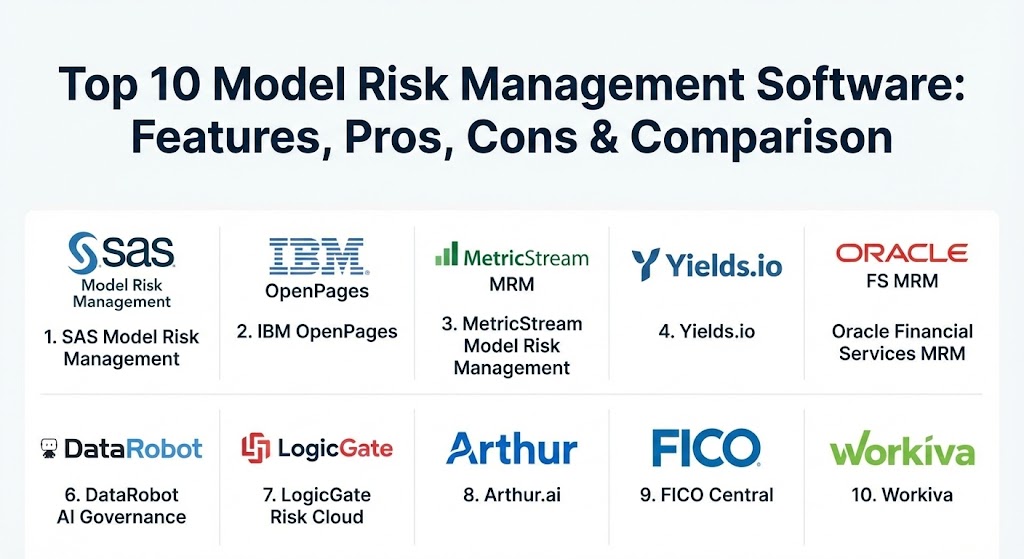
Top 10 Model Risk Management Software Tools
1 — SAS Model Risk Management
SAS is a long-standing titan in the analytics world, and its MRM solution is widely considered the gold standard for large-scale financial institutions. It provides an end-to-end framework that integrates seamlessly with existing SAS analytics pipelines.
- Key features:
- Centralized, searchable model inventory with hierarchical relationships.
- Automated workflow for model validation and approval cycles.
- Deep integration with SAS and open-source models (Python, R).
- Comprehensive reporting for regulatory compliance (SR 11-7, IFRS 9).
- Qualitative and quantitative risk assessment modules.
- Robust version control and documentation management.
- Customizable dashboards for “model health” at an enterprise level.
- Pros:
- Unmatched depth in regulatory reporting and audit readiness.
- Highly scalable for organizations managing thousands of models.
- Cons:
- Significant cost and implementation time compared to newer SaaS rivals.
- Requires a high level of technical expertise to configure and maintain.
- Security & compliance: SOC 2, HIPAA, GDPR, and FIPS 140-2 compliant. Includes granular SSO and multi-factor authentication.
- Support & community: World-class enterprise support; extensive training via SAS Academy and a massive global user community.
2 — IBM OpenPages (with Watson OpenScale)
IBM OpenPages offers a comprehensive GRC platform, and when combined with Watson OpenScale, it becomes a powerhouse for managing both traditional math formulas and the latest AI models.
- Key features:
- AI-driven model identification and classification.
- Real-time bias detection and “explainability” for black-box AI.
- Automated monitoring for model accuracy and data drift.
- Integration with enterprise risk management (ERM) for a unified view.
- “Challenger” model benchmarking and performance comparison.
- Regulatory change management to keep up with new AI laws.
- Pros:
- The best solution for companies prioritizing “Explainable AI” (XAI).
- Strong synergy for existing IBM Cloud and Watson users.
- Cons:
- The UI can be complex and overwhelming for casual users.
- Licensing can be expensive when mixing the GRC and AI monitoring modules.
- Security & compliance: ISO 27001, SOC 2 Type II, HIPAA, and GDPR. Data is encrypted in transit and at rest.
- Support & community: Access to IBM’s global support network and deep technical documentation through IBM Developer.
3 — MetricStream Model Risk Management
MetricStream is a leader in the “Connected GRC” space. Their MRM tool is built for organizations that want to tie model risk directly to other operational and financial risks.
- Key features:
- Unified GRC platform that links model risk to business units.
- Automated assessment workflows with email notifications.
- Visual heat maps for identifying high-risk model clusters.
- Built-in libraries for global regulatory standards.
- Ad-hoc reporting for board-level risk oversight.
- Support for third-party and vendor-provided model tracking.
- Pros:
- Excellent for linking model errors to the “big picture” of corporate risk.
- Highly configurable “no-code” elements for business users.
- Cons:
- Can feel more like a compliance tool than a data science tool.
- Manual data entry may be required if model metadata isn’t automated.
- Security & compliance: SOC 2, ISO 27001, and robust audit logging for every user action.
- Support & community: Strong emphasis on customer success with a dedicated “MetricStream University” for onboarding.
4 — Yields.io
Yields.io is a modern, specialized “Challenger” in the MRM space. It focuses on the automated testing and validation of models, making it a favorite for data science teams.
- Key features:
- Automated “independent validation” through a proprietary engine.
- Real-time monitoring of model performance and drift.
- Support for multi-cloud and hybrid environments.
- Rapid model documentation generation.
- Collaborative environment for developers and validators.
- Specialized modules for financial markets and “market risk.”
- Pros:
- Significantly reduces the time required for model validation.
- Much more “data-science friendly” than traditional GRC tools.
- Cons:
- Smaller ecosystem and community compared to giants like IBM or SAS.
- Lacks some of the broader “Enterprise Risk” modules found in GRC suites.
- Security & compliance: GDPR compliant; supports modern SSO and encrypted telemetry.
- Support & community: High-touch support model; responsive to custom feature requests.
5 — Oracle Financial Services MRM
Oracle’s solution is a heavy-duty platform designed specifically for the banking sector, leveraging Oracle’s massive data infrastructure.
- Key features:
- Pre-built regulatory templates for banking (CCAR, DFAST).
- Integrated model development environment (MDE).
- Advanced analytics for stress testing and scenario modeling.
- High-performance processing for large-scale data validation.
- Native integration with Oracle Financial Services Data Foundation.
- Pros:
- Best-in-class for tier-one banks with massive transaction volumes.
- Strong focus on the financial integrity of valuation models.
- Cons:
- “Old school” interface that feels dated compared to modern SaaS.
- Implementation typically requires a large consulting project.
- Security & compliance: FedRAMP, SOC 1/2, HIPAA, and industry-leading database security.
- Support & community: Extensive enterprise support and partner network (e.g., Big Four accounting firms).
6 — DataRobot (AI Governance)
DataRobot is unique because it is primarily an AI development platform that has built some of the market’s best tools for AI governance and risk management.
- Key features:
- Automated bias detection and mitigation.
- Real-time monitoring of production AI models.
- “Humble AI” triggers that alert when data falls outside known bounds.
- Automated compliance report generation (PDF/Word).
- Centralized governance dashboard for all AI projects.
- Pros:
- The most “automation-first” approach to model risk.
- Ideal for managing the risks of Generative AI and LLMs.
- Cons:
- Primarily focused on AI; not ideal for traditional, non-AI math models.
- Pricing is tied to the broader DataRobot platform.
- Security & compliance: SOC 2 Type II, HIPAA, and GDPR. Supports VPC deployments.
- Support & community: Very active community and “DataRobot University” for training.
7 — LogicGate Risk Cloud
LogicGate takes a “Lego-like” approach to risk. Their Risk Cloud platform allows users to build custom MRM workflows without writing a single line of code.
- Key features:
- Drag-and-drop workflow builder for model approvals.
- Visual relationship mapping between models and data sources.
- Automated evidence collection for audits.
- Customizable risk scoring and weighting.
- Seamless integration with Slack, Jira, and other dev tools.
- Pros:
- The most flexible tool; adapts to your process rather than forcing one on you.
- Exceptional user interface that increases adoption among non-technical staff.
- Cons:
- Lacks the deep mathematical “validation engine” of SAS or Yields.io.
- Users must invest time in “building” their ideal application.
- Security & compliance: SOC 2 Type II, SSO support, and encrypted storage at rest.
- Support & community: Highly rated customer success team and a library of pre-built “Agile GRC” templates.
8 — Arthur.ai
Arthur.ai is a cloud-native platform specifically designed for “Model Monitoring” and performance risk. It is the go-to for teams concerned with the real-world behavior of live models.
- Key features:
- Real-time detection of data drift and performance decay.
- Advanced bias and fairness monitoring tools.
- Integrated query interface to investigate model anomalies.
- Multi-cloud and on-premise monitoring support.
- Collaborative “incident management” for model failures.
- Pros:
- Very strong for “Day 2” operations (monitoring models in production).
- Highly intuitive for data scientists and MLOps teams.
- Cons:
- Narrower focus on monitoring; less of a “legal compliance” tool.
- Not suitable for managing the inventory of “static” models.
- Security & compliance: SOC 2 compliant; focuses on data privacy and anonymization.
- Support & community: Strong technical support; well-regarded by the AI research community.
9 — FICO Central
FICO is synonymous with credit scoring, and FICO Central is their internal tool turned commercial product for managing the rigor of financial modeling.
- Key features:
- Disciplined model development lifecycle (MDLC) management.
- Strict adherence to banking regulatory standards.
- Integrated testing and benchmarking for credit models.
- Strong version control for model parameters and coefficients.
- Comprehensive audit trail for every model change.
- Pros:
- Deep industry expertise in financial services.
- Helps enforce a “culture of discipline” in modeling.
- Cons:
- Very specialized for finance; less applicable to other industries.
- Can be rigid in terms of workflow flexibility.
- Security & compliance: PCI-DSS, ISO 27001, and SOC 2.
- Support & community: Professional services focused on high-stakes financial risk.
10 — Workiva
Workiva is the world leader in regulatory reporting. Their MRM solution is best for companies that care most about the reporting and board-level visibility of their model risks.
- Key features:
- Live data linking between model results and board reports.
- Collaborative workspace for auditors and model owners.
- Automated evidence gathering for regulatory filings.
- Integration with major cloud storage and data warehouses.
- Real-time tracking of “open issues” in the model inventory.
- Pros:
- The best tool for turning model data into polished, audit-ready reports.
- Extremely high adoption in the C-suite and boardrooms.
- Cons:
- Lacks the deep math-testing capabilities of technical MRM tools.
- Pricing is geared toward large enterprise budgets.
- Security & compliance: SOC 1/SOC 2, ISO 27001, and FedRAMP authorized.
- Support & community: Renowned for 24/7 support and a massive community of reporting professionals.
Comparison Table
| Tool Name | Best For | Platform(s) Supported | Standout Feature | Rating (Gartner/TrueReview) |
| SAS MRM | Global Banks | On-prem, Cloud | Regulatory Depth | 4.6 / 5 |
| IBM OpenPages | AI Governance | Hybrid Cloud | Explainability (XAI) | 4.4 / 5 |
| MetricStream | Connected GRC | SaaS, Cloud | Enterprise Risk Linkage | 4.5 / 5 |
| Yields.io | Automated Validation | Multi-cloud | Auto-Testing Engine | 4.7 / 5 |
| Oracle MRM | High-Volume Finance | On-prem, Oracle Cloud | CCAR/DFAST Templates | 4.2 / 5 |
| DataRobot | Generative AI Risk | SaaS, VPC | Bias Mitigation | 4.6 / 5 |
| LogicGate | Workflow Flexibility | SaaS | No-code UI | 4.4 / 5 |
| Arthur.ai | Live Monitoring | Cloud, On-prem | Real-time Drift Detection | 4.8 / 5 |
| FICO Central | Credit Modeling | On-prem, Cloud | Financial Discipline | 4.3 / 5 |
| Workiva | Board Reporting | SaaS | Live Data Linking | 4.8 / 5 |
Evaluation & Scoring of Enterprise Risk Management (ERM) Tools
| Category | Weight | Evaluation Criteria |
| Core Features | 25% | Model inventory, validation workflows, and automated testing capabilities. |
| Ease of Use | 15% | UI/UX for both technical data scientists and non-technical risk managers. |
| Integrations | 15% | Compatibility with Python, R, Cloud providers, and existing GRC systems. |
| Security & Compliance | 10% | Support for global standards (SR 11-7, EU AI Act) and SSO/encryption. |
| Performance | 10% | Ability to handle large datasets and monitor thousands of models in real-time. |
| Support & Community | 10% | Training quality, documentation, and the availability of 24/7 enterprise support. |
| Price / Value | 15% | Total cost of ownership relative to the risk reduction achieved. |
Which Model Risk Management Tool Is Right for You?
Choosing an MRM tool depends on whether you value technical depth (for data scientists) or organizational governance (for compliance officers).
- Solo Users vs. SMBs: Dedicated MRM software is rarely needed for solo users. For SMBs using a handful of models, LogicGate is the best entry point due to its flexibility and lower implementation hurdle.
- Budget-Conscious vs. Premium: If budget is the primary concern, start with the basic MetricStream modules. If you need a “premium” solution with every possible regulatory bell and whistle, SAS remains the leader.
- Feature Depth vs. Ease of Use: DataRobot and Yields.io offer the deepest technical automation. However, if your team is less technical, Workiva or LogicGate will be much easier to adopt across the company.
- AI vs. Traditional Models: For companies pivoting heavily toward GenAI and LLMs, Arthur.ai or IBM OpenPages are essential. For traditional financial institutions stuck with legacy math models, Oracle or FICO are more suitable.
- Security & Compliance: Ensure the tool you choose supports the specific laws of your region, such as the EU AI Act or the US SR 11-7 guidelines. Workiva and SAS are the strongest in this regard.
Frequently Asked Questions (FAQs)
1. What is the difference between MLOps and Model Risk Management? MLOps focuses on the operational efficiency of deploying AI (speed, scale, uptime). MRM focuses on the governance and safety of those models (accuracy, bias, regulatory compliance).
2. Can I manage Excel-based models in MRM software? Yes. Most enterprise MRM tools, especially Workiva and SAS, allow you to inventory and “validate” the logic inside critical spreadsheets to prevent human error.
3. Does this software automatically fix biased models? Not exactly. Tools like DataRobot can suggest “mitigation strategies,” but a human validator usually needs to approve the fix to ensure it doesn’t break the model’s predictive power.
4. How long does implementation take? For SaaS tools like LogicGate, you can be up and running in a few weeks. For enterprise systems like Oracle or SAS, implementation can take 6 to 12 months.
5. What is “Model Drift”? Model drift occurs when the real-world data changes so much that the model’s predictions are no longer accurate. MRM software monitors for this and alerts you when a model needs to be retrained.
6. Do I need MRM software if I use vendor-bought models? Yes. Even if you don’t build the model, you are responsible for its outcomes. MRM tools help you track vendor performance and ensure their models fit your specific data.
7. Is MRM software only for banks? While it started in banking, it is now used in healthcare (diagnostic models), retail (pricing algorithms), and HR (hiring tools) to manage AI risk.
8. Can these tools handle Generative AI (LLMs)? Leading tools like IBM OpenPages and Arthur.ai now include specific modules to monitor LLMs for “hallucinations,” data leakage, and toxic outputs.
9. What is SR 11-7? It is a key regulatory guidance from the US Federal Reserve that outlines how financial institutions should manage model risk. Most MRM software is built around this standard.
10. Why is “Model Inventory” so important? You cannot manage what you can’t see. An inventory ensures every model is accounted for, preventing “rogue models” from operating without oversight.
Conclusion
The best Model Risk Management software is not the one with the most features, but the one that your team will actually use. Whether you choose the technical rigor of SAS, the AI-first approach of DataRobot, or the reporting excellence of Workiva, the goal remains the same: transforming model risk from a hidden liability into a strategic advantage. As AI continues to integrate into every facet of business, having a “seatbelt” for your algorithms is no longer optional—it is a requirement for survival.