Introduction
Model monitoring tools are specialized platforms that track the health of machine learning models in real-time. Unlike traditional software monitoring that looks at CPU and memory, these tools analyze the statistical properties of data inputs and model outputs. They detect when the production data has shifted away from the training distribution (data drift) or when the relationship between variables has changed (concept drift).
In the real world, these tools are critical for high-stakes applications. For example, a credit scoring model might fail if economic conditions change suddenly, or a recommendation engine might start showing irrelevant products if consumer trends shift. Choosing the right tool involves evaluating its ability to handle unstructured data, its explainability features (understanding why a model failed), and its integration with existing MLOps pipelines.
Best for: Data scientists, ML engineers, and MLOps teams in mid-to-large enterprises, particularly in regulated sectors like finance, healthcare, and e-commerce where model reliability is non-negotiable.
Not ideal for: Small startups with very simple, low-stakes models, or researchers working solely in offline environments where production monitoring isn’t a requirement.
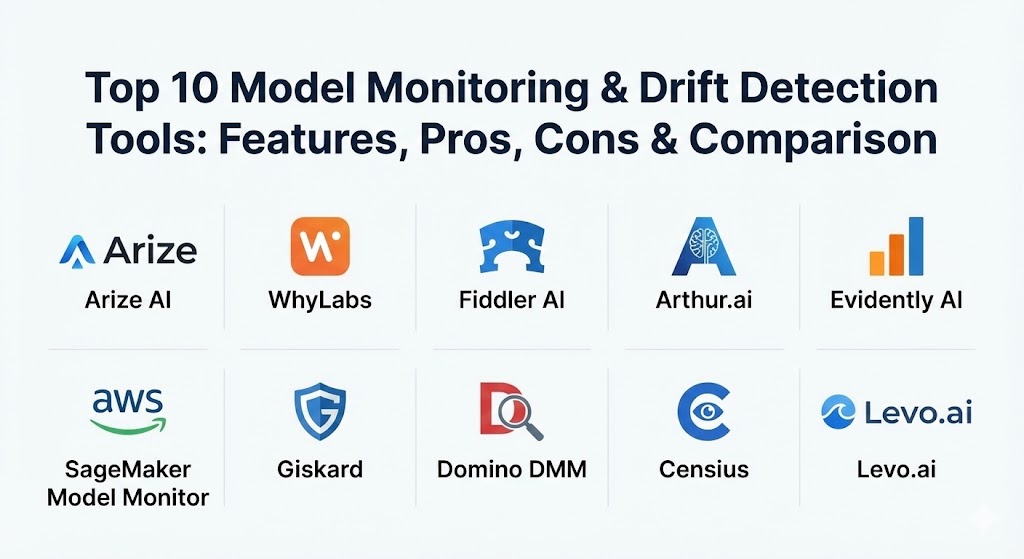
Top 10 Model Monitoring & Drift Detection Tools
1 — Arize AI
Arize AI is a leader in “ML Observability,” going beyond simple monitoring to provide deep forensic analysis of model failures. It is highly regarded for its ability to visualize complex data embeddings.
- Key features:
- Automated drift detection for tabular, image, and text data.
- 3D embedding visualization to identify “pockets” of model failure.
- Real-time performance tracking against baseline training sets.
- Root-cause analysis tools to pinpoint specific feature shifts.
- Specific modules for LLM (Large Language Model) monitoring and hallucination detection.
- Pros:
- Exceptional at handling unstructured data like NLP and Computer Vision.
- User interface is designed for high-speed troubleshooting.
- Cons:
- Can be complex for beginners to set up initially.
- Higher pricing tier compared to lightweight open-source alternatives.
- Security & compliance: SOC 2 Type II, HIPAA, GDPR compliant, and SSO integration.
- Support & community: Extensive documentation, a robust Slack community, and high-touch enterprise support.
2 — WhyLabs
WhyLabs provides a privacy-first, “zero-egress” monitoring platform. It uses statistical profiling (whylogs) to monitor data without ever seeing the raw sensitive data itself.
- Key features:
- Statistical profiling via the open-source
whylogslibrary. - Privacy-preserving monitoring (raw data stays in your environment).
- Automated anomaly detection and smart alerting.
- Support for multi-modal data including tabular, text, and images.
- Seamless integration with Spark, Kafka, and Ray.
- Statistical profiling via the open-source
- Pros:
- Best-in-class for privacy and security-conscious industries.
- Extremely lightweight; does not impact model inference latency.
- Cons:
- The dashboard is primarily focused on health; less focus on “explainability.”
- Advanced visualization features require the commercial platform.
- Security & compliance: SOC 2, HIPAA, and GDPR. Data remains local/private.
- Support & community: Strong open-source community around
whylogsand dedicated enterprise onboarding.
3 — Fiddler AI
Fiddler AI emphasizes model governance and explainability. It is built to help enterprises understand “black box” models and ensure they remain fair and unbiased.
- Key features:
- Post-hoc explainability using SHAP and other attribution methods.
- Bias and fairness monitoring to detect discriminatory patterns.
- Real-time drift detection for features and predictions.
- Model registry and versioning integrated with monitoring.
- “Fiddler Auditor” for stress-testing models before deployment.
- Pros:
- Unmatched for compliance and regulatory reporting needs.
- Strong link between statistical drift and actual business impact.
- Cons:
- More expensive than most tools in this category.
- Can be resource-intensive for high-frequency real-time applications.
- Security & compliance: SOC 2 Type II, HIPAA, ISO 27001, and GDPR.
- Support & community: High-touch enterprise support and detailed technical guides.
4 — Arthur.ai
Arthur is an enterprise-grade platform that centers on proactive model health and “Model Operations” governance. It is designed for scale and institutional oversight.
- Key features:
- Advanced policy engine for automated interventions.
- Fairness and algorithmic bias tracking over time.
- Data integrity checks to prevent “garbage in, garbage out” scenarios.
- Performance visualization across multiple model versions.
- Centralized governance dashboard for all organizational models.
- Pros:
- Designed for “Auditability,” making it a favorite for legal and compliance teams.
- Highly scalable for managing thousands of models simultaneously.
- Cons:
- Strictly an enterprise solution; lacks a lightweight free tier for small teams.
- Setup requires significant cross-departmental coordination.
- Security & compliance: SOC 2, HIPAA, GDPR, and FedRAMP readiness.
- Support & community: Dedicated customer success managers and training workshops.
5 — Evidently AI (Open Source)
Evidently AI is the gold standard for open-source model monitoring. It allows users to generate visual reports and JSON profiles for a quick understanding of data and model health.
- Key features:
- Modular “Reports” and “Test Suites” for data drift and quality.
- Interactive visual dashboards that can be embedded in Jupyter notebooks.
- Support for batch monitoring and real-time data monitoring.
- Custom metric support for domain-specific tracking.
- Integration with tools like Grafana, Prometheus, and MLflow.
- Pros:
- Free and open-source; the easiest way to start monitoring today.
- Highly flexible and developer-friendly.
- Cons:
- Open-source version lacks centralized user management and RBAC.
- Cloud/Enterprise platform is required for scaling and long-term storage.
- Security & compliance: GDPR compliant; SOC 2 (Enterprise version).
- Support & community: Massive Discord community and very active GitHub project.
6 — Amazon SageMaker Model Monitor
For teams already deep in the AWS ecosystem, SageMaker Model Monitor provides a native, fully managed experience for tracking models deployed on SageMaker.
- Key features:
- Automatic scheduling of monitoring jobs.
- Native integration with SageMaker Endpoints and S3.
- Data quality and feature attribution drift detection.
- Built-in visualizations via SageMaker Studio.
- Automated alerts via Amazon CloudWatch.
- Pros:
- “Zero-friction” setup for models already on AWS.
- No separate infrastructure to manage; fully serverless.
- Cons:
- Locked into the AWS ecosystem; difficult to use with models elsewhere.
- Limited visualization capabilities compared to specialized tools like Arize.
- Security & compliance: FIPS, SOC 1/2/3, HIPAA, and GDPR.
- Support & community: Standard AWS enterprise support and massive documentation.
7 — Giskard
Giskard is a specialized tool that focuses on “QA for AI.” It allows collaborative testing and monitoring to ensure models meet quality and safety standards.
- Key features:
- Automated vulnerability scanning (hallucinations, bias, drift).
- Collaborative dashboard where business stakeholders can “rate” model outputs.
- Python library for creating ML “unit tests.”
- Automated data drift and performance monitoring.
- Specific support for LLM evaluation and scanning.
- Pros:
- Excellent for bridging the gap between developers and business users.
- Unique focus on proactive “bug” hunting in ML models.
- Cons:
- Newer tool with a smaller ecosystem than Fiddler or Arize.
- Less focus on traditional hardware metrics (latency, throughput).
- Security & compliance: GDPR compliant and SSO support.
- Support & community: Growing community and high-quality technical blog/docs.
8 — Domino Model Monitor (DMM)
Domino Model Monitor is part of the broader Domino Enterprise AI platform, aimed at large-scale governance and institutionalizing data science.
- Key features:
- Universal monitoring for models hosted anywhere (AWS, Azure, On-prem).
- Automated retraining triggers based on drift thresholds.
- Comprehensive audit trails for compliance.
- Centralized view of model health across the entire enterprise.
- Integration with Domino’s broader MLOps lifecycle tools.
- Pros:
- Fantastic for cross-platform monitoring in hybrid-cloud setups.
- Deeply integrated with data science workflows and collaboration.
- Cons:
- Best value is only realized if using the full Domino platform.
- Can feel “over-engineered” for smaller, focused teams.
- Security & compliance: SOC 2 Type II, ISO 27001, and HIPAA.
- Support & community: Global enterprise support with 24/7 availability.
9 — Censius
Censius is a full-stack ML observability platform designed to automate the entire monitoring lifecycle, emphasizing ease of use and rapid setup.
- Key features:
- Multi-environment tracking (Dev, Staging, Production).
- Root-cause analysis with visual “impact” maps.
- Automated data integrity and schema validation checks.
- Flexible alerting via Slack, PagerDuty, and Email.
- Support for multi-tenant monitoring for service providers.
- Pros:
- Very intuitive UI; requires very little “expert” knowledge to operate.
- Excellent value for mid-market companies.
- Cons:
- Fewer advanced explainability features compared to Fiddler.
- Community resources are still catching up to the market leaders.
- Security & compliance: SOC 2, GDPR, and SSO support.
- Support & community: Personalized onboarding and responsive technical support team.
10 — Levo.ai
Levo.ai is a modern, “runtime-first” AI monitoring platform specifically designed for agentic AI and LLM systems, focusing on runtime security and governance.
- Key features:
- eBPF-based instrumentation for zero-impact runtime monitoring.
- Hallucination and safe-tool-usage detection for AI agents.
- Policy enforcement for sensitive data flows (PII detection).
- Real-time visibility into AI agent behavior and tool calls.
- Privacy-first, zero-data-ingestion architecture.
- Pros:
- Ideal for the new wave of “Agentic” AI systems.
- Low-level instrumentation means no latency impact on inference.
- Cons:
- Highly specialized; not the best choice for traditional “tabular” models.
- Emerging platform in a rapidly changing sub-sector.
- Security & compliance: SOC 2, GDPR, and strong PII redaction capabilities.
- Support & community: High-touch engineering support for early adopters.
Comparison Table
| Tool Name | Best For | Platform(s) Supported | Standout Feature | Rating (G2 / Gartner) |
| Arize AI | Deep Observability | SaaS, Hybrid | Embedding Visualization | 4.7 / 5 |
| WhyLabs | Data Privacy | SaaS, On-prem | Zero-Egress Profiling | 4.6 / 5 |
| Fiddler AI | Explainability | SaaS, On-prem | Compliance/Explainability | 4.5 / 5 |
| Arthur.ai | Governance | SaaS, On-prem | Enterprise Policy Engine | 4.6 / 5 |
| Evidently AI | Open Source / Devs | Python, Self-host | No-code Visual Reports | 4.8 / 5 |
| Amazon SageMaker | AWS Users | AWS Native | Serverless Integration | 4.4 / 5 |
| Giskard | AI Quality/QA | SaaS, Self-host | Collaborative ML Testing | 4.7 / 5 |
| Domino DMM | Hybrid Cloud | Any Hosting | Universal Monitoring | 4.5 / 5 |
| Censius | Mid-Market | SaaS, Hybrid | Root Cause Mapping | 4.6 / 5 |
| Levo.ai | Agentic AI / LLMs | Cloud, Runtime | eBPF Instrumentation | 4.9 / 5 |
Evaluation & Scoring of Model Monitoring Tools
The following table evaluates these tools based on a weighted scoring rubric designed for enterprise-grade ML operations.
| Category | Weight | Key Considerations |
| Core Features | 25% | Drift detection, data quality, performance metrics, and LLM support. |
| Ease of Use | 15% | Time to setup, UI/UX quality, and complexity of dashboards. |
| Integrations | 15% | Support for Spark, Kubernetes, major clouds, and BI tools. |
| Security | 10% | Compliance certifications (SOC 2, GDPR), SSO, and data privacy. |
| Performance | 10% | Latency impact on production pipelines and scalability. |
| Community | 10% | Availability of documentation, Slack channels, and tutorials. |
| Price / Value | 15% | TCO vs. feature set and open-source flexibility. |
Which Model Monitoring Tool Is Right for You?
Choosing the right tool depends on your organization’s maturity level and infrastructure.
- Solo Users & Researchers: Stick with Evidently AI. It’s free, open-source, and integrates perfectly with Jupyter notebooks. It provides all the charts you need for a single project.
- Small to Medium Businesses (SMBs): Censius or WhyLabs offer a great balance. WhyLabs is particularly good if you are worried about data privacy, while Censius is easier for non-experts to navigate.
- Mid-Market Growth Teams: Arize AI is the choice for teams that need “forensic” detail. If you have unstructured data (NLP/CV), Arize’s embedding visualizations are essential for root-cause analysis.
- Enterprise & Regulated Sectors: Fiddler AI or Arthur.ai are the clear winners. They provide the explainability and bias-tracking reports required by legal departments in finance or insurance.
- Cloud-Native AWS Shops: If you want a managed service without extra procurement, use Amazon SageMaker Model Monitor. However, consider a third-party tool if you need cross-cloud monitoring.
Frequently Asked Questions (FAQs)
1. What is the difference between data drift and concept drift?
Data drift is a change in the input data (e.g., users are getting younger). Concept drift is a change in the relationship between input and output (e.g., younger users’ buying habits have fundamentally shifted).
2. Can these tools help with LLM hallucinations?
Yes. Tools like Arize and Levo.ai have specific modules that use “evaluator” models to check LLM outputs for factuality, toxic language, and prompt injection.
3. Do monitoring tools slow down my model?
Most use “asynchronous” monitoring. They read logs or statistical “sketches” (like WhyLabs) after the prediction is made, meaning there is near-zero impact on user-facing latency.
4. How do I start if I have zero budget?
Start with Evidently AI (Python library). It’s open-source and provides professional-grade drift reports that you can generate manually or on a schedule.
5. Are these tools strictly for production?
No. Many teams use them in “Staging” to compare new model versions against current ones before a full rollout to ensure the new model isn’t “drifting” immediately.
6. What is “Explainability” in model monitoring?
It’s the ability to see which features caused a model to make a specific decision. Tools like Fiddler use SHAP values to show if a model is relying on the “right” data points.
7. Can I monitor models running on-premise?
Yes. Solutions like Domino and Arthur offer on-premise or “Virtual Private Cloud” deployments for companies that cannot send data to the public cloud.
8. What is “Data Integrity” in ML?
It refers to checking for pipeline breaks—like a sensor sending null values or a category changing from “m/f” to “male/female”—which can break a model before statistical drift even happens.
9. How many models can these tools handle?
Enterprise tools like Domino and Arize are designed to monitor thousands of models across different departments from a single control plane.
10. Do I need these tools if I retrain my model weekly?
Yes. Even weekly retraining can fail if the new training data is corrupted or if a sudden event (like a market crash) happens mid-week. Monitoring tells you when to retrain.
Conclusion
The best model monitoring tool is not the one with the most features, but the one that ensures your models stay “safe” and “accurate” within your specific constraints. Whether you prioritize open-source flexibility with Evidently AI, privacy with WhyLabs, or deep explainability with Fiddler, the goal is the same: transparency. As AI becomes more autonomous, the human ability to monitor and intervene will be the most critical component of a successful MLOps strategy.