Introduction
Mining Operations Management Software is a category of enterprise-grade applications designed to streamline the entire mining lifecycle—from initial geological exploration and 3D mine design to production scheduling, fleet dispatch, and environmental rehabilitation. These platforms serve as a bridge between the digital twin of the mine and the physical reality of the rock face, allowing engineers and managers to optimize every blast, haul, and shift.
The importance of these tools lies in their ability to eliminate operational silos. In traditional mining, the geology team often worked independently of the production team; today, MFT tools ensure that if a grade changes at the face, the processing plant and the logistics chain are alerted instantly. Key real-world use cases include automated fleet dispatching to reduce “queue time,” 3D scenario modeling for underground safety, and real-time monitoring of tailings dams to prevent environmental disasters. When evaluating these tools, users should prioritize multi-vendor hardware compatibility, edge computing capabilities (for remote sites with poor connectivity), AI-driven predictive maintenance, and ESG (Environmental, Social, and Governance) reporting modules.
Best for: Large-scale mining conglomerates managing multiple global sites, engineering firms specializing in mine design, and mid-sized operations transitioning to autonomous or semi-autonomous fleets. It is also vital for compliance officers who must meet rigorous safety and sustainability reporting standards.
Not ideal for: Small-scale artisanal or “junior” exploration companies that haven’t yet moved into production phases. These teams may find more value in simple geological modeling software or standard project management tools until their operational complexity justifies an enterprise MOM platform.
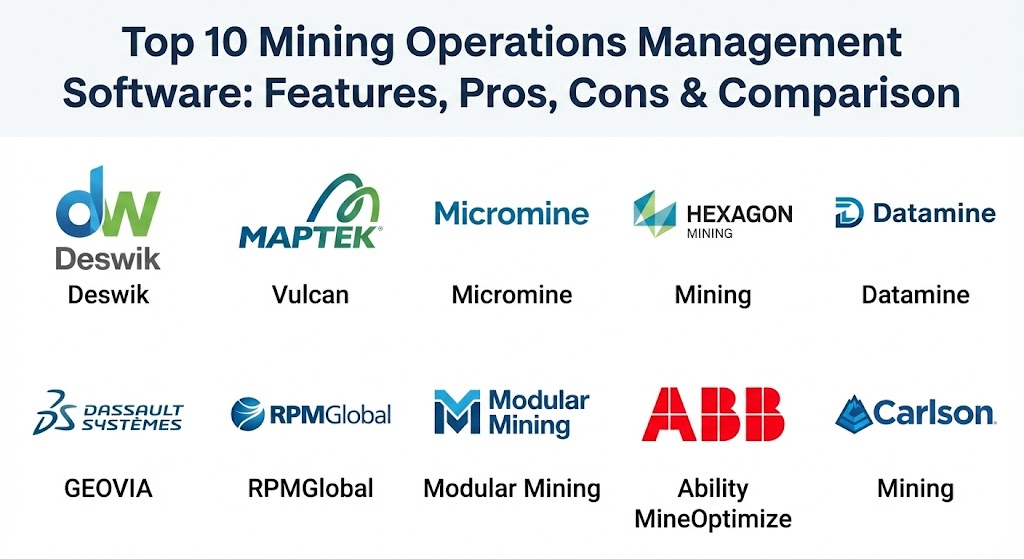
Top 10 Mining Operations Management Software
1 — Deswik (by Sandvik)
Deswik is widely recognized as the industry benchmark for integrated mine planning and scheduling. It is a high-fidelity tool used by mining engineers to handle the most complex underground and open-pit designs.
- Key features:
- Integrated CAD engine designed specifically for mining environments.
- Deswik.IS: Interactive scheduling that links planning to production.
- Advanced 3D modeling for underground mine development.
- Multi-scenario modeling to compare financial outcomes of mine plans.
- Automated underground design tools for rapid layout generation.
- Seamless data flow between short-term and long-term planning modules.
- Pros:
- Unmatched depth in handling complex geological and structural constraints.
- The integration between CAD and scheduling reduces data transfer errors.
- Cons:
- Extremely steep learning curve; requires dedicated, specialized training.
- Requires high-end workstation hardware to maintain performance.
- Security & compliance: SOC 2 compliant, featuring advanced data encryption and strict version control for planning files.
- Support & community: Extensive training programs and a global network of specialized consultants; very high reputation among engineering professionals.
2 — Maptek Vulcan
Maptek Vulcan is one of the longest-standing and most powerful geological modeling and mine planning packages in the world. It is the preferred choice for sites requiring massive dataset management and high-resolution 3D visualization.
- Key features:
- High-performance 3D block modeling and resource estimation.
- Interactive mine design for both surface and underground operations.
- Integrated drill and blast design with precision fragmentation modeling.
- Sophisticated surveying and pit optimization tools.
- Advanced grade control and reconciliation modules.
- Native support for massive point-cloud data from drone and laser scans.
- Pros:
- Excellent at processing large, complex geological datasets without lag.
- The visualization engine is considered best-in-class for detailed site analysis.
- Cons:
- The user interface can feel somewhat dated and “legacy” to new users.
- Licensing can be expensive due to the modular “per-feature” pricing model.
- Security & compliance: Role-based permissions, data encryption, and detailed audit trails for geological data.
- Support & community: Large global user base with frequent regional user conferences and 24/7 technical assistance.
3 — Micromine
Micromine offers a modern, modular suite of tools that covers the entire mining cycle. It has gained significant market share by providing an intuitive user experience that is more accessible than its legacy competitors.
- Key features:
- Micromine Origin: Specialized for exploration and resource estimation.
- Micromine Beyond: Focused on mine design and scheduling.
- Micromine Alastri: Advanced open-pit tactical scheduling.
- Real-time production control and equipment tracking.
- Modern, ribbon-based UI that mimics standard Windows applications.
- Integrated data management for geological and drilling logs.
- Pros:
- Much more intuitive and easier to learn than Deswik or Vulcan.
- Highly modular; operations can purchase only the specific modules they need.
- Cons:
- Some advanced scheduling features aren’t as deep as specialized competitors.
- Integration between the exploration and production modules can occasionally be clunky.
- Security & compliance: SOC 2 compliant; features advanced encryption and strict versioning for data integrity.
- Support & community: Strong online presence with a dedicated “Micromine Academy” for self-paced learning.
4 — Hexagon Mining
Hexagon provides a holistic “Life-of-Mine” solution that is uniquely focused on safety and autonomy. Their platform integrates mine planning with real-time fleet safety and collision avoidance.
- Key features:
- Integrated HxGN MinePlan for design and scheduling.
- HxGN MineProtect: Industry-leading collision avoidance and fatigue monitoring.
- Autonomous haulage and drill system support.
- Real-time fleet management and dispatch optimization.
- Enterprise-wide operational analytics and “Control Tower” views.
- Integrated high-precision GPS for equipment guidance.
- Pros:
- The best choice for sites prioritizing worker safety and autonomous operations.
- Provides a truly unified view from the engineer’s desk to the machine cab.
- Cons:
- Implementation is a major undertaking, often requiring hardware retrofitting.
- Can be overly complex for smaller mines that don’t need autonomy.
- Security & compliance: ISO 27001, SOC 2, and GDPR compliant; features bank-level encryption for telemetry.
- Support & community: Global enterprise support with heavy emphasis on on-site deployment and training.
5 — Datamine
Datamine offers the broadest range of mining software solutions in the industry, with specialized tools for nearly every specific sub-discipline of mining, from geostatistics to logistics.
- Key features:
- Studio RM: The industry standard for resource and reserve modeling.
- Studio UG/OP: Specialized environments for underground and open-pit design.
- MineScape: The global leader for coal and stratigraphic deposits.
- integrated Supply Chain and Logistics (MineMarket) management.
- CCLAS: A specialized laboratory information management system (LIMS).
- Automated pit-to-port visibility for commodity sales and tracking.
- Pros:
- If you have a specific niche (like coal or laboratory management), Datamine has a specific tool for it.
- Exceptional depth in geostatistics and complex geological modeling.
- Cons:
- The “broad” product range can lead to fragmented workflows across different modules.
- Learning multiple Datamine tools requires significant time and effort.
- Security & compliance: Varies by module, but generally supports enterprise SSO and encrypted data flows.
- Support & community: Strong presence in Africa, Latin America, and CIS; offers extensive localized support.
6 — GEOVIA (by Dassault Systèmes)
GEOVIA (incorporating Surpac, Whittle, and MineSched) provides a sophisticated platform focused on the “Virtual Twin.” It leverages Dassault’s 3DEXPERIENCE platform to simulate mining operations in high fidelity.
- Key features:
- Surpac: Popular for multi-commodity geological modeling.
- Whittle: The industry standard for strategic pit optimization.
- MineSched: Advanced scheduling for surface and underground mines.
- High-fidelity 3D simulation of mining processes.
- Cloud-based collaboration through the 3DEXPERIENCE platform.
- Integrated ESG and sustainability tracking within the “Virtual Twin.”
- Pros:
- Whittle remains the undisputed king of strategic pit optimization.
- Excellent for large enterprises looking for cloud-based collaborative design.
- Cons:
- Can feel expensive and “over-engineered” for small, single-site operations.
- The 3DEXPERIENCE transition can be complex for users of legacy Surpac.
- Security & compliance: ISO 27001 certified; high-level enterprise security for global data sets.
- Support & community: Massive global support infrastructure and deep integration with academic mining programs.
7 — RPMGlobal
RPMGlobal is the leader in “mining economics.” They bridge the gap between technical mine planning and financial performance, focusing on the profitability of the mine plan.
- Key features:
- XERAS: Enterprise-grade financial modeling and cost management.
- XPAC Solutions: Specialized scheduling for different commodities (Coal, Oil Sands, Metals).
- Asset Management (AMT) for tracking equipment maintenance and lifecycle.
- Integrated simulation of haulage and production costs.
- Dynamic linking of mine plans to real-time commodity market prices.
- ESG modules for tracking carbon footprint and rehabilitation costs.
- Pros:
- The best tool for CFOs and Executives to understand the financial impact of engineering decisions.
- Superior asset management and maintenance scheduling.
- Cons:
- Not as strong in raw geological modeling as Vulcan or Datamine.
- Requires high-quality input data from other engineering tools to be effective.
- Security & compliance: SOC 2 Type II compliant, SSO integration, and secure cloud hosting.
- Support & community: Highly professional enterprise support; focuses on high-level strategic partnerships.
8 — Modular Mining (by Komatsu)
Modular Mining is the pioneer of Fleet Management Systems (FMS). Their DISPATCH system is the most widely deployed fleet optimization tool in the world.
- Key features:
- DISPATCH FMS: Automated, real-time fleet assignment and optimization.
- MineCare: Predictive equipment health and maintenance monitoring.
- ProVision: High-precision machine guidance for shovels and drills.
- Integrated data platform for autonomous haulage systems (AHS).
- Real-time production tracking and KPIs for shift supervisors.
- Dynamic payload monitoring and fuel management.
- Pros:
- Unrivaled experience in fleet optimization; proven to increase productivity by 10-15%.
- Ruggedized hardware integration that withstands extreme mine environments.
- Cons:
- Primary focus is on production and fleet, not on geology or mine design.
- Heavily integrated with Komatsu hardware, though it supports other brands.
- Security & compliance: Industrial-grade cybersecurity; ISO and SOC 2 compliant data flows.
- Support & community: Global 24/7 technical support with a heavy field-service presence.
9 — ABB Ability MineOptimize
ABB Ability is a digital transformation suite that focuses on the electrification and automation of the mine. It is essential for operations moving toward “All-Electric” and “Net-Zero” mines.
- Key features:
- Enterprise-wide energy management and electrification tracking.
- Integrated process control and automation for mills and plants.
- Digital twin technology for visualizing mine infrastructure.
- Remote Operations Center (ROC) capabilities.
- Predictive maintenance for large electrical assets (motors, drives, hoists).
- Sustainability dashboards for tracking water and energy intensity.
- Pros:
- The leader in power management and process automation for mining.
- Critical for companies committed to aggressive decarbonization targets.
- Cons:
- More focused on the “processing and power” side than the “extraction and geology” side.
- Best suited for very large, modern operations with high electrification needs.
- Security & compliance: World-class industrial cybersecurity standards; ISO 27001 and SOC compliant.
- Support & community: Global engineering partners and a vast library of technical whitepapers.
10 — Carlson Mining
Carlson Mining is a favorite for mid-sized operations and surface mines that need a reliable, AutoCAD-based tool without the massive enterprise overhead of the “Big 3.”
- Key features:
- Runs natively on AutoCAD or IntelliCAD, reducing training time.
- Specialized modules for coal, limestone, and aggregate mining.
- Advanced drill hole mapping and section generation.
- Block modeling and volumetric calculations for surface mining.
- Integrated site rehabilitation and land-leveling design.
- Support for GNSS/GPS machine control.
- Pros:
- High value-for-money; much more affordable than Deswik or Vulcan.
- Very low learning curve for anyone already familiar with AutoCAD.
- Cons:
- Not designed for extremely complex underground metal mines.
- Lacks the deep AI and automation features of Hexagon or Modular Mining.
- Security & compliance: Varies; primarily depends on the security of the local CAD environment and server.
- Support & community: Excellent US-based support and a loyal community in the quarrying and aggregates sector.
Comparison Table
| Tool Name | Best For | Platform(s) Supported | Standout Feature | Rating (Gartner/TrueReview) |
| Deswik | Complex Planning | Windows (Workstation) | CAD-Schedule Integration | 4.8 / 5 |
| Maptek Vulcan | Visual Modeling | Windows (High-End) | Massive Dataset Handling | 4.7 / 5 |
| Micromine | Ease of Use | Windows, SaaS | Intuitive 3D Interface | 4.6 / 5 |
| Hexagon Mining | Safety & Autonomy | Windows, Hardware | Collision Avoidance | 4.5 / 5 |
| Datamine | Specialized Niches | Windows, Cloud | 50+ Specialized Modules | 4.4 / 5 |
| GEOVIA | Strategic Optimization | Cloud / 3DEXPERIENCE | Whittle Pit Optimization | 4.4 / 5 |
| RPMGlobal | Mining Economics | Windows, Cloud | Financial-Mine Linkage | 4.5 / 5 |
| Modular Mining | Fleet Management | Hardware-Native | DISPATCH Optimization | 4.7 / 5 |
| ABB Ability | Electrification | Cloud / Edge | Energy/Process Control | 4.6 / 5 |
| Carlson Mining | Mid-Size / Surface | AutoCAD / IntelliCAD | Low Learning Curve | 4.3 / 5 |
Evaluation & Scoring of Mining Operations Management Software
The mining industry requires software that is both physically rugged (in terms of hardware integration) and digitally sophisticated. The following weighted rubric is used by modern mining procurement teams to score these tools.
| Category | Weight | Evaluation Notes |
| Core Features | 25% | Includes geological modeling, 3D design, scheduling, and resource estimation. |
| Ease of Use | 15% | The intuitiveness for mine engineers and the speed of the onboarding process. |
| Integrations | 15% | Compatibility with fleet (Komatsu/CAT), ERP (SAP), and OT systems. |
| Security & Compliance | 10% | Data encryption, safety certifications, and ESG/audit reporting depth. |
| Performance | 10% | Ability to handle million-block models and low-latency real-time dispatch. |
| Support | 10% | Availability of on-site field support and localized technical training. |
| Price / Value | 15% | Total cost of ownership vs. the productivity gains (e.g., lower cost-per-tonne). |
Which Mining Operations Management Tool Is Right for You?
Deciding on a mining platform is a long-term commitment that often lasts 10 to 20 years (the Life-of-Mine).
- Junior Explorers & Small Sites: If you are just starting, Carlson Mining or Micromine offer the most accessible entry points. They allow you to build accurate models without needing a team of data scientists.
- Underground Metal Mines: This is the specialty of Deswik. Its ability to handle complex decline designs and intricate stope scheduling is unmatched for underground operations.
- Large Open-Pit Operations: Maptek Vulcan and Hexagon Mining are the powerhouses here. They handle the massive scale and high-speed data of major open-cut sites with ease.
- Financial & Cost-Focused Teams: If your primary goal is to optimize the “Net Present Value” (NPV) of your mine, RPMGlobal or GEOVIA Whittle are indispensable for strategic decision-making.
- Production & Fleet Focus: If your engineers are happy with their planning tools but your fleet is inefficient, you don’t need a new design suite—you need Modular Mining’s DISPATCH.
- The “Net-Zero” Mine: For organizations transitioning to hydrogen or electric fleets, ABB Ability provides the energy orchestration layer that traditional mining tools lack.
Frequently Asked Questions (FAQs)
1. What is the difference between General Mining Software (GMS) and Fleet Management (FMS)? GMS (like Vulcan or Deswik) is used for planning and design. FMS (like Modular Mining) is used during the actual shift to manage trucks and shovels in real-time. Modern MOM platforms try to integrate both.
2. Can these tools run without an internet connection? Yes. Most mining software is designed for “Edge” or offline use because many mines are in remote locations. Data is synced to the cloud once a connection is available.
3. Do these tools support autonomous vehicles? Leading platforms like Hexagon and Modular Mining are the foundational layers for autonomous haulage, providing the “brain” that tells autonomous trucks where to go.
4. How does AI help in mining software? AI is used for “Implicit Modeling” (automatically generating geology from drill holes), predictive maintenance (predicting a truck’s engine failure), and blast optimization to reduce costs.
5. Is the data between different vendors compatible? Historically, no. However, in 2026, many vendors support “Open Data” standards and APIs, though moving data from Deswik to Vulcan can still require some manual cleanup.
6. What hardware is required for these tools? Planning tools require high-end workstations with dedicated GPUs. Fleet management requires ruggedized tablets and high-precision GPS antennas installed on the machines.
7. How do these tools improve safety? They use collision avoidance (proximity alerts), fatigue monitoring (tracking driver eye movement), and geofencing (keeping machines out of high-risk zones).
8. Can I manage multiple mine sites from one dashboard? Yes, enterprise solutions like GEOVIA 3DEXPERIENCE or ABB Ability offer a “Global Control Tower” view of all global operations in real-time.
9. Why is ESG reporting now a feature in mining software? Regulators now require mines to report real-time water usage, carbon emissions, and rehabilitation progress. Modern MOM tools automate this data collection for audits.
10. How long is the training period for these tools? Basic proficiency in tools like Micromine takes 1-2 weeks. Mastering Deswik or Vulcan for complex underground design can take 6 months to a year of regular use.
Conclusion
The choice of a Mining Operations Management tool is no longer just a technical decision; it is a strategic one. As the industry moves toward a digital, autonomous, and green future, the tools you choose today will define your operational resilience for decades. Whether you prioritize the engineering depth of Deswik, the safety-first approach of Hexagon, or the financial clarity of RPMGlobal, ensure that your platform is open, scalable, and ready for the era of the “Digital Mine.”