Introduction
Mindfulness and meditation apps are software applications designed to facilitate the practice of mindfulness—the act of being present and non-judgmental—and various forms of meditation. These tools are important because they democratize mental health support, making expert-led techniques accessible to anyone with a smartphone, regardless of their location or budget.
Real-world use cases span from a five-minute “SOS” session to calm anxiety before a high-stakes meeting, to “Sleep Stories” that help chronic insomniacs drift off, and long-term courses aimed at rewiring the brain’s response to stress. When evaluating these tools, users should look for content depth, teacher expertise, personalization algorithms, and UI/UX quality to ensure the experience remains a help rather than a digital distraction.
Best for: Individuals looking to reduce stress, employees in high-pressure roles, HR departments implementing wellness programs, and students seeking better focus. It is ideal for those who prefer structured guidance and a portable mental health toolkit.
Not ideal for: Those who find smartphone usage inherently stressful or triggering, individuals with severe clinical psychological conditions requiring in-person psychiatric care, or “purists” who prefer silent, unguided meditation in a traditional setting.
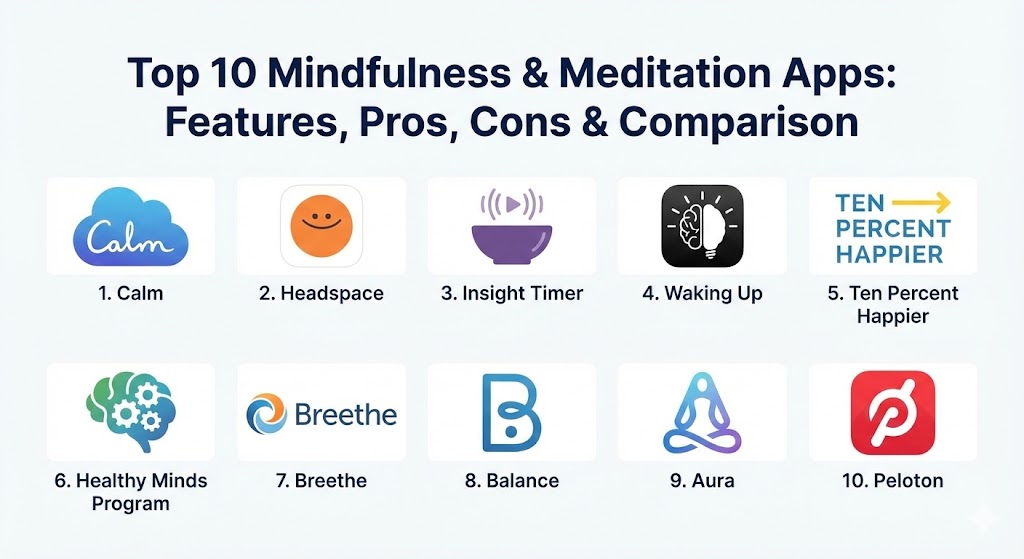
Top 10 Mindfulness & Meditation Apps
1 — Calm
Calm is widely considered the “aesthetic” leader of the meditation world, famous for its soothing nature scenes and high-profile celebrity partnerships. It is designed for anyone from beginners to advanced practitioners who want a multisensory approach to relaxation.
- Key features:
- The Daily Calm: A fresh, 10-minute meditation released every single day.
- Sleep Stories: Bedtime tales read by celebrities like Matthew McConaughey and Cillian Murphy.
- Calm Masterclass: Long-form audio lessons taught by world-renowned experts on topics like “Social Media Fix” or “Conscious Parenting.”
- Calm Kids: Specialized content for different age groups, including Thomas & Friends themed sessions.
- Breathe Bubbles: Visual, interactive breathing guides for quick resets.
- Nature Soundscapes: Hundreds of high-quality ambient sounds to aid focus or sleep.
- Pros:
- Unmatched library of sleep-related content and bedtime stories.
- The most visually beautiful and immersive user interface in the category.
- Cons:
- The free version is extremely limited, essentially requiring a subscription.
- Can feel “over-produced” or too commercial for those seeking a more spiritual/minimalist path.
- Security & compliance: GDPR and HIPAA compliant. Data is encrypted in transit and at rest. SSO available for “Calm for Business.”
- Support & community: Extensive online help center, email support, and a massive global community with millions of active users.
2 — Headspace
Headspace is the pioneer that brought meditation to the mainstream with its iconic colorful animations. Founded by former monk Andy Puddicombe, it uses a science-backed, friendly approach to teach the fundamentals of mindfulness.
- Key features:
- The Wake Up: A daily mini-podcast/video to start your day with intention.
- Guided Courses: Thematic series (10–30 days) on topics like grieving, anger, or productivity.
- Move Mode: Mindful fitness sessions and stretches led by experts.
- Focus Music: Lo-fi beats and curated playlists (some by John Legend) to help with deep work.
- Ebb (AI Companion): An empathetic AI assistant that recommends content based on your current mood.
- Buddies: A social feature that lets you see when friends are meditating to build accountability.
- Pros:
- The best “onboarding” experience for absolute beginners who are intimidated by meditation.
- High-quality animated explainers that make complex psychological concepts easy to grasp.
- Cons:
- Monthly subscription is slightly higher than some smaller competitors.
- Some advanced users find the “hand-holding” guidance a bit repetitive over time.
- Security & compliance: ISO 27001, SOC 2 Type II, GDPR, and HIPAA compliant. High emphasis on data privacy.
- Support & community: Comprehensive documentation, 24/7 customer support for enterprise, and active “Headspace for Educators” community.
3 — Insight Timer
Insight Timer is the “People’s Choice” app, boasting the largest free library of meditations in the world. It acts as a marketplace for teachers, musicians, and neuroscientists to share their content directly with users.
- Key features:
- Massive Library: Over 150,000 guided meditations available for free.
- Customizable Timer: High-quality polyphonic bells and ambient backgrounds for unguided sessions.
- Live Events: Daily live sessions where users can interact with teachers in real-time.
- Teacher Marketplace: Follow specific world-renowned teachers like Jack Kornfield or Tara Brach.
- Discussion Groups: Thousands of community groups based on specific interests (e.g., “Meditation for Nurses”).
- Workplace Mode: Basic tools for companies to encourage team meditation.
- Pros:
- Most value for money, with the vast majority of core content being free.
- Incredible variety of styles, from secular mindfulness to chanting and yoga nidra.
- Cons:
- The interface can feel cluttered and overwhelming due to the sheer volume of content.
- Quality control varies since anyone can upload content to the platform.
- Security & compliance: GDPR compliant. Uses standard encryption for personal data.
- Support & community: Strongest community aspect of any app; users can see who is meditating around the world in real-time.
4 — Waking Up
Created by neuroscientist and author Sam Harris, Waking Up is more than a meditation app—it’s a guide to understanding the mind. It focuses on the theory behind mindfulness and explores the nature of consciousness.
- Key features:
- The Introductory Course: A 28-day program that teaches the “non-dual” approach to mindfulness.
- Sam Harris’s Daily Meditations: Philosophical and technical guidance from the founder.
- Theory Section: Hours of conversations and lessons on philosophy, neuroscience, and Stoicism.
- Life Lessons: Content focused on productivity, relationships, and ethics.
- Moments: Short, unexpected audio snippets pushed to your phone to trigger “mindfulness in the wild.”
- No-Cost Access: A unique policy where the app is free for anyone who truly cannot afford it.
- Pros:
- Best for intellectuals and skeptics who want to understand why they are meditating.
- Zero “fluff” or “woo-woo” content; strictly secular and evidence-based.
- Cons:
- The concepts (like “looking for the looker”) can be intellectually demanding and difficult for beginners.
- Lacks the sleep stories and music found in “lifestyle” apps like Calm.
- Security & compliance: SOC 2 compliant, GDPR, and standard data encryption.
- Support & community: Excellent email support and a dedicated website for theoretical deep-dives.
5 — Ten Percent Happier (Happier)
Based on Dan Harris’s best-selling book, this app is designed specifically for “fidgety skeptics.” It pairs world-class meditation teachers with journalists to make the practice accessible and grounded.
- Key features:
- The Basics Course: A no-nonsense introduction to meditation.
- Video Lessons: Every meditation starts with a short video “chat” between Dan Harris and a teacher.
- Topic-Specific Hubs: Categories for “Healthy Habits,” “Relationships,” and “Work.”
- Podcast Integration: Easy access to the “Ten Percent Happier” podcast episodes.
- One-on-One Coaching: (Premium) Access to real meditation coaches to answer your questions.
- Pros:
- Very relatable; the “skeptical” tone resonates with people who think meditation isn’t for them.
- High production value with a focus on practical, “real-world” benefits.
- Cons:
- No monthly subscription option—it’s an annual commitment or nothing.
- Very little content geared toward sleep or kids compared to Headspace/Calm.
- Security & compliance: GDPR and HIPAA compliant. Enterprise-level SSO support.
- Support & community: Direct access to coaches (for premium users) provides a unique support layer.
6 — Healthy Minds Program
The Healthy Minds Program is a rare gem in the app store: it is a high-quality, fully featured meditation app that is completely free (supported by donations). It is based on a neuroscientific framework developed at the University of Wisconsin-Madison.
- Key features:
- The Four Pillars: Content structured around Awareness, Connection, Insight, and Purpose.
- Active Practices: Meditations designed to be done while walking, commuting, or doing chores.
- Podcast-style Lessons: Educational segments that explain the science of well-being.
- Well-being Assessment: A scientific survey to track your progress across different mental dimensions.
- Male/Female Voice Toggle: For almost every guided session.
- Pros:
- 100% free with no hidden paywalls or ads.
- Deeply rooted in academic neuroscience and peer-reviewed research.
- Cons:
- The interface is functional but lacks the high-end “polish” and celebrity glitz of Calm.
- Smaller library compared to the major commercial players.
- Security & compliance: Strong privacy protections; data is used for research (anonymized) if users opt-in.
- Support & community: Email-based support; documentation is high-quality and science-focused.
7 — Breethe
Breethe is an all-in-one wellness companion that aims to be a “friend in your pocket.” It leans heavily into personalization and provides tools for stress, sleep, and even hypnotherapy.
- Key features:
- Made 4 You: An AI-driven personalization engine that builds daily programs based on your goals.
- Hypnotherapy Tracks: Guided sessions for specific behavior changes like weight loss or quitting smoking.
- Emotional Assistant: A supportive chatbot that recommends tracks based on your current feelings.
- Taxing Times: A unique section for “in-the-moment” stress relief during specific life events.
- Sleep Stories & Music: A massive library of audio for nighttime relaxation.
- Pros:
- Excellent for those who want a “buffet” of wellness tools (meditation, music, hypnotherapy).
- The AI-driven recommendations are highly effective at surfacing relevant content.
- Cons:
- The wide variety of content can sometimes feel a bit less “focused” than a pure meditation app.
- Subscription costs can be on the higher end of the spectrum.
- Security & compliance: GDPR and CCPA compliant. Uses modern encryption protocols.
- Support & community: Responsive customer service and a helpful “Get Started” onboarding flow.
8 — Balance
Balance is a newer entrant that has quickly gained popularity through its extreme personalization. It functions like a personal meditation coach that learns about you over time.
- Key features:
- Interactive Meditations: The app asks you questions before and after sessions to refine its future guidance.
- 10-Day Plans: Structured paths to build specific skills (e.g., “Foundations,” “Focus,” “Sleep”).
- Immersive Meditations: Uses the phone’s haptics (vibrations) and 3D sound to deepen the experience.
- Wind Down activity: A first-of-its-kind interactive prep for sleep.
- Bilateral Stimulation: Audio techniques designed to reduce anxiety through alternating sounds.
- Pros:
- The most personalized experience available; no two users have the same meditation.
- Often offers a “one year free” promotion, making it highly accessible.
- Cons:
- Relies heavily on user input; if you don’t answer the questions, the personalization fails.
- The library is growing but smaller than Insight Timer or Calm.
- Security & compliance: Standard data encryption; privacy-focused with limited data sharing.
- Support & community: Email support and a well-curated FAQ section.
9 — Aura
Aura is designed for busy people who want “mindfulness in micro-doses.” It is a platform that hosts thousands of coaches and therapists, offering everything from CBT to life coaching.
- Key features:
- 3-Minute Meditations: Perfect for those with zero time.
- AI Personalization: Learns your preferences to recommend tracks from its vast database.
- CBT & Life Coaching: Goes beyond meditation to include cognitive behavioral therapy tools.
- Gratitude Journal: An integrated space to log daily positive reflections.
- Coach Marketplace: Follow and support individual wellness creators.
- Pros:
- Best for people who struggle to sit for more than 5 minutes.
- All-in-one mental health approach including therapy-based tools.
- Cons:
- The “antivirus” brand sharing the same name can make finding the app in searches confusing.
- Some content quality is variable as it is a marketplace model.
- Security & compliance: HIPAA and GDPR compliant. High-tier encryption for journal entries.
- Support & community: 24/7 support for premium users and a community-driven feedback loop.
10 — Peloton (Mindfulness)
While primarily known for its bikes, the Peloton app has quietly become one of the best sources for mindfulness and yoga. It is ideal for users who are already active and want to integrate mental wellness into their fitness routine.
- Key features:
- Diverse Instructor Roster: High-energy, world-class instructors with diverse teaching styles.
- Yoga & Meditation Integration: Classes often link physical movement with mental stillness.
- Outdoor Meditations: Specifically designed for walking or running.
- Themed Sessions: Meditations focused on “Gratitude,” “Restoration,” or “Courage.”
- Apple Watch Integration: Tracks heart rate during meditation sessions to show physiological impact.
- Pros:
- Best music integration in the industry; uses popular licensed tracks.
- High “community” energy; you can see others taking the class with you.
- Cons:
- Lacks the deep theoretical or clinical depth of Sam Harris or Healthy Minds.
- Requires a Peloton membership (though a standalone “App Only” tier exists).
- Security & compliance: SOC 2 compliant, GDPR, and standard health data privacy.
- Support & community: One of the most passionate and active social communities in the world.
Comparison Table
| Tool Name | Best For | Platform(s) Supported | Standout Feature | Rating (TrueReviewnow / App Store) |
| Calm | Sleep & Aesthetics | iOS, Android, Web | Celebrity Sleep Stories | 4.8 / 5 |
| Headspace | Beginners | iOS, Android, Web | Animated Courses | 4.9 / 5 |
| Insight Timer | Free Content | iOS, Android, Web | 150k+ Free Tracks | 4.9 / 5 |
| Waking Up | Intellectuals/Theory | iOS, Android, Web | Non-Dual Philosophy | 4.8 / 5 |
| Happier | Skeptics | iOS, Android, Web | Video-First Teaching | 4.7 / 5 |
| Healthy Minds | Science-Based | iOS, Android | Free Research-Backing | 4.9 / 5 |
| Breethe | Total Wellness | iOS, Android, Web | Hypnotherapy Content | 4.7 / 5 |
| Balance | Personalization | iOS, Android | Adaptive Coach UI | 4.8 / 5 |
| Aura | Micro-meditations | iOS, Android, Web | 3-Minute Sessions | 4.6 / 5 |
| Peloton | Active Lifestyles | iOS, Android, Apple TV | Fitness Integration | 4.9 / 5 |
Evaluation & Scoring of Mindfulness & Meditation Apps
When selecting the right app, we use a weighted scoring system to ensure a balanced perspective between technical capability and user experience.
| Category | Weight | Key Evaluation Points |
| Core Features | 25% | Variety of meditations, sleep support, and specialized content (kids/work). |
| Ease of Use | 15% | Navigation simplicity, onboarding flow, and visual design. |
| Integrations | 15% | Apple Health/Google Fit syncing, wearable support, and smart home integration. |
| Security & Compliance | 10% | Data encryption, GDPR/HIPAA compliance, and privacy transparency. |
| Performance | 10% | App stability, offline listening capability, and load times. |
| Support & Community | 10% | Quality of help docs, response time, and active user forums. |
| Price / Value | 15% | Free tier quality vs. cost of premium subscription. |
Which Mindfulness & Meditation App Is Right for You?
The “best” app is entirely subjective and depends on your specific goals. Here is a decision-making guide:
- Solo Users & Beginners: Start with Headspace. Its structured approach will teach you the “how-to” of meditation without confusing you with jargon.
- The “Fidgety Skeptic”: If you think meditation is a bit too mystical, Ten Percent Happier or Waking Up will speak your language. They use science and logic to explain the benefits.
- Budget-Conscious Users: If you don’t want to spend a dime, Healthy Minds Program is the clear winner for quality, followed by Insight Timer for quantity.
- Premium Experience Seekers: If you value high-end production, celebrity voices, and beautiful visuals, Calm is worth the subscription.
- The Busy Professional: If you only have minutes between meetings, Aura or the “Singles” in Balance are designed for your schedule.
- Enterprises & HR Managers: Look for Headspace for Work or Calm for Business. They offer robust administrative dashboards, SSO, and bulk-licensing that makes deployment across 1,000+ employees simple.
Frequently Asked Questions (FAQs)
1. Are meditation apps actually effective?
Yes. Peer-reviewed studies on apps like Healthy Minds and Headspace have shown significant reductions in stress and cortisol levels with just 10 minutes of daily use.
2. Can I use these apps offline?
Most premium versions (Calm, Headspace, Waking Up) allow you to download tracks for offline use, making them perfect for flights or areas with poor reception.
3. Do I need special equipment like a meditation cushion?
No. Most apps have “Anywhere” meditations designed for chairs, buses, or walking. Comfort is key, but expensive gear is not required.
4. Is my data private? Can my employer see what I meditate on?
For enterprise versions (like Calm for Business), employers generally only see aggregated, anonymized data (e.g., “60% of employees used the app this week”) and cannot see your individual session history.
5. How much do these apps typically cost?
Most premium subscriptions range from $60 to $100 per year. Monthly options are usually around $13 to $15.
6. Can kids use these apps?
Yes. Calm and Headspace have dedicated “Kids” sections with age-appropriate content (3–5, 6–8, and 9–12).
7. How long should I meditate each day?
Research suggests that consistency is more important than duration. Even 3–5 minutes daily is more effective than 60 minutes once a week.
8. Is meditation a religious practice?
While meditation has roots in various religions, all the apps in this list provide secular, non-religious guidance focused on psychological and neurological benefits.
9. What if I fall asleep during meditation?
That’s perfectly fine! Many apps even have “Sleep Meditations” designed to help you drift off. If you’re trying to stay awake, try meditating sitting upright.
10. What’s the best time of day to meditate?
Most experts suggest first thing in the morning to set a tone for the day, but the “best” time is whenever you can consistently stick to the habit.
Conclusion
Choosing a mindfulness app is a deeply personal journey. Whether you are drawn to the scientific rigor of the Healthy Minds Program, the philosophical depth of Waking Up, or the calming visuals of Calm, the most important factor is habit formation. These tools are not magic bullets, but they are incredibly powerful mental gymnasiums. Start with a free trial of two or three that resonate with you, and stick with the one that feels like a relief, not a chore.