Introduction
Marketplace seller tools are specialized software applications designed to help e-commerce merchants manage and scale their business operations across one or multiple online marketplaces. These tools act as the “central nervous system” of a digital storefront, aggregating data from various sales channels into a single dashboard. By automating repetitive tasks—such as keyword research, price adjustments, and inventory syncing—they allow sellers to focus on high-level strategy rather than manual data entry.
In today’s landscape, these tools are vital because marketplace algorithms have become increasingly pay-to-play and data-driven. Without real-time analytics and automated optimization, a seller’s organic visibility can vanish overnight. Key real-world use cases include identifying high-demand product niches, automating “reverse ASIN” lookups to spy on competitor keywords, and maintaining 100% stock accuracy to avoid the dreaded “Out of Stock” penalty. When evaluating these tools, users should look for native API integrations, AI-driven predictive analytics, multi-currency support for international expansion, and robust security protocols.
Best for: Professional e-commerce brands, private-label sellers, dropshippers, and retail arbitrage experts looking to automate multi-channel scaling. It is particularly valuable for mid-to-large businesses managing thousands of SKUs across diverse global regions.
Not ideal for: Casual “garage sale” sellers or individuals with a very small, static inventory (e.g., 1–5 items) who can easily manage their listings manually through the marketplace’s native seller central portals.
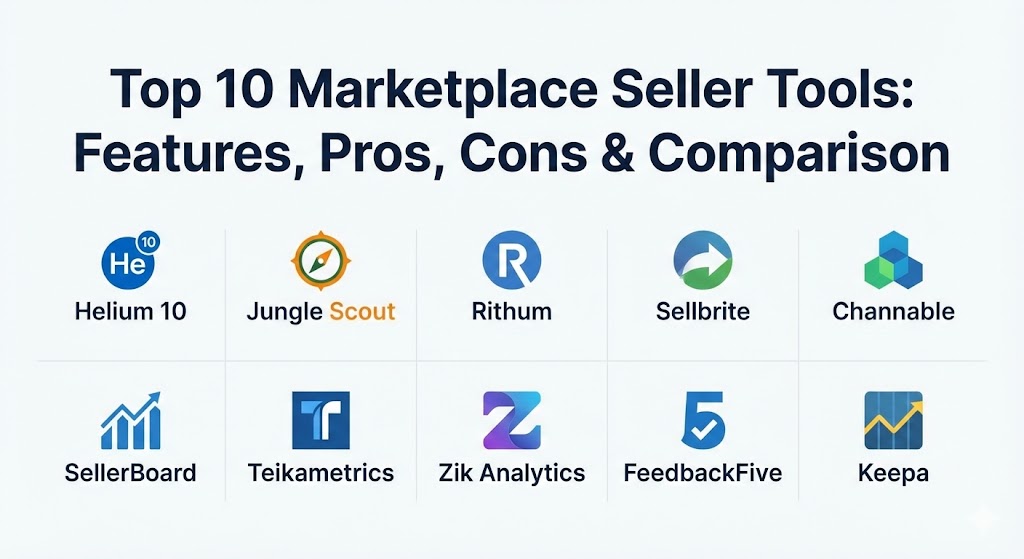
Top 10 Marketplace Seller Tools
1 — Helium 10
Helium 10 is widely considered the “Swiss Army Knife” for Amazon and Walmart sellers. It provides an all-in-one suite of over 30 tools that cover everything from initial product research and SEO to financial analytics and advertising management.
- Key features:
- Cerebro: A powerful reverse ASIN lookup tool to identify competitor keywords.
- Magnet: A massive keyword research database for SEO optimization.
- Adtomic: An AI-powered PPC (Pay-Per-Click) advertising platform.
- Xray: A Chrome extension for real-time market validation while browsing.
- Inventory Management: Automated forecasting to prevent stockouts or overstocking.
- Listing Analyzer: Evaluates listing quality against competitor benchmarks.
- Pros:
- The most comprehensive feature set in the industry; literally everything is in one box.
- The mobile app allows for real-time monitoring of sales and alerts on the go.
- Cons:
- The pricing for the full suite is quite high for beginners.
- The sheer number of tools creates a steep learning curve for new users.
- Security & compliance: SOC 2 Type II compliant, SSO integration, and secure Amazon/Walmart API connections.
- Support & community: Extensive “Helium 10 Academy” training, a massive private Facebook community, and 24/7 technical support.
2 — Jungle Scout
Jungle Scout pioneered the product research space and has evolved into a robust platform for both brand owners and professional sellers. It is famous for its data accuracy and its “Supplier Database” which helps sellers find vetted manufacturers.
- Key features:
- Opportunity Finder: Identifies high-demand, low-competition niches.
- Supplier Database: A unique tool to track down the actual manufacturers of top products.
- Product Tracker: Monitors the daily sales of competitors over long periods.
- Listing Builder: Uses AI to write optimized product titles and descriptions.
- Review Automation: Automatically sends review requests compliant with TOS.
- Sales Analytics: Real-time tracking of profit, revenue, and hidden fees.
- Pros:
- Known for having some of the most accurate sales estimation data in the market.
- The interface is exceptionally clean and modern, making it easier to use than Helium 10.
- Cons:
- Lacks some of the ultra-deep SEO features found in more specialized keyword tools.
- Extensions are occasionally slower to load on high-traffic marketplace pages.
- Security & compliance: GDPR compliant, ISO 27001 certified data centers, and encrypted API data handling.
- Support & community: Excellent customer service and one of the best educational blogs/YouTube channels in e-commerce.
3 — Rithum (formerly ChannelAdvisor)
Rithum is an enterprise-level marketplace management platform. It is designed for massive retailers and manufacturers who need to synchronize thousands of products across dozens of global marketplaces simultaneously.
- Key features:
- Inventory Synchronization: Real-time stock updates across 100+ channels globally.
- Algorithmic Repricing: Dynamic price adjustments based on competitor movement and margins.
- Marketplace Ad Management: Unified control of ads on Amazon, eBay, and Walmart.
- Order Management: Centralized fulfillment routing and logistics tracking.
- Actionable Insights: Deep data science reports on channel performance.
- Pros:
- Unrivaled scalability; if you sell in 10 countries on 20 sites, this is the industry standard.
- Managed services available where Rithum experts help manage your campaigns.
- Cons:
- Prohibitively expensive for small or medium-sized businesses.
- Implementation is a complex process that can take weeks or months.
- Security & compliance: Enterprise-grade security, SOC 2, HIPAA compatibility, and robust audit logs.
- Support & community: Dedicated account managers for enterprise tiers and a high-level professional services team.
4 — Sellbrite
Sellbrite is the go-to solution for SMBs (Small to Medium Businesses) that want a simple, effective way to list and sync inventory across multiple channels like Etsy, eBay, Amazon, and Shopify.
- Key features:
- Multi-Channel Listing: Create listings in bulk across different marketplaces from one catalog.
- Inventory Sync: Automatically adjusts stock levels everywhere when a sale happens on one channel.
- ShipStation Integration: Native integration for streamlined shipping and label printing.
- FBA Integration: Route orders from any channel (like eBay) to be fulfilled by Amazon.
- Centralized Dashboard: A unified view of all orders and customer interactions.
- Pros:
- One of the most intuitive user interfaces in the multi-channel space.
- Highly affordable for smaller sellers who are just starting to diversify their channels.
- Cons:
- Lacks the deep product research or keyword tools found in Helium 10.
- Limited advanced advertising management features.
- Security & compliance: Standard SSL/TLS encryption, PCI compliance for payments, and secure OAuth API connections.
- Support & community: Solid documentation and responsive email/chat support for all plan levels.
5 — Channable
Channable is a “rule-based” feed management and PPC tool. It is unique because it allows sellers to create complex “If/Then” logic to optimize their product data for hundreds of different comparison sites and marketplaces.
- Key features:
- Data Feed Optimization: Clean and map product data to meet the specific requirements of 2,500+ channels.
- Smart Categorization: Uses AI to automatically categorize products for different marketplaces.
- PPC Tool: Automatically generates thousands of Google Ads and Microsoft Advertising campaigns based on live stock.
- Order Connection: Syncs orders from marketplaces directly back to your webstore (e.g., Magento, Shopify).
- Marketplace Integration: Direct API connections to Amazon, eBay, Walmart, and bol.com.
- Pros:
- The rule-based engine provides unmatched control over how your data appears on different sites.
- Excellent for European sellers due to its vast support for local EU marketplaces.
- Cons:
- The logic-based setup can be confusing for non-technical users.
- Pricing scales based on the number of items, which can get pricey for large catalogs.
- Security & compliance: ISO 27001 certified, GDPR compliant, and 2FA support for all accounts.
- Support & community: Multi-language support and very high-quality technical documentation.
6 — SellerBoard
SellerBoard is widely regarded as the world’s most accurate profit analytics tool for Amazon and Walmart sellers. It focuses on the “unseen” costs like returns, storage fees, and PPC spend to show your true take-home profit.
- Key features:
- Live Profit Dashboard: Real-time visibility of every penny earned and spent.
- Inventory Planning: Tells you exactly when to restock based on sales velocity.
- PPC Dashboard: Detailed breakdown of ad spend vs. organic profit per SKU.
- Review Request Automation: Follows up with customers to build social proof.
- Money Back Tool: Identifies Amazon errors (like lost inventory) so you can claim refunds.
- Pros:
- Extremely accurate data that accounts for complex marketplace fee structures.
- Much more affordable than full-suite tools if you only need profit analytics.
- Cons:
- Does not offer keyword research or product scouting tools.
- UI is data-dense and can feel overwhelming at first.
- Security & compliance: Amazon SP-API authorized developer; does not store sensitive banking passwords.
- Support & community: Very fast email support and a helpful blog focusing on profit optimization.
7 — Teikametrics
Teikametrics is an AI-powered advertising optimization platform (Flywheel 2.0). It is designed for sellers who want to maximize their ROI on Amazon and Walmart ads using machine learning.
- Key features:
- Flywheel AI: Automatically adjusts keyword bids 24/7 to hit your target ACOS (Advertising Cost of Sales).
- Multi-Marketplace Optimization: Manage and compare ad performance on Amazon and Walmart in one view.
- Market Intelligence: Insights into how your ad spend is affecting your organic ranking.
- Automated Keyword Harvesting: Finds new high-converting keywords and adds them to campaigns.
- Profit Tracking: Integrates sales data to ensure ads remain profitable.
- Pros:
- The AI is “set and forget,” saving hours of manual bidding every week.
- Very strong for large brands with high ad spend looking for data-backed efficiency.
- Cons:
- The cost is often a percentage of ad spend, which can be high for large accounts.
- The interface focuses strictly on advertising; you’ll still need other tools for research.
- Security & compliance: SOC 2 Type I, secure API handling, and enterprise-grade privacy controls.
- Support & community: Offers managed services where professional ad managers handle your accounts.
8 — Zik Analytics
If your primary marketplace is eBay, Zik Analytics is the essential research tool. While most of the industry focuses on Amazon, Zik provides deep data specifically for the eBay ecosystem.
- Key features:
- Competitor Research: Scan any eBay seller to see their best-selling items.
- Product Research: Find trending products with high “sell-through” rates.
- Category Research: Analyze entire eBay categories to find untapped opportunities.
- Title Builder: Creates eBay titles based on actual search volume data.
- AliExpress/Amazon Scanners: Tools specifically for dropshippers to find items to flip.
- Pros:
- The undisputed leader for eBay-specific data and dropshipping research.
- Very affordable pricing plans compared to Amazon-centric tools.
- Cons:
- Not useful for sellers who are purely focused on Amazon or Walmart.
- The interface feels a bit more “internet-marketer” style than professional corporate software.
- Security & compliance: Standard web security, secure payment processing, and eBay API authorization.
- Support & community: Huge community of eBay sellers and regular webinars on dropshipping strategy.
9 — FeedbackFive
FeedbackFive (by eComEngine) is a specialized tool dedicated to one thing: getting more (and better) reviews. Since reviews are the lifeblood of marketplace rankings, this tool is vital for brand building.
- Key features:
- Automated Requests: Sends TOS-compliant review requests via Amazon’s “Request a Review” button.
- Review Monitoring: Alerts you instantly when you receive a negative review.
- Analytics: Tracks which products are getting the most reviews and why.
- Request Timing: Optimizes when emails are sent based on delivery time.
- International Support: Supports review requests across 17 global marketplaces.
- Pros:
- Focuses exclusively on reviews, making it much more powerful than the “bonus” review tools in larger suites.
- Helps prevent account suspensions by ensuring all communications follow strict marketplace rules.
- Cons:
- It is a single-purpose tool; you will need other software for inventory or research.
- Monthly costs add up if you have a high volume of orders.
- Security & compliance: Fully compliant with Amazon’s communication policies and GDPR.
- Support & community: Excellent customer support team that are experts in marketplace policy.
10 — Keepa
Keepa is the “history book” of the marketplace. It tracks every price change, rank change, and buy box change for millions of products over years of time.
- Key features:
- Price History Graphs: See every price fluctuation in a product’s history.
- Sales Rank Tracking: Monitor how popular a product is over time.
- Buy Box Statistics: See which sellers are winning the Buy Box and at what price.
- Price Increase/Decrease Alerts: Get notified when a competitor changes their price.
- Data Export: Pull massive amounts of historical data into spreadsheets for analysis.
- Pros:
- The depth of historical data is unmatched; essential for retail arbitrage and wholesale.
- Very low cost for the amount of data provided.
- Cons:
- The UI is famously “ugly” and looks like a stock market chart from the 90s.
- It is a data tool, not a management tool; it won’t help you list products or sync inventory.
- Security & compliance: Standard web security and respects all marketplace data-scraping rules.
- Support & community: Very active community of “data nerds” and power-sellers who use the API.
Comparison Table
| Tool Name | Best For | Platform(s) Supported | Standout Feature | Rating (Gartner / Trust) |
| Helium 10 | All-in-One Amazon | Amazon, Walmart | Cerebro (Reverse ASIN) | 4.6 / 5 |
| Jungle Scout | Product Research | Amazon, Walmart | Supplier Database | 4.8 / 5 |
| Rithum | Global Enterprise | 100+ Marketplaces | Global Scalability | 4.2 / 5 |
| Sellbrite | SMB Multi-Channel | eBay, Etsy, Amazon, Shopify | Ease of Setup | 4.4 / 5 |
| Channable | Data Feed Mastery | 2,500+ Channels | Rule-Based Feed Logic | 4.5 / 5 |
| SellerBoard | Profit Analytics | Amazon, Walmart | Real-Time Profit Tracking | 4.7 / 5 |
| Teikametrics | AI Ad Optimization | Amazon, Walmart | Flywheel 2.0 AI Bidding | 4.3 / 5 |
| Zik Analytics | eBay Research | eBay | eBay Market Trends | 4.4 / 5 |
| FeedbackFive | Review Building | Amazon (Global) | Negative Review Alerts | 4.6 / 5 |
| Keepa | Historical Data | Amazon | Multi-Year Price Graphs | 4.8 / 5 |
Evaluation & Scoring of Marketplace Seller Tools
To choose the right tool, it is helpful to understand how these solutions are judged by industry experts. The following rubric breaks down the critical components of a marketplace management solution.
| Category | Weight | Evaluation Criteria |
| Core Features | 25% | Multi-channel listing, inventory sync, and keyword research depth. |
| Ease of Use | 15% | Onboarding speed, UI clarity, and mobile accessibility. |
| Integrations | 15% | Native API connections with major marketplaces and 3PL/Logistics. |
| Security | 10% | SOC 2 status, GDPR compliance, and secure API handling. |
| Performance | 10% | Data accuracy, sync speed, and platform uptime. |
| Support | 10% | Quality of documentation, community size, and response times. |
| Price / Value | 15% | TCO relative to efficiency gains and revenue growth. |
Which Marketplace Seller Tool Is Right for You?
Selecting the right tool depends on your current stage of growth and your specific business model (Private Label, Wholesale, or Arbitrage).
- Solo Users & Beginners: If you are just starting, Jungle Scout is the best choice because of its high-quality education and intuitive UI. If you are on a very tight budget, Keepa (for research) and the basic plan of Sellbrite (for listing) are excellent entry points.
- The Growing SMB: Once you hit $10k+ in monthly revenue, you need to know your numbers. SellerBoard is essential for tracking real profit. To expand your reach beyond one marketplace, Sellbrite or Channable will help you sync inventory without the risk of overselling.
- The Private Label Brand: You live and die by SEO and reviews. Helium 10 is the gold standard for keyword dominance, and FeedbackFive is the best way to ensure your review count stays high and healthy.
- The High-Spend Advertiser: If you are spending $5,000+ per month on ads, the human brain cannot keep up with thousands of keyword bids. Teikametrics will pay for itself by cutting wasted ad spend and boosting high-performing keywords.
- The Global Enterprise: If you are a corporation managing a global supply chain across every continent, Rithum provides the architectural “heavy lifting” needed to keep millions of data points in sync.
Frequently Asked Questions (FAQs)
1. Can I use these tools for dropshipping?
Yes, several tools are specifically built for this. Zik Analytics is the leader for eBay dropshipping, while Channable is great for managing feeds from multiple dropship suppliers.
2. Do I need a different tool for every marketplace?
Not necessarily. All-in-one tools like Helium 10 now support both Amazon and Walmart. Multi-channel tools like Sellbrite can manage almost all major platforms from one dashboard.
3. Will using these tools get my account suspended?
Only if the tool violates marketplace Terms of Service (TOS). All the tools on this list use official APIs (like Amazon SP-API), which are the safe, approved way to connect. Avoid tools that “scrape” data by logging into your account.
4. How accurate are the sales estimates?
No tool is 100% accurate because they don’t have access to the marketplace’s private internal databases. However, Jungle Scout and Helium 10 are generally within 10–15% accuracy.
5. Can I manage my social media sales (TikTok Shop, Instagram) with these?
Yes, Sellbrite and Channable have recently added integrations for TikTok Shop and Instagram, allowing you to sync your inventory from your warehouse to your social storefronts.
6. What is a “Reverse ASIN” lookup?
It is a feature (found in Helium 10) where you paste a competitor’s product ID (ASIN), and the tool shows you every single keyword that the product is currently ranking for.
7. Is a monthly subscription required?
Most of these tools are SaaS (Software as a Service) and require monthly or annual fees. Some, like Keepa, offer limited free versions, but the professional data is always paid.
8. Can these tools help me find a manufacturer?
Yes, Jungle Scout’s Supplier Database allows you to search the actual US Customs import records to see which factories the top brands are using.
9. Do I need to be a tech expert to use them?
Most are designed for “business users,” but tools like Channable or Rithum do require a more technical understanding of data feeds and logic.
10. What is ACOS and why does Teikametrics care about it?
ACOS stands for Advertising Cost of Sales. It’s the percentage of sales that went to advertising. Teikametrics uses AI to lower your ACOS while increasing your total sales volume.
Conclusion
The “best” marketplace seller tool is the one that addresses your specific operational bottleneck. For most, that starts with product research and eventually moves toward inventory management and automated advertising. As we head into 2026, the gap between “amateur” and “professional” sellers is defined by their tech stack. Choosing the right tool from this list isn’t just about saving time—it’s about having the data and automation required to win the Buy Box in a global economy.