Introduction
Marketing attribution platforms are specialized software solutions designed to identify and assign credit to the various touchpoints a customer interacts with before making a conversion. In an era where a user might see an Instagram ad on their phone, read a review on their tablet, and finally purchase via a search ad on their desktop, these tools provide the “glue” that connects these disparate events. They move beyond the limitations of “last-click” models, which often ignore the vital top-of-funnel efforts that built the initial brand awareness.
The importance of these platforms lies in their ability to optimize return on ad spend (ROAS) and drive strategic budget allocation. Without them, marketers are essentially “flying blind,” often over-investing in channels that appear to close deals while under-investing in the channels that actually start them. Key real-world use cases include identifying the long-term lifetime value (LTV) of customers acquired through specific social campaigns, measuring the impact of podcast or television ads on digital sales, and deduplicating conversions across different ad networks. When evaluating these tools, users should look for server-side tracking capabilities (to bypass cookie restrictions), machine learning-driven modeling, and native integrations with their existing CRM and eCommerce stacks.
Best for: High-growth eCommerce brands, B2B companies with long sales cycles, agencies managing multi-channel ad spend, and any organization spending over $10,000 per month on paid advertising across multiple platforms.
Not ideal for: Local businesses with a single marketing channel (e.g., just a local SEO presence) or very small startups where a free tool like basic Google Analytics 4 provides sufficient insight into their low-volume traffic.
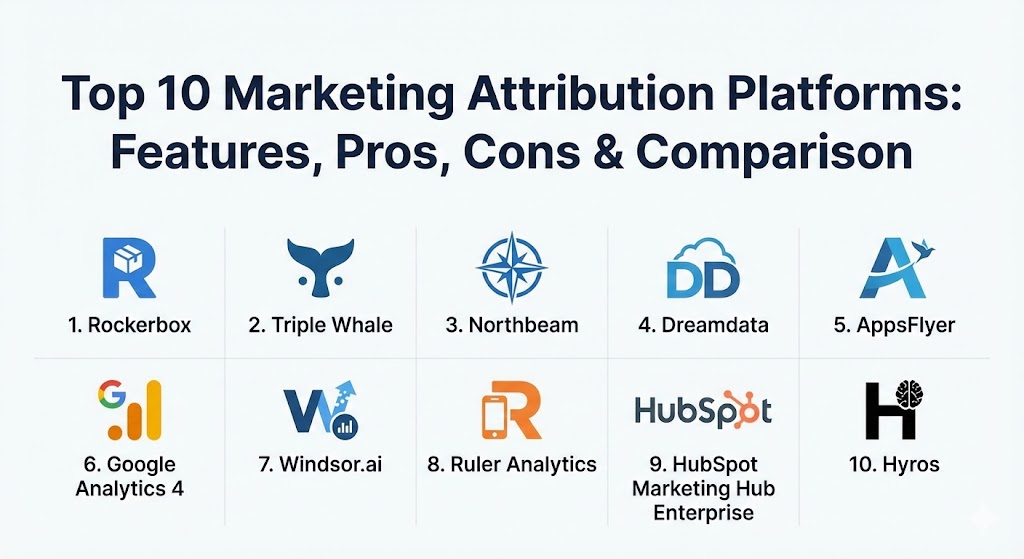
Top 10 Marketing Attribution Platforms
1 — Rockerbox
Rockerbox is a premier attribution solution specifically built for direct-to-consumer (DTC) brands that need to centralize their marketing data and move beyond the biased reporting of individual ad platforms like Facebook or Google.
- Key features:
- Centralized dashboard for all digital and offline marketing spend.
- Advanced “Incrementality” testing to see the true impact of ad spend.
- Multi-touch attribution (MTA) models that account for “messy” customer journeys.
- Integration with non-digital channels like TV, Direct Mail, and OOH (Out-of-Home).
- Automated data cleaning and normalization across different platforms.
- “Path to Purchase” visualizations for granular user-level analysis.
- Pros:
- Excellent at unmasking “dark social” and direct traffic origins.
- Highly responsive customer success team that assists with custom data modeling.
- Cons:
- The pricing reflects its enterprise-grade power; it is not a “budget” tool.
- The platform’s deep feature set requires a dedicated team member to manage and interpret data.
- Security & compliance: SOC 2 Type II certified, GDPR/CCPA compliant, and supports enterprise SSO and data encryption.
- Support & community: Offers white-glove onboarding and a dedicated account manager for most tiers, alongside a robust documentation portal.
2 — Triple Whale
Triple Whale has become the de facto standard for Shopify-based eCommerce brands, offering a “single pane of glass” that combines attribution, profit tracking, and creative analytics.
- Key features:
- Triple Pixel: A proprietary tracking technology that bypasses browser-based ad blockers.
- Real-time “MER” (Marketing Efficiency Ratio) and blended ROAS tracking.
- Creative-level attribution to see which specific ad visuals drive profit.
- Cohort analysis for tracking customer lifetime value (LTV) over time.
- Mobile app that allows founders to check performance on the go.
- AI-powered “Smart Insights” that highlight anomalies in ad spend.
- Pros:
- Incredible ease of use; setup takes minutes for Shopify store owners.
- Combines attribution with actual profit/loss data (shipping, COGS, etc.).
- Cons:
- Strictly limited to the Shopify ecosystem; not usable for custom-built sites.
- Some of the most valuable features are locked behind higher-tier “Enterprise” plans.
- Security & compliance: Shopify App Store vetted, CCPA/GDPR compliant, and uses secure API tokens for all data connections.
- Support & community: Very active community of eCommerce founders and extensive “Triple Whale University” educational resources.
3 — Northbeam
Northbeam is an advanced, machine learning-driven attribution platform that prioritizes data accuracy in a post-iOS 14.5 world. It is designed for high-spend brands that require deep statistical modeling.
- Key features:
- Proprietary machine learning models that update hourly.
- First-party data collection through a server-side tracking pixel.
- Cross-domain and cross-device journey mapping.
- Detailed “New vs. Returning” customer attribution breakdowns.
- Bias removal technology to counter-act the inflated ROAS claims of ad platforms.
- Support for multi-brand conglomerates through a unified parent-account view.
- Pros:
- Exceptionally high data accuracy, even for long consideration cycles.
- Visualizations are clean and built specifically for scaling aggressive ad spend.
- Cons:
- Requires a significant minimum ad spend to justify the platform cost.
- More of a “black box” machine learning approach compared to rule-based models.
- Security & compliance: SOC 2 Type II, GDPR compliant, and utilizes ISO-standard data centers.
- Support & community: Provides professional services for complex integrations and has a high-quality technical support desk.
4 — Dreamdata
Dreamdata is the leading attribution platform specifically designed for B2B companies. It solves the unique problem of multi-stakeholder buying committees where a sale involves multiple people from the same company.
- Key features:
- Account-based attribution that groups individual users into “companies.”
- Integration with major B2B CRMs like Salesforce, HubSpot, and Pipedrive.
- Revenue and pipeline attribution to show how marketing drives real deals.
- Content-level attribution to see which whitepapers or blogs influence sales.
- Data warehouse export (BigQuery) for custom BI reporting.
- Benchmarking tools to compare your performance against industry standards.
- Pros:
- The only tool on this list that truly understands the “account-level” B2B journey.
- Excellent at showing the long-term ROI of content marketing and organic search.
- Cons:
- Can be complex to set up if your CRM data is not clean or organized.
- Reporting can be “delayed” as it relies on CRM syncs rather than just pixel hits.
- Security & compliance: SOC 2 Type II, GDPR compliant, and ISO 27001 certified.
- Support & community: Strong focus on “Revenue Operations” (RevOps) community and detailed B2B-specific playbooks.
5 — AppsFlyer
AppsFlyer is the global leader in mobile app attribution. If your marketing is primarily focused on getting users to download and engage with a mobile application, this is the industry gold standard.
- Key features:
- Accurate mobile install attribution across all major ad networks.
- OneLink: A deep-linking solution that ensures users land in the right spot in the app.
- Protect360: Advanced ad fraud prevention suite to block fake installs.
- Privacy-safe attribution using Apple’s SKAdNetwork and Google’s Privacy Sandbox.
- Multi-touch modeling for complex mobile-to-web user journeys.
- Real-time analytics with granular “in-app event” tracking.
- Pros:
- Unrivaled global presence and integration with thousands of ad partners.
- The most robust fraud detection in the mobile space.
- Cons:
- Extremely complex interface that requires a dedicated mobile marketing specialist.
- The pricing is based on “events,” which can scale rapidly as your app grows.
- Security & compliance: SOC 2, ISO 27001, GDPR, and rigorous privacy-centric data handling.
- Support & community: Global support teams with 24/7 availability and a massive developer documentation library.
6 — Google Analytics 4 (GA4)
While technically a general web analytics tool, GA4 is the most widely used “entry-level” attribution platform in the world, leveraging Google’s massive data ecosystem to provide model-based insights.
- Key features:
- Data-Driven Attribution (DDA) as the default model for all accounts.
- Seamless integration with Google Ads, Search Console, and YouTube.
- Cross-platform tracking for businesses that have both a website and an app.
- Predictive metrics for churn and purchase probability using AI.
- Free BigQuery export (with some limits) for advanced data analysis.
- Real-time reporting on active users and conversion events.
- Pros:
- It is free for the vast majority of users, making it the most cost-effective starting point.
- The direct link to Google Ads allows for instant bid optimization based on GA4 data.
- Cons:
- Known for a steep learning curve and a UI that many find confusing.
- Significant data thresholding and “sampling” in the free version for high-traffic sites.
- Security & compliance: GDPR/CCPA compliant (with proper configuration), ISO 27001, and SOC 3.
- Support & community: Limited direct support for free users; however, it has the largest community of experts and tutorials online.
7 — Windsor.ai
Windsor.ai is a data-integration-focused attribution platform that excels at pulling data from hundreds of sources and pushing it into your favorite visualization tools like Looker Studio or Power BI.
- Key features:
- Connector-based architecture for over 200 marketing and sales platforms.
- Automated “Last Click” to “Multi-Touch” conversion modeling.
- Media mix modeling (MMM) to account for offline and high-level trends.
- Budget optimization recommendations based on algorithmic insights.
- Data blending capabilities to combine cost data with conversion data.
- No-code setup for pushing data to BigQuery, Snowflake, or Excel.
- Pros:
- Perfect for analysts who want to build their own dashboards rather than use a pre-set UI.
- Very affordable pricing compared to enterprise competitors.
- Cons:
- Lacks the “polished” visual interface of tools like Triple Whale or Rockerbox.
- You essentially need another tool (like Looker Studio) to actually see your data.
- Security & compliance: GDPR compliant, uses encrypted API tunnels, and hosted on secure EU-based servers.
- Support & community: Responsive technical support via chat and email; good documentation for API setups.
8 — Ruler Analytics
Ruler Analytics is a unique attribution tool that bridges the gap between online marketing and offline phone calls or CRM deals. It is a favorite for service-based businesses like lawyers, dentists, and home services.
- Key features:
- Dynamic Number Insertion (DNI) for tracking phone calls back to ad sources.
- Closed-loop marketing that links website visitors to CRM revenue.
- Form-level attribution to see which keywords drive specific lead submissions.
- Integration with telephony systems and popular CRMs like Zoho and Salesforce.
- Visitor-level journey tracking across multiple sessions.
- Revenue-based reporting for service industries.
- Pros:
- The best solution for businesses where the “conversion” happens over a phone call.
- Provides absolute clarity on lead quality by linking leads to actual revenue.
- Cons:
- Limited usefulness for pure eCommerce brands that don’t take phone calls.
- Call tracking requires additional configuration for phone number porting.
- Security & compliance: GDPR compliant, ISO 27001, and secure data handling for sensitive lead info.
- Support & community: High-quality UK-based support and personalized onboarding sessions.
9 — HubSpot (Marketing Hub Enterprise)
While HubSpot is a full CRM and marketing suite, its Enterprise-level attribution reporting is incredibly powerful for companies that want to see how their emails, ads, and blogs contribute to closed-won deals.
- Key features:
- Multi-touch revenue attribution built directly into the CRM.
- Content attribution: See which specific blog posts or whitepapers generated the most revenue.
- Account-based marketing (ABM) reporting for target accounts.
- Automated lead scoring based on cross-channel interactions.
- Seamless integration of sales and marketing data in one dashboard.
- “Journey Analytics” to visualize every step a lead takes before a deal is created.
- Pros:
- Total alignment between sales and marketing; no “finger-pointing” about lead source.
- Very easy to build reports if you are already using the HubSpot ecosystem.
- Cons:
- High-end attribution features are only available in the “Enterprise” tier ($3,600+/mo).
- Not as specialized for “ad-level” deep dives as dedicated tools like Northbeam.
- Security & compliance: SOC 2 Type II, HIPAA compliant (with add-on), ISO 27001, and enterprise SSO.
- Support & community: World-class support, a massive “HubSpot Academy,” and a global network of user groups.
10 — Hyros
Hyros is a high-performance attribution tool designed specifically for “info-marketers” and companies with high-ticket sales funnels that rely heavily on email, webinars, and long-form sales pages.
- Key features:
- “Hyper-accurate” tracking that uses a proprietary “digital fingerprint” for each user.
- Call tracking and email attribution for long consideration cycles.
- Ad platform optimization: Feeds data back to Facebook/Google to improve their AI.
- Customer LTV tracking spanning years, not just weeks.
- ROI tracking for complex funnels (webinars, phone sales, and email sequences).
- Automated “Blacklist” for junk traffic and ad fraud.
- Pros:
- Known for finding “lost” sales that other pixels miss, often increasing reported ROAS.
- Excellent for high-ticket coaching, consulting, and SaaS businesses.
- Cons:
- The marketing and sales process for the tool itself can be very aggressive.
- Requires a high volume of sales to train its tracking “brain” effectively.
- Security & compliance: CCPA/GDPR compliant, uses secure API connections, and follows standard SOC guidelines.
- Support & community: High-touch onboarding and a very active community of performance marketers.
Comparison Table
| Tool Name | Best For | Platform(s) Supported | Standout Feature | Rating (Gartner / Expert) |
| Rockerbox | Multi-channel DTC | Web, TV, Offline | Incrementality Testing | 4.6 / 5 |
| Triple Whale | Shopify Brands | Shopify (Exclusively) | Creative-Level Insights | 4.8 / 5 |
| Northbeam | High-Growth Scale | Web, App, Cloud | Hourly ML Modeling | 4.7 / 5 |
| Dreamdata | B2B / RevOps | Web, CRM, SQL | Account-Level Mapping | 4.6 / 5 |
| AppsFlyer | Mobile Apps | iOS, Android, Web | Fraud Protection 360 | 4.5 / 5 |
| GA4 | SMBs / Free Users | Web, App, Google Ads | Free BigQuery Export | 4.2 / 5 |
| Windsor.ai | Data Analysts | 200+ Connectors | Any-to-Any Integration | 4.3 / 5 |
| Ruler Analytics | Lead-Gen / Service | Web, Call, CRM | Call Attribution | 4.6 / 5 |
| HubSpot Ent. | Sales Alignment | Web, Email, CRM | Revenue Attribution | 4.5 / 5 |
| Hyros | High-Ticket Funnels | Web, Email, Phone | Long-Term Fingerprinting | 4.4 / 5 |
Evaluation & Scoring of Marketing Attribution Platforms
To help you compare these tools objectively, we have scored them based on the seven key criteria that matter most to modern marketing teams.
| Category | Weight | Evaluation Criteria |
| Core Features | 25% | Variety of models, cross-device tracking, and server-side capabilities. |
| Ease of Use | 15% | Intuitiveness of the dashboard and speed of setup. |
| Integrations | 15% | Native connections to major ad platforms, CRMs, and eCommerce tools. |
| Security & Compliance | 10% | Privacy-first architecture (GDPR/CCPA) and SOC certifications. |
| Performance | 10% | Data latency, API uptime, and accuracy under high traffic volumes. |
| Support & Community | 10% | Access to experts, quality of documentation, and user forums. |
| Price / Value | 15% | Scalability of the pricing relative to the revenue growth it unlocks. |
Which Marketing Attribution Platform Is Right for You?
The right choice depends on your specific business model and where your biggest “data blind spots” currently exist.
- Solo Founders vs. Small Teams: If you are just starting out and your budget is tight, stick with Google Analytics 4. It is free, and the data-driven model is surprisingly accurate for basic needs. If you are on Shopify, Triple Whale’s lower tiers are also worth the investment for the time they save.
- High-Growth DTC & eCommerce: If you are spending $20k-$100k+ per month on Meta and TikTok, you need a “dedicated” pixel tool like Northbeam or Triple Whale. These will pay for themselves by helping you identify which ads to scale and which to kill.
- B2B & Sales-Driven Teams: If your marketing exists to feed a sales team, do not buy an eCommerce tool. You need Dreamdata (for account-level visibility) or HubSpot Marketing Hub Enterprise (for total CRM integration).
- Mobile-First Businesses: If your primary goal is app installs, AppsFlyer is the only choice. General web attribution tools struggle to track app store interactions accurately.
- Service Businesses (Call-Based): If your leads come through phone calls, Ruler Analytics is the standout choice. Most other tools on this list do not have native, dynamic call tracking.
Frequently Asked Questions (FAQs)
1. Why is “last-click” attribution considered bad in 2026?
Last-click gives 100% of the credit to the final touchpoint (usually a “branded search” or a direct link). This ignores the awareness-building ads on social media that actually introduced the customer to your brand in the first place.
2. How do these tools handle the “death of the cookie”?
Most top-tier tools now use Server-Side Tracking. Instead of relying on a cookie in the user’s browser (which can be blocked), the server sends data directly to the attribution platform, making the tracking much more resilient.
3. What is “Incrementality”?
Incrementality is the measure of sales that would not have happened without a specific ad. It helps you figure out if you’re just paying for customers who were going to buy anyway (e.g., bidding on your own brand name).
4. How long does it take to see results?
While you can see data within 24 hours, most machine learning models need 14 to 30 days of consistent data to accurately map your customer journeys and provide reliable recommendations.
5. Can these platforms track offline sales?
Yes. Tools like Rockerbox and Nielsen can ingest data from offline store POS systems or television air-times to find correlations with digital traffic and sales.
6. Do I need a data scientist to run these?
For enterprise tools like Rockerbox, having a data-savvy person is helpful. However, tools like Triple Whale and CData Arc are designed specifically for marketers and founders with no coding background.
7. What is “Multi-Touch Attribution” (MTA)?
MTA is a method of assigning credit to every interaction in a journey. For example, a “Linear” model gives equal credit to the first ad, the second email, and the third search click.
8. Is GA4 enough for a large enterprise?
Usually, no. While powerful, GA4 lacks the multi-vendor cost-integration and the advanced “bias-removal” logic found in specialized platforms like Northbeam or Rockerbox.
9. How do these tools prevent ad fraud?
Leading platforms like AppsFlyer and Hyros monitor for “bot-like” behavior, such as thousands of clicks from a single IP address or impossibly fast conversion times, and strip that data from your reports.
10. What is “Media Mix Modeling” (MMM)?
MMM is a top-down statistical approach that looks at broad trends over time to see how different channels interact. Many modern tools are now combining MTA (bottom-up) with MMM (top-down) for a “unified” view.
Conclusion
In 2026, marketing attribution is no longer a “nice-to-have” luxury—it is a competitive necessity. As the digital advertising market becomes more expensive and privacy-constrained, the brands that win will be those that have the clearest view of their customer journey. Whether you are a small Shopify store using Triple Whale or a global B2B powerhouse using Dreamdata, the goal is the same: to stop guessing and start growing. Choose the tool that matches your business model, clean up your data, and let the insights lead your budget.