Introduction
Manufacturing Resource Planning (MRP II) is a comprehensive software category that integrates all aspects of a manufacturing business. While the original MRP (Material Requirements Planning) focused strictly on what materials were needed and when, MRP II expanded the scope to include labor capacity, machine scheduling, and financial integration. These tools provide a unified database that allows stakeholders to see how a change in a sales order impacts the production line, the warehouse, and the bottom line in real-time.
The importance of MRP tools lies in their ability to eliminate the “guesswork” that leads to overstocking or, worse, production halts due to missing components. Key real-world use cases include managing complex Bills of Materials (BOMs), calculating lead times for multi-stage assemblies, and optimizing shop floor capacity to avoid bottlenecks. When evaluating these tools, users should look for strong demand forecasting capabilities, real-time inventory visibility, and a user interface that shop floor operators can actually use without extensive technical training.
Best for: Small to enterprise-scale manufacturers, production managers, and supply chain directors in industries like electronics, automotive, medical devices, and food and beverage who need to synchronize complex production cycles.
Not ideal for: Service-based businesses, pure retailers who do not assemble products, or micro-businesses with extremely simple, low-volume assembly needs where the administrative overhead of an MRP would outweigh the benefits.
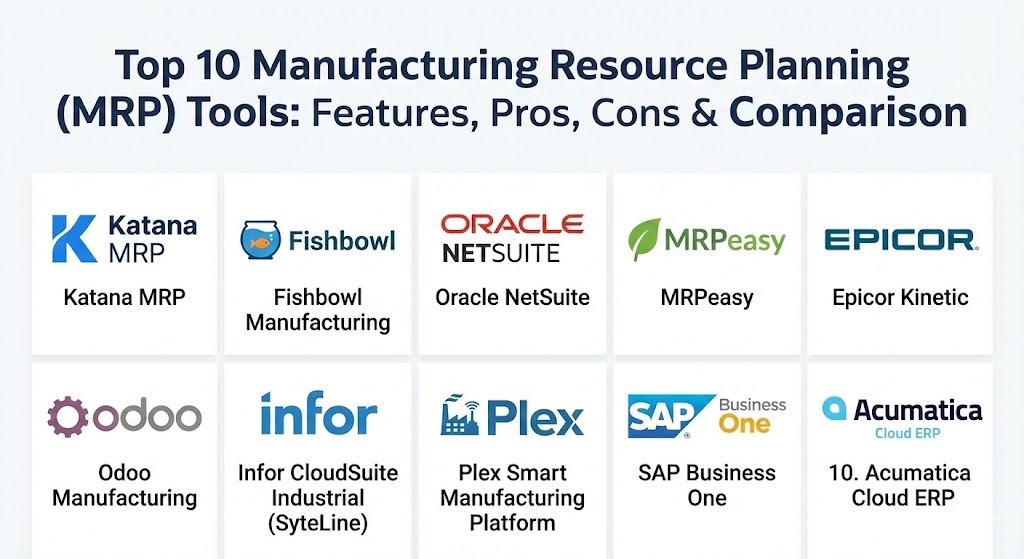
Top 10 Manufacturing Resource Planning (MRP) Tools
1 — Katana MRP
Katana is a modern, cloud-native MRP designed for scaling manufacturers who prioritize a clean user interface and seamless integration with e-commerce platforms like Shopify and BigCommerce.
- Key features:
- Real-time master production scheduling and inventory management.
- Automatic “Available to Promise” (ATP) logic for sales orders.
- Visual shop floor control with the Katana Shop Floor App.
- Multilevel Bill of Materials (BOM) management.
- Contract manufacturing tracking for outsourced production.
- Seamless integration with Xero, QuickBooks, and Shopify.
- Pros:
- One of the most intuitive and modern user interfaces in the MRP market.
- Extremely fast setup and onboarding process for cloud-savvy teams.
- Cons:
- Limited advanced customization for highly complex process manufacturing.
- Reporting capabilities, while good, can feel restrictive for power users.
- Security & compliance: SOC 2 Type II, GDPR compliant, and data encryption at rest and in transit.
- Support & community: Excellent knowledge base, responsive email/chat support, and a growing community of “Modern Manufacturers.”
2 — Fishbowl Manufacturing
Fishbowl is a veteran in the space, originally known for being the #1 inventory management pick for QuickBooks users. It has evolved into a robust MRP solution for mid-sized manufacturers.
- Key features:
- Deep integration with QuickBooks (Online and Desktop).
- Work order management and production stage tracking.
- Advanced barcoding and asset tracking.
- Multi-location warehouse management.
- Variable pricing and tiered customer cost tracking.
- Automated reorder points based on historical usage.
- Pros:
- Ideal for businesses already entrenched in the QuickBooks ecosystem.
- Highly stable and proven platform with a long history of industrial use.
- Cons:
- The user interface feels dated compared to newer cloud-native tools.
- Can become expensive as you add more users and specialized modules.
- Security & compliance: SSO integration, role-based access control (RBAC), and HIPAA compliant features for medical manufacturing.
- Support & community: Dedicated account managers for enterprise plans and a vast network of certified implementation partners.
3 — Oracle NetSuite Manufacturing
NetSuite is a global leader in cloud ERP, and its manufacturing module offers enterprise-grade MRP capabilities that scale from high-growth mid-market firms to global conglomerates.
- Key features:
- Comprehensive demand planning using AI and machine learning.
- Global supply chain visibility and multi-subsidiary support.
- Finite capacity scheduling for complex shop floors.
- Integrated Quality Management Systems (QMS).
- Real-time financial consolidation across manufacturing sites.
- Mobile-ready Warehouse Management System (WMS).
- Pros:
- Unmatched scalability; it is likely the last MRP your company will ever need to buy.
- “One source of truth” that eliminates the need for third-party accounting integrations.
- Cons:
- High cost of entry and significant implementation timelines (typically months).
- Highly complex; requires dedicated administrators or consultants for maintenance.
- Security & compliance: SOC 1/SOC 2, ISO 27001, GDPR, HIPAA, and PCI DSS.
- Support & community: Tiered support plans ranging from basic to 24/7 “Premier” support and a massive global user group.
4 — MRPeasy
As the name suggests, MRPeasy focuses on providing a powerful yet simple MRP solution for small manufacturers (10–200 employees) who find traditional ERPs too cumbersome.
- Key features:
- Integrated production planning, inventory, and sales.
- Precise cost and lead time estimations.
- Shop floor reporting via any web-connected device.
- Multilevel BOM with version control.
- Procurement automation based on production demand.
- Built-in CRM and light accounting features.
- Pros:
- Remarkably affordable for small teams; transparent per-user pricing.
- Can be self-implemented using their extensive “how-to” library and videos.
- Cons:
- The UI is functional but lacks the visual polish of competitors like Katana.
- Limited advanced integrations outside of the major accounting players.
- Security & compliance: SSL encryption, AWS-hosted security, and GDPR compliant.
- Support & community: Strong documentation and email support; lacks a large third-party consultant ecosystem.
5 — Epicor Kinetic
Epicor Kinetic is a purpose-built MRP for mid-market and large manufacturers in discrete industries such as aerospace, automotive, and medical devices.
- Key features:
- Deep industry-specific functionality (e.g., ITAR for defense).
- Advanced Planning and Scheduling (APS) with visual gantt charts.
- Embedded MES (Manufacturing Execution System) for real-time tracking.
- Quality assurance and regulatory compliance tracking.
- Product Configurator for complex Engineer-to-Order (ETO) products.
- Integrated EDI for high-volume supply chain communication.
- Pros:
- Built by manufacturing experts; it understands industrial nuances better than general ERPs.
- Extremely strong for companies with heavy regulatory or audit requirements.
- Cons:
- Can feel overly complex for simpler manufacturing operations.
- Mobile and web versions have improved but can still feel sluggish in parts.
- Security & compliance: SOC 2, ISO 27001, GDPR, and supports CMMC requirements for defense contractors.
- Support & community: Epicor Users Group (EUG) is one of the most active industrial user communities in the world.
6 — Odoo Manufacturing
Odoo is a modular, open-source business suite that allows manufacturers to start with a basic MRP and add modules (like PLM or Maintenance) as they grow.
- Key features:
- Modular architecture; only pay for the “apps” you use.
- Real-time Work Center management and OEE (Overall Equipment Effectiveness) tracking.
- Integrated PLM (Product Lifecycle Management) for engineering changes.
- Quality checks and preventative maintenance alerts.
- Barcode integration for all inventory moves.
- Fully customizable workflows through the Odoo Studio app.
- Pros:
- Highly cost-effective for small teams; the community version is free.
- Unlimited customization potential for companies with unique processes.
- Cons:
- Heavy customization can make version upgrades difficult.
- Finding high-quality, local Odoo partners can be a challenge in some regions.
- Security & compliance: GDPR compliant, SSO, and localized compliance modules for over 50 countries.
- Support & community: Massive global community with thousands of third-party apps and community-driven forums.
7 — Infor CloudSuite Industrial (SyteLine)
Infor CSI is an enterprise-grade MRP solution that excels in complex discrete and process manufacturing environments, particularly for multi-site operations.
- Key features:
- Advanced Planning and Scheduling (APS) with constraint-based logic.
- Global multi-plant and multi-currency management.
- Industry-specific “Analytics” dashboards powered by Birst.
- Integrated Service Management for post-sale support.
- High-fidelity demand forecasting.
- Comprehensive Quality Management (QMS).
- Pros:
- Powerful APS engine that can handle thousands of variables simultaneously.
- Deeply integrated “Social Collaboration” tools for engineering and production teams.
- Cons:
- The learning curve is steep; requires a dedicated IT or operations lead.
- Implementation can be expensive due to the need for specialized consultants.
- Security & compliance: SOC 1/2, ISO 27001, HIPAA, and GDPR compliant.
- Support & community: Infor Concierge provides a centralized portal for support, training, and software updates.
8 — Plex Smart Manufacturing Platform
Plex is a cloud-native platform that focuses on the shop floor first, providing real-time visibility and control for automotive and metal-forming manufacturers.
- Key features:
- “Shop Floor to Top Floor” integration in a single cloud.
- Integrated MES + MRP + ERP architecture.
- Real-time production monitoring and IoT sensor integration.
- Strict traceability and genealogy tracking for every part.
- Supplier portal for real-time procurement collaboration.
- High-resolution quality control and digital checklists.
- Pros:
- Best-in-class for factories requiring real-time shop floor visibility.
- Cloud-native since day one; no legacy “on-prem” baggage.
- Cons:
- Pricing is generally higher than traditional MRP systems.
- Not a general-purpose tool; designed specifically for high-volume manufacturing.
- Security & compliance: SOC 2, ISO 27001, GDPR, and IATF 16949 (Automotive) support.
- Support & community: Strong emphasis on customer success with a dedicated “Plex Community” portal for sharing best practices.
9 — SAP Business One
SAP Business One (B1) is the global giant’s offering for small and mid-sized enterprises (SMEs), bringing the power of SAP to a more accessible platform.
- Key features:
- SAP HANA in-memory platform for lightning-fast analytics.
- Integrated material requirement planning (MRP) wizard.
- Project management and service modules included.
- Comprehensive financial and sales management.
- Mobile app for sales and production monitoring.
- Thousands of industry-specific add-ons from SAP partners.
- Pros:
- A globally recognized brand that makes international expansion much easier.
- Extremely fast reporting even with large datasets thanks to HANA.
- Cons:
- Can be rigid; changing core workflows often requires partner intervention.
- Maintenance costs can be high over the long term.
- Security & compliance: Top-tier global security standards; SOC 1/2/3, ISO 27001, and GDPR.
- Support & community: Massive ecosystem of certified SAP partners and a world-class training platform (OpenSAP).
10 — Acumatica Cloud ERP
Acumatica is a rapidly growing cloud ERP known for its unique “Unlimited User” pricing model and its modern, highly flexible architecture.
- Key features:
- Consumption-based pricing (pay for what you use, not who uses it).
- Integrated MRP and visual production scheduling.
- Real-time BOM management and engineering change orders.
- Field Service and CRM modules are natively integrated.
- Advanced inventory management with matrix items and lot/serial tracking.
- Open API for easy integration with third-party software.
- Pros:
- The best value for large teams who don’t want to pay per-seat licenses.
- Highly adaptable user interface that is fully mobile-responsive.
- Cons:
- The “manufacturing” specific features are slightly newer than veterans like Epicor.
- Requires a strong partner for initial setup as there is no direct-sales model.
- Security & compliance: SOC 1/2, GDPR, ISO 27001, and PCI DSS compliant.
- Support & community: Strong partner-driven support model and the Acumatica Open University for free training.
Comparison Table
| Tool Name | Best For | Platform(s) Supported | Standout Feature | Rating (Gartner Peer Insights) |
| Katana MRP | Scaling SMBs | Cloud / Web | Real-time ATP logic | 4.7 / 5 |
| Fishbowl Mfg | QuickBooks Users | Windows / Web | QuickBooks Integration | 4.2 / 5 |
| Oracle NetSuite | Global Growth | Cloud / SaaS | Global AI-Demand Planning | 4.5 / 5 |
| MRPeasy | Small Manufacturers | Cloud / Web | Simplicity & Self-Setup | 4.8 / 5 |
| Epicor Kinetic | Industrial Depth | Cloud / On-prem | Industry-Specific Logic | 4.3 / 5 |
| Odoo Mfg | Customization | Cloud / On-prem | Modular App Ecosystem | 4.1 / 5 |
| Infor SyteLine | Multi-site Ops | Cloud / On-prem | Powerful APS Engine | 4.2 / 5 |
| Plex Platform | Shop Floor Tech | Cloud / SaaS | MES + MRP Integration | 4.4 / 5 |
| SAP Business One | Mid-market Global | Cloud / On-prem | SAP HANA Performance | 4.3 / 5 |
| Acumatica | High-User Teams | Cloud / SaaS | Unlimited User Pricing | 4.6 / 5 |
Evaluation & Scoring of Manufacturing Resource Planning (MRP) Tools
To choose the right MRP, it is helpful to use a standardized rubric. The following table represents how these categories are weighted in a professional software selection process.
| Category | Weight | Evaluation Criteria |
| Core Features | 25% | Multi-level BOM, demand forecasting, Master Production Schedule (MPS), and capacity planning. |
| Ease of Use | 15% | Intuitiveness of the UI, mobile accessibility, and the speed of daily data entry. |
| Integrations | 15% | Quality of native connections to accounting (QuickBooks/Xero), e-commerce, and CRM. |
| Security & Compliance | 10% | SOC 2/ISO certifications, encryption levels, and support for industry-specific audits (ITAR/HIPAA). |
| Performance | 10% | System uptime, calculation speed for large MRP runs, and data synchronization frequency. |
| Support & Community | 10% | Quality of documentation, speed of support tickets, and availability of local consultants. |
| Price / Value | 15% | Transparent pricing, lack of hidden implementation fees, and long-term ROI. |
Which Manufacturing Resource Planning (MRP) Tool Is Right for You?
Choosing an MRP is a strategic decision that will impact your business for the next 5 to 10 years. Follow this guide to narrow down your search:
Solo Users vs SMB vs Mid-Market vs Enterprise
If you are a solo entrepreneur or a very small team (1-10 people), Katana or MRPeasy are your best bets; they provide professional power without the administrative burden of an ERP. Mid-market companies (50-500 employees) should look at Acumatica or Fishbowl if they want to maintain flexibility, or SAP Business One if they plan on international expansion. Global enterprises should stick with the heavyweights like NetSuite, Infor, or Epicor.
Budget-conscious vs Premium Solutions
If budget is the primary driver, Odoo (Community Version) or MRPeasy offer the highest functionality-to-dollar ratio. If you have a larger budget and require a “failed-is-not-an-option” industrial implementation, premium suites like NetSuite or Plex provide more robust safeguards and enterprise security.
Feature Depth vs Ease of Use
There is usually a trade-off here. Epicor and Infor have incredible feature depth but take a long time to learn. Katana and Acumatica prioritize ease of use, which often leads to higher employee adoption rates but might require workarounds for very niche manufacturing processes.
Integration and Scalability Needs
Do you rely on Shopify? Katana is built for you. Do you have 10 subsidiaries across 4 continents? NetSuite is the only logical choice. Always look for a tool that integrates with the software you are already using and loving.
Frequently Asked Questions (FAQs)
1. What is the main difference between MRP and ERP?
MRP (Manufacturing Resource Planning) is a subset of ERP (Enterprise Resource Planning). While an MRP focuses strictly on production, inventory, and procurement, an ERP covers the entire business, including HR, high-level finance, and advanced CRM.
2. Can an MRP system work for custom, one-off manufacturing?
Yes. Modern systems like Epicor Kinetic or Omron (and some on this list like MRPeasy) have specialized “Engineer-to-Order” modules designed specifically for custom fabrication and job shops.
3. Is cloud-based MRP as secure as on-premise software?
In 2026, cloud security often exceeds on-premise security. Vendors like Oracle and SAP spend billions on cybersecurity, providing enterprise-grade encryption and redundancy that most small factories could never afford on their own.
4. How long does a typical MRP implementation take?
Small systems like Katana or MRPeasy can be live in 2–4 weeks. Enterprise systems like NetSuite or Infor typically take 4–9 months depending on the complexity of data migration.
5. Do I need an IT person to manage these tools?
For cloud-native tools like Katana or Acumatica, a tech-savvy operations manager is usually sufficient. For enterprise tools like SAP or Epicor, a dedicated IT lead or an external consultant is highly recommended.
6. What are the common mistakes when buying an MRP?
The biggest mistakes are buying a system that is too complex for your team to use, failing to clean your data before migration, and not involving the shop floor operators in the selection process.
7. Can these tools help with sustainability and waste reduction?
Absolutely. By providing precise material requirements and tracking “scrap” rates, MRP tools help manufacturers reduce overproduction and optimize raw material usage, leading to a smaller environmental footprint.
8. Do MRP tools handle payroll and HR?
Generally, no. Most MRP tools integrate with specialized payroll software like Gusto or ADP, or they are part of a larger ERP (like NetSuite) that includes those modules.
9. What is “Real-time master production scheduling”?
It is a feature that automatically updates your production timeline the second a new sales order comes in or a shipment is delayed, ensuring that everyone in the factory is working on the highest-priority task.
10. Why is “Bill of Materials” (BOM) management so important?
The BOM is the recipe for your product. If an MRP can’t handle multi-level BOMs, it can’t tell you that a delay in a tiny screw will stop the production of a multi-million dollar machine.
Conclusion
The journey to manufacturing excellence begins with visibility. Choosing a Manufacturing Resource Planning tool is about more than just managing parts; it’s about empowering your team to make data-driven decisions that drive profitability and customer satisfaction. Whether you choose the agile, modern approach of Katana, the robust industrial power of Epicor, or the global reach of NetSuite, the key is to prioritize a tool that fits your specific workflow. In 2026, the factory of the future is no longer a dream—it is a software-driven reality.