Introduction
An IVR and Voice Bot platform is a technology suite that allows organizations to automate inbound and outbound voice interactions. While traditional IVR relies on keypad inputs (DTMF) or simple speech recognition, modern Voice Bots utilize Natural Language Understanding (NLU) and Automatic Speech Recognition (ASR) to interpret intent, tone, and context. These platforms are essential for modern businesses because they reduce wait times, lower operational costs, and provide 24/7 support that scales effortlessly.
Key real-world use cases include automated appointment scheduling, secure bill payments, flight status updates, and identifying high-priority callers to route them to specialized human agents. When evaluating these platforms, you should look for several critical criteria: the accuracy of the NLU engine, the ease of flow design (often through “no-code” visual builders), the latency in voice responses, and how seamlessly the platform integrates with your existing CRM or helpdesk software.
Best for: Large-scale enterprises, healthcare providers, financial institutions, and e-commerce companies with high call volumes that need to provide efficient, multi-language, and highly secure self-service options.
Not ideal for: Very small boutique businesses with a low volume of calls where a personal touch is the primary brand differentiator, or organizations with highly erratic, non-standardized service requests that require deep human empathy for every interaction.
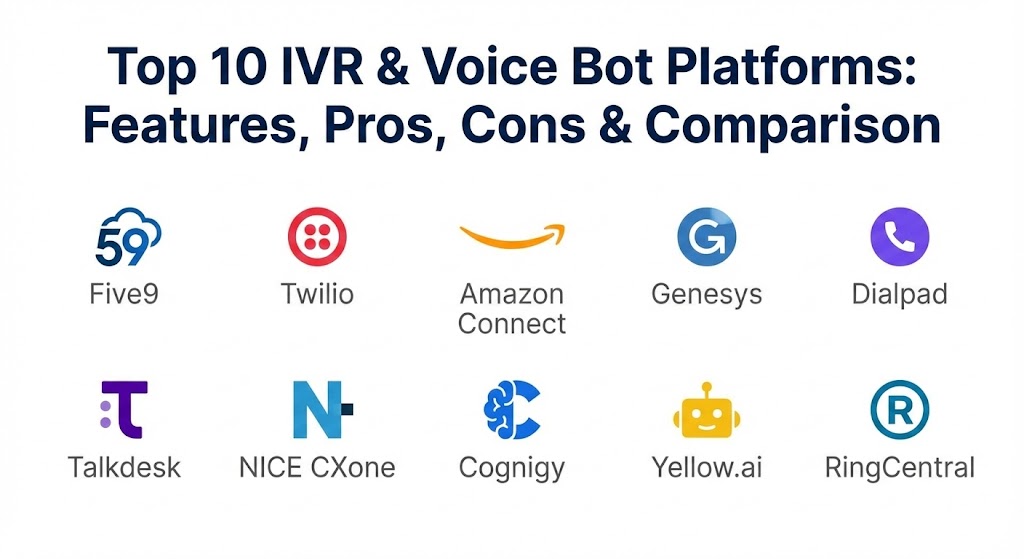
Top 10 IVR & Voice Bot Platforms Tools
1 — Five9
Five9 is a leader in the Cloud Contact Center (CCaaS) space, specifically known for its Intelligent Virtual Agent (IVA). It is designed for enterprises that want to move away from rigid IVR trees and toward fluid, AI-driven conversations.
Key Features:
- Intelligent Virtual Agent (IVA): Uses advanced NLU to handle routine calls without human involvement.
- Visual Flow Designer: A drag-and-drop tool that allows business analysts to create complex call flows without writing code.
- Real-time Transcription: Converts voice to text instantly for better data logging and sentiment analysis.
- Pre-built CRM Connectors: Deep integrations with Salesforce, ServiceNow, and Zendesk.
- Omnichannel Consistency: Ensures the voice bot experience matches the tone of chat and email bots.
- Self-Service Reporting: Detailed dashboards that show where customers drop off in the automated menu.
Pros:
- Excellent scalability for organizations that experience seasonal spikes in call volume.
- The “IVA” approach feels significantly more human and less “robotic” than standard IVR.
Cons:
- Implementation can be complex and usually requires a dedicated success manager.
- Pricing is at the higher end of the market, which may deter mid-market buyers.
Security & Compliance: SOC 2, GDPR, HIPAA, PCI-DSS Level 1, and ISO 27001.
Support & Community: Five9 University provides extensive training; 24/7 global technical support and a robust partner ecosystem.
2 — Twilio (Programmable Voice)
Twilio is the developer’s favorite, providing a set of powerful APIs to build virtually any voice experience. It is designed for companies with in-house engineering talent who want total control over their voice automation.
Key Features:
- Twilio Studio: A visual application builder for those who want to prototype IVR flows quickly.
- Autopilot: A conversational AI platform that allows developers to build voice bots that learn over time.
- Global Infrastructure: Massive reach with local numbers in over 100 countries.
- Speech-to-Text & TTS: High-quality text-to-speech with various accents and languages.
- Voice Insights: Real-time monitoring of call quality and carrier performance.
- Pay-as-you-go Pricing: Only pay for the minutes and API calls you actually use.
Pros:
- Unrivaled flexibility; you are not locked into a specific “way” of doing things.
- Extremely cost-effective for high-volume users who can optimize their own code.
Cons:
- Requires significant developer resources to build and maintain a professional-grade voice bot.
- Support can be slow unless you are on a high-tier paid support plan.
Security & Compliance: SOC 2, GDPR, HIPAA (with BAA), and ISO 27001.
Support & Community: Massive developer community; extensive documentation and tutorials; tiered support plans available.
3 — Amazon Connect
Amazon Connect is AWS’s answer to the contact center. It leverages the same technology used by Amazon.com customer service and integrates natively with the entire AWS ecosystem.
Key Features:
- Amazon Lex Integration: The same NLU that powers Alexa, used to create sophisticated voice bots.
- Amazon Polly: Converts text into life-like speech with dozens of realistic voices.
- Contact Lens: AI-powered analytics that provide sentiment analysis and automated call categorization.
- Serverless Architecture: No infrastructure to manage; scales automatically to any volume.
- Skills-based Routing: Intelligently passes a caller from a voice bot to the best-suited human agent.
- Customer Profiles: Aggregates data from multiple sources to give bots context on who is calling.
Pros:
- The pay-per-minute model is highly transparent and allows for low-risk experimentation.
- Native integration with AWS Lambda allows the voice bot to trigger complex backend actions easily.
Cons:
- The interface can be intimidating for non-technical users who are not familiar with the AWS Console.
- Building a truly “human-like” voice bot requires careful tuning of Amazon Lex intents.
Security & Compliance: FedRAMP, SOC 2, GDPR, HIPAA, and PCI-DSS.
Support & Community: AWS Premium Support; vast community forums and a network of AWS Certified Partners.
4 — Genesys Cloud CX
Genesys is the “gold standard” for enterprise-grade customer experience platforms. Their voice automation focuses on predictive engagement and high-end NLU capabilities.
Key Features:
- Architect: A powerful, visual design tool for managing both simple IVRs and complex bots.
- Predictive Routing: Uses AI to predict the best outcome for a call before it’s even answered.
- Native NLU & Third-party Support: Use Genesys’s own NLU or plug in Google Dialogflow or Amazon Lex.
- Voice Biometrics: Can identify callers based on their unique voiceprint for added security.
- Unified Interaction Management: A single interface for agents to see the full history of bot interactions.
- Contextual Handoff: When a bot fails, the human agent receives a full transcript of the conversation.
Pros:
- Deepest feature set for multi-national corporations with complex routing needs.
- Highly reliable with a strong track record of uptime in mission-critical environments.
Cons:
- The platform can feel “heavy” and slow to navigate for smaller administrative teams.
- One of the more expensive options when you factor in all the necessary modules.
Security & Compliance: ISO 27001, SOC 2, GDPR, HIPAA, and PCI-DSS.
Support & Community: Genesys Knowledge Network; 24/7 global support; extensive professional services available.
5 — Dialpad
Dialpad is an AI-native platform that has “Work from Anywhere” in its DNA. It is designed for mid-market and enterprise companies that want a modern, sleek interface with built-in AI.
Key Features:
- Dialpad Ai: Built-in engine that provides real-time transcription and “Agent Assist” during calls.
- Self-Service IVR: Simple, web-based setup for multi-level menus.
- CSAT AI: Automatically predicts customer satisfaction scores for every voice bot interaction.
- Real-time Analytics: Tracks keyword mentions and sentiment as the call is happening.
- Mobile-first Design: Outstanding apps that allow admins to change IVR flows from their phones.
- Automatic Post-call Summaries: Bots generate a written summary of the interaction for the CRM.
Pros:
- The most intuitive user interface in the CCaaS category; requires almost no training.
- AI features are included natively, not as an afterthought or expensive add-on.
Cons:
- International phone number support is not as extensive as Twilio or Amazon Connect.
- Voice bot customization is slightly more limited for very niche, non-standard use cases.
Security & Compliance: SOC 2 Type II, GDPR, HIPAA, and ISO 27001.
Support & Community: 24/7 chat and phone support; well-regarded help center and video tutorials.
6 — Talkdesk
Talkdesk is known for its “clicks, not code” philosophy. It is a cloud-native platform that focuses on helping businesses get their IVR and voice bots up and running in record time.
Key Features:
- Talkdesk Studio: A low-code tool to design customer journeys across voice and digital channels.
- Experience.ai: A suite of AI tools that includes specialized voice bots for industries like retail and banking.
- Knowledge Management: Bots can pull answers directly from a centralized company knowledge base.
- Visual Feedback: Admins can see a “heat map” of where callers are getting stuck in the IVR.
- AppConnect: A marketplace that allows you to add third-party voice tools with one click.
- Global Low Latency (GLL): Architecture designed to reduce the “lag” often felt in international voice bot calls.
Pros:
- Exceptionally fast implementation; companies can go live in days rather than months.
- Industry-specific templates make it easy to follow best practices for voice bot design.
Cons:
- Some advanced reporting features require an upgrade to the highest-tier plans.
- Customizing the AI’s “brain” for unique terminology can be a bit tedious.
Security & Compliance: SOC 2, GDPR, HIPAA, and ISO 27001.
Support & Community: Talkdesk Academy; 24/7 support; a very active community of CX professionals.
7 — NICE CXone
NICE CXone is a massive, comprehensive platform that excels in workforce optimization and advanced analytics. It is designed for the most demanding enterprise contact centers.
Key Features:
- Enlighten AI: A specialized engine that scores every interaction for “soft skills” and sentiment.
- CXone SmartAssist: An end-to-end conversational AI solution for building voice and chatbots.
- Interactive Voice Response (IVR): Highly customizable DTMF and speech-enabled menus.
- Omnichannel Routing: Ensures that voice interactions are perfectly synced with digital ones.
- Workforce Management: Predicts call volume so you know when to rely on bots versus humans.
- Direct CRM Integration: Bi-directional sync with almost any major enterprise database.
Pros:
- Unmatched depth in analytics and reporting for large-scale operations.
- The AI is particularly good at understanding complex, emotional customer interactions.
Cons:
- The user interface is dated compared to newer competitors like Dialpad or Talkdesk.
- The sheer number of features can lead to “paralysis by analysis” for smaller teams.
Security & Compliance: FedRAMP, SOC 2, GDPR, HIPAA, and PCI-DSS.
Support & Community: Extensive global support network; NICE User Group (NUG) is very active.
8 — Cognigy
Cognigy is a specialist in conversational AI. Unlike others that are broad contact centers, Cognigy is a dedicated “brain” for voice bots and chatbots, designed to be plugged into any telephony system.
Key Features:
- Cognigy.AI: An enterprise-class platform for building complex, multi-lingual voice bots.
- Voice Gateway: Connects your AI bots to any phone line or SIP trunk with ultra-low latency.
- Cognigy Insights: A specialized analytics suite focused entirely on conversational performance.
- Human Handoff: Sophisticated logic for deciding exactly when a bot should stop and a human should start.
- Generative AI Integration: Uses LLMs to make voice bot responses more natural and context-aware.
- On-premises or Cloud Deployment: One of the few platforms offering total flexibility in hosting.
Pros:
- If you only want a “Voice Bot” and already have a phone system, this is the most powerful choice.
- The NLU is world-class, handling slang, dialects, and complex intent with ease.
Cons:
- It is not a full “Contact Center,” so you still need a telephony provider or CCaaS to make calls.
- The power of the tool comes with a steeper learning curve for non-AI specialists.
Security & Compliance: SOC 2, GDPR, ISO 27001, and HIPAA compatible.
Support & Community: Cognigy Academy; highly technical support staff; active developer Slack community.
9 — Yellow.ai
Yellow.ai is a fast-rising star that focuses on “Dynamic Automation.” They use a multi-LLM (Large Language Model) approach to create voice bots that require very little training.
Key Features:
- Dynamic AI Agents: Bots that can generate responses on the fly based on your documentation.
- Zero-shot Learning: Ability for the voice bot to understand intents it hasn’t been specifically trained for.
- Voice-first Architecture: Designed specifically to handle the nuances of speech, like interruptions and background noise.
- 100+ Languages: One of the best platforms for global companies needing localized voice bots.
- Marketplace Templates: Pre-built bots for HR, ITSM, and Customer Support.
- Unified Dashboard: Manages voice, WhatsApp, and web automation in one view.
Pros:
- Requires significantly less “manual training” than traditional NLU-based voice bots.
- Excellent performance in non-English languages and regional dialects.
Cons:
- As a newer company, their enterprise support infrastructure is still catching up to the giants.
- The “Generative” nature of the responses requires strict guardrails to prevent “hallucinations.”
Security & Compliance: ISO 27001, GDPR, SOC 2, and HIPAA.
Support & Community: Growing documentation; 24/7 chat support; personalized onboarding for large clients.
10 — RingCentral (RingCX)
RingCentral is the leader in Unified Communications (UCaaS). Their RingCX product offers a tightly integrated IVR and voice bot experience for businesses that want their phone system and contact center in one box.
Key Features:
- Integrated IVR: Easy-to-use visual builder that is part of the standard RingCentral admin portal.
- RingSense AI: AI engine that provides conversation intelligence and automated scoring.
- Smart Routing: Connects voice bot data to the user’s phone extension for a personalized experience.
- Cloud-based Portability: Manage your voice bot and phone settings from any device, anywhere.
- Video Escalation: Seamlessly move from a voice bot call to a video meeting if needed.
- Reliability: Famous for their “five nines” (99.999%) uptime SLA.
Pros:
- Best choice for companies that want to consolidate their internal office phones and external customer support.
- Extremely reliable; you rarely have to worry about the platform “going down.”
Cons:
- The voice bot features are not as “deep” as specialized AI platforms like Cognigy or Yellow.ai.
- Customization of the conversational flows can feel a bit more rigid than Twilio or Genesys.
Security & Compliance: SOC 2 Type II, GDPR, HIPAA, and ISO 27001.
Support & Community: Global 24/7 support; huge user base; extensive online community and help center.
Comparison Table
| Tool Name | Best For | Platform(s) Supported | Standout Feature | Rating (Gartner) |
| Five9 | Enterprise CCaaS | Cloud / Web | Intelligent Virtual Agent (IVA) | 4.6 / 5 |
| Twilio | Developer Flexibility | API / Web | Programmable Voice Studio | 4.5 / 5 |
| Amazon Connect | AWS Ecosystem Users | Cloud / Web | Lex & Polly AI Integration | 4.5 / 5 |
| Genesys Cloud CX | High-end Enterprise | Cloud / Web | Predictive Routing AI | 4.7 / 5 |
| Dialpad | AI-Native Startups/SMBs | Cloud / Mobile | Native Dialpad Ai Transcription | 4.4 / 5 |
| Talkdesk | Fast Implementation | Cloud / Web | Clicks-not-code Designer | 4.5 / 5 |
| NICE CXone | Massive Scalability | Cloud / Web | Enlighten AI Analytics | 4.6 / 5 |
| Cognigy | Conversational AI Specialists | Cloud / On-prem | Low-latency Voice Gateway | 4.8 / 5 |
| Yellow.ai | Multi-lingual Automation | Cloud / Web | Generative Dynamic AI Agents | 4.7 / 5 |
| RingCentral | Integrated UCaaS/CCaaS | Cloud / Mobile | Five Nines (99.999%) Reliability | 4.5 / 5 |
Evaluation & Scoring of IVR & Voice Bot Platforms
To help you decide, we have evaluated these platforms across several critical dimensions using a weighted scoring rubric. This reflects the reality of what matters most in a production environment in 2026.
| Criteria | Weight | Why It Matters |
| Core Features | 25% | The quality of NLU, ASR, and the ability to handle complex call flows. |
| Ease of Use | 15% | Can a non-technical manager update the IVR, or do you need a developer? |
| Integrations & Ecosystem | 15% | How well the platform talks to your CRM and other business tools. |
| Security & Compliance | 10% | Essential for handling payments (PCI) or medical data (HIPAA). |
| Performance & Reliability | 10% | Latency (lag) and uptime. A slow voice bot is a bad customer experience. |
| Support & Community | 10% | The availability of help when things inevitably go wrong during setup. |
| Price / Value | 15% | Whether the features justify the monthly cost or the per-minute rate. |
Which IVR & Voice Bot Platforms Tool Is Right for You?
Choosing the right platform is a strategic decision that depends on your company’s size, technical depth, and specific goals.
Solo Users vs SMB vs Mid-Market vs Enterprise
If you are an SMB or a fast-growing startup, look toward Dialpad or Talkdesk. They offer the best balance of sophisticated AI and extreme ease of use. You don’t need an army of engineers to get them running. Mid-market companies often find Five9 or RingCentral to be the sweet spot for reliability and consolidated communications. Enterprises with complex, global needs should stick to Genesys or NICE CXone, as they have the security and routing depth required for thousands of agents.
Budget-conscious vs Premium Solutions
If you want to pay only for what you use, Amazon Connect and Twilio are the champions of the budget-conscious. However, remember that “cheap” in minutes can become “expensive” in developer hours. If you want a premium, “turn-key” solution where you pay for the peace of mind and high-end features, Five9 and Genesys are worth the investment.
Feature Depth vs Ease of Use
If you have a highly technical team and want to build something revolutionary, Cognigy and Twilio offer the most depth. If you have business users who need to change the “Press 1” menu every week for promotions, Talkdesk and Dialpad provide the most intuitive visual builders.
Integration and Scalability Needs
If your entire business runs on AWS, the native connection of Amazon Connect is hard to beat. If you are a Salesforce shop, Five9 and Genesys have the most mature, battle-tested integrations that pull customer data into the voice bot interaction seamlessly.
Security and Compliance Requirements
For Healthcare and Finance, compliance is non-negotiable. Ensure that whichever platform you choose, you are looking at their “Enterprise” tier which usually includes the BAA (for HIPAA) or the specific PCI-compliant payment modules. NICE CXone and Genesys are often the top choices for highly regulated industries.
Frequently Asked Questions (FAQs)
1. What is the main difference between IVR and a Voice Bot?
A traditional IVR is menu-driven (Press 1, Press 2) and uses keypad inputs. A Voice Bot is conversational; it uses AI to understand what you say (e.g., “I’m calling about my late package”) and responds in kind without a menu.
2. Does a Voice Bot sound like a robot?
In 2026, not necessarily. Technologies like Amazon Polly and Google TTS offer “Neural” voices that include natural pauses, inflections, and high-quality tonality that can be almost indistinguishable from a human.
3. How much do these platforms usually cost?
Pricing varies wildly. Some charge a flat monthly fee per agent ($70–$150), while others like Twilio or Amazon Connect charge by the minute (usually $0.01 to $0.03 per minute plus AI fees).
4. How long does it take to set up an automated voice system?
A simple IVR can be set up in an afternoon using a tool like Talkdesk. A sophisticated, AI-driven Voice Bot that integrates with your database usually takes 4 to 12 weeks of training and testing.
5. Can these bots handle different languages and accents?
Yes. Most leading platforms (Yellow.ai, Genesys, Twilio) support 50+ languages and have improved significantly at understanding regional accents and dialects.
6. What happens if the Voice Bot doesn’t understand the caller?
A well-designed system will have a “fallback” mechanism. After one or two failed attempts at understanding, the bot should gracefully hand the call over to a human agent along with a transcript of the failure.
7. Are automated voice systems secure enough for credit card payments?
Yes, but you must ensure the platform is PCI-DSS compliant. Many platforms use “DTMF suppression” where the bot can’t “hear” the tones, or they redirect the caller to a secure, encrypted payment leg.
8. Do I need to be a programmer to use these tools?
No. Platforms like Dialpad, Talkdesk, and Five9 use “Visual Flow Designers” where you drag and drop boxes to create the call logic. Programmer skills are only needed for very advanced custom integrations.
9. Can a Voice Bot detect if a customer is angry?
Yes. This is called “Sentiment Analysis.” Modern platforms can detect the tone and volume of a caller’s voice and instantly route an “angry” caller to a senior manager or a retention specialist.
10. What is “latency” and why does it matter?
Latency is the delay between the user finishing their sentence and the bot starting to speak. High latency (more than 1 second) makes a conversation feel awkward and frustrating for the customer.
Conclusion
The “best” IVR and Voice Bot platform is not the one with the most features, but the one that aligns with your customer’s journey. In 2026, customers value their time above all else. A simple, fast IVR that gets them to the right person is infinitely better than a “fancy” Voice Bot that doesn’t understand their problem.