Introduction
IP Management (Patents/Trademarks) Software is a specialized category of legal technology designed to manage the entire lifecycle of intellectual property assets. These tools automate the tracking of critical dates (docketing), store sensitive legal documents, facilitate communication with patent offices, and provide deep analytics to assess the financial value of an IP portfolio. By integrating global patent and trademark data, these systems reduce the risk of human error and significantly lower administrative overhead.
The importance of these tools is amplified by the sheer complexity of international law. Real-world use cases include automating USPTO status updates, managing foreign filing deadlines, and generating “cost-to-life” reports for stakeholders. When evaluating software, users must look for “gold-standard” data integration, customizable workflow engines, and high-level security to protect trade secrets.
Best for: Corporate IP departments, large-scale law firms, R&D organizations, and technology transfer offices that need a single source of truth for their legal assets. It is essential for teams managing multi-jurisdictional filings and high-volume trademark portfolios.
Not ideal for: Solo inventors with only one or two patents, or small businesses with a single local trademark. In these cases, the high cost of implementation and complexity of enterprise-grade IPMS may outweigh the benefits.
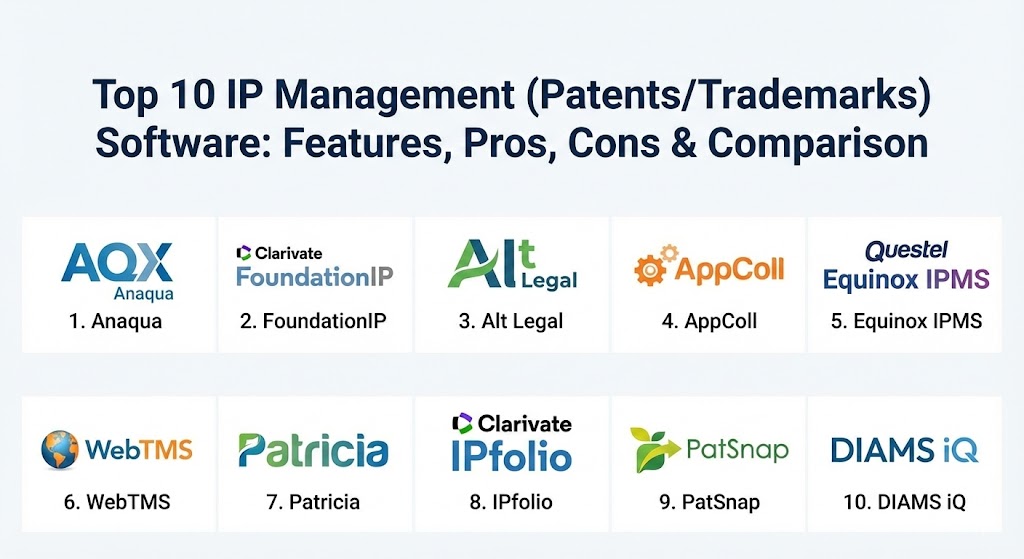
Top 10 IP Management (Patents/Trademarks) Software Tools
1 — Anaqua (AQX)
Anaqua is a global leader in the IP management space, offering the AQX platform. It is a comprehensive, enterprise-grade solution that combines advanced workflow automation with high-level business intelligence.
- Key features:
- End-to-end management of the patent and trademark lifecycle.
- Integrated financial management for tracking legal spend and annuities.
- AQX Analytics for portfolio valuation and competitive benchmarking.
- Global office data synchronization for automated docketing.
- Specialized portal for external counsel collaboration.
- AI-powered “Predictive Insights” for filing strategy.
- Pros:
- Exceptionally deep functionality that can handle the most complex global portfolios.
- High level of customization for corporate workflows.
- Cons:
- One of the more expensive options on the market.
- Complex implementation process that requires dedicated time and training.
- Security & compliance: SOC 2 Type II, ISO 27001 certified, GDPR compliant, and features robust encryption and SSO.
- Support & community: Offers dedicated account managers, an extensive customer portal, and structured global user conferences.
2 — FoundationIP (Clarivate)
FoundationIP, a Clarivate product, is one of the most popular cloud-based IP management tools specifically tailored for law firms and corporate legal departments that prioritize speed and reliability.
- Key features:
- One-click docketing from USPTO Private PAIR.
- Multi-jurisdiction support for over 300 jurisdictions globally.
- Automated data verification against official patent office records.
- Custom report builder with role-based scheduling.
- Integrated Clarivate data for enhanced patent research.
- Advanced task dashboards for paralegal teams.
- Pros:
- Highly reliable cloud infrastructure with frequent feature updates.
- Excellent balance between enterprise depth and user-friendliness.
- Cons:
- Reporting can sometimes be less intuitive for non-technical users.
- Customer support response times can vary following recent acquisitions.
- Security & compliance: SOC 2, HIPAA, GDPR, and ISO 27001.
- Support & community: Comprehensive documentation, regular webinars, and a massive user base within the Clarivate ecosystem.
3 — Alt Legal
Alt Legal has carved out a niche as the most user-friendly and modern trademark management tool on the market. It is designed to automate the mundane aspects of trademark docketing so attorneys can focus on strategy.
- Key features:
- Fully automated trademark docketing for US and global marks.
- USPTO and CIPO (Canada) data sync that requires zero manual entry.
- Automated client reporting with customizable email templates.
- 2(d) Trademark Watch for infringement detection.
- Collaborative “TEAS” intake forms for gathering client information.
- Calendar sync for Outlook and Google.
- Pros:
- Extremely modern and intuitive UI; requires almost zero training.
- Unmatched customer support and proactive “hand-holding” during migration.
- Cons:
- Primarily focused on trademarks; patent functionality is limited.
- Not suitable for firms requiring deep, complex “invention disclosure” workflows.
- Security & compliance: AES-256 encryption, SSO integration, and GDPR compliant.
- Support & community: Top-tier US-based support via live chat, phone, and a very active IP legal blog.
4 — AppColl
AppColl is a robust, cloud-based platform that offers a highly efficient “Prosecution Manager” for law firms and corporate IP departments. It is known for its incredible value and flexibility.
- Key features:
- Automated docketing for US patents and trademarks.
- Seamless data validation against USPTO and Espacenet records.
- Custom workflow rules for non-standard prosecution steps.
- Integrated billing and invoicing module.
- Invention Manager for capturing and reviewing new disclosures.
- No long-term contracts; month-to-month subscription.
- Pros:
- One of the most cost-effective enterprise-capable tools available.
- “Set it and forget it” automation for standard deadlines.
- Cons:
- The UI is functional but looks a bit dated compared to newer SaaS competitors.
- Accounting features might not be advanced enough for massive firms.
- Security & compliance: Secure cloud hosting, daily backups, and role-based access controls.
- Support & community: Highly responsive email and phone support, plus extensive “how-to” video libraries.
5 — Equinox IPMS (Questel)
Equinox, recently acquired by the Questel group, is an AI-powered IP management system that is gaining massive popularity in the UK and Europe for its scalability and modern design.
- Key features:
- AI-assisted case management for faster drafting and analysis.
- Direct links to national patent and trademark office records.
- Integrated foreign filing and translation support.
- High-performance KPI dashboards for portfolio health tracking.
- Automated task sequences for repeatable legal processes.
- Multi-currency financial tracking.
- Pros:
- Built on modern tech stacks (including Salesforce integration options).
- Excellent scalability; works well for small boutiques and massive global firms alike.
- Cons:
- Implementation can be slow as teams work through extensive customization options.
- Some users report a steep learning curve for the “Equinox Law Firm+” version.
- Security & compliance: ISO 27001 certified, GDPR compliant, and 99.9% uptime guarantee.
- Support & community: Strong technical support and deep integration with Questel’s global IP services.
6 — WebTMS
WebTMS is a powerhouse in the trademark management industry. It is specifically built for trademark professionals who manage high volumes of brand assets and need granular control over records.
- Key features:
- Real-time data sync with over 180 trademark jurisdictions.
- Multi-screen view for comparing documents and office actions.
- Advanced deadline management and automated reminder emails.
- Customizable client portals for self-service reporting.
- Intelligent automation for core renewal processes.
- Built-in international classification tools.
- Pros:
- The most specialized “trademark-first” tool on the market.
- Highly intuitive reporting that clients find very easy to digest.
- Cons:
- Not a strong choice for companies that primarily manage complex utility patents.
- Onboarding can be slightly manual compared to fully cloud-automated tools.
- Security & compliance: Role-based access, comprehensive audit trails, and secure data hosting.
- Support & community: Exceptional customer service with a reputation for deep trademark expertise.
7 — Patricia (Patrix AB)
Patricia is a veteran in the IPMS world, known for its extreme flexibility and its ability to handle block-chain levels of data complexity. It is a preferred choice for large IP families and diverse portfolios.
- Key features:
- Highly flexible “Workflow” engine for any type of IP matter.
- Batch processing for letters, invoices, and status updates.
- Family tree visualization for complex patent priority lineages.
- Integrated time registration for billing accuracy.
- Electronic filing functionality with various patent offices.
- World map views for global portfolio coverage.
- Pros:
- Perhaps the most flexible platform in terms of custom coding and rules.
- Can manage patents, trademarks, designs, and even contracts in one place.
- Cons:
- The interface can be overwhelming for new users.
- Requires a significant investment in initial setup and training.
- Security & compliance: Enterprise-level audit logs, encryption, and GDPR compliance.
- Support & community: Professional consulting services for complex data migrations.
8 — IPfolio (Clarivate)
IPfolio is a cloud-based solution that prioritizes the “Corporate IP” experience. It is designed to be lean, fast, and integrated with modern business tools like Salesforce.
- Key features:
- Built natively on the Salesforce platform (for some versions).
- Real-time portfolio visibility for C-suite executives.
- Automated docketing and renewal tracking.
- Clean, modern interface designed for mobile accessibility.
- Integrated cost forecasting and budgeting.
- One-click invention disclosure submission for employees.
- Pros:
- Best-in-class UI/UX; users actually enjoy using the software.
- Seamlessly connects IP data to other business departments via CRM integration.
- Cons:
- Advanced analytics often require extra Clarivate module subscriptions.
- Less focus on the day-to-day “paralegal-intensive” tasks than FoundationIP.
- Security & compliance: Inherits the top-tier security of the Salesforce infrastructure (SOC 2, ISO).
- Support & community: Very active community and strong technical documentation.
9 — PatSnap
PatSnap is a game-changer because it moves beyond management into IP Intelligence. It is ideal for R&D-heavy companies that want to understand the competitive landscape while managing their filings.
- Key features:
- AI-driven patent searching and landscaping.
- Competitive benchmarking and technology trend analysis.
- Integrated innovation management workflows.
- Strategic portfolio valuation tools.
- Visualization maps for seeing who is filing what and where.
- Automated alerts for competitor patent filings.
- Pros:
- The best tool for strategic decision-making and R&D alignment.
- Visualizations are stunning and boardroom-ready.
- Cons:
- Management features (docketing) are secondary to intelligence/analytics.
- High pricing makes it a “premium” add-on or primary tool for large R&D teams.
- Security & compliance: ISO 27001, GDPR, and enterprise-grade data privacy.
- Support & community: Excellent training webinars and dedicated “Customer Success” managers.
10 — DIAMS iQ (Dennemeyer)
DIAMS iQ from the Dennemeyer group is a high-end IP management software that bridges the gap between software and professional IP services like annuity payments.
- Key features:
- Seamless integration with Dennemeyer’s global annuity and renewal services.
- Multi-jurisdictional docketing and automated legal rule updates.
- High-level document management with full-text search.
- Specialized trademark and patent modules that can be purchased separately.
- Comprehensive reporting and financial auditing.
- “Global Filing” support directly through the software interface.
- Pros:
- Ideal for teams that want a “one-stop-shop” for both software and services.
- Extremely high data accuracy due to Dennemeyer’s internal legal research.
- Cons:
- Can feel a bit “locked-in” to the Dennemeyer service ecosystem.
- The interface is dense and requires a fair amount of initial training.
- Security & compliance: ISO 9001, ISO 27001, and full GDPR compliance.
- Support & community: 24/7 global support with offices in all major time zones.
Comparison Table
| Tool Name | Best For | Platform(s) Supported | Standout Feature | Rating (TrueReview) |
| Anaqua (AQX) | Large Corporations | Cloud / On-Prem | Enterprise Analytics | 4.6 / 5 |
| FoundationIP | High-Volume Law Firms | Cloud | USPTO Direct Sync | 4.5 / 5 |
| Alt Legal | Trademark Automation | Cloud | Modern UI / Ease of Use | 4.8 / 5 |
| AppColl | SMB Firms & Budget | Cloud | Value for Money | 4.7 / 5 |
| Equinox IPMS | Scalable Law Firms | Cloud | AI-Assisted Drafting | 4.4 / 5 |
| WebTMS | Trademark Professionals | Cloud / Local | 180+ Jurisdiction Sync | 4.5 / 5 |
| Patricia | Complex IP Families | Cloud / Local | Absolute Flexibility | 4.3 / 5 |
| IPfolio | Corporate Strategy | Cloud (SaaS) | Salesforce Integration | 4.7 / 5 |
| PatSnap | R&D Intelligence | Cloud | Competitive Landscaping | 4.8 / 5 |
| DIAMS iQ | Managed Services | Cloud / Local | Integrated Renewals | 4.4 / 5 |
Evaluation & Scoring of IP Management Software
To determine the true value of an IPMS, we evaluate it against seven core criteria weighted by importance to the average professional user.
| Category | Weight | Evaluation Criteria |
| Core Features | 25% | Docketing accuracy, renewal automation, and global office data sync. |
| Ease of Use | 15% | UI design, intuitiveness, and time required for user onboarding. |
| Integrations | 15% | Connections with Salesforce, MS Office, Outlook, and financial ERPs. |
| Security & Compliance | 10% | SOC 2/ISO certifications, encryption, and data residency options. |
| Performance | 10% | Speed of search, system uptime, and handling of large data volumes. |
| Support | 10% | Availability of US-based support, training videos, and documentation. |
| Price / Value | 15% | Total cost of ownership vs. administrative hours saved. |
Which IP Management Tool Is Right for You?
Selecting an IPMS is a long-term commitment. Migrating data between these platforms can be costly, so it is vital to pick the right one the first time.
- Solo Practitioners vs. Boutique Firms: If you are a small team, avoid the “heavy hitters” like Anaqua. AppColl offers incredible value, while Alt Legal is the gold standard if your practice is 80% trademarks.
- Mid-Market Law Firms: You need scalability and reliability. FoundationIP and Equinox provide the enterprise features you need without the massive overhead of a custom enterprise installation.
- Corporate IP Departments: Focus on integration and strategy. IPfolio is excellent for aligning with the business side, while Anaqua is the best for companies that need a complete end-to-end ecosystem for thousands of patents.
- R&D and Innovation Teams: If your goal is to use IP to guide your future product development, PatSnap is an essential addition to your toolkit for its intelligence and landscaping features.
- Budget vs. Premium: AppColl is the budget champion that doesn’t feel cheap. Anaqua and Clarivate’s higher-end tools are the premium choices for those who need “white-glove” support and global service integration.
Frequently Asked Questions (FAQs)
1. What is “docketing” in IP management?
Docketing is the process of tracking legal deadlines related to patent and trademark applications. In the IP world, missing a “Final Office Action” date can lead to an abandoned application, making automated docketing a must-have feature.
2. Can I manage both patents and trademarks in the same software?
Yes, most enterprise tools like Anaqua, FoundationIP, and AppColl are “multi-matter,” meaning they can handle patents, trademarks, copyrights, and even trade secrets in one database.
3. Is cloud-based IP software secure enough for trade secrets?
Modern cloud IPMS providers use military-grade encryption (AES-256) and hold certifications like SOC 2 and ISO 27001. For most firms, these cloud environments are actually more secure than a local server.
4. How long does data migration take?
Migrating from spreadsheets to an IPMS usually takes 4–8 weeks. Moving from one IPMS to another can take 3–6 months depending on the volume of documents and historical data.
5. Does the software automatically pay my renewal fees?
Some tools (like DIAMS iQ or those from Clarivate) offer integrated renewal services where you can authorize payments directly in the software. Others only provide “alerts,” and you must pay via an external agent.
6. What is “Private PAIR” integration?
This is a feature that allows the software to log into the USPTO’s system securely and pull down status updates and documents automatically, eliminating manual data entry.
7. Can these tools help with patent litigation?
While not primary litigation tools, platforms like Anaqua and PatSnap provide “patent strength” metrics and litigation history data that can help attorneys assess the risks and rewards of a lawsuit.
8. Do these platforms support international languages?
Enterprise tools like WebTMS and Patricia support international character sets (like Mandarin or Japanese), which is critical for managing global trademark portfolios.
9. Are there open-source IP management tools?
There are very few reputable open-source IPMS tools because the cost of maintaining global legal rules (laws change daily) is too high for volunteer communities. It is almost always better to use a paid service.
10. What is the most common mistake when buying IP software?
Buying based on features rather than usability. If the paralegal team finds the software too difficult to use, they will revert to spreadsheets, and you will lose the “single source of truth” benefit.
Conclusion
The evolution of IP Management Software has moved from simple digital filing cabinets to AI-powered strategic advisors. While Anaqua and Clarivate remain the titans of the enterprise space, specialized tools like Alt Legal and AppColl have made high-level automation accessible to smaller firms. Ultimately, the “best” tool is the one that your team will actually use every day. Before signing a long-term contract, ensure the platform offers the specific office syncs you need and a migration path that won’t paralyze your practice.