Introduction
Identity Resolution (IDR) is the process of accurately resolving consumer data from a variety of sources to a specific individual or household in a privacy-centric manner. These platforms ingest identifiers such as email addresses, hashed phone numbers, device IDs, and physical addresses, using complex algorithms to link them to a single persistent ID. By doing so, they bridge the gap between anonymous web traffic and known customer profiles, enabling marketers to deliver 1:1 personalization without the need for intrusive third-party cookies.
The importance of these tools is skyrocketing as global privacy regulations like GDPR and CCPA tighten and web browsers phase out tracking technologies. Modern identity resolution is no longer just a marketing “nice-to-have”; it is a foundational requirement for data governance, fraud prevention, and customer experience. Key evaluation criteria for these platforms include the breadth of their “Identity Graph” (the database of known connections), the accuracy of their deterministic vs. probabilistic matching, real-time processing capabilities, and their ability to integrate with existing Customer Data Platforms (CDPs) and Data Warehouses.
Best for: Mid-to-large enterprises in retail, financial services, healthcare, and media that manage high volumes of first-party data. It is essential for data engineers and digital marketers who need to eliminate data silos and drive omnichannel personalization at scale.
Not ideal for: Small businesses with minimal digital touchpoints or companies that rely solely on simple, single-channel marketing where identity fragmentation is not a significant hurdle. Organizations with very low data maturity may find the complexity and cost of these platforms outweigh the immediate benefits.
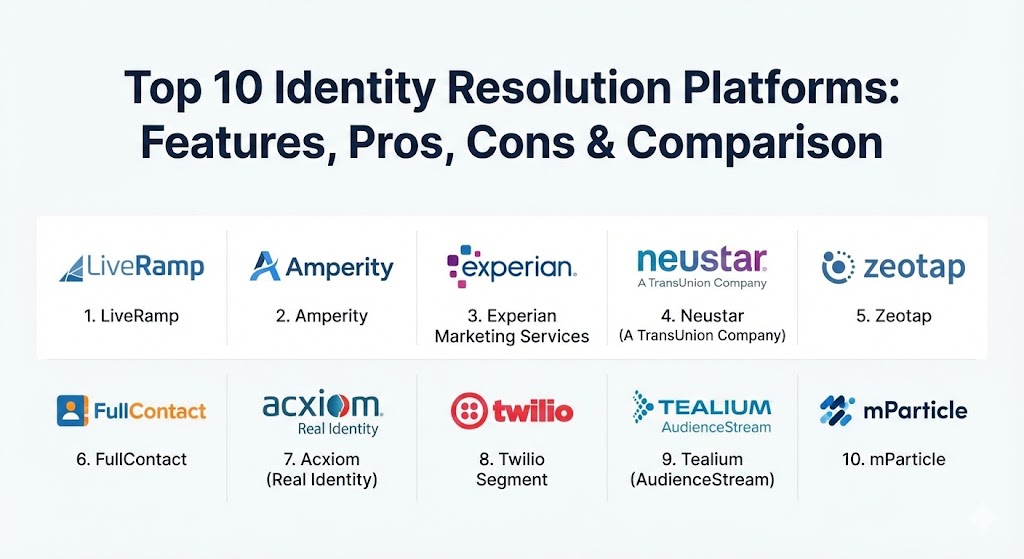
Top 10 Identity Resolution Platforms
1 — LiveRamp
LiveRamp is widely considered the industry heavyweight in identity resolution. It provides a neutral, privacy-safe infrastructure that allows brands and their partners to connect data across the digital ecosystem using its proprietary “RampID” (formerly IdentityLink).
- Key features:
- AbiliTec Graph: One of the world’s largest and most accurate deterministic identity graphs.
- Data Clean Rooms: Enables secure data collaboration with partners without exposing PII.
- Omnichannel Activation: Seamlessly connects offline data to over 500 digital destinations.
- Advanced Pseudonymization: Ensures all data is anonymized before it enters the ecosystem.
- Cookieless Identity: Built to survive the deprecation of third-party cookies via the Authenticated Traffic Solution (ATS).
- Household Mapping: Capability to resolve identities at both the individual and household levels.
- Pros:
- Unrivaled scale and accuracy within the North American and European markets.
- Deeply established trust among major ad platforms and publishers.
- Cons:
- Known for a high price point that can be prohibitive for mid-market companies.
- The platform interface and workflow can be complex for non-technical users.
- Security & compliance: SOC 2 Type II, HIPAA, GDPR, CCPA, and ISO 27001. Features extensive “safe haven” privacy protections.
- Support & community: Enterprise-grade 24/7 support, extensive training through LiveRamp University, and a massive global partner network.
2 — Amperity
Amperity is a leading Customer Data Platform (CDP) that distinguishes itself with an AI-driven approach to identity resolution. Its “AmpID” system uses machine learning to handle messy, inconsistent data that traditional rules-based systems often fail to match.
- Key features:
- AI-Powered Stitching: Uses probabilistic models to link records with missing or misspelled identifiers.
- Patented Match UI: Provides full transparency into why two records were (or weren’t) merged.
- Warehouse-Native Integration: Can sit directly on top of Snowflake or BigQuery.
- Predicted Customer Lifetime Value (pCLV): Built-in analytics to identify high-value segments.
- Real-Time Profile API: Serves unified profiles to frontline systems in milliseconds.
- Governance & Consent Management: Centralizes opt-out preferences across all stitched records.
- Pros:
- Exceptional at cleaning and resolving “dirty” data from legacy systems.
- Much faster time-to-value compared to traditional Master Data Management (MDM) tools.
- Cons:
- Requires a certain level of data engineering expertise to maximize the AI’s potential.
- Pricing is usage-based, which can become expensive as your data footprint grows.
- Security & compliance: SOC 2, GDPR, HIPAA, and CCPA. All data is encrypted at rest and in transit.
- Support & community: Highly rated for its customer success teams and detailed technical documentation.
3 — Experian Marketing Services
Experian leverages its decades of experience as a global credit bureau to provide one of the most stable and data-rich identity resolution solutions on the market, focused heavily on accuracy and demographic enrichment.
- Key features:
- Persistent Linkage: Assigns a unique “Experian ID” that stays constant even as devices change.
- Demographic Enrichment: One-click access to thousands of attributes like age, income, and lifestyle.
- Consumer View Database: Access to a verified database of nearly every household in the US/UK.
- Identity Proofing: Integrated fraud detection and identity verification during the resolution process.
- Real-Time API: Enables instant identity matching during website visits or call center interactions.
- Address Standardization: Built-in industry-standard postal cleaning and verification.
- Pros:
- The “gold standard” for household-level resolution and demographic accuracy.
- Extremely stable infrastructure with nearly zero downtime.
- Cons:
- Can feel less “agile” than newer, SaaS-first startups.
- Heavily focused on offline and traditional digital identifiers rather than social/mobile-first IDs.
- Security & compliance: Rigorous financial-grade security standards; ISO 27001, HIPAA, and GDPR compliant.
- Support & community: Global professional services team for complex implementations; vast online knowledge base.
4 — Neustar (A TransUnion Company)
Neustar, now part of TransUnion, provides a “telecom-grade” identity platform. It relies on a unique set of authoritative data sources—such as carrier-level telco data—to provide high-confidence identity matching.
- Key features:
- OneID System: An authoritative identity graph that is updated in real-time.
- Carrier Data Access: Uses exclusive telco signals for unparalleled mobile device matching.
- Inbound/Outbound Authentication: Verifies the identity of callers in real-time for call centers.
- Marketing Attribution: Advanced multi-touch attribution (MTA) built directly into the identity layer.
- Fraud Protection: Cross-references identity signals to flag high-risk or bot interactions.
- Privacy-Safe Environments: Specialized modules for collaborative data analysis between brands.
- Pros:
- The use of telco-verified data provides a level of deterministic accuracy few can match.
- Excellent for cross-channel attribution and media measurement.
- Cons:
- The platform can feel segmented due to its many different modules and acquisitions.
- Higher entry costs often limit its use to large enterprises.
- Security & compliance: SOC 2, HIPAA, GDPR, and ISO 27001. Heavy focus on data minimization.
- Support & community: Strong dedicated support for enterprise accounts and regular executive business reviews.
5 — Zeotap
Zeotap is a European-headquartered “Customer Intelligence Platform” that places a massive emphasis on data privacy and GDPR compliance. It is ideal for companies operating in strictly regulated markets.
- Key features:
- ID+: A universal ID solution that works across the global open web without cookies.
- Deterministic-First Matching: Prioritizes 100% verified matches before using probabilistic models.
- Integrated CDP: Provides unification, enrichment, and activation in a single interface.
- Consent Orchestration: Ensures that identity resolution only happens for users who have opted in.
- Predictive Modeling: Built-in machine learning to predict churn or purchase intent.
- Global Partner Ecosystem: Over 100+ native integrations with DSPs and social platforms.
- Pros:
- Superior compliance posture for European businesses compared to US-based rivals.
- Very intuitive, modern interface that is accessible for marketing teams.
- Cons:
- Identity graph coverage is significantly stronger in Europe than in some parts of Asia.
- Not as deep in traditional “Master Data Management” as some older legacy tools.
- Security & compliance: ISO 27001, CSA STAR, GDPR “EuroPriSe” certified, and SOC 2.
- Support & community: Excellent onboarding support and a highly responsive multi-lingual support team.
6 — FullContact
FullContact is a developer-friendly identity resolution platform that focuses on real-time person-level insights. It is famous for its powerful API that can resolve an identity from a single fragment, such as an old email or a phone number.
- Key features:
- Person API: High-speed resolution that returns a unified profile in milliseconds.
- Identity Map: A persistent, private identity graph for your organization.
- Lead Enrichment: Automatically adds social handles and professional data to CRM leads.
- Real-Time Scrubber: Cleans and de-duplicates data as it enters your system.
- Multi-Factor Resolution: Uses over 248 billion attributes to connect the dots.
- Privacy by Design: Employs advanced hashing and “salting” to protect raw PII.
- Pros:
- The most developer-centric and API-forward tool in this category.
- Very competitive pricing for businesses that need high-volume, real-time lookups.
- Cons:
- Lacks the broader “orchestration” and “marketing activation” features of a full CDP.
- The depth of demographic data is slightly lower than Experian or Acxiom.
- Security & compliance: SOC 2 Type II, GDPR, CCPA, and HIPAA compliant.
- Support & community: Strong community on GitHub; excellent documentation and Slack-based support for developers.
7 — Acxiom (Real Identity)
Acxiom is one of the oldest names in the data industry. Its “Real Identity” platform is an enterprise-class solution that blends deep legacy data assets with modern digital identity stitching.
- Key features:
- Global Reach: Identity resolution services available in over 60 countries.
- Real Identity Graph: Combines first-party data with Acxiom’s massive third-party data set.
- First-Party Focus: Helps brands build and own their private identity graph.
- Ethical Data Governance: Rigorous internal frameworks for the ethical use of consumer data.
- B2B Identity: Specific capabilities for resolving business identities and hierarchies.
- Partner Integration: Pre-built connectors for Adobe, Salesforce, and Oracle clouds.
- Pros:
- One of the few providers that can offer truly global identity resolution.
- Exceptional for B2B use cases where company/individual relationships matter.
- Cons:
- Implementation cycles can be lengthy and often involve professional services.
- The platform can feel “heavy” for organizations looking for a lightweight SaaS tool.
- Security & compliance: SOC 2, ISO 27001, HIPAA, GDPR, and multiple regional certifications.
- Support & community: Top-tier consulting and support services; focused on long-term enterprise partnerships.
8 — Twilio Segment (Identity Resolution)
While primarily known as a Customer Data Platform (CDP), Segment’s “Unify” and identity resolution features have become a core part of its offering, specifically for digital-first product teams.
- Key features:
- Automatic Identity Stitching: Resolves anonymous and logged-in events in real-time.
- Computed Traits: Creates attributes (like “Frequent Shopper”) that update as identities merge.
- Profile API: Allows developers to pull unified profiles directly into their apps.
- Identity Conflict Resolution: Configurable rules for what to do when identifiers clash.
- Event-Driven Architecture: Every new data point triggers a potential identity update.
- Reverse ETL Integration: Syncs resolved identities back into your operational databases.
- Pros:
- Seamlessly integrates identity resolution into the data collection process.
- Best-in-class for digital product companies (SaaS, Apps, E-commerce).
- Cons:
- Identity resolution is largely limited to the data collected via Segment.
- Can be very expensive as the volume of monthly tracked users (MTUs) grows.
- Security & compliance: SOC 2, ISO 27001, GDPR, HIPAA (for specific tiers).
- Support & community: Massive online community; extensive self-service documentation and video tutorials.
9 — Tealium (AudienceStream)
Tealium provides identity resolution through its AudienceStream CDP, with a specific focus on real-time event processing and consent-driven data orchestration.
- Key features:
- Real-Time Stitching: Merges profiles the instant a new identifier (like an email) is captured.
- Consent Management: Built-in tools to ensure identity resolution honors user privacy choices.
- Visitor Stitching UI: Visual interface to see how different devices are being linked.
- Omnichannel Connectors: Over 1,300+ pre-built integrations for activation.
- Offline File Import: Easily bring in CRM and point-of-sale data for resolution.
- EventStream: Handles high-volume, raw data processing before it hits the identity layer.
- Pros:
- Excellent for companies that need real-time personalization (e.g., website banners).
- Very strong focus on the “governance” of identity data.
- Cons:
- The learning curve for the “AudienceStream” logic can be steep.
- Primarily designed to work within the Tealium ecosystem; less effective as a standalone tool.
- Security & compliance: HIPAA, SOC 2, ISO 27001, GDPR, and CCPA compliant.
- Support & community: “Tealium Learning Center” and a very active professional user community.
10 — mParticle
mParticle is an enterprise-grade CDP with a mobile-first heritage. Its identity resolution framework, “IDSync,” is designed to handle the complexities of mobile device IDs and app-based user journeys.
- Key features:
- IDSync: A flexible, rules-based identity framework.
- Mobile-First Mapping: Superior handling of IDFA, GAID, and other mobile-specific signals.
- Cross-Platform Stitching: Connects web, mobile, OTT (Smart TVs), and offline data.
- Real-Time Data Pipelines: Ensures identity updates are reflected across the stack instantly.
- Partner ID Syncing: Automatically manages ID mapping with major ad partners.
- Data Quality Tools: Built-in checks to prevent “identity bloat” from bad data.
- Pros:
- The clear winner for brands where the primary customer interaction is via a mobile app.
- Highly scalable and designed for massive, high-concurrency environments.
- Cons:
- Lacks the deep “third-party enrichment” assets of Experian or Acxiom.
- Can be complex to set up if you have a massive amount of legacy offline data.
- Security & compliance: SOC 2, HIPAA, GDPR, ISO 27001, and Shield for advanced security.
- Support & community: White-glove enterprise support; highly detailed technical API documentation.
Comparison Table
| Tool Name | Best For | Platform(s) Supported | Standout Feature | Rating (Gartner Peer Insights) |
| LiveRamp | Global AdTech Scale | SaaS / Cloud | AbiliTec Identity Graph | 4.6 / 5 |
| Amperity | Messy / Legacy Data | Cloud-Native | AI-Driven Stitching | 4.8 / 5 |
| Experian | Household Accuracy | On-Prem / Cloud | Verified Credit Bureau Data | 4.5 / 5 |
| Neustar | Cross-Channel MTA | SaaS / API | Telco-Verified Identity | 4.4 / 5 |
| Zeotap | EU Privacy / GDPR | SaaS | EuroPriSe Privacy Certification | 4.7 / 5 |
| FullContact | Real-Time Developers | REST API | Person-Resolution API | 4.5 / 5 |
| Acxiom | B2B / Global Reach | Hybrid Cloud | Global Identity Coverage | 4.3 / 5 |
| Twilio Segment | Digital Product Teams | SaaS / SDK | Event-Based Auto-Stitching | 4.6 / 5 |
| Tealium | Real-Time Governance | SaaS / Hybrid | 1,300+ Native Connectors | 4.5 / 5 |
| mParticle | Mobile & App Focus | iOS/Android/Web | IDSync Mobile Framework | 4.7 / 5 |
Evaluation & Scoring of Identity Resolution Platforms
The following scoring rubric reflects the priorities of a modern enterprise looking to balance marketing performance with data privacy.
| Category | Weight | Evaluation Criteria |
| Core Features | 25% | Graph size, match accuracy, deterministic/probabilistic flexibility, and enrichment. |
| Ease of Use | 15% | UI clarity, visual identity graphs, and no-code workflow builders. |
| Integrations | 15% | Depth of the ecosystem (DSPs, CRMs, Data Warehouses, and social platforms). |
| Security & Compliance | 10% | GDPR/CCPA readiness, PII hashing, and data clean room capabilities. |
| Performance & Reliability | 10% | Latency of the API, processing speed of batch files, and uptime. |
| Support & Community | 10% | Documentation quality, speed of support response, and training resources. |
| Price / Value | 15% | Return on Investment (ROI) relative to total licensing and implementation costs. |
Which Identity Resolution Platform Tool Is Right for You?
Selecting an Identity Resolution Platform depends heavily on your data maturity and your specific business goals.
- Solo Users vs SMBs: Most independent operators do not need a dedicated IDR platform. A good CRM with basic de-duplication is usually sufficient. Mid-market brands with growing data should look at FullContact or Zeotap for a balanced entry point.
- Large Enterprises: If you are a global brand managing millions of records, LiveRamp or Experian are the only ones with the “heft” to handle massive requirements.
- Budget-Conscious vs Premium: FullContact offers a highly competitive pay-as-you-go API model. Amperity and LiveRamp are premium, “white-glove” solutions that require significant investment but deliver massive efficiency gains.
- Developer vs Marketer Focused: If your team wants to build custom applications using identity data, FullContact or Segment are the best choices. If you want a GUI where a marketing manager can build audiences, Amperity or Tealium are superior.
- Privacy & Security: For organizations in Europe or highly regulated industries like Healthcare, Zeotap and mParticle provide the most robust privacy “guardrails” out of the box.
Frequently Asked Questions (FAQs)
1. Is identity resolution the same as a Customer Data Platform (CDP)?
Not exactly. Identity resolution is a process or a feature of many CDPs. While a CDP stores and activates data, an Identity Resolution Platform specifically focuses on the logic of connecting different identifiers to a single person.
2. What is the difference between deterministic and probabilistic matching?
Deterministic matching is 100% certain (e.g., two records share the same verified email). Probabilistic matching uses AI to predict a match based on clues like IP address, location, and device type (e.g., “there is an 85% chance these are the same person”).
3. Is identity resolution legal under GDPR?
Yes, provided you have a legal basis (usually consent) and the platform uses “Privacy by Design” techniques like hashing and pseudonymization to protect user data.
4. How do these tools work without third-party cookies?
They rely on “first-party identifiers” like hashed emails (HEMs) or phone numbers that users provide directly to a brand. They also use persistent IDs that work across the “open web” via authenticated traffic.
5. Can identity resolution help reduce ad spend waste?
Yes. By recognizing that “Visitor A” on mobile and “Visitor B” on desktop are the same person, you can stop showing them duplicate ads, saving up to 20% of your marketing budget.
6. Do I need a data scientist to run these platforms?
Modern platforms like Amperity and Segment are designed to be “low-code.” However, a data engineer is usually needed for the initial setup and to ensure data is flowing correctly from your sources.
7. How long does it take to implement?
A simple API integration can take a few days. A full enterprise deployment involving millions of historical records from multiple legacy systems can take 3 to 6 months.
8. Can these tools resolve household-level data?
Yes. Tools like Experian and LiveRamp can group individuals into a single household unit, which is critical for industries like Real Estate, Insurance, and CPG.
9. What is an “Identity Graph”?
It is the underlying database that maps all the connections between identifiers (e.g., “This email belongs to this Device ID, which is associated with this physical address”).
10. What happens if a tool makes a “false match”?
Good platforms provide a “match confidence score.” You can set a threshold so the system only merges records when it is, for example, 95% sure. If a match is wrong, tools like Amperity allow you to “un-stitch” them easily.
Conclusion
Identity resolution is the silent engine behind every seamless modern customer experience. As the digital landscape moves away from invasive tracking toward a first-party, privacy-safe future, the ability to “connect the dots” will be the defining factor between brands that thrive and those that become irrelevant. Whether you prioritize the AI-driven power of Amperity, the global scale of LiveRamp, or the developer-first simplicity of FullContact, the most important step is to stop treating your data as a collection of fragments and start seeing it as a unified story of your customers.