Introduction
Integrated Circuit (IC) design and verification tools are high-performance software environments used by semiconductor engineers to create, simulate, and validate the complex circuitry of microchips. In an era where a single silicon chip can contain billions of transistors, these Electronic Design Automation (EDA) tools are the only way to ensure that a design is logically correct and physically manufacturable. The process involves multiple stages, from Register Transfer Level (RTL) coding and logic synthesis to physical layout, parasitic extraction, and final sign-off verification. Without these tools, the risk of a “silicon failure”—a bug discovered only after a multi-million dollar manufacturing run—would be catastrophic for any tech company.
The importance of this software category has surged in 2026 as industries move toward 2nm process nodes and 3D-IC architectures. Key real-world use cases include the development of AI accelerators for data centers, automotive SoCs for self-driving vehicles, and low-power RF chips for 6G communication. When evaluating tools, engineers prioritize foundry certification (validation by manufacturers like TSMC or Samsung), simulation throughput, and accuracy in parasitic modeling. As designs grow more complex, the ability of a tool to handle “hyper-scale” compute across cloud environments has become a critical evaluation criterion.
Best for: Semiconductor design houses, fabless startups, and large-scale hardware manufacturers in the aerospace, automotive, and consumer electronics sectors. It is essential for Silicon Architects, Verification Engineers, and Physical Design Specialists.
Not ideal for: Simple Printed Circuit Board (PCB) designers who do not deal with internal transistor-level silicon logic. Small-scale hobbyists may also find the licensing costs and steep learning curves of these enterprise suites prohibitive compared to basic open-source logic simulators.
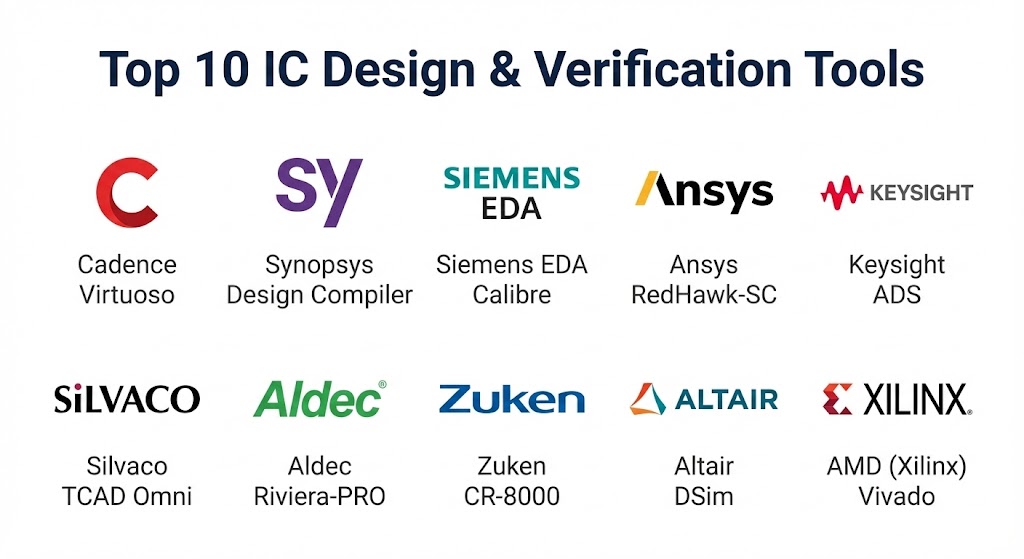
Top 10 IC Design & Verification Tools
1 — Cadence Virtuoso
Cadence Virtuoso is the global standard for custom analog, mixed-signal, and RF design. It provides a seamless, schematic-driven layout environment that allows for extreme precision at the transistor level.
- Key Features:
- Advanced Schematic Editor: Highly intuitive environment for capturing complex analog designs.
- Constraint-Driven Layout: Automatically ensures physical designs adhere to electrical requirements.
- Spectre Simulation Integration: Native connectivity with the industry’s most trusted analog solver.
- PDK Support: Direct compatibility with Process Design Kits from every major foundry.
- Analog Design Environment (ADE): A comprehensive cockpit for simulation, corner analysis, and centering.
- Real-time Parasitic Estimation: Provides early feedback on how physical wires will impact electrical performance.
- Pros:
- The undisputed leader for analog design; finding engineers trained in Virtuoso is easier than any other tool.
- Exceptional reliability and accuracy, especially for high-frequency RF applications.
- Cons:
- Heavy resource requirements for local workstations.
- The licensing cost is among the highest in the EDA industry.
- Security & compliance: ISO 27001 certified; supports multi-factor authentication (MFA), encrypted design databases, and granular user audit logs.
- Support & community: Extensive; includes the Cadence Learning Maps, a massive user forum, and 24/7 global enterprise support.
2 — Synopsys Design Compiler
Synopsys Design Compiler is the foundational tool for digital logic synthesis. it takes high-level RTL code (Verilog/VHDL) and optimizes it into a gate-level netlist, balancing power, performance, and area (PPA).
- Key Features:
- Topographical Technology: Predicts post-layout timing and power during the synthesis stage.
- Machine Learning Optimization: Uses AI to find the most efficient gate configurations.
- Multi-Voltage Support: Native handling of complex power-management strategies.
- Physically-Aware Synthesis: High correlation between early synthesis and final physical placement.
- Congestion Prediction: Identifies potential routing bottlenecks before they happen.
- Hierarchical Logic Optimization: Efficiently handles designs with hundreds of millions of gates.
- Pros:
- The industry “gold standard” for digital synthesis; results are highly trusted by all major foundries.
- Extremely robust scripting environment (Tcl-based) for automating complex flows.
- Cons:
- Can be slow when running massive, multi-million gate blocks without high-end server clusters.
- Interpreting complex timing reports requires significant engineering expertise.
- Security & compliance: SOC 2 Type II compliant; features secure IP encryption and role-based access controls.
- Support & community: Excellent; backed by Synopsys SolvNetPlus and a global network of field application engineers.
3 — Siemens EDA Calibre
Calibre (formerly Mentor Graphics) is the industry’s premier physical verification suite. It is the “gatekeeper” of the tapeout process, ensuring every geometric shape on the chip meets the foundry’s manufacturing rules.
- Key Features:
- nmDRC (Design Rule Checking): Validates layout geometries against thousands of complex manufacturing rules.
- nmLVS (Layout vs. Schematic): Ensures the physical shapes exactly represent the intended logical circuit.
- nmpPEX (Parasitic Extraction): Accurately models the unintended resistance and capacitance of wires.
- DFM (Design for Manufacturability): Analyzes designs to predict and improve manufacturing yield.
- Calibre Real-Time: Provides instant DRC feedback directly within the layout editor.
- Cloud-Ready Scaling: Can distribute verification tasks across thousands of CPU cores for 2nm chips.
- Pros:
- The “Golden” sign-off tool; if it passes Calibre, foundries will accept the design for manufacturing.
- Incredible scalability; it is the only tool that can verify the world’s largest AI processors in a reasonable timeframe.
- Cons:
- Modern rule decks for advanced nodes (3nm/2nm) are massive and require huge amounts of memory.
- The user interface for error debugging can be overwhelming for new users.
- Security & compliance: Varies by deployment; Enterprise versions are ISO 27001 and GDPR compliant.
- Support & community: World-class; the Siemens Verification Academy is a top-tier resource for training.
4 — Ansys RedHawk-SC
Ansys RedHawk-SC is a specialized platform for power integrity and reliability. It ensures the chip’s power grid is robust enough to handle high-speed switching without failing due to voltage drops or overheating.
- Key Features:
- Elastic Compute Architecture: Built on a big-data platform to handle billions of transistors.
- Dynamic IR Drop Analysis: Predicts real-time voltage dips during peak chip activity.
- Thermal-Aware Reliability: Models how heat affects the lifespan of internal wiring.
- Electro-migration (EM) Analysis: Detects wires that might “wear out” due to high current density.
- 3D-IC Support: Specialized tools for verifying power in stacked chip architectures.
- Foundry Certified: Certified for all advanced nodes including TSMC N2 and Intel 18A.
- Pros:
- The industry leader for sign-off power analysis; essential for high-performance computing (HPC).
- Excellent at visualizing “hot spots” where a chip is likely to fail electrically.
- Cons:
- It is a niche analysis tool, not a full design suite; it must be used alongside other EDA platforms.
- Extremely memory-intensive for full-chip analysis.
- Security & compliance: ISO 27001 and SOC 2 compliant; features secure multi-cloud data handling.
- Support & community: Strong; includes the Ansys Learning Hub and deep technical consultancy services.
5 — Keysight ADS (Advanced Design System)
Keysight ADS is the leading platform for high-frequency RF and microwave IC design. It is the primary tool used for designing the wireless front-ends of modern smartphones and satellite systems.
- Key Features:
- Harmonic Balance Simulator: Specialized math for analyzing non-linear high-frequency circuits.
- Integrated 3D EM Solvers: Analyzes how physical structures (like antennas) interact with electromagnetic fields.
- W-Standard Libraries: Pre-built test benches for 5G, 6G, and Wi-Fi standards.
- Electro-Thermal Analysis: Predicts how heat buildup changes RF signal quality.
- System-Level Simulation: Allows engineers to test a single chip within a larger wireless network model.
- High-Speed Digital Links: Specialized tools for designing ultra-fast data interfaces like PCIe 6.0.
- Pros:
- Absolute standard for RFIC; its simulation models for high-frequency components are unmatched.
- Seamless workflow from circuit simulation to physical electromagnetic analysis.
- Cons:
- Not suitable for general-purpose digital ASIC design.
- The high-frequency simulation engines require significant computational overhead.
- Security & compliance: ISO 27001 compliant; features secure IP protection for sensitive defense and telecom designs.
- Support & community: Highly technical; Keysight provides extensive “Knowledge Centers” and expert application notes.
6 — Silvaco TCAD Omni
Silvaco is a leader in Technology Computer-Aided Design (TCAD), which is used to model the physical manufacturing process of a semiconductor at the atomic and molecular level.
- Key Features:
- Process Simulation: Models how layers of silicon are grown, etched, and doped in a factory.
- Device Simulation: Predicts the electrical behavior of a single transistor based on its physical shape.
- 3D Finite Element Analysis: Highly accurate modeling of modern “FinFET” and “GAA” transistors.
- SPICE Model Extraction: Converts physical device results into models that tools like Virtuoso can use.
- Wide Bandgap Support: Specialized for designing GaN and SiC power semiconductors for EVs.
- Variation Analysis: Models how tiny manufacturing defects change chip performance.
- Pros:
- Essential for researchers and foundry engineers who are developing new types of transistors.
- Highly accurate at predicting the physics of semiconductor behavior.
- Cons:
- Not used for “designing a chip” in the traditional sense, but for “designing the transistor.”
- Simulations are mathematically intense and can take hours for a single device.
- Security & compliance: Varies; generally compliant with standard enterprise data security protocols.
- Support & community: Expert-level support; Silvaco is deeply embedded in the semiconductor research community.
7 — Aldec Riviera-PRO
Aldec Riviera-PRO is a high-performance verification platform used for functional simulation of digital designs. It is widely praised for its stability and its ability to handle multiple hardware languages simultaneously.
- Key Features:
- Mixed-Language Simulation: Effortlessly handles Verilog, VHDL, SystemVerilog, and SystemC in one run.
- Advanced Debugging: Includes a rich set of visualization tools for tracking signal paths and logic errors.
- UVM Support: Full compatibility with the Universal Verification Methodology.
- Assertion-Based Verification: Uses mathematical “checks” to ensure logic never enters an invalid state.
- Code Coverage: Detailed reporting on which parts of the logic have been tested.
- High-Performance Kernel: Optimized for fast execution of long verification regressions.
- Pros:
- Offers a more cost-effective alternative to the “Big Three” simulators while maintaining high performance.
- Excellent user interface that is generally considered easier to learn than Synopsys VCS.
- Cons:
- Lacks the massive ecosystem of pre-built “Verification IP” found with Cadence or Synopsys.
- Not always the first choice for the absolute largest SoC designs at 2nm.
- Security & compliance: SOC 2 compliant; features secure data isolation for defense and government projects.
- Support & community: Strong; Aldec provides localized support and an extensive library of online training videos.
8 — Zuken CR-8000
Zuken CR-8000 is a unique platform that focuses on “system-level” design, specifically the co-design of the IC, its physical package, and the PCB it sits on.
- Key Features:
- 3D IC/Package/Board Co-design: Allows engineers to see how the chip fits into the final hardware product.
- Chip-Package-Board Signal Integrity: Analyzes how a signal moves from the chip to the motherboard.
- Multi-Board System Design: Coordinates the design of products that contain multiple interlocking PCBs.
- Constraint-Based Layout: Ensures the physical package meets strict thermal and electrical rules.
- Design Reuse Management: A centralized library for sharing verified package and board designs.
- Direct Integration with MCAD: Allows electronic designs to be imported into mechanical tools like SolidWorks.
- Pros:
- The best tool for avoiding “package-related” failures where a chip works but won’t fit the board.
- Critical for modern mobile and wearable devices where space is extremely limited.
- Cons:
- Not a replacement for a transistor-level design tool like Virtuoso.
- The system-level approach requires a wider range of engineering disciplines to collaborate.
- Security & compliance: ISO 27001 compliant; features robust PDM (Product Data Management) security.
- Support & community: Global presence with a particularly strong support network in Asia and Europe.
9 — Altair DSim
Altair DSim (formerly Metrics) is a modern, cloud-native functional simulator that has disrupted the market by offering a “SaaS” model for IC verification.
- Key Features:
- Cloud-Native Architecture: Designed to run natively on AWS, Google Cloud, and Azure.
- Infinite Scaling: Allows companies to spin up 10,000 simulations instantly for peak verification.
- Usage-Based Pricing: Pay only for the simulation cycles you actually use.
- Unified Debug Environment: Web-based interface for analyzing simulation results from anywhere.
- SystemVerilog/UVM Support: Fully compatible with industry-standard verification methodologies.
- Automated Regression Management: Handles the scheduling and cleanup of massive test suites automatically.
- Pros:
- Extremely cost-effective for startups that don’t want to buy expensive perpetual licenses.
- Eliminates the need for a company to maintain its own expensive server farm.
- Cons:
- Requires a high-speed, reliable internet connection for smooth web-based debugging.
- Some conservative enterprises are still wary of putting their design IP in a public cloud.
- Security & compliance: SOC 2 Type II and GDPR compliant; uses high-grade AES-256 encryption for all data.
- Support & community: Growing; provides excellent documentation and “Cloud-Onboarding” specialists.
10 — AMD (Xilinx) Vivado
While primarily known as an FPGA tool, AMD’s Vivado Design Suite is a critical component of the IC verification world, particularly for hardware emulation and prototyping.
- Key Features:
- High-Level Synthesis (HLS): Converts C/C++ code directly into hardware logic.
- Integrated IP Integrator: Drag-and-drop environment for building systems from pre-verified blocks.
- Logic Simulation: Built-in simulator for checking logic before programming the hardware.
- Hardware Debugger: Allows for real-time viewing of signals inside a running prototype.
- Power Analysis & Optimization: Predicts power consumption based on real-world switching activity.
- Dynamic Function eXchange: Allows parts of a chip to be “reprogrammed” while the rest stays running.
- Pros:
- Essential for “Hardware-in-the-Loop” verification where software is tested on real silicon prototypes.
- The HLS feature is world-class for moving AI algorithms from software to hardware.
- Cons:
- It is a proprietary tool; you cannot use it to design chips for other vendors or pure-ASIC tapeouts.
- The software installation is massive, often requiring over 60GB of disk space.
- Security & compliance: SOC 2 compliant; features secure bitstream encryption and hardware root-of-trust.
- Support & community: Massive; the Xilinx Community Forums are among the most active engineering boards in the world.
Comparison Table
| Tool Name | Best For | Platform(s) Supported | Standout Feature | Rating (Gartner) |
| Cadence Virtuoso | Custom Analog/RFIC | Linux | Schematic-Driven Layout | 4.8 / 5 |
| Synopsys DC | Digital Logic Synthesis | Linux | Physically-Aware Synthesis | 4.9 / 5 |
| Siemens Calibre | Physical Verification | Linux | Industry “Golden” DRC/LVS | 4.9 / 5 |
| Ansys RedHawk-SC | Power & Thermal Analysis | Linux, Cloud | Hyper-Scale Architecture | 4.7 / 5 |
| Keysight ADS | RFIC & Wireless | Windows, Linux | Harmonic Balance Simulator | 4.7 / 5 |
| Silvaco TCAD | Device Physics Modeling | Windows, Linux | Transistor Process Simulation | 4.6 / 5 |
| Aldec Riviera-PRO | Logic Verification | Windows, Linux | Mixed-Language Stability | 4.5 / 5 |
| Zuken CR-8000 | Chip/Package/Board | Windows, Linux | 3D System-Level Co-design | 4.4 / 5 |
| Altair DSim | Cloud-based Simulation | Cloud (SaaS) | Usage-Based SaaS Model | 4.5 / 5 |
| AMD Vivado | FPGA & Prototyping | Windows, Linux | High-Level Synthesis (HLS) | 4.6 / 5 |
Evaluation & Scoring of IC Design & Verification Tools
The following table evaluates these tools based on a weighted rubric to help you understand their relative strengths in the 2026 market.
| Category | Weight | Evaluation Criteria |
| Core Features | 25% | Breadth of supported nodes (e.g., 2nm), PPA optimization, and sign-off accuracy. |
| Ease of Use | 15% | Intuitive UI, quality of debug tools, and scripting flexibility (Tcl/Python). |
| Integrations | 15% | Compatibility with foundry PDKs and interoperability with other EDA vendors. |
| Security & Compliance | 10% | Encryption standards, IP protection, and industry certifications (ISO/SOC). |
| Performance | 10% | Simulation speed, memory efficiency, and horizontal scalability. |
| Support & Community | 10% | Documentation quality, speed of vendor support, and talent availability. |
| Price / Value | 15% | Licensing flexibility, TCO, and overall return on investment. |
Which IC Design & Verification Tool Is Right for You?
Solo Users vs. SMBs vs. Enterprises
Solo users and students should focus on AMD Vivado (free versions) or Altair DSim (low-cost entry) to learn industry concepts. SMBs and startups should prioritize Altair DSim for its lack of infrastructure costs or Aldec for its balance of power and price. Large Enterprises have no choice but to build a “Big Three” flow (Synopsys, Cadence, Siemens) to ensure foundry sign-off and global scale.
Budget-Conscious vs. Premium Solutions
- Budget-Conscious: Altair DSim and Aldec Riviera-PRO offer professional results without the high perpetual licensing fees of the market leaders.
- Premium: Cadence, Synopsys, and Siemens are the premium “Sign-off” tools. You pay for the absolute certainty that your chip will work on the first try.
Feature Depth vs. Ease of Use
If your priority is Ease of Use, Cadence Virtuoso and Aldec are known for superior graphical interfaces. If you need Feature Depth for the most complex digital logic, Synopsys Design Compiler provides the most advanced optimization algorithms available.
Integration and Scalability Needs
For companies building massive AI data center chips, Ansys RedHawk-SC and Siemens Calibre are non-negotiable due to their ability to scale across thousands of cloud instances. For wireless communication projects, Keysight ADS is the only tool with the necessary RF-specific libraries.
Frequently Asked Questions (FAQs)
1. What is the difference between ASIC and FPGA design?
ASIC (Application-Specific Integrated Circuit) is a custom-made chip that cannot be changed once manufactured. FPGA (Field-Programmable Gate Array) is a chip that can be reprogrammed after manufacturing. ASIC design is much more complex and requires more expensive tools like Virtuoso or Calibre.
2. Why are these tools so expensive?
These tools involve massive amounts of R&D to simulate billions of transistors with sub-nanometer accuracy. A single error in the software could cause a chip to fail, costing the customer millions of dollars, so vendors charge a premium for that reliability.
3. Do I need a supercomputer to run these?
For large chips, yes. Most companies use a “Linux Farm” or a high-performance compute (HPC) cluster. However, cloud-native tools like Altair DSim allow you to “rent” this compute power instead of buying it.
4. What is a PDK?
A Process Design Kit (PDK) is a set of files from a foundry (like TSMC) that defines the rules for a specific manufacturing process. IC design tools use PDKs to ensure the digital design matches the physical reality of the factory.
5. Which tool is best for learning?
For digital design, AMD Vivado is excellent because of its free tier. For analog design, there is no true “free” version of Virtuoso, but many universities offer access.
6. Can these tools run on Windows?
Most professional IC design tools run only on Linux (RHEL or CentOS) because of the stability and memory management needed for long simulation runs. Keysight ADS and Vivado are rare exceptions that support Windows.
7. Is open-source EDA viable?
Open-source tools like OpenLane and Verilator are gaining traction for research and low-complexity chips, but for high-end 3nm or 2nm designs, they lack the foundry certification required for mass production.
8. What is “Tapeout”?
Tapeout is the final moment when the design files are sent to the foundry. Tools like Calibre and PrimeTime are used to give the final “Sign-off” that the chip is ready to be made.
9. How does AI help in IC design?
AI is used to automate the “Placement and Routing” of wires and to predict where a design might fail timing or power tests, saving human engineers months of trial-and-error.
10. Can I design an IC without an EDA tool?
In 2026, it is impossible. The complexity of modern silicon involves billions of connections that no human could ever manage or verify manually.
Conclusion
The choice of an IC design and verification tool is a foundational decision that impacts your company’s time-to-market and manufacturing yield. For custom analog work, Cadence Virtuoso remains the industry’s heartbeat. For digital logic, Synopsys provides the most robust optimization. And for the critical final sign-off that ensures your multi-million dollar chip is manufacturable, Siemens Calibre is the global standard. Ultimately, your choice should be driven by your target process node and whether your focus is on pure performance, RF communication, or cloud-native agility.
IC design tools have become essential as microchips grow more complex. This guide highlights leaders like Cadence Virtuoso and Synopsys, helping you navigate everything from transistor-level design to final verification. It’s a great roadmap for any semiconductor project.