Introduction
Human-in-the-Loop (HITL) labeling tools are specialized software platforms that combine automated AI-assisted labeling with human oversight. These tools allow data scientists and annotators to work in a continuous feedback loop: the AI makes a first pass at labeling data (pre-labeling), and humans review, correct, and refine those labels. This iterative process not only ensures near-perfect accuracy but also helps “teach” the model by focusing human attention on the most difficult or ambiguous edge cases—a process known as active learning.
The importance of HITL tools cannot be overstated. In industries like autonomous driving, medical diagnostics, and legal tech, a 1% error rate in data labeling can lead to catastrophic real-world consequences. Key use cases include training computer vision for surgery, fine-tuning Large Language Models (LLMs) through Reinforcement Learning from Human Feedback (RLHF), and moderating sensitive content across social platforms. When evaluating these tools, users should look for multi-modal support (text, image, video, 3D), robust quality assurance (QA) workflows, seamless API integrations, and the ability to scale to millions of data points without compromising on speed.
Best for: Machine learning teams at scale, enterprise AI labs, and regulated industries (healthcare, finance, defense) that require high-precision datasets and auditable data pipelines.
Not ideal for: Individual researchers with static, small-scale datasets where a simple open-source script might suffice, or companies that do not plan to iterate on their models frequently.
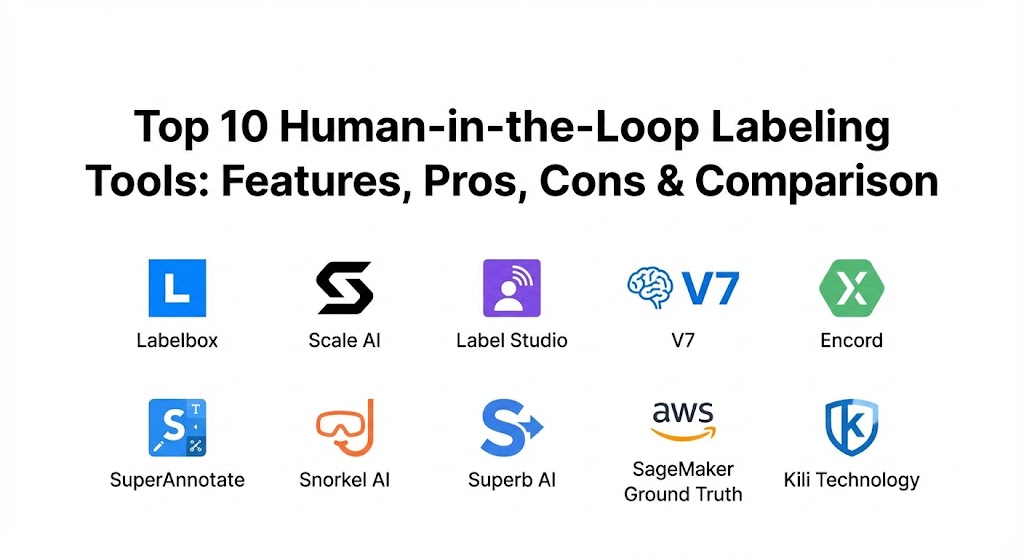
Top 10 Human-in-the-Loop Labeling Tools
1 — Labelbox
Labelbox is widely considered the “Data Engine” for modern AI teams. It provides a unified platform for data labeling, data management, and model evaluation, focusing heavily on creating a collaborative environment between data scientists and annotators.
- Key features:
- Integrated Data Catalog to visualize and curate unstructured data.
- Model-assisted labeling (MAL) to accelerate throughput by up to 10x.
- High-performance editors for images, video, text, and geospatial data.
- Collaborative workflows with real-time feedback and consensus scoring.
- Robust Python SDK for building automated data pipelines.
- Built-in workforce management for internal and external teams.
- Advanced analytics to track labeler performance and quality metrics.
- Pros:
- Exceptionally intuitive user interface that minimizes labeler fatigue.
- Strong emphasis on the “Data-Centric AI” philosophy, helping find data errors as much as labeling data.
- Cons:
- The enterprise pricing tier can be a significant investment for smaller startups.
- Some advanced automation features require significant engineering effort to set up via SDK.
- Security & compliance: SOC 2 Type II, HIPAA, GDPR, and SSO support. Offers data isolation and private cloud deployment.
- Support & community: Extensive documentation, a dedicated customer success manager for enterprise clients, and a helpful community forum.
2 — Scale AI
Scale AI is the powerhouse of the labeling world, famous for providing not just the software but also the massive, managed workforce (via Outlier/Alignerr) required to power the world’s leading LLMs and autonomous vehicle projects.
- Key features:
- Scale Generative AI platform for RLHF and model evaluation.
- Support for high-complexity 3D sensor fusion and LiDAR data.
- “Scale Rapid” for quick-turnaround labeling with pre-vetted crowds.
- Quality Assurance via programmatic gold standard checks.
- Unified dashboard for monitoring massive-scale data operations.
- Scale Nucleus for data curation and model debugging.
- Pros:
- Unmatched ability to handle extreme scale—millions of annotations per week.
- High accuracy in specialized domains like autonomous driving and LLM training.
- Cons:
- Operates somewhat like a “black box”; users have less visibility into the individual labelers.
- Premium pricing reflects its status as an industry leader.
- Security & compliance: ISO 27001, SOC 2, HIPAA, and GDPR compliant. Frequently used by government and defense agencies.
- Support & community: High-touch enterprise support and exhaustive technical documentation for their vast API ecosystem.
3 — Label Studio (HumanSignal)
Label Studio is the leading open-source choice for teams that value flexibility and data sovereignty. It allows users to build custom labeling interfaces for almost any data type imaginable.
- Key features:
- Multi-modal support for text, audio, images, video, and time-series data.
- Fully customizable UI templates using a simple XML-like configuration.
- Integration with popular ML frameworks (PyTorch, TensorFlow) for active learning.
- Webhook support to trigger model retraining or data movement.
- Community and Enterprise editions to suit different scaling needs.
- Flexible deployment options (Docker, Kubernetes, on-premise).
- Pros:
- The open-source version is incredibly powerful and completely free for most use cases.
- Unmatched flexibility; if you have a niche data type, you can build a tool for it here.
- Cons:
- The UI can feel less “polished” and more developer-centric compared to Labelbox.
- Setting up complex collaborative workflows requires the paid Enterprise version.
- Security & compliance: Enterprise version includes SSO, audit logs, and RBAC. Self-hosting options offer maximum data privacy.
- Support & community: One of the largest active communities in the labeling space; excellent Slack community and GitHub support.
4 — V7 (V7 Labs)
V7 is a computer vision-first platform that stands out for its “Auto-Annotate” feature, which uses deep learning to segment objects with pixel-perfect accuracy in seconds.
- Key features:
- Class-leading automated segmentation and keypoint tools.
- V7 Darwin for managing complex video and image pipelines.
- Support for medical imaging formats like DICOM and NIfTI.
- Integrated model training (V7 Neurons) to build “micro-models” during labeling.
- Dataset management with advanced versioning and branching.
- Real-time collaboration and QA review stages.
- Pros:
- The Auto-Annotate tool is arguably the fastest in the market for complex shapes.
- Highly specialized and effective for healthcare and life sciences.
- Cons:
- Not a strong choice for text-only or NLP-heavy projects.
- Can be more expensive than general-purpose tools for basic bounding-box tasks.
- Security & compliance: SOC 2 Type II, GDPR, and HIPAA compliant.
- Support & community: Known for high-quality technical support and regular webinars/educational content.
5 — Encord
Encord focuses on “Video-First” and multimodal data, offering a platform that excels in complex temporal data and high-frequency video annotation.
- Key features:
- Automated object tracking and interpolation across video frames.
- Encord Index for fine-grained data curation and edge-case discovery.
- Integration with Segment Anything Model (SAM 2) for rapid labeling.
- Native support for medical imaging (DICOM) and SAR imagery.
- “Micro-models” for specific task automation within the platform.
- Comprehensive quality control dashboards with inter-annotator agreement metrics.
- Pros:
- Significant time savings for video projects due to intelligent interpolation.
- Strong focus on data curation, helping teams label only the most “useful” data.
- Cons:
- Steep learning curve for the more advanced indexing and curation features.
- Newer to the market than Scale or Labelbox, though rapidly catching up.
- Security & compliance: SOC 2 Type II, GDPR, and HIPAA compliant.
- Support & community: Responsive customer support and detailed technical blogs.
6 — SuperAnnotate
SuperAnnotate is a comprehensive platform designed to streamline the entire lifecycle of AI data management, from curation to annotation and model iteration.
- Key features:
- Visual data management for millions of assets.
- Advanced toolsets for LiDAR and 3D point cloud annotation.
- Integrated workforce marketplace to find domain-expert labelers.
- Custom automated QA workflows with multi-level review.
- LLM evaluation and RLHF capabilities.
- Real-time project tracking and performance analytics.
- Pros:
- Excellent for projects involving 3D data or multimodal inputs (e.g., video + text).
- Very strong project management features for large, distributed teams.
- Cons:
- The vast amount of features can make the initial setup feel overwhelming.
- Pricing can escalate quickly with high volumes of 3D data.
- Security & compliance: SOC 2 Type II, HIPAA, and GDPR compliant.
- Support & community: Offers 24/7 enterprise support and a robust technical knowledge base.
7 — Snorkel AI
Snorkel AI is unique because it emphasizes “Programmatic Labeling.” Instead of labeling every single data point by hand, users write “Labeling Functions” to label data at scale, with humans only reviewing the results.
- Key features:
- Programmatic data labeling using weak supervision.
- Snorkel Flow platform for rapid iterative model development.
- AI-assisted discovery of data slices where the model is failing.
- Foundation model fine-tuning and evaluation.
- Enterprise-grade data governance and lineage.
- Integrated human-in-the-loop review for “conflicted” labels.
- Pros:
- Can label millions of data points in hours rather than months.
- Ideal for organizations with massive amounts of unlabeled internal data.
- Cons:
- Requires a high level of engineering expertise to write effective labeling functions.
- High entry price point (often starting in the six figures for enterprise).
- Security & compliance: SOC 2, HIPAA, and GDPR compliant.
- Support & community: Focused on white-glove enterprise service and academic-style documentation.
8 — Superb AI
Superb AI aims to make labeling “autonomous” by leveraging its Superb Suite to automatically generate high-quality labels that humans then audit.
- Key features:
- Superb Curate for identifying data imbalance and bias.
- Automated labeling powered by pre-trained foundation models.
- “Uncertainty-based” sampling to prioritize human review on difficult data.
- CLI and SDK for seamless developer integration.
- Collaboration tools for project managers and labelers.
- Pros:
- Very fast onboarding; teams can get started in minutes.
- The active learning loop is highly automated, reducing manual intervention.
- Cons:
- Customizing the auto-labeling models for very niche domains can be tricky.
- Less flexible UI compared to Label Studio for highly specialized tasks.
- Security & compliance: SOC 2 compliant and GDPR ready.
- Support & community: Reliable customer support with helpful onboarding tutorials.
9 — Amazon SageMaker Ground Truth
As part of the AWS ecosystem, Ground Truth offers a highly scalable, integrated way to label data that is already stored in S3.
- Key features:
- Seamless integration with Amazon S3 and SageMaker models.
- Access to a public workforce (Mechanical Turk), private teams, or vendors.
- Automated data labeling with active learning.
- Built-in templates for common tasks like object detection and sentiment analysis.
- Support for 3D point cloud and video annotation.
- Pros:
- If your data is already on AWS, the data security and latency benefits are significant.
- Highly cost-effective for simple, high-volume tasks using Mechanical Turk.
- Cons:
- The user interface is functional but lacks the modern UX of dedicated startups.
- AWS documentation can be dense and difficult for non-technical users to navigate.
- Security & compliance: Inherits the vast security of the AWS cloud (FedRAMP, HIPAA, SOC, etc.).
- Support & community: Backed by AWS enterprise support plans and a massive global developer base.
10 — Kili Technology
Kili Technology is an enterprise-grade platform from Europe that focuses heavily on quality control, governance, and auditability in the labeling process.
- Key features:
- Sophisticated QA workflows including consensus, review, and honey-pots.
- Support for a wide range of data types: text, image, video, and audio.
- Seamless integration with LLM workflows for RLHF.
- Strong focus on “Project Management” for data operations.
- API-first design for easy integration into MLOps pipelines.
- Pros:
- One of the best tools for tracking “inter-annotator agreement” and labeler quality.
- Highly compliant with European data privacy standards (GDPR).
- Cons:
- Pricing is on the higher end, aimed primarily at mid-market and enterprise.
- The automation features, while good, are slightly behind Scale or Snorkel.
- Security & compliance: SOC 2, HIPAA, GDPR, and ISO 27001.
- Support & community: Excellent documentation and high-touch support for enterprise deployments.
Comparison Table
| Tool Name | Best For | Platform(s) Supported | Standout Feature | Rating (Gartner/G2) |
| Labelbox | Large-scale AI Ops | SaaS, Cloud, On-Prem | Integrated Data Catalog | 4.6 / 5 |
| Scale AI | High-volume RLHF/Vision | SaaS, API | Managed Expert Workforce | 4.5 / 5 |
| Label Studio | Custom Formats | Open Source, Self-Host | Infinite UI Flexibility | 4.7 / 5 |
| V7 | Medical / CV | SaaS | Auto-Annotate AI | 4.8 / 5 |
| Encord | Video / Multimodal | SaaS | Temporal Object Tracking | 4.7 / 5 |
| SuperAnnotate | LiDAR / 3D Data | SaaS | 3D Point Cloud Editor | 4.6 / 5 |
| Snorkel AI | Programmatic Labeling | SaaS, Enterprise | Labeling Functions (Weak Supervision) | 4.3 / 5 |
| Superb AI | Automated ML Teams | SaaS | Uncertainty-based Sampling | 4.4 / 5 |
| SageMaker | AWS-Native Pipelines | AWS Cloud | AWS Ecosystem Integration | 4.1 / 5 |
| Kili Technology | Quality Governance | SaaS, Cloud | Consensus & QA Analytics | 4.5 / 5 |
Evaluation & Scoring of Human-in-the-Loop Labeling Tools
The following rubric is used by industry experts to score HITL platforms. Use these weights when conducting your own internal Proof of Concept (PoC).
| Category | Weight | Key Evaluation Criteria |
| Core Features | 25% | Multi-modal support, active learning, and annotation tool precision. |
| Ease of Use | 15% | UX for both labelers (fatigue) and admins (project setup). |
| Integrations | 15% | API quality, SDK, and native cloud storage (S3/Azure/GCP) connectors. |
| Security & Compliance | 10% | HIPAA, SOC 2, GDPR, and ability to handle sensitive PII data. |
| Performance | 10% | Low latency for high-resolution images/videos and project scalability. |
| Support & Community | 10% | Documentation quality, Slack communities, and enterprise response times. |
| Price / Value | 15% | Flexibility of pricing (pay-per-label vs. seat-based) and ROI. |
Which Human-in-the-Loop Labeling Tool Is Right for You?
The right tool depends on your data type, team size, and regulatory environment.
- Solo Researchers & Small Teams: If you are working on a budget and have technical skills, Label Studio (Open Source) is the obvious choice. For NLP researchers, Prodigy (by the creators of spaCy) is also a strong alternative.
- Computer Vision Specialists: If your primary data is images or video, V7 and Encord offer the best AI-assisted automation, saving thousands of manual hours.
- Enterprise Building LLMs: For RLHF and model evaluation at scale, Scale AI and Labelbox provide the most mature platforms and access to the specialized workforces needed for fine-tuning.
- Regulated Industries (Health/Finance): Prioritize Kili Technology or the Enterprise version of Label Studio (Self-hosted) to ensure data never leaves your secure network.
- Large AWS Users: If your infrastructure is 100% on Amazon, SageMaker Ground Truth simplifies billing and data movement, though you may sacrifice some of the “smart” UI features found in specialized startups.
Frequently Asked Questions (FAQs)
1. What exactly is “Human-in-the-Loop” in labeling? It is a workflow where a machine makes a first pass at labeling data, and a human reviewer confirms or corrects it. The human’s feedback is then fed back to the machine to improve its future performance.
2. How does HITL save money? By using AI to “pre-label” data, humans only need to click “confirm” or make minor adjustments, rather than drawing every box from scratch. This can reduce manual effort by 50% to 90%.
3. What is Active Learning? Active learning is a strategy where the labeling tool identifies the data points the model is most “confused” about (uncertainty sampling) and prioritizes those for human labeling, making the model learn faster.
4. Can these tools handle video? Yes, tools like Encord and V7 are specialized for video, using interpolation to track a label across frames automatically so a labeler doesn’t have to draw it 30 times per second.
5. Is open-source labeling safe for sensitive data? Yes, open-source tools like Label Studio can be self-hosted on your private servers, meaning the data never touches the vendor’s cloud, which is ideal for PII or medical data.
6. Do these tools provide the people to do the labeling? Some do (like Scale AI and Appen), while others provide only the software (like Label Studio). Some platforms (like Labelbox) offer “Labeling Services” as a managed add-on.
7. What is “Consensus” in labeling? Consensus is a quality control method where multiple people label the same data point. The tool then calculates an agreement score to ensure accuracy and reduce individual bias.
8. Can I integrate these tools with my existing ML pipeline? Most modern tools are “API-first,” meaning you can automatically push new data to the labeling tool and pull labeled data back into your training script via Python or REST APIs.
9. How do these tools handle 3D data like LiDAR? Platforms like SuperAnnotate and Scale AI have specialized 3D viewers that allow annotators to navigate a 3D space and draw “cuboids” around objects.
10. Why should I use a tool instead of just hiring a contractor with a spreadsheet? Spreadsheets lack the visual interfaces, quality control mechanisms (like consensus), and audit trails required for machine learning. A specialized tool ensures your data is actually usable for training.
Conclusion
Selecting a Human-in-the-Loop labeling tool is a strategic decision that will define the quality of your AI models for years to come. In 2026, the trend is moving away from “simple labeling” toward “intelligent data curation.” The most successful teams aren’t just labeling data faster—they are using these tools to find the most valuable data to label. Whether you choose the massive scale of Scale AI, the flexibility of Label Studio, or the precision of V7, ensure the platform can grow with your data and your compliance needs.