Introduction
HR Analytics Platforms (also known as People Analytics software) are specialized data solutions that aggregate, analyze, and visualize workforce data. Unlike a standard HRIS that simply stores employee records, an analytics platform pulls data from various sources—payroll, performance reviews, recruitment pipelines, and even employee surveys—to uncover deep-seated trends. By applying machine learning and statistical modeling, these tools provide actionable insights into workforce productivity, compensation equity, and future hiring needs.
The importance of these tools lies in their ability to solve complex business problems before they escalate. For instance, predictive analytics can flag departments with high burnout risk, allowing HR to intervene before a mass exodus occurs. Key evaluation criteria for these platforms include data integration capabilities (the ability to “talk” to existing tools), the depth of predictive modeling, user interface (UI) intuitiveness for non-technical users, and stringent data privacy compliance.
Best for: Mid-sized to large enterprises, CHROs looking to prove ROI, and data-driven People Ops teams in fast-scaling industries like tech, finance, and healthcare. It is essential for organizations that have outgrown manual spreadsheets and need a “single source of truth” for people data.
Not ideal for: Micro-businesses (under 50 employees) where basic HRIS reporting is sufficient, or companies with highly siloed data who are not yet ready to invest in the data cleansing required for advanced analytics.
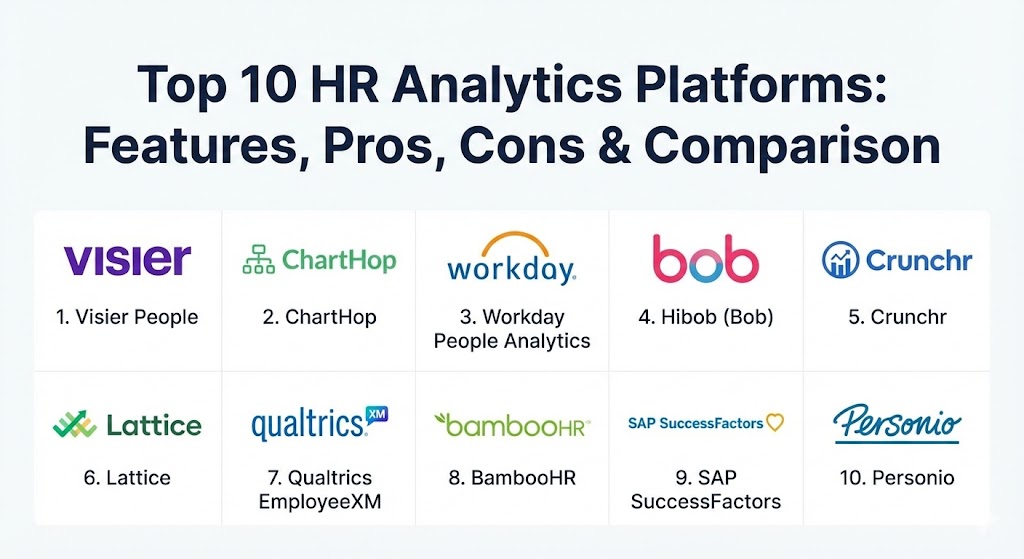
Top 10 HR Analytics Platforms
1 — Visier People
Visier is widely considered the market leader in the people analytics space. It is a purpose-built platform designed to answer hundreds of complex workforce questions out of the box, specializing in “augmented analytics” to simplify data storytelling.
- Key features:
- Over 2,000 pre-built metrics and 250+ “best practice” questions.
- Predictive analytics for turnover, internal mobility, and headcount.
- Advanced “What-If” scenario modeling for workforce planning.
- Benchmarking data against industry peers.
- Automated insights that highlight anomalies in the data.
- Diversity, Equity, and Inclusion (DEI) tracking and modeling.
- Pros:
- Extremely deep functionality; it can handle the most complex enterprise data.
- Excellent data visualization that makes complex trends easy for executives to understand.
- Cons:
- High price point; generally out of reach for small businesses.
- Implementation can be complex, requiring clean data from multiple legacy systems.
- Security & compliance: SOC 2 Type II, GDPR, HIPAA, and ISO 27001 compliant. Robust role-based access control (RBAC).
- Support & community: Top-tier enterprise support, a dedicated “Visier University,” and a highly active community of people analytics professionals.
2 — ChartHop
ChartHop stands out for its visual-first approach to people data. It transforms a standard org chart into a dynamic, data-rich map of the entire company, making it a favorite for headcount planning and transparency.
- Key features:
- Dynamic, interactive org charts that sync with HRIS data.
- Headcount and compensation planning with collaborative “scenarios.”
- Integrated employee engagement surveys and performance data.
- Visual DEI dashboards to track representation at every level.
- Powerful filtering to view the company by tenure, department, or location.
- Pros:
- Unmatched transparency; employees can see where they fit in the larger picture.
- Simplifies the nightmare of manual headcount planning in spreadsheets.
- Cons:
- Some advanced analytics features are not as deep as Visier’s.
- Larger organizations may find the “everything-in-one-chart” view cluttered.
- Security & compliance: SOC 2 Type II, GDPR, and SSO integration (SAML/Okta).
- Support & community: Strong onboarding support and a helpful library of templates for first-time people analysts.
3 — Workday People Analytics
As the “Gold Standard” of enterprise HCM, Workday’s native analytics module leverages the vast amounts of data already in its ecosystem to provide “stories” about the workforce.
- Key features:
- “Vibe” (Value Inclusion, Belonging, and Equity) index for DEI tracking.
- Augmented analytics that use AI to explain the “why” behind trends.
- Native integration with Workday Financial Management for headcount ROI.
- Benchmarking against other Workday customers (anonymized).
- Skills-based analytics to identify talent gaps.
- Pros:
- Zero data integration issues if you are already in the Workday ecosystem.
- Powerful enough to support the world’s largest Fortune 500 companies.
- Cons:
- Prohibitively expensive if you aren’t already using Workday HCM.
- The interface can feel “corporate” and less agile than modern SaaS rivals.
- Security & compliance: Industry-leading standards (ISO, SOC 2, HIPAA, FedRAMP).
- Support & community: Massive global support network and the extensive “Workday Community” portal.
4 — Hibob (Bob)
Hibob (commonly known as “Bob”) is a modern, culture-first HR platform. Its analytics module is designed to look and feel like a social media dashboard, making data accessible to everyone from HR to line managers.
- Key features:
- Real-time KPIs on retention, growth, and turnover.
- “People Directory” analytics that show social connections and influence.
- Integrated lifecycle surveys (onboarding to exit).
- Easy-to-build custom reports for board meetings.
- Time-off and attendance analytics integrated with productivity.
- Pros:
- Exceptional user experience; high adoption rates among non-technical users.
- Great for “culture-driven” companies that want to measure engagement.
- Cons:
- Not as powerful for advanced statistical modeling as specialized tools.
- Analytics are mostly descriptive (what happened) rather than predictive (what will happen).
- Security & compliance: GDPR, ISO 27001, and SOC 2 Type II compliant.
- Support & community: Known for responsive customer success teams and a vibrant community of “Bob” enthusiasts.
5 — Crunchr
Crunchr is a specialized people analytics platform that focuses on “Augmented Analytics.” It is designed for HR teams that want to get answers fast without having to build complex spreadsheets themselves.
- Key features:
- Automated data cleaning and validation (essential for messy HR data).
- Predictive attrition modeling to identify flight risks.
- Interactive scenario planning for organizational design.
- Deep DEI modeling and pay equity analysis.
- “Storytelling” dashboards that guide users through data insights.
- Pros:
- Strong focus on data quality; it fixes your data as it ingests it.
- Very intuitive; built by former HR consultants who understand business needs.
- Cons:
- Smaller market presence; fewer third-party integrations than Visier.
- Can be slow when performing extremely large, complex statistical simulations.
- Security & compliance: GDPR-first (European-based), SOC 2, and high-level encryption.
- Support & community: Personalized onboarding and a focus on building a “data-driven HR” culture.
6 — Lattice
Lattice is primarily known for performance management, but its analytics module is essential for companies that want to link employee performance directly to business outcomes and engagement.
- Key features:
- Sentiment analysis from continuous employee feedback.
- Performance-to-engagement correlation dashboards.
- Goal (OKR) tracking analytics.
- Manager effectiveness scores based on team data.
- Attrition risk alerts based on performance and survey trends.
- Pros:
- The best tool for connecting “soft” data (engagement) with “hard” data (performance).
- Very easy to set up for companies already using Lattice for appraisals.
- Cons:
- Limited as a general-purpose HRIS analytics tool (best for performance/engagement).
- Reporting is less flexible than standalone BI tools.
- Security & compliance: SOC 2 Type II, GDPR, and HIPAA compliant.
- Support & community: Excellent webinars, templates, and the “Resources for Humans” community.
7 — Qualtrics EmployeeXM
Qualtrics is the leader in “Experience Management.” Their HR analytics focus heavily on the “Voice of the Employee,” using advanced text and sentiment analysis to understand how employees feel.
- Key features:
- Advanced NLP (Natural Language Processing) for open-ended survey comments.
- Predictors for employee intent-to-leave and burnout.
- Lifecycle tracking (candidate experience to alumni feedback).
- Driver analysis to see what actually impacts engagement in your specific company.
- Manager-specific action plans based on team sentiment.
- Pros:
- Unrivaled for understanding the “human” element of the workforce.
- Extremely powerful research-grade analytics for DEI and culture.
- Cons:
- Can be very complex and “academic” for smaller teams.
- High cost of ownership; often requires a dedicated researcher to manage.
- Security & compliance: FedRAMP, SOC 2, ISO 27001, and HIPAA.
- Support & community: Global enterprise support and a large network of experience management experts.
8 — BambooHR
BambooHR is the go-to choice for small and growing businesses. Its analytics are built for the “HR team of one,” focusing on simplicity and clarity over complex data modeling.
- Key features:
- 1-click reporting for standard metrics (headcount, turnover, age).
- Employee Satisfaction (eNPS) tracking.
- Time-off and benefit usage analytics.
- Training and compliance tracking dashboards.
- Mobile app for on-the-go reporting for managers.
- Pros:
- The most user-friendly interface in the HR software world.
- Incredible value for money for companies under 200 people.
- Cons:
- Very limited predictive capabilities (no “What-If” modeling).
- Reporting is rigid; custom metrics are difficult to build.
- Security & compliance: SOC 2, GDPR, and data encryption at rest.
- Support & community: Award-winning customer support and a very helpful blog for SMB HR leaders.
9 — SAP SuccessFactors Workforce Analytics
For global giants, SAP SuccessFactors offers a comprehensive analytics suite that handles massive datasets across dozens of countries and languages.
- Key features:
- 2,000+ standardized metrics across all HR domains.
- Global compliance reporting (essential for multi-national firms).
- Strategic workforce planning with long-term financial modeling.
- Automated data “scrubbing” for heterogeneous global data.
- Seamless integration with SAP ERP for total business visibility.
- Pros:
- Unbeatable for global, multi-currency, and multi-language environments.
- Highly structured and defensible data for board-level reporting.
- Cons:
- Traditional, “heavyweight” UI that feels dated to some users.
- Very long and expensive implementation cycles.
- Security & compliance: Maximum enterprise security (ISO, SOC, HIPAA, GDPR).
- Support & community: Worldwide support infrastructure and a massive partner ecosystem.
10 — Personio
Personio is the “Europe-first” HR platform. It is designed specifically for SMBs and mid-market companies that need to navigate the complexities of European labor laws and GDPR.
- Key features:
- Unified dashboards for core HR, payroll, and recruiting.
- GDPR-compliant data management and “right-to-be-forgotten” workflows.
- Automated reports for German, UK, and other local compliance needs.
- Time and attendance analytics integrated with payroll.
- Performance tracking with simple, visual growth charts.
- Pros:
- The safest choice for European companies concerned with data privacy.
- Modular pricing allows you to only pay for the analytics you need.
- Cons:
- Limited presence in the US/Asian markets; less support for non-EU laws.
- Not as strong for deep predictive talent modeling as Visier or Crunchr.
- Security & compliance: Highest-tier European data protection standards (GDPR, ISO).
- Support & community: Strong localized support in multiple European languages.
Comparison Table
| Tool Name | Best For | Platform(s) Supported | Standout Feature | Rating (Gartner) |
| Visier People | Enterprise Analytics | Cloud / SaaS | 2,000+ Pre-built Metrics | 4.5 / 5 |
| ChartHop | Org Planning | Cloud / SaaS | Visual Data Org Charts | 4.0 / 5 |
| Workday | Global HCM | Cloud / SaaS | Augmented Data Stories | 4.4 / 5 |
| Hibob | Mid-Market Culture | Cloud / SaaS | Social-Style Dashboards | 4.7 / 5 |
| Crunchr | Data Storytelling | Cloud / SaaS | Automated Data Cleaning | 3.9 / 5 |
| Lattice | Performance Linkage | Cloud / SaaS | Sentiment Correlation | 4.6 / 5 |
| Qualtrics | Employee Sentiment | Cloud / SaaS | Advanced NLP Analysis | 4.5 / 5 |
| BambooHR | Small Business (SMB) | Cloud / Mobile | 1-Click Simple Reports | 4.4 / 5 |
| SAP SuccessFactors | Global Enterprises | Cloud / On-Prem | Strategic Workforce Planning | 4.0 / 5 |
| Personio | European SMBs | Cloud / SaaS | GDPR-First Architecture | 4.5 / 5 |
Evaluation & Scoring of HR Analytics Platforms
We have evaluated these tools based on a weighted rubric to help you understand where each shines and where they may fall short for your specific organizational needs.
| Category | Weight | Evaluation Criteria |
| Core Features | 25% | Predictive modeling, DEI tracking, workforce planning, and ad-hoc reporting. |
| Ease of Use | 15% | Intuitiveness for HR generalists; dashboard clarity and visual appeal. |
| Integrations | 15% | Pre-built connectors for HRIS (Workday, ADP, Oracle) and communication tools (Slack). |
| Security | 10% | Encryption standards, GDPR/HIPAA compliance, and audit logs. |
| Performance | 10% | Data refresh speeds, system uptime, and handling of large datasets. |
| Support | 10% | Documentation quality, human support speed, and community engagement. |
| Price / Value | 15% | Transparency of pricing and ROI for the specific target market. |
Which HR Analytics Platforms Tool Is Right for You?
The right choice depends on your current “data maturity” and the size of your organization.
- Solo HR / Small Business (<100 employees): Stick with BambooHR. You likely don’t have enough data for machine learning to be accurate, and you need simple, clear reports for the CEO.
- Fast-Growing Mid-Market (100–1,000 employees): If culture is your focus, go with Hibob. If you are trying to align performance with growth, Lattice is your best bet. For European teams, Personio is non-negotiable for compliance.
- Large Enterprises (1,000+ employees): If you have a dedicated People Analytics team, Visier is the gold standard. If you are a “Workday shop,” stay in that ecosystem to avoid the headache of data integration.
- Big Data & Sentiment Experts: If your goal is to truly understand the “voice” of your employees and conduct deep psychological research on your workforce, Qualtrics is the industry leader.
- Budget vs. Premium: BambooHR and the basic tiers of Lattice offer great entry-level value. At the premium end, Visier and Workday offer “million-dollar insights” but require a significant financial and time investment.
Frequently Asked Questions (FAQs)
1. Is HR analytics the same as “spying” on my employees?
No. Professional HR analytics tools focus on aggregated trends and high-level patterns. Best practices involve anonymizing sensitive data and being transparent with employees about how data is used to improve the workplace.
2. How long does it take to set up an HR analytics platform?
For simple tools like BambooHR, it can take a few days. For enterprise platforms like Visier or SAP, implementation typically takes 3 to 6 months due to the need for data cleansing and multi-system integration.
3. Do I need to be a data scientist to use these tools?
Most modern platforms (like Hibob and Crunchr) are built for HR generalists. However, enterprise tools like Visier offer deeper “power user” features that a data-literate analyst will appreciate.
4. Can these tools really predict who is going to quit?
Yes, using “predictive attrition modeling.” These tools look at patterns—like missed promotions, commute times, and low engagement scores—to flag individuals or departments at high risk of turnover.
5. How much do these platforms cost?
Pricing usually follows a “PEPM” (Per Employee Per Month) model. SMB tools can range from $5–$15 PEPM, while enterprise platforms often require custom quotes ranging from $20,000 to over $250,000 annually.
6. Is my data safe in the cloud?
All top-tier providers use bank-level encryption and undergo rigorous audits (SOC 2, ISO). Ensure your chosen vendor hosts data in a region that complies with your local laws (e.g., EU for GDPR).
7. Can I use these tools for remote teams?
Absolutely. Many tools now include specific metrics for remote work, such as “digital collaboration health” and “geographical compensation benchmarking.”
8. What is “Augmented Analytics”?
This is a feature where AI looks at your data and automatically writes a summary in plain English (e.g., “Your turnover in Marketing increased by 10% due to a lack of career growth opportunities”).
9. Can I export these charts for board meetings?
Yes. All major platforms allow you to export high-resolution charts into PDFs, PowerPoints, or interactive dashboards for executive presentations.
10. Do these tools help with DEI?
This is a core feature for most modern platforms. They can show you pay gaps, representation at various levels of seniority, and whether diverse candidates are being “weeded out” of your hiring funnel.
Conclusion
The “best” HR analytics platform isn’t the one with the most features; it’s the one that your team will actually use to make better decisions. For a small business, a simple turnover report in BambooHR can be revolutionary. For a global enterprise, the predictive modeling of Visier can save millions in attrition costs. As AI continues to integrate into the HR stack, these tools will move from simply reporting the past to actively designing the future of work.