Introduction
A Hospitality Channel Manager is a software solution that allows accommodation providers to manage their room inventory and rates across multiple online distribution channels simultaneously. Instead of logging into each Online Travel Agency (OTA) extranet individually, a manager can update a single dashboard, and the software instantly synchronizes that information across all connected platforms in real-time.
The importance of these tools lies in their ability to maximize online visibility while eliminating the risk of overbookings (double bookings). When a room is booked on one site, the channel manager immediately reduces availability on all other sites. Key real-world use cases include dynamic pricing (adjusting rates based on demand across all channels instantly) and centralizing guest communication. When evaluating these tools, users should look for two-way XML connectivity, a high number of OTA integrations, user-friendly interfaces, and robust reporting analytics that show which channels are actually driving profit.
Best for: Independent hotels, boutique resorts, bed and breakfasts, vacation rental managers, and global hotel chains looking to automate inventory distribution, maintain rate parity, and increase occupancy without increasing manual labor.
Not ideal for: Very small, single-unit properties that only list on one platform (like Airbnb only) or established properties with extremely high walk-in rates that do not rely on online distribution for their business model.
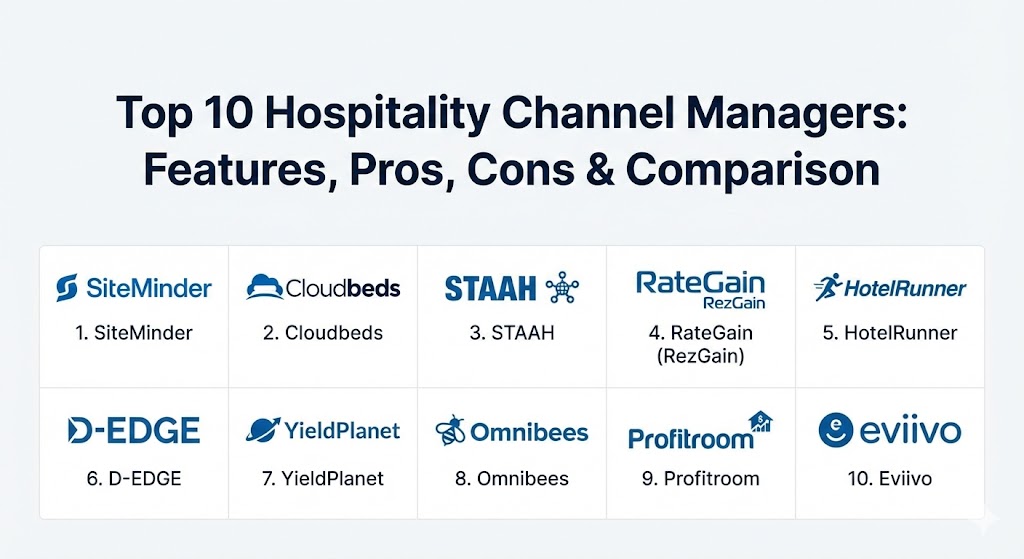
Top 10 Hospitality Channel Managers Tools
1 — SiteMinder
SiteMinder is widely considered the industry leader, offering the most extensive distribution network in the hospitality world. It is designed for hotels of all sizes that want to reach a global audience through a robust, stable platform.
- Key features:
- Connectivity to 450+ OTAs, GDS, and wholesale channels.
- Real-time, two-way ARI (Availability, Rates, and Inventory) synchronization.
- Integrated “Little Hotelier” suite for smaller properties.
- Smart reporting on channel performance and cost-of-acquisition.
- Seamless integration with hundreds of Property Management Systems (PMS).
- Automated rate parity monitoring to ensure consistent pricing.
- Pros:
- Unrivaled reach; if a booking site exists, SiteMinder likely connects to it.
- High reliability with minimal “sync lag,” significantly reducing overbooking risks.
- Cons:
- The sheer number of features can be overwhelming for smaller, less tech-savvy teams.
- Pricing is often on the higher end of the market, reflecting its premium status.
- Security & compliance: PCI DSS certified, GDPR compliant, uses end-to-end encryption, and supports SSO for enterprise accounts.
- Support & community: 24/7 global support with a multi-language team; extensive documentation and a massive community of certified partners.
2 — Cloudbeds
Cloudbeds provides an all-in-one hospitality management suite where the channel manager (formerly myallocator) is deeply integrated with their own PMS and booking engine.
- Key features:
- Unified “One-to-Many” inventory distribution.
- 300+ pre-built integrations with global and niche OTAs.
- Real-time dashboard that updates across PMS and channels instantly.
- Intelligent “Shared Inventory” for managing dorms and private rooms simultaneously.
- Automated credit card processing and validation.
- Advanced analytics on revenue-per-available-room (RevPAR).
- Pros:
- The all-in-one approach eliminates data silos between the PMS and the channel manager.
- Highly intuitive, modern interface that requires minimal staff training.
- Cons:
- Users often feel “locked in” to the Cloudbeds ecosystem for the best experience.
- Limited customization for specific, complex multi-property group reporting.
- Security & compliance: SOC 2 Type II, PCI DSS Level 1, GDPR compliant, and secure data encryption at rest.
- Support & community: 24/7 support via chat and email; “Cloudbeds University” offers comprehensive training tracks for staff onboarding.
3 — STAAH
STAAH is a New Zealand-based powerhouse known for its “Max” and “Instant” channel managers. It focuses on delivering high-performance distribution with a specific emphasis on the Asia-Pacific market.
- Key features:
- Real-time updates with sub-second synchronization speeds.
- “Stop-Sell” limit features to prevent overbooking during peak events.
- Integrated ReviewMinder to manage online reputation alongside distribution.
- Mobile app for managing rates and availability on the go.
- Support for multi-currency and multi-language setups.
- Detailed yield management and rate-matching tools.
- Pros:
- Extremely fast implementation and one of the most responsive mobile apps in the category.
- Very competitive pricing for mid-market boutique hotels.
- Cons:
- The UI feels a bit more traditional compared to the “sleek” designs of newer SaaS tools.
- Some niche European OTAs have less robust support compared to SiteMinder.
- Security & compliance: PCI DSS certified, GDPR compliant, and utilizes secure API protocols for data transmission.
- Support & community: Dedicated account managers for larger properties and a strong local support presence in several countries.
4 — RateGain (RezGain)
RateGain’s RezGain is an enterprise-grade channel manager that leverages AI and big data to help large hotel chains and groups optimize their distribution and pricing.
- Key features:
- AI-powered “Smart Distribution” that recommends the best channels for your specific hotel type.
- Global connectivity to 400+ channels and 1,500+ tour operators/wholesalers.
- Automated content management (photos and descriptions) across all channels.
- Advanced parity management with proactive alerts for price discrepancies.
- Deep integration with RateGain’s revenue management and rate shopping tools.
- Multi-property dashboard for “at-a-glance” group management.
- Pros:
- Exceptional for enterprise groups that need to manage hundreds of properties from a central office.
- The AI recommendations provide actual strategic value rather than just moving data.
- Cons:
- Can be overly complex and expensive for a small 10-room boutique hotel.
- Onboarding takes longer due to the depth of the enterprise configuration.
- Security & compliance: ISO 27001 certified, PCI DSS compliant, GDPR, and SOC 2.
- Support & community: Enterprise-level support with dedicated technical success managers and 24/7 global coverage.
5 — HotelRunner
HotelRunner is a cloud-based platform that positions itself as a “growth engine.” It is particularly strong for properties that want to focus on direct bookings alongside OTA management.
- Key features:
- Two-way synchronization with all major OTAs and niche local platforms.
- Integrated booking engine designed for high conversion on mobile.
- “HotelRunner Network” which allows hotels to connect directly with travel agents.
- Automated guest messaging and CRM capabilities.
- Promotions and package builder for multi-channel marketing campaigns.
- Simple, drag-and-drop calendar interface.
- Pros:
- Great for hotels that want a strong “direct-booking-first” strategy.
- The “Network” feature provides unique B2B opportunities that other tools lack.
- Cons:
- Reporting depth is somewhat limited compared to SiteMinder or RateGain.
- Customer support response times can vary during peak regional seasons.
- Security & compliance: GDPR compliant, PCI DSS certified, and secure SSL/TLS encryption.
- Support & community: Online knowledge base, video tutorials, and email-based support tickets.
6 — D-EDGE
D-EDGE (part of the Accor group) offers a “Smart Channel Manager” that is renowned for its high technical stability and its seamless integration with Global Distribution Systems (GDS).
- Key features:
- One-click distribution to 300+ channels and 600+ PMS integrations.
- Central Reservation System (CRS) integration for complex hotel groups.
- Built-in “Data Intelligence” to track competitor pricing.
- Automated rate derivation (e.g., automatically calculate non-refundable rates).
- Integrated payment gateway for secure transaction handling.
- High-conversion booking engine as an optional add-on.
- Pros:
- Extremely stable infrastructure with high uptime, even during peak traffic.
- Strongest choice for hotels that rely heavily on corporate travel through GDS.
- Cons:
- The cost can escalate quickly as you add more modules from the D-EDGE ecosystem.
- Primarily focused on the European and Asian markets; less dominant in the US.
- Security & compliance: PCI DSS, GDPR, and ISO 27001; highly secure data handling protocols.
- Support & community: Localized support teams across Europe and Asia; extensive documentation in multiple languages.
7 — YieldPlanet
YieldPlanet is highly regarded for its advanced revenue management capabilities, making it the tool of choice for revenue managers who want granular control over their pricing.
- Key features:
- Sophisticated “Revenue Management System” (RMS) features built directly into the channel manager.
- Multi-currency and multi-language support for global distribution.
- Flexible rate-loading rules for complex seasonal pricing.
- Integration with 400+ OTAs and GDS.
- Customizable reporting dashboards for revenue and occupancy analysis.
- Strong API for custom enterprise integrations.
- Pros:
- Offers more “yield control” than almost any other channel manager in its price bracket.
- Excellent for managing complex hotel apartments and aparthotels.
- Cons:
- The interface has a steeper learning curve than Cloudbeds or HotelRunner.
- Smaller properties may find the advanced revenue features more than they need.
- Security & compliance: GDPR, PCI DSS, and encrypted data transfers.
- Support & community: High-quality technical support; often praised for their willingness to build custom features for large clients.
8 — Omnibees
Omnibees is a dominant player in the Latin American and Iberian markets, offering a comprehensive platform that includes a channel manager, CRS, and a powerful booking engine.
- Key features:
- Deep penetration into LATAM local channels that global tools often miss.
- Integrated “BeeDirect” to boost direct sales via social media and websites.
- Powerful CRM for guest loyalty and retention management.
- Business intelligence tools for market trend analysis.
- Multi-property management with a centralized inventory pool.
- Dynamic pricing engine based on real-time competitor data.
- Pros:
- If your primary market is Brazil, Mexico, or Portugal, Omnibees’ channel reach is unparalleled.
- Strong focus on digital marketing integrations.
- Cons:
- English-language documentation and support are not as extensive as Spanish/Portuguese.
- Connectivity to certain North American niche channels can be slower to update.
- Security & compliance: GDPR and LGPD (Brazilian data protection) compliant, PCI DSS.
- Support & community: Strong community presence in South America with frequent regional webinars and events.
9 — Profitroom
Profitroom is a boutique-focused tool that emphasizes high-end guest experiences and high-conversion direct booking technology.
- Key features:
- Award-winning booking engine with a focus on visual storytelling.
- Automated marketing automation and CRM included.
- Two-way synchronization with major OTAs.
- Integrated “Voucher” and gift card management.
- Mobile-optimized administration dashboard.
- Advanced segmentation for personalized guest offers.
- Pros:
- The best tool for boutique hotels that want their website to be their #1 sales channel.
- Beautifully designed user interfaces for both staff and guests.
- Cons:
- OTA connectivity count is lower than SiteMinder or RateGain.
- Not the best fit for large, budget-chain hotels where “visual storytelling” is less relevant.
- Security & compliance: GDPR, PCI DSS, and secure data encryption standards.
- Support & community: Very personalized support; often described as a “partner” rather than just a software vendor.
10 — Eviivo
Eviivo is specifically designed for the smaller end of the market—Bed & Breakfasts, guest houses, and independent vacation rentals—offering a “suite” approach that is incredibly easy to use.
- Key features:
- Eviivo Suite: an all-in-one PMS, website builder, and channel manager.
- One-click connection to Airbnb, Booking.com, and Expedia.
- “Promo Manager” to run seasonal sales across all sites instantly.
- Mobile app for managing bookings while on the move.
- Automated guest communication for check-in and check-out.
- Integrated payment processing for small business owners.
- Pros:
- Perhaps the easiest tool on this list to set up; ideal for “non-techy” owners.
- Excellent value for money for single properties or small portfolios.
- Cons:
- Lacks the deep enterprise features (GDS, complex ARI derived rates) needed by large hotels.
- Limited third-party PMS integrations as they prefer you use their own.
- Security & compliance: PCI DSS certified, GDPR compliant, and secure login protocols.
- Support & community: Highly rated customer service; strong online help center and friendly onboarding.
Comparison Table
| Tool Name | Best For | Platform(s) Supported | Standout Feature | Rating (HTR / G2) |
| SiteMinder | Global Reach | Cloud / Web | 450+ OTA Integrations | 4.7 / 5 |
| Cloudbeds | SMB All-in-One | Cloud / Mobile | Deep PMS Integration | 4.6 / 5 |
| STAAH | APAC Boutique Hotels | Cloud / Mobile | Sub-second Sync Speed | 4.5 / 5 |
| RateGain | Enterprise Chains | Cloud / Web | AI Smart Distribution | 4.4 / 5 |
| HotelRunner | Direct Booking Focus | Cloud / Web | HotelRunner B2B Network | 4.3 / 5 |
| D-EDGE | Corporate & GDS | Cloud / Web | CRS & GDS Stability | 4.5 / 5 |
| YieldPlanet | Revenue Management | Cloud / Web | Advanced Yield Rules | 4.4 / 5 |
| Omnibees | LATAM / Iberia | Cloud / Web | Regional Market Reach | 4.3 / 5 |
| Profitroom | Luxury Boutiques | Cloud / Web | Conversion-Focused IBE | 4.8 / 5 |
| Eviivo | B&Bs & SMBs | Cloud / Mobile | Simplistic All-in-One | 4.6 / 5 |
Evaluation & Scoring of Hospitality Channel Managers
When selecting a tool, it is essential to weight criteria based on what will actually drive revenue for your property.
| Category | Weight | Evaluation Criteria |
| Core Features | 25% | Number of OTA connections, 2-way XML speed, and ARI depth. |
| Ease of Use | 15% | Training time for staff and intuitiveness of the dashboard. |
| Integrations | 15% | Compatibility with existing PMS, GDS, and payment gateways. |
| Security & Compliance | 10% | PCI DSS, GDPR, and data encryption standards. |
| Performance | 10% | System uptime and absence of synchronization errors. |
| Support | 10% | 24/7 availability and multi-language technical assistance. |
| Price / Value | 15% | Return on investment based on time saved and bookings gained. |
Which Hospitality Channel Managers Tool Is Right for You?
The “right” channel manager depends almost entirely on your property’s scale and your technical comfort level.
- Solo Owners & B&Bs: If you are a single owner-operator, Eviivo or the Little Hotelier version of SiteMinder is perfect. They provide the basics without a high price tag or steep learning curve.
- Mid-Market Boutique Hotels: For properties with 20-100 rooms, Cloudbeds is excellent if you want an all-in-one system, while STAAH or HotelRunner offer great value if you want a standalone channel manager that plays well with other tools.
- Enterprise Groups & Global Chains: You require high-level analytics and bulk property management. RateGain and SiteMinder are the industry standards for this tier, offering the scalability and security required for thousands of rooms.
- Regional Specialists: If your property is in Brazil or Mexico, Omnibees is a must-have. If you are in Europe and rely on business travel, D-EDGE should be at the top of your list.
- Budget vs. Premium: If budget is the primary concern, YieldPlanet often provides enterprise-like features at a more accessible price. If you want the “Ferrari” of guest conversion and don’t mind paying for it, Profitroom is the winner.
Frequently Asked Questions (FAQs)
1. Does a channel manager replace a Property Management System (PMS)?
No. A PMS handles on-site operations (check-ins, housekeeping), while a channel manager handles external distribution. However, some tools like Cloudbeds and Eviivo combine both into a single platform.
2. How exactly does a channel manager prevent overbookings?
It uses “Two-Way XML” connectivity. When a room is booked on Booking.com, the channel manager instantly updates your inventory to “minus one” across all other sites, usually within seconds.
3. Is rate parity mandatory?
While legal “parity” clauses vary by country, maintaining consistent prices across all sites prevents consumer confusion and ensures you don’t get penalized by OTAs in search rankings.
4. How long does implementation take?
For a small property, it can be set up in a few days. For a large hotel with complex rate plans and PMS integration, it typically takes 2 to 4 weeks for full testing and staff training.
5. Can I manage Airbnb through these tools?
Yes, almost all modern channel managers have direct API integrations with Airbnb, allowing you to manage it just like any other OTA.
6. Do these tools handle payments?
Many do. Most channel managers are PCI DSS compliant and can pass secure guest credit card details directly to your PMS or payment gateway for processing.
7. Can I use a channel manager without a website?
Yes, you can use it just to manage OTAs. However, most providers offer an integrated booking engine so you can take direct, commission-free bookings on your own site.
8. What is “Two-Way XML”?
It is a communication standard that allows the channel manager and the OTA to “talk” to each other in both directions—sending rates to the OTA and receiving bookings back from the OTA.
9. Will using a channel manager improve my SEO?
Indirectly, yes. By increasing your visibility on many OTAs (the “Billboard Effect”), more people will search for your hotel directly on Google, driving more traffic to your site.
10. What happens if the internet goes down?
Since most tools are cloud-based, the “sync” between the OTAs and the channel manager continues even if your hotel’s local Wi-Fi is down. You just won’t be able to log in to see updates until your connection returns.
Conclusion
Choosing the right hospitality channel manager is one of the most significant technology decisions a hotelier will make. The best tool isn’t necessarily the one with the most features, but the one that seamlessly integrates into your daily workflow and connects you to the markets where your guests live. Whether you prioritize the global reach of SiteMinder, the all-in-one simplicity of Cloudbeds, or the regional expertise of Omnibees, the goal remains the same: spend less time on spreadsheets and more time on the guest experience.