Introduction
A Hospital Bed Management System (HBMS) is a real-time software solution designed to track, coordinate, and optimize the occupancy and turnaround of hospital beds. By integrating data from Electronic Health Records (EHR), Admission-Discharge-Transfer (ADT) systems, and environmental services, these tools provide a live “map” of the facility’s capacity. They automate the communication between clinicians, housekeepers, and transporters, reducing the manual “phone tag” that traditionally slows down patient throughput.
The importance of these systems has reached a critical peak. Without a centralized view of capacity, hospitals suffer from “Emergency Department (ED) boarding,” where patients wait in hallways for hours because no one knows a bed has actually been cleaned on the fourth floor. Key real-world use cases include managing surgical schedules to ensure post-op beds are reserved, predicting peak census times using AI, and coordinating inter-facility transfers in large health systems. When evaluating these tools, organizations should look for real-time visibility, mobile accessibility for frontline staff, predictive analytics, and deep EHR integration.
Best for: Large multi-specialty hospitals, academic medical centers, and sprawling health systems that struggle with high occupancy and complex patient flow. It is essential for Chief Operating Officers (COOs) and Nursing Directors who need to reduce “Length of Stay” (LOS) and improve patient safety.
Not ideal for: Small outpatient clinics, long-term physical therapy centers with static populations, or very small rural facilities where bed status can be managed effectively through simple direct communication or basic EHR modules.
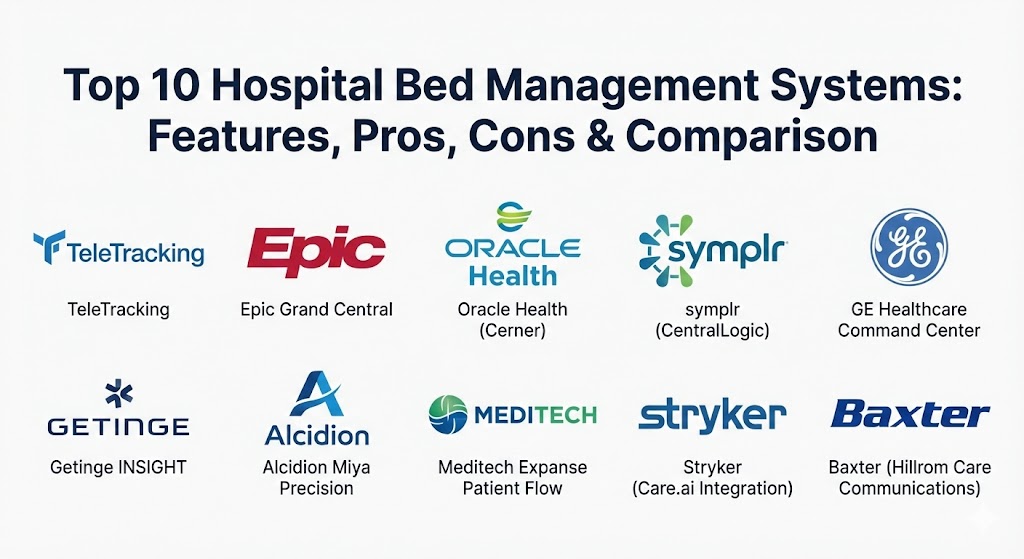
Top 10 Hospital Bed Management Systems
1 — TeleTracking Technologies
TeleTracking is often considered the “gold standard” in the industry, having pioneered the concept of the hospital command center. It is a comprehensive operations platform that focuses exclusively on the logistics of care delivery.
- Key features:
- Capacity Management Suite providing a 30,000-foot view of the entire health system.
- Real-Time Location System (RTLS) integration to track patients and equipment.
- Automated alerts for “bed ready” and “dirty bed” status.
- Custom dashboards for Environmental Services (EVS) and Transport.
- Predictive analytics to forecast daily admissions and discharges.
- Milestone tracking to identify bottlenecks in the patient journey.
- Pros:
- Deeply specialized; the tool is built specifically for logistics rather than as an EHR add-on.
- Proven to significantly reduce ED wait times and boarding hours.
- Cons:
- High cost of implementation and maintenance compared to modular additions.
- Requires a significant cultural shift and dedicated staff to operate a “Command Center.”
- Security & compliance: HIPAA, SOC 2 Type II, and ISO 27001 compliant. Supports SSO and robust audit logs.
- Support & community: Extensive onboarding programs, a dedicated “TeleTracking University,” and a massive global user community.
2 — Epic Grand Central (Bed Planning)
For hospitals already running the Epic EHR, Grand Central is the native module for ADT and bed management. Its primary strength is its total integration with the clinical record.
- Key features:
- Seamless integration with clinical data; bed planners see the patient’s actual medical status.
- Predictive analytics for “Expected Discharge” dates based on clinical milestones.
- Rover mobile app integration for housekeepers and transporters.
- Capacity Command Center views showing real-time census across the system.
- Automated “cleaning” requests triggered by discharge orders.
- Visual floor maps with color-coded bed status.
- Pros:
- No need for a third-party interface; data is always in sync with the medical record.
- User interface is consistent with the rest of the Epic ecosystem, reducing training time.
- Cons:
- Only available to Epic customers; it is not a standalone solution.
- Some users find the configuration “rigid” compared to dedicated logistics tools.
- Security & compliance: Industry-leading security; HIPAA, SOC 2, and FIPS 140-2 compliance.
- Support & community: Supported via the standard Epic maintenance contract; access to the “UserWeb” community.
3 — Oracle Health (Cerner) Capacity Management
Oracle Health (formerly Cerner) offers a robust suite of tools including CareAware and the Command Center Dashboard, designed to provide “operational awareness” across the hospital.
- Key features:
- CareAware MultiMedia for visual digital whiteboards at nurse stations.
- Real-time tracking of staff and patient location through sensors.
- Predictive dashboards that show projected census for the next 24-48 hours.
- Automated bed assignment logic based on patient acuity and unit specialty.
- Integrated EVS and Transport management modules.
- Advanced reporting on “transfer center” efficiency.
- Pros:
- Strong “cross-stack” visibility; links clinical, financial, and operational data.
- The digital whiteboard feature is highly praised for improving unit-level communication.
- Cons:
- Can be complex to configure correctly across multiple disparate departments.
- Like Epic, it is most powerful when used within the Oracle Health EHR ecosystem.
- Security & compliance: HIPAA, GDPR, ISO 27001, and SOC 1/2 compliance.
- Support & community: Global enterprise support with 24/7 availability and extensive documentation.
4 — symplr (CentralLogic)
CentralLogic, now part of the symplr ecosystem, focuses heavily on the “Access Center”—the front door of the hospital. It is designed to manage transfers and referrals while optimizing bed use.
- Key features:
- Advanced “Transfer Center” workflows to bring patients in from other facilities.
- Real-time visibility into bed availability across a whole region or network.
- Automated referral tracking and physician alignment tools.
- “Leakage” tracking to see why patients are being sent to competitors.
- Integrated clinical decision support for patient placement.
- Pros:
- Excellent for large systems that need to coordinate patient movement between hospitals.
- Strong focus on the financial health of the hospital (minimizing “lost” transfers).
- Cons:
- Does not go as deep into EVS/Housekeeping workflows as TeleTracking.
- The user interface can feel slightly more “database-driven” than “map-driven.”
- Security & compliance: HIPAA compliant, SOC 2, and HITRUST certified.
- Support & community: Access to symplr’s massive support infrastructure and professional services.
5 — GE Healthcare Command Center
GE Healthcare provides a “Wall of Analytics” that acts as a mission control for hospital operations. It is often used to sit on top of multiple different EHRs.
- Key features:
- High-level data visualization through “Tiles” (specific apps for different needs).
- AI-driven “nudge” system that alerts staff to potential bottlenecks before they happen.
- EHR-agnostic; can pull data from Epic, Cerner, Meditech, etc.
- Multi-hospital system visibility for large regional providers.
- Detailed tracking of “boarding” in the ED and PACU.
- Pros:
- Best-in-class visualization; the “Wall of Analytics” is genuinely impressive.
- Excellent for heterogeneous health systems running different software at different sites.
- Cons:
- Extremely high price point; usually reserved for top-tier medical centers.
- Requires a dedicated team to respond to the AI “nudges” for the tool to be effective.
- Security & compliance: HIPAA, ISO 27001, and SOC 2 compliant.
- Support & community: High-touch implementation support; GE provides “advisory” services to help change culture.
6 — Getinge INSIGHT
Getinge INSIGHT is a visual flow management solution that replaces traditional whiteboards with interactive, digital touchscreen displays.
- Key features:
- Digital whiteboards that synchronize data across all departments in real-time.
- Simple “drag-and-drop” bed assignments.
- Visual tracking of surgery status and PACU readiness.
- Automated notifications for cleaning and porter requests.
- Performance analytics dashboards for departmental managers.
- Pros:
- Highly tactile and visual; nurses find it much easier to use than a complex EHR screen.
- Great for improving communication at the “unit” level.
- Cons:
- Requires significant hardware investment (large touchscreens in hallways/stations).
- Less focus on “system-wide” predictive analytics than TeleTracking or GE.
- Security & compliance: GDPR and HIPAA compliant. Data is encrypted and access-controlled.
- Support & community: Strong European presence with a growing North American support network.
7 — Alcidion Miya Precision
Alcidion is a newer, “smart” entrant that uses AI to create what they call a “Command Center in your pocket.” It is designed to be mobile-first and highly intuitive.
- Key features:
- Miya Flow for real-time journey tracking from admission to discharge.
- AI-driven “Discharge Roadmaps” that identify what a patient needs before they can leave.
- Mobile alerts for clinicians regarding bed status and clinical results.
- Integrated clinical decision support.
- Light-weight, cloud-native architecture.
- Pros:
- Modern, sleek interface that clinicians actually enjoy using.
- Strong focus on “clinical” barriers to discharge rather than just “bed status.”
- Cons:
- Smaller footprint in the US market compared to the “Big Two” (Epic/Cerner).
- May require more custom integration work for older legacy systems.
- Security & compliance: ISO 27001, Cyber Essentials Plus, and HIPAA compliant.
- Support & community: Highly responsive support team; known for collaborative implementation.
8 — Meditech Expanse Patient Flow
For hospitals using Meditech, the Expanse Patient Flow module provides an integrated approach to managing the movement of patients.
- Key features:
- Integrated “Status Boards” for tracking patient location and acuity.
- Automated EVS and Transport notifications.
- Real-time census tracking by unit, wing, or facility.
- Seamless data flow from the ED and Surgical modules.
- Mobile access for nursing and support staff.
- Pros:
- Cost-effective for current Meditech users; avoids the “integration tax.”
- Very stable and reliable; built on the modern Expanse web-based platform.
- Cons:
- Lacks the advanced AI and predictive “command center” features of GE or TeleTracking.
- User interface is functional but can feel “utilitarian.”
- Security & compliance: HIPAA, SOC 2, and FIPS-compliant data security.
- Support & community: Supported through Meditech’s standard customer service portal and regional user groups.
9 — Stryker (Care.ai Integration)
Stryker has moved beyond physical beds into the software space, recently acquiring Care.ai to create “Smart Hospitals” that use sensors to manage occupancy.
- Key features:
- Virtual Nursing and “Always-on” room monitoring.
- Automated sensing of bed occupancy (no more manual clicking “Patient in Bed”).
- Integration with Vocera communication badges for instant staff alerts.
- Falls prevention and pressure injury monitoring.
- AI-driven environmental awareness (lights, temperature, and bed position).
- Pros:
- Reduces the data entry burden on nurses by using sensors to detect bed status.
- Provides a higher level of patient safety than software-only solutions.
- Cons:
- Requires physical infrastructure (sensors/cameras) in every room.
- More expensive than software-only MFT tools.
- Security & compliance: HIPAA compliant with a heavy focus on “Privacy by Design” for video monitoring.
- Support & community: Massive global support network; enterprise-level service contracts.
10 — Baxter (Hillrom Care Communications)
Baxter (through its Hillrom acquisition) provides the Voalte platform and “Smart Bed” integration, which bridges the gap between the physical bed and the EHR.
- Key features:
- Smart Bed integration: The bed itself sends status updates to the system.
- Voalte Messenger for secure communication between caregivers.
- Automated alerts for bed exits and position changes.
- Real-time dashboards for bed occupancy and housekeeping status.
- Integrated nurse call systems.
- Pros:
- The physical bed becomes part of the IT network, increasing data accuracy.
- Excellent for improving staff response times to bed-side events.
- Cons:
- Hardware-dependent; works best if you also purchase Hillrom beds.
- Can lead to “alert fatigue” if not configured carefully.
- Security & compliance: HIPAA, SOC 2, and ISO 27001 compliant.
- Support & community: Strong clinical implementation teams; global support presence.
Comparison Table
| Tool Name | Best For | Platform(s) Supported | Standout Feature | Rating (Gartner Peer Insights) |
| TeleTracking | System-Wide Logistics | Cloud / Web / Mobile | Integrated Command Center | 4.7 / 5 |
| Epic Grand Central | Epic EHR Users | Web / Mobile | Native Clinical Integration | 4.8 / 5 |
| Oracle Health | Cerner EHR Users | Web / Mobile | Digital Whiteboard Views | 4.5 / 5 |
| symplr (CentralLogic) | Transfers & Access | Web / Cloud | Regional Transfer Tracking | 4.4 / 5 |
| GE Command Center | Heterogeneous Systems | Web / “Tiles” | AI-Driven “Nudge” Logic | 4.6 / 5 |
| Getinge INSIGHT | Unit-Level Visuals | Touchscreen / Web | Tactile Digital Whiteboard | 4.3 / 5 |
| Alcidion Miya | Mobile-First AI | Cloud / Mobile | Discharge Roadmaps | 4.5 / 5 |
| Meditech Expanse | Meditech Users | Web / Mobile | Budget-Friendly Integration | 4.2 / 5 |
| Stryker (Care.ai) | Smart Facilities | Hardware / Sensors | Automated Bed Sensing | 4.4 / 5 |
| Baxter (Hillrom) | Bed-to-Staff Alerts | Hardware / Mobile | Smart-Bed Connectivity | 4.2 / 5 |
Evaluation & Scoring of Hospital Bed Management Systems
When choosing a bed management system, hospitals should use a weighted rubric to ensure they are prioritizing the right metrics for patient safety and flow.
| Category | Weight | Evaluation Criteria |
| Core Features | 25% | Real-time tracking, EVS/Transport modules, and discharge planning. |
| Ease of Use | 15% | Intuitiveness for nurses and housekeepers; mobile accessibility. |
| Integrations | 15% | Depth of connection with existing EHR (Epic, Cerner, etc.) and ADT. |
| Security & Compliance | 10% | HIPAA compliance, data encryption, and audit trails. |
| Performance | 10% | Latency of data updates (near real-time is essential). |
| Support & Community | 10% | Training resources, onboarding speed, and vendor responsiveness. |
| Price / Value | 15% | ROI measured through reduced LOS and increased capacity. |
Which Hospital Bed Management Tool Is Right for You?
The decision-making process for an HBMS is unique because it often involves “buy vs. add-on.”
- Solo Users vs SMB: While single clinics don’t need these, small community hospitals should look at Meditech Expanse or Alcidion for a lightweight, budget-friendly approach.
- Enterprise Health Systems: If you have the budget, TeleTracking or GE Healthcare offer the most comprehensive “Command Center” experience that can manage thousands of beds across a multi-state region.
- The “Native” Choice: If you are a dedicated Epic or Cerner shop, your first look should always be at their native modules (Grand Central or CareAware). The seamless clinical data often outweighs the deeper specialized features of third-party tools.
- Feature Depth vs Ease of Use: If your main problem is “staff communication,” Getinge INSIGHT or Baxter/Hillrom provide the best user-facing tools. If your problem is “predictive modeling,” GE or TeleTracking are superior.
- Hardware vs Software: If you are building a new facility, consider Stryker (Care.ai). Using sensors to automate bed status saves nurses thousands of clicks per year and provides the most accurate data possible.
Frequently Asked Questions (FAQs)
1. What is “ED Boarding,” and how does a bed management system help? ED Boarding is when a patient is admitted but stuck in the Emergency Department because no floor bed is available. An HBMS helps by providing visibility into “dirty” beds and pending discharges, allowing staff to move the patient faster.
2. Can these systems predict how many beds I will need tomorrow? Yes. Advanced systems like GE Healthcare and TeleTracking use machine learning to analyze historical data, weather patterns, and surgical schedules to forecast tomorrow’s census with high accuracy.
3. Do nurses have to manually update the bed status every time? In older systems, yes. In modern “Smart Hospital” setups (like Stryker), sensors in the bed detect when a patient has left, automatically alerting housekeeping without a single manual click.
4. How does a bed management system integrate with the EHR? Most use the HL7 or FHIR standards. When a doctor enters a “Discharge Order” in the EHR, the Bed Management System instantly sees it and alerts the cleaning crew.
5. What is the difference between “Clean” and “Ready” in these systems? “Clean” usually means the room has been scrubbed. “Ready” means it has been inspected and is actually available for a new patient. High-quality systems track both stages to prevent errors.
6. Can these tools manage equipment like ventilators too? Many (especially TeleTracking and Oracle) include asset tracking modules that show you not just where the bed is, but where the nearest IV pump or ventilator is located.
7. Is a “Command Center” necessary for bed management? It is not strictly necessary for a single small hospital, but for systems with 500+ beds, a centralized “mission control” is the best way to coordinate flow across silos.
8. Do these tools help with infection control? Yes. If a patient with a specific infection (like MRSA) is discharged, the system automatically tags the bed for a “Specialized/Deep Clean” protocol for the EVS team.
9. How does “Auto-Assignment” work? Some systems use algorithms to suggest the best bed based on the patient’s condition, proximity to nursing stations, and the “acuity” of other patients in that unit.
10. What is the typical ROI for these systems? Hospitals typically see ROI through a 10-20% reduction in “Length of Stay” and an increase in the number of surgical cases they can take because they aren’t “bed-blocked.”
Conclusion
The evolution of Hospital Bed Management Systems represents a shift from “reactive” to “proactive” healthcare operations. As margins tighten and patient expectations rise, the ability to see your facility’s capacity in real-time is no longer just a convenience—it is a clinical necessity. Whether you choose the native integration of an EHR-based module like Epic Grand Central or the specialized logistics power of TeleTracking, the goal remains the same: ensuring that the “bed” is ready the moment the patient needs it.