Introduction
A Hedge Fund Order Management System (OMS) is a specialized software platform designed to manage the entire lifecycle of a trade. It sits between the Portfolio Manager’s (PM) investment idea and the final execution at the broker or exchange. Unlike generic trading platforms, a hedge fund-specific OMS is “position-aware,” meaning it integrates real-time P&L and existing holdings into the order generation process. This allows PMs to see the impact of a potential trade on their overall risk and exposure before hitting “send.”
The importance of an OMS in 2026 cannot be overstated. With regulatory bodies like the SEC and ESMA demanding faster reporting and more transparency, a manual or fragmented workflow is a significant liability. Real-world use cases range from automated “Algo-Wheels” that select the best broker for a specific trade to real-time pre-trade compliance checks that prevent “fat-finger” errors or regulatory breaches. When evaluating an OMS, funds should prioritize multi-asset coverage, API-first extensibility, cloud-native stability, and seamless integration with Execution Management Systems (EMS)—a combination often referred to as an OEMS.
Best for: Hedge fund traders, portfolio managers, and compliance officers. It is essential for funds ranging from emerging managers (who need a “bank-in-a-box” solution) to multi-billion dollar institutional platforms requiring complex, multi-strategy oversight.
Not ideal for: Long-only retail advisors with simple buy-and-hold strategies or solo day traders who do not need institutional-grade compliance and reporting.
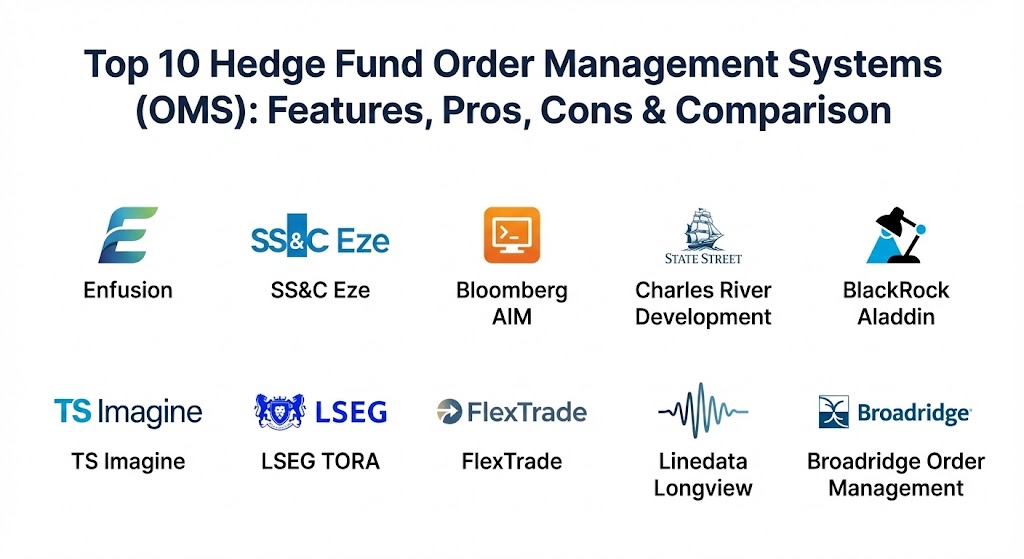
Top 10 Hedge Fund Order Management Systems (OMS)
1 — Enfusion
Enfusion has become the benchmark for modern, cloud-native investment management. Its unified platform combines OMS, Portfolio Management (PMS), and Accounting (ABOR) into a single “golden source” of data, eliminating the need for reconciliation between front and back offices.
- Key features:
- Unified cloud-native architecture for real-time data consistency.
- Integrated Portfolio Management (PMS) and General Ledger.
- Automated multi-asset reconciliation with brokers and custodians.
- Mobile and web-based applications for PMs on the move.
- Robust pre-trade, intra-day, and post-trade compliance engine.
- Drag-and-drop workflow for order staging and execution.
- Pros:
- Extremely fast implementation compared to legacy on-premise systems.
- The single data set eliminates the “reconciliation nightmare” between systems.
- Cons:
- Highly standardized; funds with extremely unique, “bespoke” workflows may find it restrictive.
- Managed services are excellent but can lead to a “black box” feeling for some controllers.
- Security & compliance: SOC 2 Type II, GDPR, and ISO 27001 compliant. Includes SSO and multi-factor authentication.
- Support & community: 24/6 global support with offices in 9 global financial hubs. High client satisfaction (94%+).
2 — SS&C Eze (Eze OMS)
Eze OMS is part of the SS&C Eze Investment Suite and is one of the most widely used platforms in the hedge fund industry. It is known for its deep functionality and its ability to handle complex, multi-strategy institutional workflows.
- Key features:
- Flexible, real-time trade blotters with advanced filtering.
- Integrated “What-If” modeling and multi-asset rebalancing.
- Centralized access to over 500 execution venues.
- Automated reporting for regulatory mandates (SEC, MiFID II).
- Commission management and tracking for soft dollar accounts.
- Real-time intraday P&L with strategy-level attribution.
- Pros:
- Unmatched depth of features; there is a rule or template for almost every scenario.
- Deep integration with the broader SS&C ecosystem, including fund administration.
- Cons:
- The interface can feel “legacy” and “heavy” compared to newer SaaS rivals.
- Customizations often require significant time and engagement with their professional services team.
- Security & compliance: SOC 1/2, GDPR, and HIPAA compliant. Robust audit logs and role-based access control.
- Support & community: Award-winning 24/7 global support and an extensive online portal for documentation and training.
3 — Bloomberg AIM
Bloomberg AIM (Asset & Investment Manager) is the preferred choice for funds that are already deeply embedded in the Bloomberg Terminal ecosystem. It provides a seamless bridge between Bloomberg’s world-class data and the trading workflow.
- Key features:
- Native integration with Bloomberg Terminal data, news, and analytics.
- Global multi-asset coverage with a single view of the firm.
- Integrated compliance engine with a massive library of pre-built rules.
- Seamless connectivity to the Bloomberg EMSX execution platform.
- Advanced risk analytics and scenario stress-testing.
- Global IBOR (Investment Book of Record) for real-time positions.
- Pros:
- If you use a terminal, the data integration is perfect—no need for external feeds.
- Strong global footprint with support for virtually every exchange and asset class.
- Cons:
- High cost of ownership; you essentially pay for the Bloomberg ecosystem.
- Can be less flexible for non-terminal workflows or proprietary data integrations.
- Security & compliance: ISO 27001, SOC 2, and GDPR compliant. Includes high-end encryption for all data in transit.
- Support & community: 24/7 support via the “HELP” key on the terminal; one of the largest financial communities in the world.
4 — Charles River Development (State Street)
Charles River (CRD) is a powerhouse in the institutional space, often favored by large hedge funds and asset managers that require extreme scalability and multi-asset depth.
- Key features:
- Unified OEMS platform that eliminates the “EMS vs. OMS” friction.
- Pre-defined regulatory rule libraries (LawCard®) for 100+ jurisdictions.
- Advanced “As-of” compliance for historical data analysis and reporting.
- Integrated Global Shareholder Disclosure service.
- Automated FIX connectivity management for hundreds of brokers.
- Support for private markets and complex derivatives.
- Pros:
- Best-in-class for global compliance and multi-jurisdictional rules.
- Scales to the largest and most complex portfolios without performance degradation.
- Cons:
- Implementation is a major multi-month (or year) project.
- Generally considered “overkill” for smaller or emerging hedge funds.
- Security & compliance: FIPS 140-2, SOC 1/2, GDPR, and ISO 27001. State Street’s institutional security standards.
- Support & community: Global enterprise support; formal “Compliance Health Check” services available.
5 — BlackRock Aladdin
Aladdin is the “gold standard” for risk-led investment management. It is more than an OMS; it is a whole-firm platform used by the world’s largest institutional investors to manage risk and performance.
- Key features:
- Real-time multi-dimensional risk modeling (VaR, stress testing).
- Unified ecosystem connecting traders, PMs, and risk managers.
- API-first approach (Aladdin Studio) for developer-led innovation.
- Integrated private markets data (eFront and Preqin).
- Automated SEC, Basel III, and ESG regulatory reporting.
- Global IBOR with real-time position and cash synchronization.
- Pros:
- Unrivaled risk analytics; the “risk-first” approach is built into every trade.
- Massive network effects—native integration with top custodians and brokers.
- Cons:
- Extremely high barrier to entry (cost and technical requirements).
- The platform is a “walled garden”; you are fully committed to the Aladdin way.
- Security & compliance: SOC 1/2, ISO 27001, and GDPR compliant. Employs distributed computing security.
- Support & community: High-touch client business teams; Aladdin Studio community for technical users.
6 — TS Imagine
TS Imagine (a Temenos company) provides TradeSmart, a cloud-native OEMS designed for high-performance multi-asset trading. It is particularly strong for funds that need integrated execution and risk in a single GUI.
- Key features:
- Single login for multi-asset trading, risk, and compliance.
- Proprietary FIX network connecting to 250+ brokers and venues.
- Advanced real-time market data and TCA (Transaction Cost Analysis).
- “Algo-Wheel” for automated broker selection and execution.
- Flexible risk dashboards that include Greeks and scenario analysis.
- Cloud-native architecture for rapid deployment.
- Pros:
- One of the few platforms that truly unifies EMS and OMS into a single interface.
- Strong performance for high-turnover and latency-sensitive strategies.
- Cons:
- Reporting and back-office accounting features are less developed than Enfusion.
- Integration with non-Imagine back-office systems can be technical.
- Security & compliance: SOC 2 Type II, ISO 27001, and GDPR compliant.
- Support & community: Global 24/5 support; proactive technical account management.
7 — LSEG TORA
TORA (now part of the London Stock Exchange Group) is a leading provider of cloud-based OEMS, specifically known for its strength in Asian markets and global equity/derivative strategies.
- Key features:
- Integrated analytics and data visualization (Refinitiv Workspace integration).
- Advanced rule and limit features for compliance without latency.
- Automated rebalancing and P&L monitoring across desktop and mobile.
- Seamless FIX communication with global broker-dealer networks.
- Real-time axe and inventory data for fixed income trading.
- AI-driven TCA to optimize execution quality.
- Pros:
- Best-in-class for Asia-Pacific market access and global derivatives.
- The UI is highly intuitive and customizable for individual trader workflows.
- Cons:
- The post-trade and accounting modules are thinner than full-service GRC platforms.
- Integration with State Street or Bloomberg-heavy workflows can be complex.
- Security & compliance: SOC 2, GDPR, and SEC/FINRA regulatory compliance ready.
- Support & community: Exceptional customer service with local presence in Tokyo, Hong Kong, and London.
8 — FlexTrade (ColorPalette / FlexOMS)
FlexTrade is the specialist’s choice. It is highly customizable and favored by quant-heavy or high-turnover funds that want to build their own proprietary edges on top of a robust system.
- Key features:
- API-first philosophy for deep customization in multiple languages.
- Advanced program trading and “Algo-Wheel” automation.
- Real-time intraday risk analysis and firm-wide P&L tracking.
- Delta One and complex options/futures trading tools.
- Global compliance from RegNMS to MiFID II.
- Integrated TCA and broker performance benchmarking.
- Pros:
- Unparalleled flexibility; if you can code it, FlexTrade can do it.
- Extremely stable and fast for high-concurrency environments.
- Cons:
- Requires a higher level of internal technical expertise to manage.
- Not a “bank-in-a-box”; requires integration with separate PMS/Accounting.
- Security & compliance: SOC 2, ISO 27001, and region-specific exchange reporting.
- Support & community: “Engineer-led” support—you often talk directly to the people who build the product.
9 — Linedata Longview
Linedata Longview is a modular OMS suite designed for institutional managers who need a highly configurable, widget-based framework to manage their front office.
- Key features:
- Linedata Workstation: a widget-based framework for custom dashboards.
- Extensible portfolio modeling and “What-If” analysis.
- Linedata Lynx: managed connectivity to 600+ global brokers.
- Integrated electronic trading for fixed income and derivatives.
- Automated commission management and tracking.
- “As-of” compliance for historical rule testing.
- Pros:
- The modular approach allows you to “pay for what you use.”
- The UI is very visual and exception-based, highlighting what needs attention.
- Cons:
- The modularity can lead to a fragmented experience if not architected correctly.
- The pace of AI and cloud updates has historically been slower than Enfusion or Mambu.
- Security & compliance: ISO 27001, SOC 2, and GDPR compliant.
- Support & community: 20+ years of experience; reliable support with a deep understanding of buy-side workflows.
10 — Broadridge Order Management
Broadridge provides a multi-asset OMS fueled by sophisticated automation. It is a favorite for mid-to-large funds that want a global footprint with “sell-side grade” connectivity.
- Key features:
- FDC3-compliant interoperability for seamless third-party app integration.
- Native connectivity to the NYFIX network (one of the world’s largest).
- Automated high- and low-touch trading processes.
- Advanced risk scoring and surveillance evaluations.
- SaaS-based architecture for efficient delivery of upgrades.
- Integrated front-, middle-, and back-office sales views.
- Pros:
- Connectivity is the standout; they have an established global infrastructure.
- Interoperability with other Broadridge tools creates a very efficient workflow.
- Cons:
- The system can feel “broker-centric,” as it is also used heavily by the sell side.
- Not as specialized in deep quantitative alpha-generation as FlexTrade.
- Security & compliance: SOC 2 Type II, ISO 27001, GDPR, and multi-language compliance support.
- Support & community: 24/6 multi-language support; deep local expertise in Americas, EMEA, and APAC.
Comparison Table
| Tool Name | Best For | Platform(s) Supported | Standout Feature | Rating (Expert Consensus) |
| Enfusion | Emerging & Mid-Market | Cloud (SaaS) | Unified PMS/OMS/Accounting | 4.8 / 5 |
| SS&C Eze | Multi-Strategy Institutional | Cloud / On-Prem | Deep Functional Rules Library | 4.6 / 5 |
| Bloomberg AIM | Bloomberg Terminal Users | Cloud / Terminal | Native Bloomberg Data Sync | 4.5 / 5 |
| Charles River | Institutional Global Scale | Cloud (State Street) | LawCard® Compliance Rules | 4.4 / 5 |
| BlackRock Aladdin | Risk-Led Tier 1 Funds | Cloud (Azure) | Institutional Risk Engine | 4.7 / 5 |
| TS Imagine | High-Turnover OEMS | Cloud-Native | Integrated Execution & Risk | 4.4 / 5 |
| LSEG TORA | Asia-Pacific & Derivatives | Cloud-Native | Refinitiv Workspace Integration | 4.5 / 5 |
| FlexTrade | Quants & Customizers | Cloud / On-Prem | API-First Flexibility | 4.6 / 5 |
| Linedata Longview | Modular Customization | Cloud / SaaS | Widget-Based Workstation | 4.2 / 5 |
| Broadridge | Global Connectivity | Cloud / SaaS | NYFIX Network Access | 4.3 / 5 |
Evaluation & Scoring of Hedge Fund OMS
To help you compare these systems objectively, we have scored them based on the 2026 industry standards for hedge fund technology.
| Category | Weight | Evaluation Criteria |
| Core Features | 25% | Multi-asset coverage, position awareness, and real-time P&L accuracy. |
| Ease of Use | 15% | Intuitiveness of UI, mobile accessibility, and dashboard customization. |
| Integrations | 15% | Strength of API, FIX connectivity, and third-party ecosystem compatibility. |
| Security | 10% | SOC 2, ISO 27001, and 2026-grade data privacy/encryption standards. |
| Reliability | 10% | System uptime, low-latency performance, and cloud stability. |
| Support | 10% | Quality of documentation, speed of onboarding, and global presence. |
| Price / Value | 15% | TCO relative to efficiency gains and risk mitigation. |
Which Hedge Fund OMS Tool Is Right for You?
Choosing an OMS is a long-term strategic decision. Use this guide to match your fund’s profile with the right technology.
- Emerging Managers (SMBs): If you are launching a new fund, you need a “bank-in-a-box.” Enfusion is the top choice here because it handles front, middle, and back office in one system, saving you from hiring a massive ops team.
- Mid-Market Institutional Funds: For funds with $500M to $5B AUM, SS&C Eze or TS Imagine provide the depth of functionality needed for institutional due diligence without the total lock-in of an Aladdin.
- Large Global Platforms (Tier 1): If you manage $10B+ and have hundreds of PMs, you need BlackRock Aladdin or Charles River. These systems are built for the regulatory and risk burdens of systemically important financial institutions.
- Quant & High-Frequency Strategies: If your edge is in the code, look at FlexTrade. Its API-first approach and high-performance execution engine are designed for quants who want to automate everything.
- Bloomberg-Centric Funds: If your PMs live and breathe on the terminal, Bloomberg AIM is the most logical choice. The time saved in data reconciliation alone pays for the platform.
Frequently Asked Questions (FAQs)
1. What is the difference between an OMS and an EMS?
An OMS focuses on compliance, position tracking, and post-trade allocation. An EMS (Execution Management System) focuses on real-time market data, speed of execution, and specialized algorithms. An OEMS combines both.
2. Is a cloud-native OMS better than an on-premise one?
In 2026, cloud-native is generally superior due to faster updates, easier remote access, and lower hardware costs. However, some HFT funds still prefer localized deployments for absolute minimum latency.
3. How long does it take to implement a new OMS?
A SaaS system like Enfusion can be live in 6-12 weeks. A major institutional deployment like Charles River or Aladdin can take 6-18 months.
4. Can an OMS handle cryptocurrency and digital assets?
Most modern OMSs (Thought Machine, Enfusion, Aladdin) now have native modules or API integrations for digital assets, treating them as another asset class in the portfolio.
5. What is “Pre-Trade Compliance”?
It is a feature that automatically checks a trade against fund rules (e.g., “no more than 5% in one stock”) and regulatory laws before the trade is sent to the broker.
6. Do I need a separate Portfolio Management System (PMS)?
Unified platforms like Enfusion include a PMS. However, many funds prefer a “best-of-breed” approach, using a specialized OMS like FlexTrade integrated with a separate risk or accounting system.
7. What are the typical costs of a hedge fund OMS?
Pricing is complex and usually involves a base platform fee plus a per-user or AUM-based fee. Small funds might pay $50k-$100k annually, while Tier 1 funds pay millions.
8. How do these systems handle “reconciliation”?
Automated reconciliation compares the fund’s internal records of trades and positions with the data provided by prime brokers and custodians, highlighting “breaks” that need to be fixed.
9. What is an “IBOR”?
IBOR stands for Investment Book of Record. It is a real-time view of all positions and cash, incorporating all traded activity, as opposed to an ABOR (Accounting Book of Record), which is usually T+1.
10. Why is API accessibility so important?
APIs allow you to pull your trading data into custom Excel sheets, AI models, or proprietary risk tools. Without a good API, your data is “trapped” in the OMS vendor’s ecosystem.
Conclusion
The best Hedge Fund OMS for 2026 is the one that removes friction from your investment process without adding technical debt. For emerging managers, that often means the unified simplicity of Enfusion. For quant-driven explorers, it means the open flexibility of FlexTrade. And for institutional giants, it remains the “fortress” security of Aladdin or Charles River.
Ultimately, an OMS is more than just software; it is the foundation of your firm’s operational credibility. When choosing, look past the features and evaluate the vendor’s commitment to innovation. In a world of “Embodied AI” and rapid market shifts, the ability of your technology to evolve is just as important as its ability to trade.