Introduction
Food Supply Chain Traceability Tools are specialized software platforms that capture, store, and share data regarding the movement of food products and ingredients throughout the supply chain. These tools create a digital “thread” that links every stakeholder—from the primary producer and processor to the distributor and retailer. By using technologies like Blockchain, IoT, and AI-driven serialization, these solutions ensure that data remains immutable and accessible.
The importance of these tools is multi-faceted. Primarily, they are life-saving: in the event of a contamination outbreak, a robust traceability system can reduce recall times from weeks to mere minutes, preventing widespread illness. Beyond safety, they combat “food fraud” (the mislabeling of products), ensure ethical sourcing (e.g., slave-free or organic certification), and significantly reduce food waste by monitoring shelf life through real-time sensors. When choosing a tool, evaluators must prioritize interoperability (the ability to “talk” to other systems via GS1 standards), ease of supplier onboarding, and the depth of their recall management workflows.
Best for: Food manufacturers, large-scale grocery retailers, multi-national restaurant chains, and agricultural cooperatives that must comply with global safety standards. It is essential for Quality Assurance (QA) managers, compliance officers, and supply chain directors.
Not ideal for: Local “mom-and-pop” restaurants or small community gardens where all sourcing is hyper-local and manual record-keeping still suffices. It may also be overkill for commodity traders who deal exclusively in bulk “anonymous” grains where individual lot-level identity isn’t yet a market requirement.
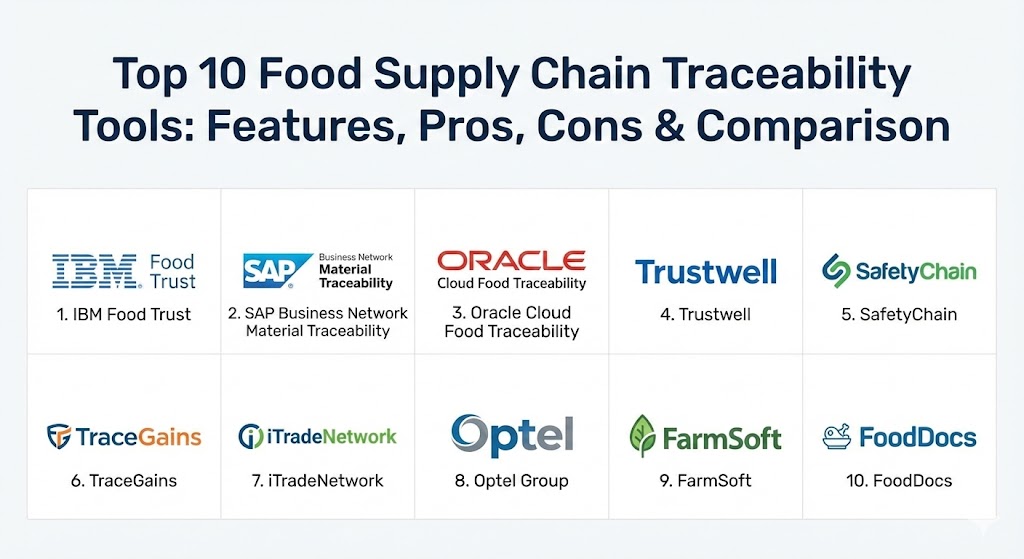
Top 10 Food Supply Chain Traceability Tools
1 — IBM Food Trust
IBM Food Trust is arguably the most recognized enterprise-grade food traceability platform. Built on the IBM Blockchain (Hyperledger Fabric), it provides a shared, immutable record of food provenance that connects all members of the food ecosystem.
- Key features:
- Blockchain-based immutable audit trails for every transaction.
- Integrated “Freshness” module to track shelf life and reduce waste.
- Rapid traceback capability that can locate a batch in under 3 seconds.
- Certificates module for managing organic, fair-trade, and safety docs.
- Data standardization using GS1 EPCIS (Electronic Product Code Information Services).
- Secure, permissioned data sharing between competitors and partners.
- Consumer-facing transparency via QR codes on packaging.
- Pros:
- Used by some of the world’s largest retailers (e.g., Walmart, Carrefour), providing a massive pre-existing network.
- Unmatched data security and trust due to its decentralized blockchain architecture.
- Cons:
- Can be prohibitively expensive for smaller suppliers to join.
- Requires a significant degree of cooperation from every partner in the chain to be 100% effective.
- Security & compliance: SOC 2 Type II, ISO 27001, GDPR, and HIPAA compliant. Uses AES-256 encryption for data at rest.
- Support & community: Professional onboarding services, 24/7 enterprise support, and a well-documented developer portal.
2 — SAP Business Network Material Traceability
SAP’s solution is the “go-to” for organizations already running on SAP S/4HANA. It extends the power of the ERP into the network, allowing for multi-tier batch and serial number tracking across company boundaries.
- Key features:
- Native integration with SAP S/4HANA and SAP Logistics Business Network.
- Bidirectional tracing (upstream to ingredients, downstream to customers).
- Graphical visualization of the entire multi-tier supply chain genealogy.
- Automated alerts for quality issues or safety recalls.
- Support for “Digital Product Passports” for sustainability reporting.
- Mobile data capture for warehouse and field personnel.
- Pros:
- If you are an SAP shop, the “plug-and-play” integration is a massive time-saver.
- Excellent for managing incredibly complex, multi-ingredient recipes with hundreds of suppliers.
- Cons:
- The interface can be dense and “corporate,” requiring substantial user training.
- High total cost of ownership (TCO) if you aren’t already an SAP customer.
- Security & compliance: ISO 27001, SOC 1/2, GDPR, and FedRAMP compliant.
- Support & community: Global network of certified implementation partners and the extensive SAP Community.
3 — Oracle Cloud Food Traceability
Oracle leverages its strength in IoT and AI to provide a traceability solution that doesn’t just record what happened, but predicts what might go wrong. It is a part of the broader Oracle Cloud SCM suite.
- Key features:
- IoT Intelligent Applications for real-time temperature and location monitoring.
- AI-powered predictive analytics to identify “at-risk” shipments.
- Blockchain-based “Smart Contracts” for automated compliance verification.
- Seamless integration with Oracle Warehouse Management (WMS).
- Global Trade Management (GTM) for managing cross-border food regulations.
- Intelligent cold-chain management for perishables.
- Pros:
- Superior data processing power for organizations handling billions of sensor data points.
- Excellent for “high-tech” food segments like lab-grown meat or specialized nutrition.
- Cons:
- Can be overwhelming for smaller, non-technical teams.
- Pricing is geared toward large-scale enterprise deployments.
- Security & compliance: OCI (Oracle Cloud Infrastructure) security standards, HIPAA, GDPR, and FIPS 140-2.
- Support & community: 24/7 global support and a dedicated “Oracle for Food and Beverage” industry group.
4 — Trustwell (formerly FoodLogiQ + Genesis)
Trustwell is the result of a powerhouse merger between FoodLogiQ (traceability/safety) and Genesis (nutrition/labeling). It is a cloud-based platform specifically designed for food safety and quality (FSQ) professionals.
- Key features:
- Automated recall management with one-click notifications.
- Supplier compliance dashboard for tracking certifications (SQF, BRC).
- Integrated nutrition labeling and ingredient analysis (via Genesis).
- Lot-level traceability compliant with FSMA 204.
- Quality incident management for tracking and resolving deviations.
- Consumer transparency portals with nutritional and sourcing data.
- Pros:
- Highly user-friendly and built specifically with the food safety expert’s brain in mind.
- The merger has created the most complete tool for “Product Lifecycle” management in food.
- Cons:
- As a specialized tool, it may require “middle-ware” to connect deeply with legacy ERPs.
- Rapid feature expansion during the merger has occasionally led to UI navigation shifts.
- Security & compliance: SOC 2 Type II compliant, SSO support, and encrypted data storage.
- Support & community: Strong educational focus with frequent webinars and a helpful user community.
5 — SafetyChain
SafetyChain is the leading “Plant Management Platform” that integrates traceability directly with production floor operations. It is designed for manufacturers who want to unify quality, safety, and production data.
- Key features:
- Real-time SPC (Statistical Process Control) to catch quality issues on the line.
- Mobile-first digital forms for floor-level data capture.
- Automated batch genealogy from raw materials to finished goods.
- Integrated CAPA (Corrective and Preventive Action) workflows.
- Supplier quality management and scorecards.
- “Audit-Ready” dashboards for instant regulatory reporting.
- Pros:
- Unlike many “office” tools, this is built for the factory floor where the food is actually made.
- Exceptionally fast at generating the documentation needed for GFSI (Global Food Safety Initiative) audits.
- Cons:
- Less focused on the “distributor-to-retailer” part of the chain than IBM or SAP.
- Implementation requires a high degree of cultural change on the factory floor.
- Security & compliance: SOC 2 compliant, role-based access, and detailed audit trails.
- Support & community: High customer satisfaction scores with proactive customer success managers.
6 — TraceGains
TraceGains focuses heavily on the “Supplier” side of the equation. It acts as a massive B2B network where food brands and ingredient suppliers can exchange data seamlessly to ensure transparency.
- Key features:
- TraceGains Gather™—a global marketplace for sourcing traceable ingredients.
- Automated document extraction (AI reads PDFs and extracts safety data).
- Supplier risk scoring based on historical performance and certifications.
- Ingredient-level traceability back to the farm or ocean.
- Integrated specification management for R&D and QA teams.
- Global regulatory alerts for pesticides and contaminants.
- Pros:
- Drastically reduces the “paperwork” of managing thousands of supplier documents.
- The “Gather” network allows brands to find pre-vetted, compliant suppliers quickly.
- Cons:
- The “Deep” traceability features (moving lots through a chain) are less robust than IBM.
- Relies on suppliers to keep their data up-to-date on the platform.
- Security & compliance: SOC 2 Type II, ISO 27001, and secure API integrations.
- Support & community: Extensive library of tutorial videos and a strong presence in the CPG industry.
7 — iTradeNetwork
iTradeNetwork is the dominant player in the fresh produce and grocery sector. It deeply understands the unique challenges of short-shelf-life items and the “perishables” supply chain.
- Key features:
- Perishable-specific traceability (case-level and lot-level).
- Integrated procurement and order management for fresh goods.
- Food waste reduction tools through real-time freshness tracking.
- Logistics and transportation visibility for cold-chain integrity.
- Supplier compliance monitoring for GAP (Good Agricultural Practices).
- Advanced analytics for demand and supply matching in produce.
- Pros:
- Deeply specialized in the “Fresh” world—knows exactly how to handle field-packed items.
- Connects you to a huge marketplace of existing grocery retailers and farmers.
- Cons:
- Less applicable to highly processed “shelf-stable” foods with many ingredients.
- The UI can feel a bit specialized and “legacy” compared to newer SaaS competitors.
- Security & compliance: Supports secure data encryption and role-based access.
- Support & community: Deep industry expertise with account managers who know the produce business.
8 — Optel Group
Optel is unique because it provides both the hardware (vision systems, sensors) and the software needed for serialization. It is a leader in high-volume track-and-trace environments.
- Key features:
- Hardware-software integration for real-time line serialization.
- End-to-end traceability platform (OptChain).
- High-speed vision systems for verifying labels and barcodes.
- Sustainability and ESG reporting (carbon footprint per batch).
- Verification of “Certified Sustainable” claims (e.g., non-deforestation).
- Global compliance for pharmaceutical-grade food items.
- Pros:
- Ideal for manufacturers who need to literally “stamp” and track every single item at speed.
- Strong focus on the environmental and “green” side of traceability.
- Cons:
- High initial capital expenditure if hardware installation is required.
- More complex to implement than a software-only cloud solution.
- Security & compliance: ISO 27001, GDPR, and pharmaceutical-grade security standards.
- Support & community: Global technical support for both hardware and software.
9 — FarmSoft
FarmSoft is designed for the “beginning” of the chain. It is a specialized tool for packhouses, orchards, and farms that need to ensure their primary produce is fully traceable before it hits the processor.
- Key features:
- Packhouse management with integrated lot-level traceability.
- Farm-level activity tracking (pesticide application, harvest dates).
- Automatic generation of compliant labels (GS1-128).
- Inventory management for fresh produce and farming supplies.
- Integration with weigh-scales and automated packing lines.
- Mobile app for in-field data entry by farm workers.
- Pros:
- One of the few tools that “speaks farm language” and manages the packhouse workflow.
- Very affordable for medium-to-large farms compared to enterprise ERPs.
- Cons:
- Lacks the “downstream” visibility into retail or consumer behavior.
- Not designed for complex multi-ingredient food manufacturers.
- Security & compliance: Secure cloud hosting and role-based access controls.
- Support & community: Personalized support and a history of success in the agriculture sector.
10 — FoodDocs
FoodDocs is an AI-powered Food Safety Management System (FSMS) that simplifies traceability for SMBs and smaller food producers who are overwhelmed by paperwork.
- Key features:
- AI-driven setup of HACCP plans and traceability logs.
- Mobile app for daily safety checks and lot-number recording.
- Automated alerts for expiring batches and shelf-life monitoring.
- Simple “trace-forward” and “trace-backward” reports for audits.
- Centralized storage for supplier certifications and audit results.
- Multi-location dashboard for managing several restaurants or bakeries.
- Pros:
- The most accessible tool for small businesses—can be set up in minutes.
- Drastically reduces the “mental load” of staying compliant for small teams.
- Cons:
- Lacks the advanced blockchain or IoT capabilities of the enterprise giants.
- Not suitable for managing complex global shipping lanes or 3PL logistics.
- Security & compliance: SOC 2 compliant and data is encrypted at rest.
- Support & community: Very hands-on onboarding and direct access to food industry experts.
Comparison Table
| Tool Name | Best For | Platform(s) Supported | Standout Feature | Rating (Gartner/TrueReview) |
| IBM Food Trust | Large Enterprises | SaaS / Blockchain | Ecosystem-wide Trust | 4.6 / 5 |
| SAP Traceability | Existing SAP Shops | Cloud / ERP Native | S/4HANA Connectivity | 4.7 / 5 |
| Oracle Food Trace | High-Tech Ops | Cloud (OCI) | Predictive IoT Analytics | 4.5 / 5 |
| Trustwell | Safety & Labeling | SaaS | FSQ-Specific UI | 4.6 / 5 |
| SafetyChain | Manufacturers | Cloud / Mobile | Plant-Floor Quality Integration | 4.8 / 5 |
| TraceGains | Ingredient Sourcing | SaaS / Network | Automated Spec Capture | 4.5 / 5 |
| iTradeNetwork | Fresh Produce | Cloud-Native | Perishables Specialist | 4.4 / 5 |
| Optel Group | High-Speed Lines | Software + Hardware | Item-Level Serialization | 4.6 / 5 |
| FarmSoft | Packhouses / Farms | Cloud / Mobile | Farm-to-Process Focus | 4.3 / 5 |
| FoodDocs | SMBs / Restaurants | SaaS / AI App | 15-Minute Setup | 4.9 / 5 |
Evaluation & Scoring of Food Supply Chain Traceability Tools
Evaluating a traceability tool requires looking beyond the “cool factor” of blockchain. We use a weighted scoring system to help you determine which tool fits your operational reality.
| Category | Weight | Evaluation Criteria |
| Core Features | 25% | FSMA 204 compliance, recall speed, lot/batch genealogy, and labeling. |
| Ease of Use | 15% | UI design, mobile accessibility for floor workers, and onboarding speed. |
| Integrations | 15% | Ability to connect with ERPs, WMS, and GS1 standardized networks. |
| Security & Compliance | 10% | Encryption, ISO certifications, and support for global trade laws. |
| Performance | 10% | Scalability for millions of transactions and real-time data ingestion. |
| Support & Community | 10% | Documentation, 24/7 support, and industry-specific expertise. |
| Price / Value | 15% | ROI from reduced waste, lower insurance premiums, and audit efficiency. |
Which Food Supply Chain Traceability Tool Is Right for You?
The “perfect” tool depends on where you sit in the chain and your technical resources.
- Solo Users (Artisanal Producers): You likely don’t need a suite. Focus on high-quality labeling software or the entry-level tier of FoodDocs.
- Small to Medium Businesses (SMBs): If you are a processor or baker, FoodDocs is the easiest to adopt. If you are a growing manufacturer, Trustwell or SafetyChain provide the growth path you need.
- Large Manufacturers: SafetyChain is unparalleled for on-the-floor operations. If your main concern is managing 2,000 global ingredient suppliers, TraceGains is the essential choice.
- Global Enterprise Retailers: You need a network, not just a tool. IBM Food Trust or SAP Business Network are the only solutions that can handle the massive scale of a “Walmart-style” ecosystem.
- Sustainability-First Brands: If your brand identity is built on carbon-neutral or slave-free claims, Optel Group or TraceX (a blockchain specialist) offer the deepest transparency metrics.
Frequently Asked Questions (FAQs)
1. What is FSMA 204 and why does it matter? FSMA 204 is a major FDA regulation requiring enhanced record-keeping for certain “high-risk” foods. It mandates that companies can provide traceability data to the FDA within 24 hours of a request.
2. Is Blockchain mandatory for food traceability? No. While blockchain (like IBM Food Trust) offers a high level of immutable trust, traditional cloud-based databases (like Trustwell) are perfectly sufficient and compliant for most businesses.
3. How do these tools help reduce food waste? By providing real-time data on shelf life and cold-chain temperature, managers can implement “First-Expired, First-Out” (FEFO) logistics, ensuring food doesn’t rot in the warehouse.
4. Can I use these tools for organic or fair-trade certification? Yes. Tools like TraceGains and IBM Food Trust have dedicated “Certificates” modules where you can upload and verify these claims with digital proof.
5. What is “Interoperability”? This is the ability of different software systems to talk to each other. In food, this usually means following GS1 Standards, allowing a farmer’s software to send data seamlessly to a retailer’s software.
6. Do these tools require every employee to have a smartphone? Most modern tools (SafetyChain, FoodDocs) rely on mobile apps for data entry on the floor or in the field, making a “tablet-friendly” or “smartphone-friendly” environment essential.
7. Can traceability tools help with “Food Fraud”? Yes. By creating an immutable record of every transaction, it becomes much harder for bad actors to swap out high-quality olive oil with a cheaper substitute without being caught in the digital audit.
8. What is the difference between “Traceback” and “Traceforward”? Traceback is looking back from the consumer to find the farm. Traceforward is looking forward from a contaminated farm to find all the consumers who bought that product.
9. Are these tools expensive to maintain? Software-only SaaS tools have a predictable monthly fee. The real “cost” is often the time spent on data entry, which is why AI-driven tools (like TraceGains) are gaining popularity.
10. Can I integrate traceability with my current ERP? Yes, most enterprise tools have APIs. However, “native” integrations (like SAP’s) are always smoother and more reliable than custom-built connections.
Conclusion
Traceability is no longer just a “safety net”; it is a competitive advantage. In a world where consumers scan QR codes to see if their salmon was sustainably caught, and regulators demand data in under 24 hours, “guessing” is not an option. Whether you are a small bakery using FoodDocs or a global giant using IBM Food Trust, the goal is clear: building a supply chain where trust is as tangible as the food itself.