Introduction
Fleet Management Tools are specialized software-as-a-service (SaaS) platforms combined with telematics hardware designed to monitor, coordinate, and optimize an organization’s vehicle operations. These platforms serve as a centralized “mission control,” aggregating data from GPS trackers, engine sensors, and AI-powered dashcams. By processing millions of data points per second, these tools provide actionable insights that help businesses reduce operational costs, extend the lifespan of their assets, and ensure the safety of their drivers.
The importance of these tools cannot be overstated in today’s high-inflation, high-regulation environment. Key real-world use cases include real-time route optimization to combat rising fuel costs, automated ELD (Electronic Logging Device) compliance for trucking fleets, and predictive diagnostics that prevent costly roadside breakdowns before they happen. When evaluating tools in this category, users should look for hardware-software synergy, ease of integration with existing ERP/CRM systems, the quality of AI-driven safety alerts, and the scalability of the data architecture.
Best for: Commercial trucking companies, construction firms, field service businesses (plumbing, HVAC, electrical), last-mile delivery providers, and government agencies managing public works vehicles. It is ideal for any organization with five or more vehicles that needs to improve efficiency and maintain regulatory compliance.
Not ideal for: Individual car owners or micro-businesses with 1–2 vehicles that do not travel outside a local area. For these users, basic smartphone-based navigation and simple fuel-tracking apps are often a more cost-effective alternative to a full enterprise telematics suite.
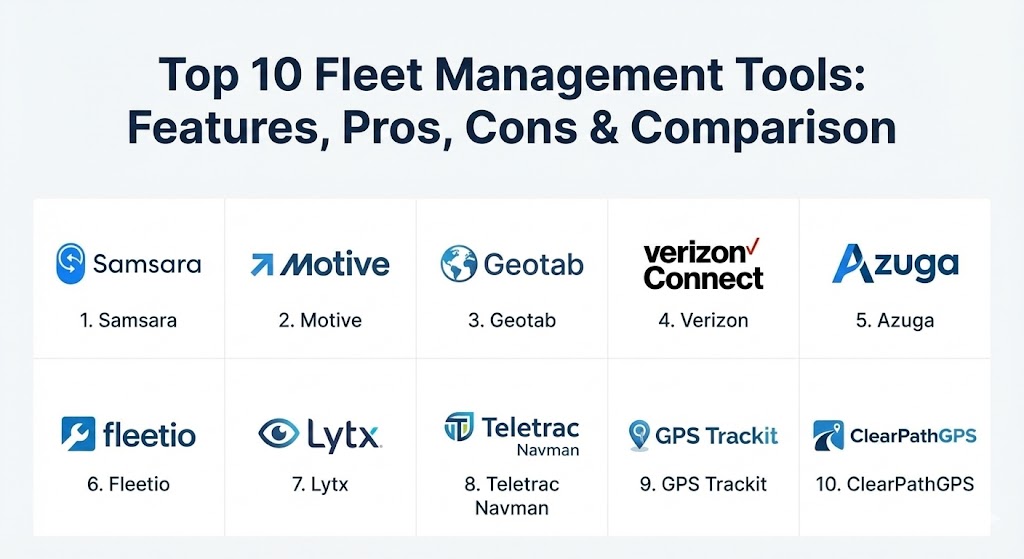
Top 10 Fleet Management Tools
1 — Samsara
Samsara is widely regarded as the most innovative leader in the “Connected Operations Cloud.” Designed for modern, data-hungry organizations, it offers an all-in-one platform that unifies fleet tracking, video safety, and site visibility.
- Key features:
- AI-Powered Dash Cams: Real-time detection of distracted driving, tailgating, and mobile phone usage.
- Plug-and-Play Telematics: High-speed GPS refresh rates (up to 1 second) for precise live tracking.
- Integrated Safety Inbox: Centralized hub for reviewing incident footage and coaching drivers.
- Predictive Maintenance: Automated alerts based on engine fault codes and mileage.
- Asset Tracking: Specialized monitors for trailers, refrigerated units (reefers), and heavy equipment.
- Sustainability Dashboard: Tools for tracking EV transitions and carbon footprint reduction.
- App Marketplace: 200+ pre-built integrations with payroll, CRM, and inventory software.
- Pros:
- Exceptionally intuitive user interface that reduces training time for both drivers and admins.
- Industry-leading AI accuracy in detecting risky driving behavior.
- Cons:
- Typically requires long-term (3-year) contracts which may be restrictive for some SMBs.
- Premium pricing reflects its position as a high-end market leader.
- Security & compliance: SOC 2 Type II, GDPR, HIPAA, and FIPS 140-2. Includes SSO and granular role-based access controls.
- Support & community: 24/7 global phone support; a massive “Samsara Community” for peer-to-peer learning and extensive technical documentation.
2 — Motive (formerly KeepTruckin)
Motive has evolved from a simple ELD provider into a robust physical economy platform. It is particularly strong in the trucking and logistics sectors where regulatory compliance and safety are the top priorities.
- Key features:
- Automated ELD & IFTA: Simplified compliance for Hours of Service (HOS) and International Fuel Tax Agreement reporting.
- AI Dashcam Ecosystem: Integrated front-facing and cabin-facing cameras with instant incident upload.
- Motive Card: A specialized fuel card that integrates directly with the management software for fraud detection.
- Driver Safety Hub: Scorecards and leaderboards that encourage healthy competition among drivers.
- Maintenance Management: Detailed service logs and automated work order triggers.
- Smart Dispatch: Real-time job assignments with traffic-aware routing.
- Pros:
- Highly flexible contract terms compared to legacy telematics providers.
- Excellent mobile app performance for drivers, reducing administrative friction.
- Cons:
- Some advanced reporting features can be overwhelming for smaller, non-tech-savvy fleets.
- Occasional hardware delays reported during large-scale rollouts.
- Security & compliance: SOC 2, ELD Certified, ISO 27001, and secure data encryption at rest and in transit.
- Support & community: 24/7 multi-lingual support; dedicated account managers for enterprise-level clients.
3 — Geotab
Geotab is the “data scientist’s choice” in fleet management. Its open-platform architecture and deep engine diagnostics make it a favorite for large enterprises and government fleets requiring high customization.
- Key features:
- Open API & SDK: Allows developers to build entirely custom applications on top of the Geotab platform.
- Geotab Marketplace: A massive ecosystem of third-party add-ons, from cameras to weight sensors.
- Electric Vehicle (EV) Suitability Assessment: Data-driven insights to help fleets transition to electric.
- Active Tracking: Second-by-second data transmission for mission-critical operations.
- IOX Expansion: Proprietary hardware expansion for connecting additional sensors like temperature probes.
- Curve Logging: Advanced algorithms that record only meaningful data points, reducing data bloat.
- Pros:
- Unmatched data granularity and customizable reporting capabilities.
- The most hardware-agnostic platform, supporting a vast array of vehicle types.
- Cons:
- Higher complexity; often requires a dedicated data analyst to get the full value.
- The user interface can feel more technical and less “polished” than Samsara.
- Security & compliance: First telematics company to achieve FIPS 140-2 validation; ISO 27001, and FedRAMP authorized.
- Support & community: Large reseller network providing local support; extensive technical wiki and developer forums.
4 — Verizon Connect
Leveraging the power of its massive telecommunications network, Verizon Connect (formerly Fleetmatics and Telogis) provides a stable and highly scalable solution for businesses of all sizes.
- Key features:
- Reveal Platform: A clean, map-centric interface for real-time vehicle and asset tracking.
- Automatic Route Optimization: Reduces mileage and fuel consumption by finding the most efficient job sequences.
- Integrated Video: AI-enhanced dashcams that link footage directly to GPS events.
- Field Service Management: Integrated tools for scheduling, dispatching, and invoicing.
- Roadside Assistance: Professional help integrated directly into the fleet subscription.
- Mobile App Suite: Separate apps for drivers and managers to streamline communication.
- Pros:
- Exceptional network reliability and coverage across North America and Europe.
- Strong “all-in-one” feature set that covers both telematics and field service.
- Cons:
- Reputation for slower customer service response times in certain regions.
- Rigid 3-year contract structures are the industry standard for their enterprise tier.
- Security & compliance: ISO 27001, SOC 2, GDPR, and rigorous data privacy protocols.
- Support & community: Extensive online help center; professional implementation services for large fleets.
5 — Azuga
Azuga is a leader in “Rewards-Driven Telematics.” By focusing on the psychology of the driver, Azuga helps fleets improve safety and retention through positive reinforcement.
- Key features:
- Driver Rewards Program: Built-in system for giving drivers gift cards and recognition based on safety scores.
- Plug-and-Play OBDII: One of the easiest hardware installations in the market.
- Safety Coaching: Automated alerts and video clips sent to drivers to help them correct behavior.
- Fuel Management: Integration with major fuel cards to track and reduce idling and fuel waste.
- Fleet Sustainability: Tools for monitoring idle time and greenhouse gas emissions.
- Route Planning: Simple, effective tools for managing daily service stops.
- Pros:
- Significant focus on driver buy-in, which often leads to higher safety scores.
- More affordable than the “Big Three” (Samsara, Geotab, Verizon).
- Cons:
- Lacks some of the ultra-deep engine diagnostic data found in Geotab.
- Not ideal for massive global enterprises requiring highly complex customizations.
- Security & compliance: SOC 2, HIPAA (for medical fleets), and encrypted cloud storage.
- Support & community: High customer satisfaction ratings; known for a proactive onboarding process.
6 — Fleetio
Fleetio is unique because it focuses primarily on fleet maintenance and asset lifecycle management. It is often used as a powerful companion to GPS tracking tools or as a standalone hub for maintenance-heavy fleets.
- Key features:
- Maintenance Workflows: Automated service reminders based on real-time odometer readings.
- Fuel Integration: Direct syncing with fuel cards to monitor TCO (Total Cost of Ownership) per mile.
- Inventory & Parts: Manage your own shop’s parts inventory and vendor relationships.
- Mobile Inspections: Digital DVIRs (Driver Vehicle Inspection Reports) that drivers can complete via smartphone.
- Outsourced Maintenance: Direct integration with 50,000+ national service shops for automated billing.
- Asset Lifecycle Tracking: Detailed reports on depreciation and replacement timing.
- Pros:
- The most powerful maintenance software in the fleet space.
- Clean, modern interface that is extremely easy for mechanics to use.
- Cons:
- Does not provide its own GPS hardware (must integrate with a telematics partner).
- Can be an additional cost if you already pay for a “basic” maintenance module in your GPS software.
- Security & compliance: SOC 2 Type II, GDPR, and ISO 27001. Support for SSO and advanced audit logs.
- Support & community: Exceptional documentation; active webinars and a strong user community.
7 — Lytx
Lytx is the pioneer of video telematics. While it has expanded into general fleet management, its core strength remains its world-class video safety technology and risk-detection algorithms.
- Key features:
- DriveCam Event Recorder: Sophisticated AI that distinguishes between “normal” and “risky” events.
- Surview Platform: Web-based dashboard for reviewing video and managing safety programs.
- Machine Vision (MV) & AI: Detects behaviors like eating, drinking, and smoking while driving.
- Fleet Dispatch: Real-time location tracking and communication tools.
- Compliance Services: Full-service management for ELD, HOS, and driver qualification files.
- Risk Scorecards: Predictive analytics that identify the most at-risk drivers in a fleet.
- Pros:
- Widely considered the gold standard for video-based safety and exoneration.
- Highly accurate AI that significantly reduces “false positive” alerts.
- Cons:
- Primarily a safety-first tool; general operational features (like routing) are less robust than competitors.
- Premium price point focused on large-scale enterprise safety programs.
- Security & compliance: ISO 27001, GDPR, and SOC 2. Advanced data privacy settings for video footage.
- Support & community: High-touch coaching and consulting services; extensive training materials for safety managers.
8 — Teletrac Navman
Teletrac Navman provides a specialized platform called TN360, which uses AI and search-based analytics to help managers find information naturally.
- Key features:
- TN360 AI Engine: A natural language search interface (e.g., “Show me drivers who idled over 1 hour today”).
- Dynamic Dashboarding: Drag-and-drop widgets for creating custom operational views.
- Job Management: Comprehensive tools for managing proof of delivery and workflow signatures.
- Equipment Tracking: Ruggedized trackers for non-powered assets in construction and mining.
- Advanced Safety: Driver scorecards and AI-powered dashcam integration.
- Global ELD: Support for international logging regulations beyond just the US market.
- Pros:
- The search-based interface makes it very easy to find data without digging through reports.
- Extremely strong in “rugged” industries like construction, mining, and oil/gas.
- Cons:
- The legacy platform can still feel clunky; users must ensure they are on the newer TN360 version.
- Hardware installation can be more complex than simple OBDII solutions.
- Security & compliance: ISO 27001, GDPR, and SOC 2. Includes advanced encryption and audit logging.
- Support & community: Global presence with 24/7 support; robust technical documentation library.
9 — GPS Trackit
GPS Trackit is the “value leader” for small to medium-sized businesses. It provides high-quality tracking and safety features without the long-term contract baggage of larger competitors.
- Key features:
- No-Contract Pricing: Offers month-to-month flexibility for smaller operations.
- Real-Time GPS Tracking: Standard location updates with historical breadcrumb trails.
- Vid-Flo Dash Cams: Affordable video telematics with cloud-based event storage.
- Maintenance Alerts: Simple reminders for oil changes, tire rotations, and inspections.
- Geofencing: Instant alerts when vehicles enter or leave specific zones.
- Temperature Monitoring: Specialized sensors for cold-chain logistics.
- Pros:
- One of the most affordable and transparent pricing models in the industry.
- Excellent for businesses that don’t want to be locked into 3-year enterprise contracts.
- Cons:
- Lacks the deep AI-driven “distraction detection” found in Samsara or Lytx.
- The software interface is functional but lacks the modern aesthetic of premium tools.
- Security & compliance: Standard data encryption and secure cloud hosting. Varies by hardware model.
- Support & community: Highly rated US-based customer support; easy-to-follow training videos.
10 — ClearPathGPS
ClearPathGPS focuses on extreme simplicity and transparency. It is designed for local service businesses that need to prove service times and keep an eye on their assets without complex overhead.
- Key features:
- Minute-by-Minute Tracking: Provides a clear picture of daily operations.
- Proof of Service: Integrated tools for showing when and where a technician was on-site.
- Asset Tracking: Small, battery-powered units for trailers and toolboxes.
- Simple Driver Behavior: Tracking speeding, harsh braking, and rapid acceleration.
- User-Friendly Dashboard: A simplified view focused on high-level operational health.
- Quick Reports: One-click exports for mileage, fuel, and stops.
- Pros:
- No hidden fees or long-term contracts; very “honest” business model.
- Extremely fast setup—often up and running in less than 48 hours.
- Cons:
- Lacks the enterprise features like advanced routing or AI safety coaching.
- Not suitable for long-haul trucking requiring full ELD compliance.
- Security & compliance: Secure web-based platform with SSL/TLS encryption. N/A for SOC 2.
- Support & community: Personalized, friendly support; helpful knowledge base for self-onboarding.
Comparison Table
| Tool Name | Best For | Platform(s) Supported | Standout Feature | Rating (Gartner/TrueReview) |
| Samsara | All-in-One Operations | Web, iOS, Android | Integrated AI Video & Safety | 4.8 / 5 |
| Motive | Trucking Compliance | Web, iOS, Android | ELD Mastery & Motive Card | 4.6 / 5 |
| Geotab | Custom Data/Enterprise | Web, Open API | Open Ecosystem & Open Data | 4.7 / 5 |
| Verizon Connect | Large Field Service | Web, iOS, Android | Network Reliability & Coverage | 4.4 / 5 |
| Azuga | Driver Retention | Web, iOS, Android | Driver Rewards & Gamification | 4.5 / 5 |
| Fleetio | Heavy Maintenance | Web, iOS, Android | Asset Lifecycle Management | 4.9 / 5 |
| Lytx | Video Safety First | Web, Mobile Web | Proprietary Vision AI | 4.4 / 5 |
| Teletrac Navman | Rugged Industries | Web, iOS, Android | Search-Based AI (TN360) | 4.3 / 5 |
| GPS Trackit | Value & SMBs | Web, iOS, Android | No Long-Term Contracts | 4.6 / 5 |
| ClearPathGPS | Simple Local Tracking | Web, iOS, Android | Extreme Ease of Use | 4.8 / 5 |
Evaluation & Scoring of Fleet Management Tools
To select the winners in this list, we evaluated each platform against a weighted scoring rubric that reflects the priorities of modern fleet managers in 2026.
| Category | Weight | Evaluation Criteria |
| Core Features | 25% | Real-time tracking, GPS refresh rates, safety tools, and compliance (ELD/HOS). |
| Ease of Use | 15% | UI/UX design, mobile app performance, and time to onboard new drivers. |
| Integrations | 15% | Openness of APIs and availability of pre-built integrations with third-party software. |
| Security & Compliance | 10% | Data privacy, SSO, encryption standards, and regulatory certifications (SOC 2). |
| Reliability | 10% | Hardware durability, network uptime, and accuracy of GPS data. |
| Support & Community | 10% | 24/7 support availability, technical documentation, and peer communities. |
| Price / Value | 15% | Transparency of pricing, contract flexibility, and ROI potential. |
Which Fleet Management Tool Is Right for You?
Choosing a fleet management tool is a significant investment that will impact your operations for years. Use this guide to narrow down your choices:
- Solo Users vs. Micro-Fleets: If you have 1–3 vehicles, avoid enterprise tools. Look at ClearPathGPS or GPS Trackit for simple tracking without the commitment.
- Small to Medium Businesses (SMBs): If driver turnover is a concern, Azuga is a great choice. If you want a platform that can grow with you but stays easy to use, Samsara is the industry standard.
- Mid-Market & Industrial: For fleets in construction or mining, Teletrac Navman offers the rugged hardware and equipment tracking you need.
- Large Enterprises: If you have a massive fleet and a dedicated IT/Data team, Geotab is the only solution that provides the level of customization you will likely demand. For global stability, Verizon Connect is a safe, established choice.
- Safety-First Organizations: If your primary goal is to reduce accidents and insurance premiums through video, Lytx and Samsara are the undisputed leaders.
- Maintenance-Intensive Operations: If you already have a GPS tracker but hate your maintenance logs, add Fleetio to your stack. It is the best-in-class tool for managing what happens under the hood.
Frequently Asked Questions (FAQs)
1. What is the average cost of a fleet management system?
In 2026, most mid-to-high tier systems cost between $25 and $45 per vehicle, per month. Hardware costs can range from $0 (with a contract) to $300 upfront per vehicle for advanced AI dash cams.
2. Is GPS tracking alone enough for a fleet?
Not for commercial fleets. You usually need Telematics, which includes engine diagnostics and driver behavior, and an ELD if you are subject to HOS regulations in the US and Canada.
3. Do these tools work with Electric Vehicles (EVs)?
Yes. Leading tools like Geotab and Samsara now include “EV Suitability Assessments” and monitor battery state-of-charge, charging health, and range in real time.
4. How does AI-powered video safety actually work?
The cameras use “Machine Vision” to look for patterns like a driver’s eyes closing (fatigue) or a hand holding a phone. It alerts the driver locally first and only uploads the clip if the behavior continues.
5. Can I install the hardware myself?
Many SMB tools use “Plug-and-Play” OBDII devices that take 30 seconds to install. Enterprise systems or those with multi-cam setups usually require professional installation to hide wiring and ensure tamper-resistance.
6. Do these tools help reduce insurance premiums?
Most insurance carriers now offer discounts for fleets that use video telematics. In the event of an accident, video footage often provides “exoneration” for the driver, saving the company millions in legal fees.
7. Is fleet data secure from hackers?
Top-tier vendors (Samsara, Geotab, Verizon) invest millions in cybersecurity. Look for SOC 2 Type II and FIPS 140-2 certifications to ensure your driver and vehicle data are protected.
8. What is a “breadcurmb trail” in GPS tracking?
It is a historical visual record of where a vehicle has been throughout the day, showing the exact route taken, stops made, and the duration of each stop.
9. Can I track non-powered assets like trailers or toolboxes?
Yes. Most providers offer small, battery-powered asset trackers that use long-life batteries (up to 5 years) to report location once or twice a day.
10. How long does implementation take?
For small fleets, you can be up and running in a week. For enterprises with 500+ vehicles, a full rollout including hardware installation and driver training typically takes 3 to 6 months.
Conclusion
The “best” fleet management tool is ultimately the one that solves your specific operational pain point. For some, that is the crushing weight of compliance audits; for others, it is the spiraling cost of fuel and vehicle maintenance. As we navigate the complexities of 2026, the shift toward AI-driven safety and EV integration is no longer optional—it is a requirement for survival. By choosing a partner that offers a balance of deep data, ease of use, and robust security, you aren’t just buying software; you are building a foundation for a more sustainable and profitable future.