Introduction
Environmental Monitoring Platforms are comprehensive software-as-a-service (SaaS) or on-premise solutions designed to collect, analyze, and report data related to air quality, water health, soil contamination, noise levels, and carbon emissions. These platforms act as a bridge between physical sensors in the field and the executive boardroom, transforming raw telemetry into actionable insights. By centralizing disparate data streams, these tools help organizations transition from reactive “damage control” to proactive environmental stewardship.
The importance of these platforms is underscored by the increasing frequency of extreme weather events and the rising cost of environmental non-compliance. Real-world use cases range from smart cities monitoring urban heat islands and air pollution to mining companies tracking groundwater quality and noise disturbances in local communities. When evaluating these tools, users should look for robust sensor integration capabilities, AI-driven predictive modeling, automated regulatory reporting templates, and highly secure data governance frameworks.
Best for: EHS (Environmental, Health, and Safety) managers, sustainability officers in manufacturing, energy, and construction, government environmental agencies, and large-scale industrial enterprises requiring strict compliance with local and international environmental laws.
Not ideal for: Small local businesses with minimal environmental footprints (e.g., a single retail shop) or companies whose “monitoring” needs are limited to basic energy bill tracking, where simpler accounting software might suffice.
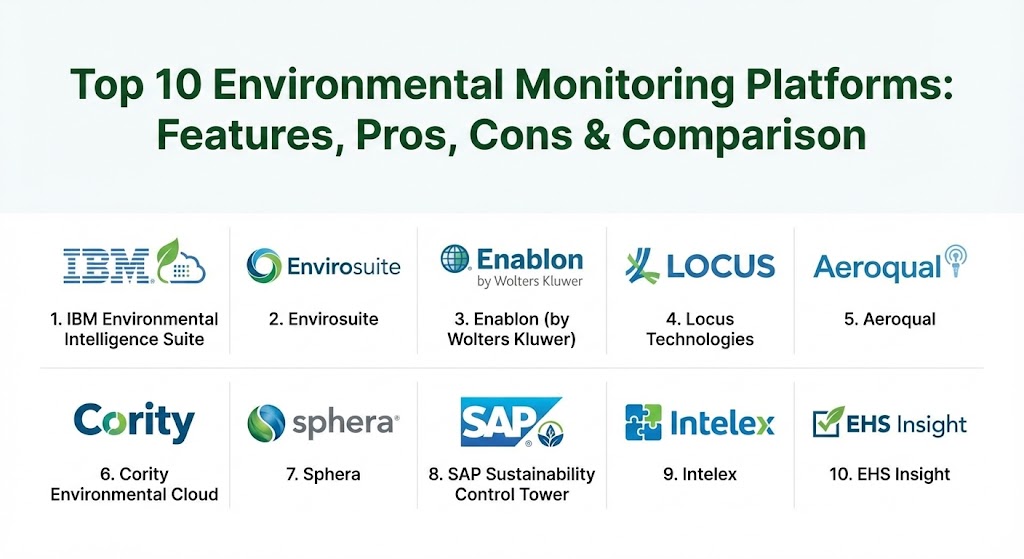
Top 10 Environmental Monitoring Platforms
1 — IBM Environmental Intelligence Suite
The IBM Environmental Intelligence Suite is an AI-powered platform that combines weather, climate, and operational data with environmental monitoring. It is designed to help organizations anticipate and respond to environmental risks while simultaneously managing their sustainability goals.
- Key features:
- AI-driven predictive analytics for weather and climate risk.
- Integrated dashboard for tracking carbon footprints and GHG emissions.
- Real-time monitoring of air quality and water levels across global sites.
- Geospatial analysis for mapping environmental impacts on assets.
- Automated alerts for impending natural disasters or threshold breaches.
- Sustainability reporting templates aligned with major frameworks (GRI, TCFD).
- Pros:
- Leverages IBM’s world-class weather data and Watson AI for unmatched predictive accuracy.
- Highly scalable for global enterprises with thousands of assets.
- Cons:
- High cost of entry makes it inaccessible for most mid-market players.
- Significant implementation time required to integrate complex data streams.
- Security & compliance: ISO 27001, SOC 2 Type II, and GDPR compliant. Features robust SSO and end-to-end data encryption.
- Support & community: Extensive enterprise-grade support, a massive global partner network, and a deep library of technical documentation.
2 — Envirosuite
Envirosuite is a specialized platform that focuses on “nuisance” monitoring—specifically noise, odor, dust, and air quality. It is widely used in aviation, mining, and wastewater treatment to manage the impact of operations on surrounding communities.
- Key features:
- Real-time noise and vibration monitoring for construction and airports.
- Advanced odor modeling and tracking to prevent community complaints.
- Automated dust monitoring and reporting for mining operations.
- Predictive modeling that uses weather data to forecast plume movements.
- Community engagement portals for transparent data sharing.
- Integration with high-precision environmental sensors.
- Pros:
- Industry leader in managing localized environmental nuisances.
- Highly visual interface that makes complex plume modeling easy to understand.
- Cons:
- More focused on immediate “site” monitoring than long-term ESG strategy.
- Dependency on high-quality proprietary or third-party sensor hardware.
- Security & compliance: SOC 2 compliant; includes secure audit logs and encrypted data storage.
- Support & community: Known for excellent field support and specialized engineering consulting for complex site setups.
3 — Enablon (by Wolters Kluwer)
Enablon is a comprehensive EHS and ESG software suite used by many of the world’s largest corporations. Its environmental module is built to handle the most complex regulatory reporting requirements across multiple jurisdictions.
- Key features:
- Global compliance tracking and legal register integration.
- Air emissions tracking for industrial stacks and vents.
- Water and waste management modules for circular economy tracking.
- Integrated risk assessment tools for environmental hazards.
- Mobile auditing tools for field-based environmental inspections.
- Deep integration with operational and financial data.
- Pros:
- Unmatched depth in regulatory compliance and legal requirement tracking.
- Extremely customizable to fit specific industrial workflows (Oil & Gas, Chemicals).
- Cons:
- The user interface can feel “heavy” and traditional compared to modern SaaS.
- Configuration usually requires specialized Enablon consultants.
- Security & compliance: ISO 27001, SOC 2, and HIPAA ready. Supports multi-factor authentication and role-based access.
- Support & community: Huge enterprise community; regular global user conferences and extensive training certifications.
4 — Locus Technologies
Locus Technologies offers a specialized environmental cloud that excels in managing laboratory data, water quality, and complex environmental remediation projects. It is a favorite among environmental engineering firms.
- Key features:
- Industry-leading EIM (Environmental Information Management) for lab data.
- Automated water quality monitoring and discharge reporting.
- Integrated GIS for spatial visualization of groundwater plumes.
- Management of environmental permits and document workflows.
- GHG and carbon footprint tracking tools.
- Direct integration with laboratory information management systems (LIMS).
- Pros:
- The way it handles large volumes of laboratory and sampling data is superior to competitors.
- Strong focus on water and soil, making it ideal for remediation sites.
- Cons:
- Not as “all-in-one” for general safety as some other EHS suites.
- User interface is focused on utility rather than modern design.
- Security & compliance: SOC 2 Type II compliant; uses high-grade encryption for sensitive site data.
- Support & community: Very professional support staff, often with environmental science backgrounds.
5 — Aeroqual
Aeroqual is a platform-and-hardware hybrid that specializes in air quality monitoring. It provides the software platform (Aeroqual Cloud) to manage their highly accurate, portable, and stationary air sensors.
- Key features:
- Real-time monitoring of O3, NO2, VOCs, and particulate matter (PM2.5, PM10).
- Remote sensor calibration and diagnostic tools via the cloud.
- Automated alerts based on local air quality standards.
- Integrated weather data to contextualize air quality readings.
- “Aeroqual Cloud” for multi-site air quality management.
- Pros:
- Exceptional precision; often used by researchers and government agencies.
- Seamless hardware-software integration—it is “plug and play.”
- Cons:
- Limited strictly to air quality; does not handle water, soil, or waste.
- Can become expensive if many specialized gas modules are needed.
- Security & compliance: Encrypted data transmission; compliant with standard web security protocols.
- Support & community: Strong focus on technical accuracy; excellent documentation for sensor maintenance.
6 — Cority Environmental Cloud
Cority (formerly Medgate) has expanded from health and safety into a powerful environmental platform. Its “Environmental Cloud” is designed to manage air, water, and waste data within a unified EHS ecosystem.
- Key features:
- Centralized waste management tracking (hazardous and non-hazardous).
- Air emissions inventory and permitting tools.
- Water quality monitoring for industrial wastewater and cooling systems.
- Environmental incident management and root cause analysis.
- Sustainability Performance (ESG) dashboarding.
- Integrated audit and inspection workflows.
- Pros:
- Excellent for companies that want to manage Health, Safety, and Environment in one place.
- Modern, responsive interface that is easy for field workers to use.
- Cons:
- The environmental module is sometimes viewed as an “add-on” to their leading safety software.
- Integration with complex third-party sensors can be more manual than Envirosuite.
- Security & compliance: ISO 27001, SOC 2 Type II, and GDPR compliant.
- Support & community: Very active user group and a robust “Cority Academy” for user training.
7 — Sphera
Sphera is a dominant player in ESG performance and risk management. Their platform is particularly strong in chemical lifecycle management and product stewardship, making it vital for the manufacturing sector.
- Key features:
- Advanced chemical and hazardous material tracking.
- Life Cycle Assessment (LCA) tools to calculate product footprints.
- Corporate sustainability reporting for Scope 1, 2, and 3 emissions.
- Real-time operational risk and environmental impact tracking.
- Compliance management for REACH, RoHS, and TSCA.
- Pros:
- The best tool for calculating the environmental impact of physical products.
- Deep expertise in chemical safety and regulatory compliance.
- Cons:
- Higher pricing tiers; designed for large-scale industrial manufacturing.
- Learning curve for LCA modules can be quite steep.
- Security & compliance: SOC 2, ISO 27001, and robust multi-tenant data isolation.
- Support & community: Global presence with 24/7 support for enterprise clients.
8 — SAP Sustainability Control Tower
As part of the SAP ecosystem, the Sustainability Control Tower allows organizations to integrate environmental data directly into their financial and operational ERP systems.
- Key features:
- Automated ESG data collection from SAP S/4HANA systems.
- Dashboard for tracking “Green Ledger” (carbon accounting).
- Integration with supply chain data for Scope 3 emissions visibility.
- Pre-built framework mapping for CSRD and ISSB.
- Holistic steering to balance profit with environmental impact.
- Pros:
- If you already use SAP, the data integration is unparalleled.
- Provides a “single version of truth” for both financial and environmental data.
- Cons:
- Almost exclusively beneficial to existing SAP customers.
- Less focus on “real-time sensor telemetry” compared to platforms like Envirosuite.
- Security & compliance: Standard SAP enterprise-grade security; GDPR, ISO, and SOC 2 compliant.
- Support & community: Backed by the world’s largest enterprise software support network.
9 — Intelex
Intelex is a flexible EHSQ (Environmental, Health, Safety, and Quality) platform. Its environmental management system (EMS) is highly modular, allowing companies to start small and scale their monitoring capabilities.
- Key features:
- Air emissions tracking and permit management.
- Water quality monitoring and discharge tracking.
- Spill and release management with automated reporting.
- Environmental compliance task tracking and calendars.
- Aspect and impact analysis for ISO 14001 certification.
- Pros:
- Very flexible and “app-based” approach; you only pay for the modules you need.
- Excellent community-driven “exchange” where users share custom-built modules.
- Cons:
- Reporting tools can be less intuitive than competitors like Cority.
- High level of customization can lead to configuration “bloat.”
- Security & compliance: ISO 27001, SOC 2, and OHSAS 18001 alignment.
- Support & community: Strong “Intelex Alliance” partner network and very active user forums.
10 — EHS Insight
EHS Insight is a modern, cloud-based platform that prioritizes ease of use and rapid deployment. It is particularly well-suited for mid-market companies that need a professional environmental management system without the “enterprise complexity.”
- Key features:
- Simplified environmental compliance tracking.
- Waste management and manifesting tools.
- Integrated greenhouse gas (GHG) inventory.
- Environmental audit and inspection checklists.
- Real-time dashboards for key environmental indicators.
- Pros:
- One of the best user interfaces in the industry—very modern and fast.
- Price point is much more accessible for mid-sized organizations.
- Cons:
- Lacks the deep “big data” predictive AI found in IBM or Envirosuite.
- Not designed for massive, multi-petabyte historical data sets.
- Security & compliance: ISO 27001 compliant; uses secure SSO and encrypted cloud hosting.
- Support & community: Highly rated for its customer success team and rapid onboarding process.
Comparison Table
| Tool Name | Best For | Platform(s) Supported | Standout Feature | Rating (Gartner Peer Insights) |
| IBM Environmental | Climate Risk & AI | Cloud (SaaS) | AI-Driven Predictive Risk | 4.6 / 5 |
| Envirosuite | Nuisance (Noise/Odor) | Web, Mobile, IoT | Odor & Dust Plume Modeling | 4.5 / 5 |
| Enablon | Global Compliance | On-Prem, Cloud | Deep Regulatory Logic | 4.4 / 5 |
| Locus Tech | Water & Lab Data | Cloud (SaaS) | EIM Lab Data Management | 4.4 / 5 |
| Aeroqual | Air Quality Science | Cloud + Hardware | High-Precision Gas Sensing | 4.7 / 5 |
| Cority | Unified EHS | Web, Mobile | Integrated Safety & Env | 4.5 / 5 |
| Sphera | Product Life Cycle | Cloud (SaaS) | LCA & Chemical Tracking | 4.3 / 5 |
| SAP Sustainability | ERP Integration | Cloud (SaaS) | Financial/Env Data Tie-in | 4.2 / 5 |
| Intelex | Modular Scaling | Cloud, Mobile | App-Based Modular Design | 4.4 / 5 |
| EHS Insight | Mid-Market Ease | Cloud, Mobile | Modern, Simple UX | 4.7 / 5 |
Evaluation & Scoring of Environmental Monitoring Platforms
Selecting a platform requires assessing how well it handles the “Data-to-Action” lifecycle. The following rubric provides a weighted scoring guide for your evaluation team.
| Category | Weight | Evaluation Criteria |
| Core Features | 25% | Ability to manage air, water, waste, and GHG; automated reporting. |
| Ease of Use | 15% | Intuitive UI for both admins and field workers; mobile accessibility. |
| Integrations | 15% | Compatibility with IoT sensors, ERP systems (SAP/Oracle), and LIMS. |
| Security & Compliance | 10% | SOC 2, ISO 27001, data residency, and encryption standards. |
| Performance | 10% | Real-time data processing speed and system uptime. |
| Support & Community | 10% | Availability of 24/7 support, training academy, and user groups. |
| Price / Value | 15% | TCO (Total Cost of Ownership) relative to compliance risk reduction. |
Which Environmental Monitoring Platform Is Right for You?
The right choice depends on your specific regulatory pressure and the type of data you are collecting.
- Solo Consultants & Small Firms: If you are an individual consultant, specialized “platforms” might be overkill. You may find more value in hardware-specific tools like Aeroqual Cloud or even high-end spreadsheets for basic reporting.
- SMBs (Mid-Market): If you need to professionalize your environmental tracking without a million-dollar budget, EHS Insight or Intelex provide the best balance of features and usability.
- Heavy Industry (Mining/Oil & Gas): If your neighbors are complaining about noise or smell, Envirosuite is indispensable. For managing thousands of global permits and stack emissions, Enablon or Cority are the preferred industry workhorses.
- The “Net-Zero” Enterprise: If your primary goal is carbon accounting and Scope 3 reporting, SAP Sustainability Control Tower (for SAP users) or IBM Environmental Intelligence Suite (for AI-driven risk) offer the best strategic depth.
- Environmental Engineers: If your world revolves around groundwater sampling and laboratory results, Locus Technologies remains the most specialized choice.
Frequently Asked Questions (FAQs)
1. What is an Environmental Monitoring Platform? It is a software system that centralizes data from sensors, field samples, and weather feeds to help organizations monitor their impact on air, water, and soil while ensuring regulatory compliance.
2. Can these platforms predict environmental disasters?Advanced platforms like IBM Environmental Intelligence Suite use AI and meteorological data to predict risks like floods, wildfires, or high-pollution events before they happen.
3. Do I need to buy sensors separately? Usually, yes. While some vendors like Aeroqual sell hardware-software bundles, most platforms (like Cority or Enablon) are “hardware-agnostic,” meaning they ingest data from any sensor you already own.
4. How does these platforms help with ESG reporting? They automate the collection of data required for frameworks like GRI or TCFD, ensuring your sustainability reports are backed by “audit-ready” data rather than estimates.
5. Are these tools cloud-based or on-premise?The industry has largely moved to the cloud (SaaS) for real-time data processing, though some legacy enterprise tools like Enablon still offer on-premise deployments for highly sensitive data.
6. Can they track Scope 3 emissions? Top-tier platforms like SAP and Sphera are increasingly adding Scope 3 capabilities, which involve tracking environmental data from your suppliers and the entire product value chain.
7. Is my data safe in these platforms? Enterprise-grade platforms are highly secure, utilizing SOC 2 Type II audits, ISO 27001 certifications, and full data encryption to protect sensitive industrial and compliance information.
8. What is “Nuisance Monitoring”? It refers to tracking environmental factors that impact human comfort and health in the short term, such as noise, dust, and odor, which are common causes of community lawsuits.
9. Do these tools integrate with my ERP system? Most enterprise platforms offer APIs to connect with ERPs like SAP or Oracle, allowing environmental costs and risks to be reflected in the company’s financial records.
10. How much do these platforms cost? Pricing varies from $10,000 per year for basic modular cloud tools to over $250,000 per year for global enterprise-wide AI suites with millions of data points.
Conclusion
The evolution of Environmental Monitoring Platforms reflects our changing relationship with the planet. We have moved from a period of “ignorant impact” to one of “measured stewardship.” Choosing the right platform is no longer just about avoiding a fine; it is about building a transparent, resilient organization that can thrive in a resource-constrained world. Whether you prioritize AI-driven weather risk, modular safety integration, or deep chemical lifecycle tracking, the key is to choose a tool that turns your data into a competitive advantage.