Introduction
Electrical CAD (Computer-Aided Design) and EDA (Electronic Design Automation) Software are specialized tools that allow engineers and designers to create, simulate, and optimize electrical and electronic systems. These platforms enable schematic design, PCB layout, circuit simulation, and verification, streamlining the development of complex electrical products and systems. By digitizing design workflows, EDA software helps reduce errors, improve productivity, and accelerate time-to-market.
The importance of electrical CAD / EDA software lies in its ability to manage the intricacies of modern electrical engineering projects, such as PCB design, embedded systems, and signal integrity. Industries including consumer electronics, aerospace, automotive, industrial automation, and telecommunications rely heavily on these tools for accurate, efficient, and compliant design. Key real-world use cases include circuit simulation, PCB layout and routing, FPGA design, embedded system integration, and power electronics modeling.
When selecting electrical CAD / EDA software, users should evaluate features like schematic capture, PCB layout, component libraries, multi-layer support, simulation accuracy, interoperability with other tools, user interface intuitiveness, and cloud or collaboration capabilities.
Best for:
Electrical engineers, PCB designers, embedded systems engineers, product design teams, and enterprises developing electronic hardware benefit most from electrical CAD / EDA software.
Not ideal for:
Small hobbyist projects, simple wiring diagrams, or organizations with minimal electronic design needs may not require full-featured EDA platforms. Basic free tools may suffice in such scenarios.
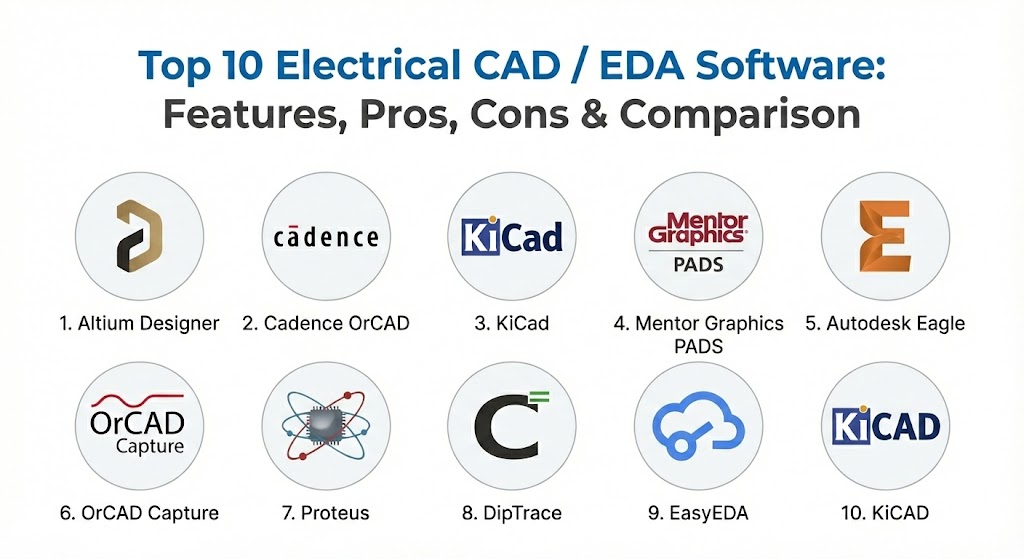
Top 10 Electrical CAD / EDA Software Tools
1 — Altium Designer
Short description:
Altium Designer is a professional EDA software that provides unified schematic capture, PCB design, and simulation tools for electronic engineers.
Key features:
- Unified schematic and PCB layout environment
- Multi-layer PCB support
- 3D visualization and component placement
- Integrated circuit simulation
- Extensive component libraries
- Collaboration via Altium 365
- Automated design rule checks
Pros:
- Seamless integration of design and simulation
- Powerful 3D visualization for mechanical compatibility
- Industry-standard for professional PCB design
Cons:
- High subscription cost
- Steep learning curve for beginners
- Hardware-intensive
Security & compliance:
SSO, encryption, GDPR-ready
Support & community:
Vendor support, tutorials, active online community.
2 — Cadence OrCAD / Allegro
Short description:
Cadence OrCAD and Allegro provide comprehensive EDA solutions for schematic capture, PCB layout, and system design.
Key features:
- Schematic capture and PCB layout
- Signal integrity and power analysis
- Multi-layer PCB routing
- Design verification and DRC
- Component libraries and automation
- Integration with SPICE simulation
- Collaboration and PLM integration
Pros:
- Industry-standard for complex PCB designs
- Advanced analysis and simulation
- Scalable from small boards to enterprise-level projects
Cons:
- Expensive licensing
- Requires training for advanced features
Security & compliance:
Enterprise-grade security, ISO-compliant
Support & community:
Professional documentation, training programs, user forums.
3 — KiCad
Short description:
KiCad is an open-source EDA platform for PCB design, schematic capture, and 3D visualization, ideal for small teams and hobbyists.
Key features:
- Schematic capture and PCB layout
- 3D visualization of boards
- Gerber file generation for manufacturing
- Component library management
- Multi-layer PCB support
- Simulation with integrated SPICE
- Open-source customization
Pros:
- Free and open-source
- Strong community support
- Suitable for education and prototyping
Cons:
- Less enterprise-ready
- Limited advanced simulation features
Security & compliance:
Varies / N/A
Support & community:
Community forums, tutorials, online documentation.
4 — Mentor Graphics PADS / Xpedition
Short description:
Mentor Graphics offers PADS and Xpedition for PCB design and system-level EDA solutions.
Key features:
- Schematic and PCB layout
- Signal and power integrity analysis
- Multi-layer routing and component placement
- High-speed PCB design
- Collaboration and version control
- Design verification and DRC
- Integration with simulation tools
Pros:
- Enterprise-grade PCB design capabilities
- Powerful analysis and verification
- Supports complex high-speed designs
Cons:
- High cost for small teams
- Learning curve for beginners
Security & compliance:
Enterprise-grade, ISO-compliant
Support & community:
Vendor support, training, documentation.
5 — Eagle (Autodesk)
Short description:
Eagle is a widely-used PCB design tool providing schematic capture, PCB layout, and component libraries.
Key features:
- Schematic and PCB editor
- Multi-layer PCB design
- Component library management
- SPICE simulation support
- 3D board visualization
- Collaboration via Autodesk cloud
- Automated design rule checks
Pros:
- User-friendly interface
- Cloud-enabled collaboration
- Cost-effective for SMBs and hobbyists
Cons:
- Limited high-end simulation
- Less suitable for very large PCBs
Security & compliance:
SSO, encryption, GDPR-ready
Support & community:
Vendor support, tutorials, online community.
6 — OrCAD Capture CIS
Short description:
OrCAD Capture CIS is a professional schematic design tool for PCB engineers, integrated with component management.
Key features:
- Schematic capture
- Component and library management
- Electrical rule checking
- Integration with PCB layout tools
- Simulation using PSpice
- BOM generation
- Collaboration with team workflows
Pros:
- Strong library and component integration
- Industry-standard for schematic capture
- Compatible with complex PCB designs
Cons:
- Requires additional tools for full PCB design
- Expensive licensing
Security & compliance:
Enterprise-grade, ISO-compliant
Support & community:
Official training, documentation, online forums.
7 — Proteus Design Suite
Short description:
Proteus Design Suite offers schematic capture, PCB design, and embedded system simulation for electronic designers.
Key features:
- Schematic and PCB layout
- Microcontroller simulation
- SPICE-based circuit simulation
- Component library management
- 3D board visualization
- BOM and documentation tools
- Design verification
Pros:
- Integrated microcontroller simulation
- Easy for education and prototyping
- Affordable pricing
Cons:
- Limited for large-scale enterprise PCB design
- Fewer advanced simulation features
Security & compliance:
Varies / N/A
Support & community:
Documentation, tutorials, online forums.
8 — DipTrace
Short description:
DipTrace is a PCB design tool offering schematic capture, PCB layout, and 3D modeling for engineers and hobbyists.
Key features:
- Schematic capture and PCB layout
- Multi-layer PCB support
- 3D visualization and export
- Component library management
- Design rule checking
- Autorouting and netlist import
- BOM and manufacturing output
Pros:
- Intuitive and easy to use
- Affordable for small teams
- Good 3D visualization
Cons:
- Limited high-end simulation
- Less suited for complex enterprise projects
Security & compliance:
Varies / N/A
Support & community:
Vendor support, tutorials, forums.
9 — EasyEDA
Short description:
EasyEDA is a cloud-based PCB design and EDA platform for schematic capture, layout, and simulation.
Key features:
- Cloud-based schematic and PCB design
- SPICE circuit simulation
- Collaboration and sharing
- Component library and footprints
- Multi-layer PCB support
- BOM generation
- 3D board visualization
Pros:
- Accessible from any device
- No installation required
- Affordable and collaborative
Cons:
- Internet required
- Limited advanced simulation capabilities
Security & compliance:
Cloud security, encryption
Support & community:
Vendor documentation, tutorials, online community.
10 — KiCAD
Short description:
KiCAD is an open-source PCB design tool with schematic capture, PCB layout, and 3D visualization, ideal for beginners and small projects.
Key features:
- Schematic capture
- Multi-layer PCB design
- 3D visualization
- Component library management
- Gerber file generation
- SPICE simulation
- Open-source customization
Pros:
- Free and open-source
- Good for educational use
- Active user community
Cons:
- Limited enterprise features
- Steep learning curve for advanced designs
Security & compliance:
Varies / N/A
Support & community:
Community forums, documentation, tutorials.
Comparison Table
| Tool Name | Best For | Platform(s) Supported | Standout Feature | Rating |
|---|---|---|---|---|
| Altium Designer | Professional PCB design | Windows | Unified schematic & PCB | N/A |
| Cadence OrCAD/Allegro | Complex PCB & systems | Windows | Multi-layer routing | N/A |
| KiCad | Hobbyists & education | Windows, macOS, Linux | Open-source flexibility | N/A |
| Mentor PADS/Xpedition | Enterprise PCB design | Windows | Signal integrity & verification | N/A |
| Eagle | SMB & hobbyists | Windows, macOS | Cloud collaboration | N/A |
| OrCAD Capture CIS | Schematic-focused PCB | Windows | Component management | N/A |
| Proteus Design Suite | Embedded & educational | Windows | Microcontroller simulation | N/A |
| DipTrace | SMB PCB design | Windows | Intuitive 3D visualization | N/A |
| EasyEDA | Cloud-based PCB | Browser | Cloud collaboration & simulation | N/A |
| KiCAD | Beginners & prototyping | Windows, macOS, Linux | Free & open-source | N/A |
Evaluation & Scoring of Electrical CAD / EDA Software
| Criteria | Weight | Description |
|---|---|---|
| Core features | 25% | Schematic, PCB layout, simulation |
| Ease of use | 15% | User interface, learning curve |
| Integrations & ecosystem | 15% | CAD/EDA integration, libraries |
| Security & compliance | 10% | Cloud/enterprise standards |
| Performance & reliability | 10% | Stability and computational performance |
| Support & community | 10% | Documentation, tutorials, forums |
| Price / value | 15% | Licensing vs features |
Which Electrical CAD / EDA Software Tool Is Right for You?
- Solo users: KiCAD, EasyEDA, Eagle for affordability and accessibility
- SMBs: Altium Designer, DipTrace, Proteus for small-to-mid scale PCB design
- Mid-market teams: OrCAD, PADS/Xpedition, Eagle for complex boards
- Enterprises: Altium Designer, Cadence Allegro, Mentor PADS/Xpedition for high-end, multi-layer PCB design
Budget-conscious users may benefit from KiCAD or EasyEDA, while premium users gain from Altium, Cadence, and PADS/Xpedition for enterprise-level capabilities.
Frequently Asked Questions (FAQs)
- What is EDA software used for?
It is used to design, simulate, and verify electronic circuits and PCB layouts. - Are EDA tools suitable for beginners?
Yes, tools like KiCAD, EasyEDA, and Eagle are beginner-friendly; professional solutions require experience. - Can EDA software simulate circuits?
Yes, many tools support SPICE-based and advanced simulation. - Are these tools expensive?
Enterprise-grade solutions can be costly; open-source or cloud-based tools are affordable. - Can EDA software handle multi-layer PCBs?
Yes, professional tools like Altium and Allegro handle complex multi-layer designs. - Is training required?
Advanced tools often require training or tutorials. - Can these tools collaborate online?
Cloud-based tools like EasyEDA and Eagle enable real-time collaboration. - Do EDA tools integrate with CAD software?
Most professional EDA platforms support CAD integration. - Can EDA software generate BOMs?
Yes, almost all tools provide bill of materials and manufacturing outputs. - Are there free EDA software options?
Yes, KiCAD and EasyEDA offer free tiers for education and prototyping.
Conclusion
Electrical CAD / EDA software is essential for designing, simulating, and optimizing electronic circuits and PCBs. From hobbyists to enterprise teams, each tool offers unique strengths for different project scales and complexity levels. Selecting the right software depends on your design requirements, team expertise, budget, and collaboration needs. There is no single “best” tool—the ideal choice aligns with your workflow, technical objectives, and project scale.
EDA software has revolutionized how we design circuits, making complex PCB layouts more manageable. This guide explores industry leaders like Altium Designer alongside accessible open-source options like KiCad, offering a balanced perspective for any project scale.