Introduction
Edge Device Management Tools are comprehensive software platforms designed to provision, monitor, secure, and update hardware operating at the “edge” of the network. Unlike traditional IT management, which focuses on centralized servers or employee laptops, edge management must contend with millions of diverse, often resource-constrained devices (like IoT sensors, PLC controllers, and gateways) that frequently operate on intermittent or low-bandwidth connections.
The importance of these tools lies in their ability to bridge the physical-digital divide. Without them, deploying a security patch to 10,000 sensors in the field would require a manual effort that is both logistically impossible and financially ruinous. Key real-world use cases include predictive maintenance in manufacturing (where edge AI detects machine failures before they happen), smart retail inventory tracking, and remote patient monitoring in healthcare. When evaluating these tools, users should look for “zero-touch” provisioning, over-the-air (OTA) update reliability, support for “digital twins,” and the ability to operate autonomously during cloud outages.
Best for: IoT architects, DevOps engineers, and Industrial IT managers in sectors like manufacturing, energy, logistics, and healthcare. It is essential for any organization managing a fleet of more than 50 distributed hardware devices that require frequent software iterations or high-security oversight.
Not ideal for: Pure-play SaaS companies with no physical hardware presence, or small businesses using only consumer-grade “Smart Office” gadgets that are managed via simple, proprietary mobile apps.
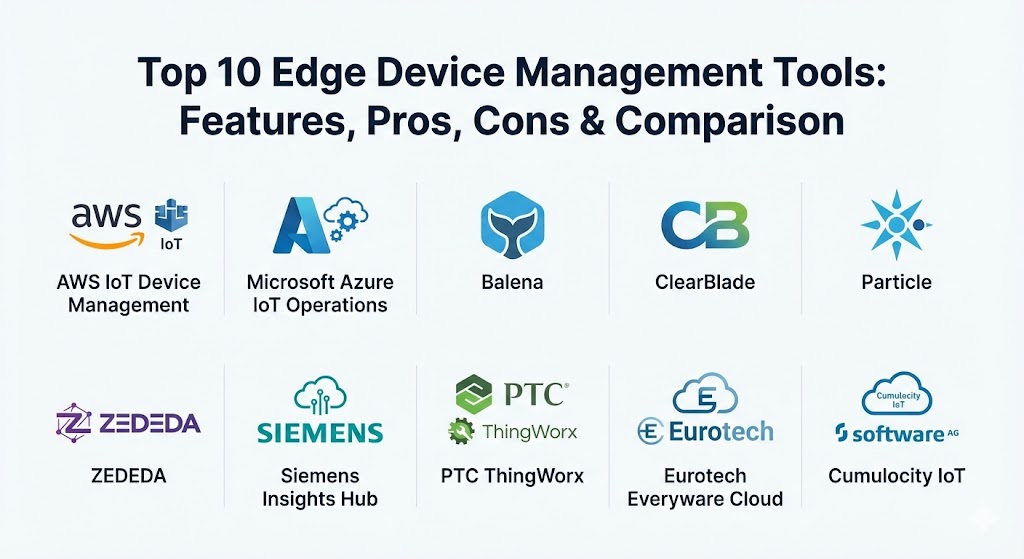
Top 10 Edge Device Management Tools
1 — AWS IoT Device Management
As a part of the vast Amazon Web Services ecosystem, this tool is the go-to for enterprises that require massive scalability and deep integration with cloud-native AI and analytics services. It excels at managing fleets that scale from dozens to millions of devices.
- Key features:
- Fleet Indexing: Search and group devices based on any combination of attributes or state.
- Jobs Engine: Schedule and track remote actions like firmware updates or reboots across the fleet.
- Device Defender: Continuous auditing of security policies and anomaly detection.
- Secure Tunneling: Secure remote access to devices even behind restrictive firewalls.
- Integration with Greengrass: Seamless local compute and ML inference execution.
- Bulk Provisioning: Onboard large numbers of devices using X.509 certificates.
- Pros:
- Unmatched scalability; it handles the world’s largest IoT deployments with ease.
- Seamlessly moves data into AWS S3, Redshift, and SageMaker for advanced analysis.
- Cons:
- The pricing structure is highly granular and can become expensive if messaging is not optimized.
- The “steep” AWS learning curve can be daunting for teams without existing AWS expertise.
- Security & compliance: SOC 1/2/3, ISO 27001, FIPS 140-2, and HIPAA eligible.
- Support & community: Extensive AWS documentation, a massive global developer community, and 24/7 premium support options.
2 — Microsoft Azure IoT Operations
In 2026, Microsoft has unified its edge offerings into “Azure IoT Operations,” a platform that leverages Kubernetes (via Azure Arc) to manage edge infrastructure with the same consistency as cloud resources. It is the gold standard for organizations heavily invested in the Microsoft ecosystem.
- Key features:
- Device Twin: A digital representation that stores state information and synchronizes it when connectivity returns.
- Azure Arc Integration: Manage edge devices as if they were standard Kubernetes nodes.
- OPC UA Support: Native connectivity for industrial assets and legacy machinery.
- Defender for IoT: Integrated threat monitoring and specialized security for OT (Operational Technology).
- Bi-directional Messaging: Reliable communication between the device and the cloud.
- Edge AI Orchestration: Deploying vision or telemetry models to the edge with one click.
- Pros:
- Best-in-class integration with Power BI for real-time executive dashboards.
- “Digital Twin” technology makes it incredibly easy to manage “offline” units.
- Cons:
- Often results in significant “vendor lock-in” to the Microsoft stack.
- The setup process for complex industrial protocols can be time-consuming.
- Security & compliance: GDPR, HIPAA, ISO certified, and integrates with Azure Active Directory (SSO).
- Support & community: World-class enterprise support; vast library of Microsoft Learn modules.
3 — Balena
Balena (formerly Resin.io) is a developer-favorite platform that treats edge devices like modern web applications. It uses container technology (Docker) to make “over-the-air” updates as reliable as a web deployment.
- Key features:
- Container-Based Updates: Package applications in Docker containers for atomic updates.
- BalenaOS: A lightweight, flash-friendly Linux OS designed specifically for the edge.
- Remote Terminal: Direct SSH access to devices through the Balena dashboard.
- Fleet-wide Environment Variables: Change device behavior instantly without a reboot.
- Public Device URLs: Securely expose a web server running on a remote device.
- Git-based Workflow: “Push to Balena” to trigger a fleet-wide deployment.
- Pros:
- Makes “bricking” a device during an update almost impossible due to its rollback features.
- The user interface is widely considered the most intuitive and modern in the industry.
- Cons:
- Not designed for extremely low-power microcontrollers (requires enough RAM to run Docker).
- Can be more expensive per device than pure cloud-provider alternatives.
- Security & compliance: End-to-end encryption, SSO support, and SOC 2 compliance.
- Support & community: Exceptionally active community forums and high-quality technical blog.
4 — ClearBlade
ClearBlade differentiates itself with its “Edge-First” philosophy. It is designed for environments where the cloud might not always be reachable (like subways or oil rigs), allowing the entire management system to run locally if needed.
- Key features:
- Edge Orchestration: Allows devices to communicate and coordinate without a cloud connection.
- Zero-Touch Provisioning: Devices securely onboard themselves as soon as they power on.
- Visual Dashboard Builder: Create custom operational views without writing code.
- Legacy Protocol Support: Connects to older industrial hardware (Modbus, BACnet).
- Scalable “MCM” (Multi-Cloud Management): Manage assets across different cloud providers simultaneously.
- Pros:
- Ideal for high-security or mission-critical sites that require 100% “offline” autonomy.
- Very low latency since the “logic” stays at the edge.
- Cons:
- The learning curve for edge orchestration can be higher than for simple cloud-only tools.
- Smaller partner ecosystem compared to giants like Amazon or Microsoft.
- Security & compliance: FIPS 140-2, ISO 27001, and HIPAA compliant.
- Support & community: Offers specialized onboarding services and dedicated engineering support.
5 — Particle
Particle is a unique, fully integrated platform that provides everything from the hardware modules to the cellular connectivity and the management software. It is a “one-stop-shop” for rapid IoT product development.
- Key features:
- Integrated Connectivity: Built-in support for Wi-Fi, Cellular, and Bluetooth management.
- Particle Console: A unified view of device health, vitals, and data usage.
- Firmware Manager: Simple versioning and rollout controls for OTA updates.
- Cloud Functions & Variables: Interact with hardware via simple REST APIs.
- Asset Tracking: Specialized tools for location-aware device fleets.
- Sandbox Environment: Test new features on a small group before a full rollout.
- Pros:
- Drastically reduces time-to-market for new hardware products.
- Handling cellular billing and device management in one bill is a major administrative win.
- Cons:
- You are largely tied to using Particle-branded hardware modules.
- Not suitable for managing “generic” Linux gateways or third-party servers.
- Security & compliance: SOC 2 Type II, GDPR, and end-to-end hardware-level encryption.
- Support & community: One of the most vibrant developer communities in the IoT space.
6 — ZEDEDA
ZEDEDA focuses on “Edge Orchestration” for the enterprise, providing a cloud-based platform that makes it easy to deploy and manage any application—from legacy Windows apps to modern AI containers—on any edge hardware.
- Key features:
- EVE-OS: An open-source, virtualization-based OS from the Linux Foundation.
- App Marketplace: Deploy common edge apps (like Azure IoT Edge or NoSQL databases) instantly.
- Hardware Root of Trust: Ensures that only authorized, untampered hardware can join the network.
- Zero-Trust Security: Policy-based access that assumes the edge environment is inherently hostile.
- Multi-Tenancy: Designed for large organizations to segment management by department.
- Pros:
- Hardware-agnostic; it runs on almost any x86 or ARM-based industrial computer.
- Excellent for managing a fleet of “mixed” applications (some legacy, some modern).
- Cons:
- Higher complexity; users need to understand virtualization and networking basics.
- It is a premium enterprise tool, which may be reflected in the entry price.
- Security & compliance: ISO 27001, SOC 2, and rigorous adherence to the EVE-OS security model.
- Support & community: Deeply involved in the open-source community; strong professional support for enterprises.
7 — Siemens Insights Hub (formerly MindSphere)
Siemens is the dominant force in the industrial sector. Insights Hub is their specialized industrial IoT (IIoT) platform designed specifically for the factory floor and large-scale infrastructure.
- Key features:
- Deep Industrial Connectivity: Native support for Siemens S7 and other PLC protocols.
- Predictive Maintenance Templates: Pre-built models for analyzing motor and bearing health.
- Closed-loop PLM: Connects edge data back to the original design and manufacturing plans.
- Fleet Manager: A powerful tool for tracking the lifecycle of high-value industrial assets.
- Edge Management Application: Deploy and update apps directly to Siemens industrial PCs.
- Pros:
- Unrivaled domain expertise in manufacturing and energy sectors.
- Strong “digital twin” capabilities for complex, multi-component machinery.
- Cons:
- Can feel “heavy” and proprietary; it is best suited for “Siemens-heavy” environments.
- The cost is typically higher, reflecting its position as a high-end industrial tool.
- Security & compliance: IEC 62443 (Industrial Security), ISO 27001, and GDPR compliant.
- Support & community: Extensive global engineering network and professional consulting services.
8 — PTC ThingWorx
ThingWorx is an enterprise-grade IIoT platform known for its rapid application development environment and its focus on bringing data into Augmented Reality (AR) for field workers.
- Key features:
- Mashup Builder: A no-code tool for creating industrial monitoring applications.
- Kezpware Integration: The industry’s most powerful library of industrial drivers.
- Asset Advisor: Real-time visibility into the health and status of every machine.
- AR Orchestration: Push edge data directly to Vuforia AR headsets for field repairs.
- Software Content Management: Automated delivery of firmware and software updates.
- Pros:
- The best tool for companies that want to combine edge data with Augmented Reality.
- Extremely fast for building custom dashboards and operator interfaces.
- Cons:
- The platform is vast and can be overwhelming for simple device management needs.
- Licensing can be complex, often requiring multiple modules.
- Security & compliance: SOC 2, ISO 27001, and robust enterprise-grade RBAC.
- Support & community: Dedicated customer success managers and a large global partner network.
9 — Eurotech Everyware Cloud
Eurotech provides a specialized IoT integration platform that focuses on “Edge-to-Cloud” data management with a strong emphasis on reducing data transport costs over cellular networks.
- Key features:
- Everyware Software Framework (ESF): An open-source-based edge runtime.
- Optimized Data Transport: Uses specialized protocols to minimize cellular bandwidth.
- Remote Device Configuration: Deep management of gateway settings and sensors.
- Asset Management: Tracks the physical and logical status of high-value equipment.
- Provisioning and Deployment: Secure, automated onboarding of gateways.
- Pros:
- Exceptional for “mobile” edge cases like connected trains, buses, and trucks.
- Follows rigorous “German Engineering” standards for reliability and security.
- Cons:
- Smaller user community than the major cloud providers.
- Interface is professional but less “modern” than Balena or Particle.
- Security & compliance: ISO 27001 certified and GDPR ready.
- Support & community: High-touch technical support and specialized engineering services.
10 — Cumulocity IoT (Software AG)
Cumulocity is an open, “low-code” IoT platform that prides itself on being completely hardware-agnostic and incredibly fast to set up for first-time users.
- Key features:
- Self-Service Device Onboarding: Connect a device in minutes using pre-configured agents.
- Real-time Analytics: A visual rule engine for creating alerts and automated actions.
- Microservices Hosting: Run custom logic at the edge or in the cloud.
- Cockpit: A highly customizable dashboard for fleet monitoring.
- Smart REST: A way to minimize data usage while maintaining rich communication.
- Pros:
- One of the few platforms that truly works well with hardware from any vendor.
- The “Buy & Build” approach provides a very fast return on investment (ROI).
- Cons:
- Advanced features often require moving into the more expensive licensing tiers.
- Reporting tools are powerful but require some training to master.
- Security & compliance: ISO 27001, SOC 2, and multi-tenant security architecture.
- Support & community: Strong documentation and a growing user community.
Comparison Table
| Tool Name | Best For | Platform(s) Supported | Standout Feature | Rating (Gartner Peer Insights) |
| AWS IoT | Global Multi-million Fleets | Linux, RTOS, ARM/x86 | Fleet Indexing / Scalability | 4.4 / 5 |
| Azure IoT Ops | Microsoft-Centric Apps | Kubernetes, Windows, Linux | Device Twin Technology | 4.5 / 5 |
| Balena | Developer-Led Teams | Any Docker-ready HW | Container Rollback Protection | 4.7 / 5 |
| ClearBlade | High-Security / Offline | Linux, Windows, Bare Metal | No-Internet Capability | 4.6 / 5 |
| Particle | Rapid Product Prototyping | Particle Modules Only | All-in-one Connectivity | 4.6 / 5 |
| ZEDEDA | Virtualized Edge Apps | x86, ARM, EVE-OS | Zero-Trust Architecture | 4.8 / 5 |
| Siemens Insights | Heavy Manufacturing | Siemens Hardware, IPCs | Deep PLC Integration | 4.4 / 5 |
| PTC ThingWorx | Industrial AR / Visuals | Windows, Linux, Android | Mashup Builder (No-code) | 4.5 / 5 |
| Eurotech | Mobile / Transportation | Eurotech Gateways, Linux | Bandwidth Optimization | 4.4 / 5 |
| Cumulocity IoT | Hardware Agnostic SMBs | Multi-platform, SaaS | 5-Minute Onboarding | 4.5 / 5 |
Evaluation & Scoring of Edge Device Management Tools
We evaluated these tools using a weighted rubric that reflects the shifting needs of 2026. While “Core Features” remain foundational, the weight of “Security” and “Integrations” has increased as the edge becomes a primary target for cyberattacks and a central part of the corporate data strategy.
| Category | Weight | Evaluation Criteria |
| Core Features | 25% | Provisioning, OTA updates, fleet grouping, and lifecycle management. |
| Ease of Use | 15% | Intuitiveness of the dashboard, mobile access, and documentation clarity. |
| Integrations | 15% | Compatibility with major clouds, AI models, and industrial protocols (OPC UA). |
| Security | 10% | Encryption, “Root of Trust” hardware support, SSO, and audit logs. |
| Performance | 10% | Latency of remote actions and impact on device resources (RAM/CPU). |
| Support | 10% | Availability of 24/7 support, community activity, and onboarding services. |
| Price / Value | 15% | Transparency of billing and cost-effectiveness at massive scale. |
Which Edge Device Management Tool Is Right for You?
Choosing an edge management platform is as much a strategic decision as it is a technical one. Your choice will likely be dictated by your existing “gravity.”
- The Cloud-Native Giant: If your company is already “all-in” on AWS or Azure, sticking with their native IoT suites is almost always the right move. The friction of moving data between different providers often outweighs the specific feature benefits of smaller tools.
- The Hardware Developer: If you are building a new product (like a smart home device or a tracking sensor) and want to get to market in weeks rather than months, Particle is unbeatable because it removes the headache of managing cellular carriers and hardware design separately.
- The Factory Manager: If your mission is to digitize a legacy manufacturing plant, you need a tool that speaks “Industrial.” Siemens Insights Hub or PTC ThingWorx are designed for the high-vibration, high-heat, and high-complexity world of the factory floor.
- The DevOps Purist: If your team loves Kubernetes and Docker and wants to treat a thousands-of-miles-away gateway like a local server, Balena or ZEDEDA offer the most modern, software-defined experience.
- The Security Specialist: For military, healthcare, or critical infrastructure applications where a cloud outage cannot mean a system failure, ClearBlade’s ability to run entirely offline makes it the premier choice.
Frequently Asked Questions (FAQs)
1. What is the difference between IoT management and Edge management? While often used interchangeably, “IoT management” usually focuses on connecting and tracking simple sensors. “Edge management” implies a higher level of compute, often involving managing containers, virtual machines, and AI models running on the hardware.
2. Can I manage devices without a constant internet connection? Yes. Tools like ClearBlade and Azure IoT Edge are designed for “intermittent” connectivity. They perform tasks locally and sync with the cloud only when a connection becomes available.
3. What is “Zero-Touch Provisioning”? It is a process where a device is shipped from the factory directly to the field. Once powered on and connected, it automatically reaches out to the management platform, identifies itself, and downloads its configuration without a technician ever touching a keyboard.
4. How do these tools handle security at the edge? Most use a combination of X.509 certificates for identity, hardware-based “Trusted Platform Modules” (TPM) to prevent tampering, and end-to-end encryption for all data in transit.
5. Do I need an agent on every device? Generally, yes. Most management tools require a small piece of software (an “agent” or “runtime”) to be installed on the device to handle communication, updates, and health reporting.
6. Can I use these tools for Raspberry Pi or Arduino? Balena, AWS IoT, and Particle are excellent for Raspberry Pi (Linux-based). Arduino and other microcontrollers usually require more lightweight tools like AWS IoT ExpressLink or Particle’s firmware-only management.
7. What is a “Digital Twin”? It is a virtual representation of your physical device in the cloud. You can change a setting on the “Twin” while the device is offline; the next time the device checks in, it will automatically download those changes to match its virtual twin.
8. Is edge management expensive? It varies. Many providers have a “Free Tier” for the first 5–10 devices. At scale, costs are usually a combination of a “per-device” fee and a “per-message” or data usage fee.
9. How do I update firmware on 1,000 devices at once? You create a “Job” or “Deployment” in the management console. You select your device group, upload the new firmware, and the tool handles the sequential rollout, often with a “canary” phase to ensure the update doesn’t fail.
10. What is the biggest mistake people make in edge management? Failing to plan for “update failure.” If an update fails and you don’t have an automated way to roll back to the previous version, you may have to send a technician to physically “un-brick” every device in the field.
Conclusion
The selection of an Edge Device Management Tool is a pivot point for any modern digital transformation. In 2026, the “Edge” is no longer a peripheral experiment—it is the frontline of the enterprise. Whether you prioritize the massive scale of AWS, the developer-centricity of Balena, or the industrial depth of Siemens, the key is to choose a tool that grows with your fleet. The best tool isn’t necessarily the one with the most features; it’s the one that ensures your distributed hardware remains invisible, reliable, and secure.