Introduction
Disaster Management & Response Platforms are specialized digital ecosystems designed to coordinate the entire lifecycle of an emergency. These tools integrate real-time data feeds, multi-channel communication systems, and collaborative workflows into a single “Common Operating Picture” (COP). By centralizing information that was historically siloed across paper binders, disparate emails, and radio frequencies, these platforms allow responders to visualize threats on a map, allocate resources dynamically, and track the status of every task in real-time.
The importance of these platforms stems from the need for interoperability—the ability for different agencies (police, fire, medical, and corporate security) to speak the same language and share the same data during a crisis. Key real-world use cases include managing large-scale evacuations, coordinating search-and-rescue missions, tracking the impact of natural disasters on corporate supply chains, and automating the “reunification” process for families during school emergencies. When choosing a platform, users should prioritize field-readiness (mobile capabilities), ease of configuration, integration with GIS (Geographic Information Systems), and the robustness of their mass notification engine.
Best for: Large government agencies, municipal emergency services, multinational corporations with global assets, and high-risk industrial sectors (energy, mining, utilities) that require a unified command structure.
Not ideal for: Small, localized businesses with a single physical site and minimal personnel, where standard communication tools like SMS and basic cloud documents are often sufficient and more cost-effective.
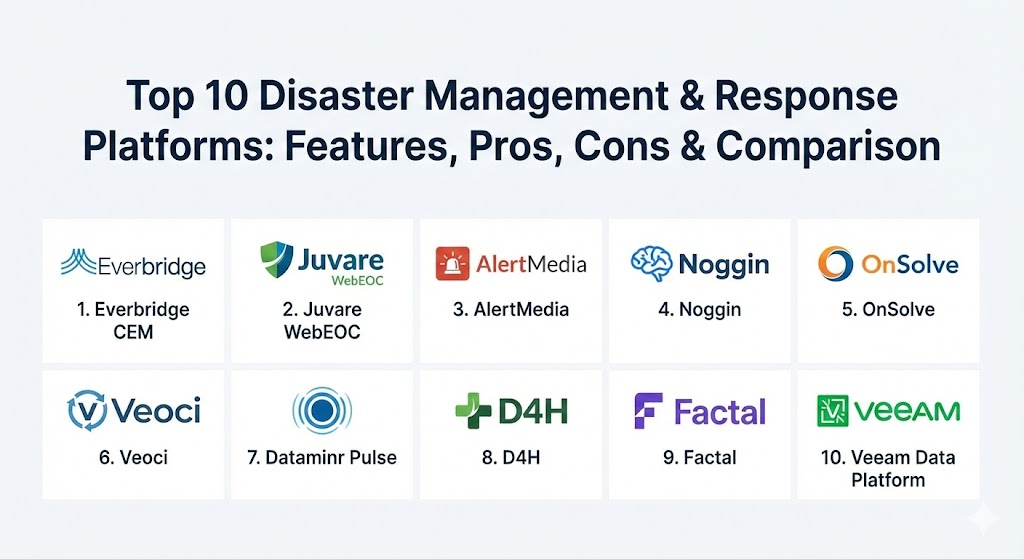
Top 10 Disaster Management & Response Platforms
1 — Everbridge Critical Event Management (CEM)
Everbridge is widely regarded as the global leader in critical event management. Its CEM platform is designed to help organizations assess threats, locate people and assets at risk, and act to mitigate damage through a highly automated, intelligence-led workflow.
- Key features:
- Visual Command Center for real-time global threat monitoring.
- Multi-modal mass notifications (SMS, Voice, Desktop, Digital Signage).
- Integrated “Safety Connection” for tracking traveling employees.
- Automated incident response playbooks and digital “Smart” folders.
- Public safety integrations for regional emergency alerts.
- Robust reporting for compliance and post-incident analysis.
- Pros:
- Massive global scale; capable of sending millions of messages in seconds.
- Extremely deep feature set that covers everything from IT outages to physical security.
- Cons:
- One of the most expensive solutions on the market.
- The interface can be overwhelming for occasional users without regular training.
- Security & compliance: FedRAMP authorized, SOC 2 Type II, ISO 27001, GDPR, and HIPAA compliant.
- Support & community: Extensive 24/7 global support, a dedicated customer success manager for enterprise accounts, and an active user community.
2 — Juvare WebEOC
Juvare WebEOC is the industry standard for Emergency Operations Centers (EOCs) worldwide. It is specifically built to mirror the complex, multi-agency structures used by state, local, and federal government entities.
- Key features:
- Customizable status boards to track missions and resource requests.
- Inter-jurisdictional data sharing (WebEOC Fusion).
- Integrated inventory management for emergency supplies and equipment.
- Mobile-responsive interface for field updates and situation reports.
- GIS mapping integration for spatial awareness of incident zones.
- After-Action Report (AAR) builders for federal grant compliance.
- Pros:
- Unmatched in its ability to support multi-agency collaboration.
- Highly flexible; administrators can build custom boards for any specific threat.
- Cons:
- Requires a high level of administrative expertise to configure properly.
- The legacy design can feel less intuitive than modern, “SaaS-native” platforms.
- Security & compliance: FIPS 140-2, SOC 2, HIPAA, and CJIS (Criminal Justice Information Services) compliant.
- Support & community: Strong presence in the public safety community with annual user conferences and specialized training tracks.
3 — AlertMedia
AlertMedia has quickly become a favorite for corporate security and business continuity teams due to its focus on ease of use and high-quality “in-house” threat intelligence.
- Key features:
- Unified interface for threat monitoring and emergency communication.
- Real-time global threat intelligence verified by human analysts.
- Multi-channel alerting with two-way messaging and safety check-ins.
- Mobile app for employees to report incidents or signal for help.
- Geographic fencing for sending location-specific alerts to travelers.
- Native integrations with major HRIS (Workday, BambooHR) for data sync.
- Pros:
- Known for having the most user-friendly interface in the industry.
- Provides verified intelligence that filters out the “noise” of raw social media.
- Cons:
- Less focus on deep EOC resource management than Juvare or Veoci.
- Can be pricier for companies that don’t need the intelligence component.
- Security & compliance: SOC 2 Type II, GDPR, and Privacy Shield compliant.
- Support & community: Highly rated customer support with 24/7 availability and personal onboarding.
4 — Noggin
Noggin is a comprehensive resilience and crisis management platform that focuses on the full lifecycle of a disaster, from initial risk assessment to long-term recovery.
- Key features:
- No-code platform that allows for rapid creation of custom workflows.
- Integrated business continuity and risk management modules.
- Unified dashboards for managing health, safety, and security.
- Library of best-practice templates for different incident types.
- Advanced analytics for identifying trends across multiple incidents.
- Dynamic forms for damage assessment and field inspections.
- Pros:
- Excellent for organizations that want to consolidate GRC (Governance, Risk, and Compliance) with disaster response.
- High level of customization without needing a developer.
- Cons:
- Setup can be complex due to the sheer number of configuration options.
- The “total” resilience approach might be overkill for teams only needing simple alerts.
- Security & compliance: ISO 27001, SOC 2, and GDPR compliant.
- Support & community: Strong technical documentation and a library of pre-configured “Standard Operating Procedures.”
5 — OnSolve
OnSolve (formerly specializing in Critical Event Management) uses AI-driven risk intelligence to help organizations detect threats early and automate their communication response across the globe.
- Key features:
- AI-powered risk intelligence that scans thousands of data sources.
- CodeRED mass notification system for high-speed emergency alerts.
- Dynamic “Safe Area” tracking for mobile and traveling workforces.
- Incident management playbooks that trigger based on threat proximity.
- Real-time situational dashboards with satellite and weather overlays.
- Public safety data feeds for local law enforcement coordination.
- Pros:
- AI filtering significantly reduces “alert fatigue” for security teams.
- The CodeRED engine is legendary for its speed and reliability in public safety.
- Cons:
- Some users find the transition between the different modules (Intel vs. Comms) a bit clunky.
- Premium features like the AI Risk Intelligence come at a significant cost.
- Security & compliance: FedRAMP authorized, SOC 2, and HIPAA compatible.
- Support & community: Dedicated account management and extensive onboarding programs for enterprise clients.
6 — Veoci
Veoci is a flexible, cloud-native platform designed to serve as a virtual EOC. It is highly collaborative, functioning like a “Slack for Emergencies” but with the structure of a professional management tool.
- Key features:
- Virtual “Rooms” for real-time department and agency collaboration.
- Customizable workflows for resource requests and expenditure tracking.
- Automated task management and notifications for “Next Steps.”
- Full offline capabilities for mobile apps in disconnected environments.
- Integrated form builder for damage assessment and situational reports.
- GIS-centric dashboards that display real-time field data.
- Pros:
- The workflow engine is incredibly powerful for automating complex bureaucracy.
- The “virtual room” concept makes it very easy for remote teams to stay synced.
- Cons:
- The flexibility can lead to “feature bloat” if not carefully managed during setup.
- Less emphasis on “automated threat feeds” than OnSolve or AlertMedia.
- Security & compliance: SOC 2 Type II, HIPAA, and GDPR compliant.
- Support & community: Praised for its collaborative implementation process and responsive support staff.
7 — Dataminr Pulse
Dataminr Pulse is the premier “Intelligence” tool for disaster response. It leverages AI to analyze billions of public data signals to provide the earliest possible warning of breaking events.
- Key features:
- AI-driven “First Alert” system that often beats traditional news by minutes or hours.
- Visual dashboards for tracking events relative to company assets.
- Integration with major response platforms (Everbridge, OnSolve).
- Real-time visual content (photos/videos) from ground-level witnesses.
- Contextual alerts that filter signals based on organizational impact.
- Historical data access for post-incident timeline reconstruction.
- Pros:
- Unrivaled speed in detecting “black swan” events.
- Essential for global organizations where minutes matter in an evacuation.
- Cons:
- It is primarily an “intelligence” tool; it does not handle mass notifications on its own.
- Can produce false positives if filters are not strictly tuned to the user’s footprint.
- Security & compliance: ISO 27001, SOC 2, and rigorous data anonymization protocols.
- Support & community: Offers high-touch analyst support and strategic intelligence reviews.
8 — D4H
D4H is a suite of tools designed specifically for the “front-line” responders—search and rescue teams, fire departments, and hazardous materials units.
- Key features:
- Equipment management module to track the health and location of gear.
- Incident management tool designed for the “incident commander” in the field.
- Personnel and training management for tracking responder certifications.
- Real-time situational awareness for small to mid-sized teams.
- Automated “Run Sheets” and reporting for operational logs.
- Mobile apps that work flawlessly in remote areas with low signal.
- Pros:
- Built by responders, for responders; it understands the reality of the field.
- Very affordable compared to the massive “enterprise” suites.
- Cons:
- Lacks the global “threat intelligence” and “mass notification” scale of Everbridge.
- Not designed for managing global corporate assets or supply chains.
- Security & compliance: GDPR compliant; cloud hosting is highly redundant.
- Support & community: Passionate community of search and rescue professionals and first responders.
9 — Factal
Factal is unique in that it combines AI technology with a 24/7 newsroom of journalists to provide the world’s most accurate, verified emergency intelligence.
- Key features:
- Journalist-verified alerts on global breaking news and disasters.
- Geographic impact analysis for company-specific sites.
- Secure chat with the Factal newsroom for real-time expert queries.
- Integration with Slack, Microsoft Teams, and major MFT/CEM tools.
- Minimalist, distraction-free interface focused on “What is happening now.”
- Collaborative maps for tracking moving threats like hurricanes or civil unrest.
- Pros:
- Eliminates the “misinformation” problem often found in raw social media feeds.
- High signal-to-noise ratio; you only get alerts that truly matter.
- Cons:
- Like Dataminr, it is an intelligence feed, not a full command-and-control platform.
- The geographical focus is primarily global/large-scale, not localized “petty” incidents.
- Security & compliance: SOC 2 Type II, GDPR, and ISO 27001.
- Support & community: Direct access to professional journalists and intelligence analysts.
10 — Veeam Data Platform (Disaster Recovery Edition)
While most tools on this list handle physical disasters, the Veeam Data Platform is the gold standard for “Digital Disaster Management.” It ensures that an organization’s digital infrastructure can survive a catastrophic failure or ransomware attack.
- Key features:
- Orchestrated recovery for virtual, physical, and cloud workloads.
- Automated “DR Testing” to ensure backups will actually work when needed.
- Ransomware recovery with immutable (unchangeable) backups.
- Unified monitoring and alerting for all backup storage health.
- “One-click” failover to secondary sites or the public cloud.
- Compliance reporting for RTO (Recovery Time Objective) and RPO targets.
- Pros:
- The essential tool for managing the “digital” half of a disaster.
- Highly reliable and widely used by the majority of the Fortune 500.
- Cons:
- Focuses strictly on IT/Data; it does not coordinate physical responders or mass alerts.
- Licensing for full orchestration features can be expensive for SMBs.
- Security & compliance: FedRAMP, SOC 2, HIPAA, and GDPR compliant.
- Support & community: World-class support and the largest community of backup professionals in the world.
Comparison Table
| Tool Name | Best For | Platform(s) Supported | Standout Feature | Rating (Gartner Peer Insights) |
| Everbridge CEM | Global Enterprises | SaaS, Mobile, Desktop | 100+ Alert Channels | 4.6 / 5 |
| Juvare WebEOC | Public Safety / Gov | Web-based, Mobile | Inter-Agency Fusion | 4.4 / 5 |
| AlertMedia | Corporate Security | SaaS, Mobile | In-House Intelligence | 4.8 / 5 |
| Noggin | Resilience & GRC | Web, Mobile | No-Code Flexibility | 4.5 / 5 |
| OnSolve | AI Risk Management | SaaS, Mobile | AI-Driven Threat Detection | 4.5 / 5 |
| Veoci | Virtual EOC | SaaS, Mobile, Offline | Collaborative “Rooms” | 4.7 / 5 |
| Dataminr Pulse | Real-time Intel | SaaS, Mobile | AI “First Alert” Speed | 4.6 / 5 |
| D4H | Front-line Responders | SaaS, Mobile, Offline | Equipment Tracking | 4.7 / 5 |
| Factal | Verified Intelligence | SaaS, Mobile | Journalist-Led Verification | 4.8 / 5 |
| Veeam Data Platform | IT Disaster Recovery | Multi-Cloud, On-Prem | Automated DR Orchestration | 4.8 / 5 |
Evaluation & Scoring of Disaster Management & Response Platforms
The following rubric is used by organizations to objectively evaluate these high-stakes platforms. In 2026, the weight has shifted slightly more toward “AI Intelligence” and “Ease of Use” to combat the increasing complexity of global crises.
| Category | Weight | Evaluation Criteria |
| Core Features | 25% | Mass notification speed, command structure support, and resource management. |
| Ease of Use | 15% | Intuitiveness during high-stress moments; quality of mobile app interface. |
| Integrations | 15% | Ability to pull data from HRIS, GIS, weather sensors, and security cameras. |
| Security & Compliance | 10% | FedRAMP/ISO status; audit logs for legal discovery; data residency. |
| Performance | 10% | Guaranteed uptime (SLA) and notification delivery success rates. |
| Support | 10% | 24/7 emergency response support and quality of implementation services. |
| Price / Value | 15% | Total cost of ownership relative to the reduction in operational risk. |
Which Disaster Management & Response Platform Is Right for You?
Deciding on a platform requires a sober assessment of your organization’s risk profile and administrative capacity.
- Solo Users vs. SMBs: Small teams with limited budgets should look at D4H for operational needs or AlertMedia for a simple, high-impact alerting system. Don’t buy a complex EOC tool if you don’t have a dedicated “Emergency Manager” to run it.
- Mid-Market vs. Enterprise: Mid-sized companies often choose AlertMedia or OnSolve for their balance of “Intelligence + Communication.” Large enterprises with global footprints should prioritize Everbridge or Dataminr to manage the scale of their operations.
- Government & Public Safety: If your primary goal is coordinating with other agencies during a hurricane or flood, Juvare WebEOC or Veoci are the logical choices, as they were built specifically for NIMS (National Incident Management System) compliance.
- Intelligence Needs: If you already have a communication tool (like Teams or Slack) and just need to know what is happening before anyone else, Factal or Dataminr are the world-class options for pure intelligence.
- Security & Compliance: If your industry requires a strict paper trail for federal audits (like Healthcare or Aviation), prioritize platforms with strong “After-Action Reporting” features like Juvare or Noggin.
Frequently Asked Questions (FAQs)
1. What is the difference between an Emergency Notification System (ENS) and a full Response Platform? An ENS is designed primarily for “one-way” alerts (sending a text message). A full Response Platform (like Veoci or WebEOC) manages the entire operation, including task tracking, resource allocation, and collaborative command.
2. Can these tools work if the internet goes down? Most platforms are cloud-based, but top-tier field tools like D4H and Veoci have offline modes that store data locally on a mobile device and sync once a connection is restored.
3. Do I need a GIS (Mapping) specialist to use these? Modern platforms have “plug-and-play” GIS integrations (often with Esri ArcGIS). While a specialist helps for complex mapping, most IT generalists can handle the standard location-based alerting.
4. How does AI help in disaster management? AI is primarily used for “filtering.” It scans millions of social media posts, sensor readings, and news reports to find the few signals that actually matter to your organization, preventing “alert fatigue.”
5. How long does it take to deploy a platform like Everbridge? A basic setup can be done in a few weeks. However, a full enterprise rollout—including integrating all employee data, creating playbooks, and training staff—can take 3 to 6 months.
6. Are there open-source disaster management tools? Yes, tools like Sahana Eden are open-source and widely used in humanitarian aid, but they often lack the 24/7 commercial support and high-speed mass notification infrastructure of the platforms listed here.
7. Can these tools help with COVID-19 or future pandemic planning? Absolutely. Many of these platforms have specific modules for “health screening,” “contact tracing,” and “vaccination tracking” that were developed or refined during the early 2020s.
8. Is my data secure on these cloud platforms? Top vendors invest heavily in security, often achieving FedRAMP (for government) or SOC 2 certifications. Your data is typically more secure there than on a localized, unmonitored server.
9. What is an “After-Action Report” (AAR)? An AAR is a formal document generated by the platform after an event that analyzes what happened, what went well, and what needs to be improved for the next disaster.
10. Do these platforms integrate with Microsoft Teams or Slack? Yes, most modern platforms have “ChatOps” integrations, allowing security teams to receive alerts and even trigger response workflows directly from within their everyday messaging apps.
Conclusion
Disaster management in 2026 is a data-driven discipline. The “best” platform is not necessarily the one with the most buttons, but the one that your team can use effectively under the extreme pressure of a crisis. Whether you prioritize the AI-driven speed of Dataminr, the multi-agency collaboration of WebEOC, or the simple reliability of AlertMedia, the goal remains the same: ensuring that when the worst happens, your organization is the most prepared entity in the room.