Introduction
Digital Forensics & Incident Response (DFIR) is a specialized field that combines two distinct but symbiotic disciplines. Incident Response (IR) focuses on the immediate containment and eradication of a cyber threat, while Digital Forensics involves the meticulous collection, preservation, and analysis of digital evidence for legal or investigative purposes. Together, a DFIR suite provides the visibility and tooling required to reconstruct a timeline of an attack, identify the root cause, and maintain a forensically sound chain of custody.
The importance of DFIR tools has skyrocketed due to the professionalization of cybercrime. From multi-stage ransomware attacks to sophisticated insider data exfiltration, organizations must be able to peer into memory, disk artifacts, and cloud logs simultaneously. Key real-world use cases include identifying compromised credentials, recovering deleted malicious scripts, and proving regulatory compliance after a data leak. When evaluating a suite, look for remote acquisition capabilities, automated artifact parsing, scalability across thousands of endpoints, and timeline visualization that turns raw data into a narrative.
Best for: Security Operations Center (SOC) teams, large-scale enterprises with complex regulatory requirements, law enforcement agencies, and third-party incident response consultants who need to handle diverse hardware and cloud environments.
Not ideal for: Small businesses with no dedicated IT security staff or individuals with basic personal security needs. For these users, a standard Endpoint Protection (EPP) platform is usually sufficient without the complexity of deep-dive forensics.
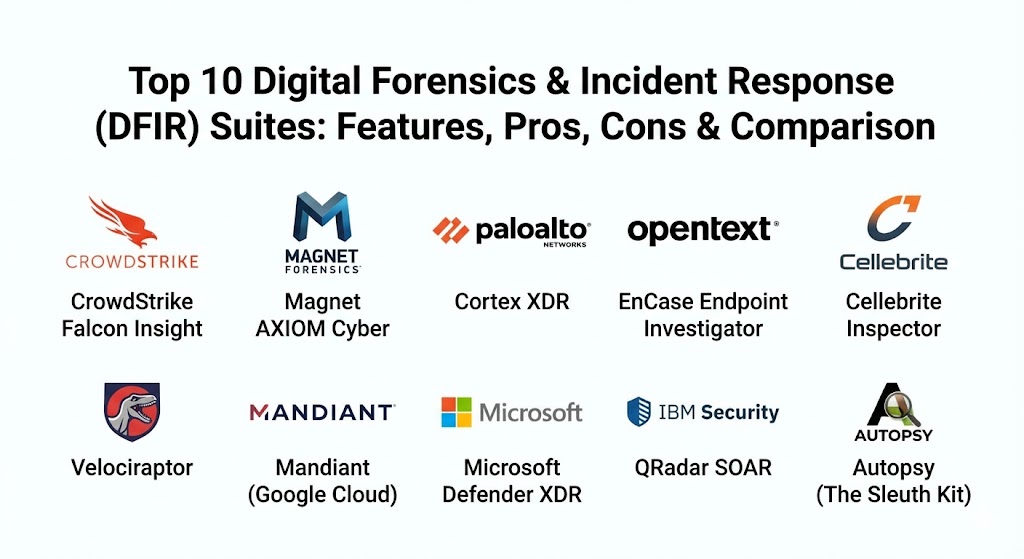
Top 10 Digital Forensics & Incident Response (DFIR) Suites
1 — CrowdStrike Falcon Insight
CrowdStrike Falcon Insight is a cloud-native Endpoint Detection and Response (EDR) platform that has become a staple in the DFIR world. It is designed to provide high-speed visibility and automated response across global enterprise environments.
- Key features:
- Falcon Real Time Response (RTR): Allows investigators to run commands and collect artifacts on remote endpoints instantly.
- CrowdScore: An incident workbench that correlates related alerts into a single, high-level threat score.
- 90-Day Data Retention: Provides a long-term historical record of endpoint activity for retrospective hunting.
- Managed Threat Hunting: Integration with Falcon OverWatch for expert-led breach detection.
- Zero Trust Assessment: Evaluates endpoint health and security posture in real-time.
- Lightweight Agent: A single, non-intrusive sensor that handles all security modules.
- Pros:
- Exceptional scalability; can manage hundreds of thousands of endpoints without performance lag.
- The “speed to investigate” is industry-leading due to its cloud-native architecture.
- Cons:
- Primarily focused on “live” response; less suited for traditional “dead-box” forensics.
- Advanced forensic features are often tied to premium licensing tiers.
- Security & compliance: SOC 2 Type II, HIPAA, GDPR, PCI DSS, and FedRAMP authorized. Includes granular RBAC and encrypted data transit.
- Support & community: World-class 24/7 support; extensive technical documentation and an elite user community through the CrowdStrike “Tech Center.”
2 — Magnet AXIOM Cyber
Magnet AXIOM Cyber is an enterprise-grade forensic platform specifically built for organizations that need to perform remote investigations on off-network endpoints and cloud services.
- Key features:
- Remote Acquisition: Collects data from Mac, Windows, and Linux computers even when they aren’t on the corporate VPN.
- Cloud Evidence Integration: Directly ingest data from AWS, Azure, Google Workspace, Slack, and Office 365.
- Magnet.AI: Uses machine learning to automatically categorize pictures and detect potential threats like credit card numbers.
- Timeline Analysis: Correlates artifacts from mobile, computer, and cloud into a single visual view.
- Forensically Sound Containers: Writes all collected data into the standardized AFF4-L format.
- Custom Artifacts: Allows users to build and share their own parsing scripts for niche applications.
- Pros:
- The best tool for unifying disparate data sources (mobile, cloud, PC) into a single case file.
- Highly intuitive interface that balances powerful deep-dives with ease of use.
- Cons:
- Remote agent deployment can sometimes be tricky in highly restrictive network environments.
- Heavy processing requirements; needs a high-performance workstation for large cases.
- Security & compliance: ISO 27001 and SOC 2 compliant. Supports full audit logs and evidence integrity verification via hashing.
- Support & community: Excellent customer support with rapid response times; Magnet Forensics is known for its heavy involvement in the DFIR community.
3 — Palo Alto Networks Cortex XDR
Cortex XDR is the industry’s first extended detection and response platform that integrates endpoint, network, and cloud data to stop sophisticated attacks. It focuses heavily on automation and data stitching.
- Key features:
- Data Stitching: Automatically correlates logs from different sources to reconstruct the full sequence of an attack.
- Cortex Query Language (XQL): A powerful search tool for digging through massive datasets for specific IOCs.
- Automated Investigation Playbooks: Speeds up response by automating common containment tasks.
- Behavioral Analytics: Detects anomalies that signify insider threats or zero-day exploits.
- Managed Detection and Response (MDR): 24/7 threat monitoring and hunting services.
- Device Control: Manages USB and external storage to prevent data exfiltration.
- Pros:
- Unrivaled for organizations already using Palo Alto firewalls, as it natively “stitches” network and endpoint data.
- Reduces alert fatigue by 98% through intelligent grouping.
- Cons:
- Maximum value is locked behind the broader Palo Alto ecosystem.
- The interface is dense and requires significant training to master.
- Security & compliance: GDPR, HIPAA, and ISO 27001 compliant. Data is encrypted at rest and in transit.
- Support & community: Strong enterprise support; extensive training certifications (PCDRA) and a large global user base.
4 — OpenText EnCase Endpoint Investigator
A legacy titan in the field, EnCase is often considered the gold standard for “court-admissible” digital forensics. The Endpoint Investigator version extends this power to remote enterprise environments.
- Key features:
- Remote Discreet Acquisition: Acquire data from remote endpoints without notifying the end-user.
- Comprehensive Artifact Support: Deep-dive parsing for system files, registry keys, and deleted data.
- Condition-Based Searching: Advanced logic for filtering through terabytes of data.
- Court-Ready Reporting: Generates standardized reports that are widely accepted in legal proceedings.
- Snapshot Capability: Capture a point-in-time image of an endpoint’s volatile memory.
- Multi-Platform Support: Works across Windows, Mac, and various Linux distributions.
- Pros:
- Reliability and legal standing are unmatched; used by law enforcement worldwide.
- Capable of performing extremely “deep” forensics that many EDR tools miss.
- Cons:
- The user interface is notoriously dated and can be difficult for newer analysts.
- Slower processing speeds compared to modern, artifact-first tools like Axiom.
- Security & compliance: FIPS 140-2, GDPR, and HIPAA compliant. Maintains a strict, documented chain of custody.
- Support & community: High-tier enterprise support; a massive historical community of “EnCase Certified Examiners” (EnCE).
5 — Cellebrite Inspector (Enterprise)
While Cellebrite is the leader in mobile forensics, their Inspector suite is a powerful computer forensic tool designed to analyze Mac and Windows systems with the same precision they apply to smartphones.
- Key features:
- Volume Shadow Copy Analysis: Exclusive capability to review device history from Windows Volume Shadow Copies.
- Mac Specialist Support: Deep-dive analysis for T2 chip systems, Fusion drives, and APFS snapshots.
- AI Media Categorization: Automatically identifies and tags images containing weapons, drugs, or PII.
- Spotlight Metadata Parsing: Extracts rich metadata from macOS Spotlight for a better timeline.
- Smart Filters: One-click filtering for Internet History, Downloads, and Recent Searches.
- Portable Case Review: Share findings with non-technical stakeholders via a lightweight reader.
- Pros:
- The absolute best tool for modern macOS forensics.
- AI-driven media analysis significantly speeds up investigations involving large image datasets.
- Cons:
- Primarily an analysis tool; requires other tools for high-speed “live” enterprise response.
- High price point compared to some general-purpose forensics suites.
- Security & compliance: ISO 27001 and SOC 2. Rigorous evidence validation and hashing.
- Support & community: World-class training programs (Cellebrite Academy) and a very active law enforcement and enterprise community.
6 — Velociraptor (Open Source)
Velociraptor is an open-source endpoint visibility and collection tool that has taken the DFIR community by storm due to its power, speed, and customizability.
- Key features:
- VQL (Velociraptor Query Language): Allows users to write custom queries to hunt for artifacts across the entire fleet.
- Remote Monitoring: Continuous monitoring of endpoint events for real-time detection.
- Fast Acquisition: Can collect a “triage” package from an endpoint in seconds.
- Offline Collection: Supports creating an offline collector for air-gapped systems.
- Scalability: Capable of managing thousands of endpoints with a very low resource footprint.
- Server-Side Post-Processing: Data can be analyzed on the server to reduce endpoint impact.
- Pros:
- Completely free and open-source, yet more powerful than many paid enterprise tools.
- The community-driven artifact library is updated almost daily with new threat-hunting logic.
- Cons:
- Requires significant technical skill to master VQL and manage the server infrastructure.
- No dedicated enterprise support (though community support is exceptional).
- Security & compliance: Varies by implementation. Supports encrypted communication between clients and servers.
- Support & community: Extremely vibrant community on Discord and GitHub; excellent documentation.
7 — Mandiant (Google Cloud)
Mandiant (now part of Google Cloud) is synonymous with elite breach response. Their suite of tools is designed for high-stakes investigations involving nation-state actors and advanced persistent threats (APTs).
- Key features:
- Frontline Intelligence: Direct integration with Mandiant’s world-leading threat intelligence feeds.
- Compromise Assessments: Specialized tooling to identify if an attacker is currently in the environment.
- Redline: A free/freemium endpoint tool for fast forensic data collection and analysis.
- ThreatSpace: A virtual cyber range for practicing IR in a controlled environment.
- Mandiant Advantage: A centralized platform for threat intelligence and security validation.
- Expert-Led IR: Direct access to Mandiant’s legendary incident response teams.
- Pros:
- The “gold standard” for threat actor attribution and understanding adversary tradecraft.
- Recently enhanced with Google Cloud’s massive data processing and AI capabilities.
- Cons:
- Primarily a service-heavy engagement; can be prohibitively expensive for mid-market users.
- Many of their best tools are proprietary and only available during active Mandiant engagements.
- Security & compliance: FedRAMP High, SOC 2, and ISO 27001 compliant.
- Support & community: Elite enterprise support; Mandiant “M-Trends” reports are industry-standard reading for DFIR pros.
8 — Microsoft Defender XDR
Microsoft Defender XDR provides a unified security suite for organizations running on the Windows and Azure ecosystem, offering deep forensic integration into the OS itself.
- Key features:
- Live Response: Built-in console for running forensic scripts and collecting files.
- Advanced Hunting: Kusto Query Language (KQL) for searching through 30 days of raw telemetry.
- Automated Investigation & Response (AIR): Automatically investigates alerts and remediates common threats.
- Forensic Artifact Collection: Native collection of event logs, MFT, and registry hives.
- Cloud App Security: Extends visibility into SaaS applications and cloud infrastructure.
- Secure Score: A dashboard that helps admins prioritize security improvements.
- Pros:
- Exceptional value for organizations already paying for Microsoft 365 E5 licenses.
- Native OS integration allows for visibility that third-party agents sometimes miss.
- Cons:
- “Live response” console can be clunky compared to specialized tools like Velociraptor.
- Not as effective for macOS or Linux forensics as it is for Windows.
- Security & compliance: Broadest compliance coverage in the industry, including HIPAA, GDPR, and FedRAMP.
- Support & community: Global enterprise support; massive community of IT and security professionals.
9 — IBM Security QRadar SOAR
QRadar SOAR (formerly Resilient) is an orchestration and response platform that serves as the brain of a SOC, guiding investigators through the DFIR process using automated playbooks.
- Key features:
- Dynamic Playbooks: Automatically adjusts response steps based on the details of the incident.
- Incident Case Management: Centralized tracking of evidence, timelines, and tasks.
- Visual Investigation: Graph views of related artifacts and threats.
- Integration Hub: Connects to over 300 different security tools (EDR, SIEM, Firewalls).
- Privacy Module: Built-in guidance for regulatory notification requirements (e.g., GDPR timelines).
- Customizable Dashboards: Real-time visibility into SOC metrics like MTTR (Mean Time to Respond).
- Pros:
- The best tool for managing the “process” of incident response at a massive scale.
- Excellent at ensuring consistent, compliant response across a large global team.
- Cons:
- It is a management/orchestration tool, not a raw forensic collection tool; requires integration with EDR/forensics.
- Configuration of complex playbooks can be time-consuming.
- Security & compliance: SOC 2, ISO 27001, and GDPR compliant.
- Support & community: IBM’s massive enterprise support infrastructure; active user groups and a deep knowledge base.
10 — Autopsy (The Sleuth Kit)
Autopsy is the premier open-source digital forensics platform. It is a GUI-based tool that makes the powerful command-line “Sleuth Kit” accessible to everyone from students to professionals.
- Key features:
- Multi-User Cases: Allows multiple investigators to work on the same large case simultaneously.
- Timeline Analysis: Generates graphical timelines of system events.
- Keyword Search: High-speed indexing and searching for specific strings or patterns.
- Web Artifact Analysis: Automatically parses history, cookies, and bookmarks from major browsers.
- Registry Analysis: Parses Windows Registry hives to find user activity and system changes.
- Android/iOS Support: Basic parsing for mobile device images.
- Pros:
- Completely free and highly extensible through a community plugin system.
- Very easy to set up; great for “quick look” investigations or academic training.
- Cons:
- Does not have remote acquisition capabilities; requires a disk image (E01/Raw) to begin.
- Can be slow when processing very large datasets compared to high-end commercial tools.
- Security & compliance: N/A (Open Source). Evidence integrity is maintained via standard hashing algorithms (MD5/SHA).
- Support & community: Robust community forum and open-source development on GitHub.
Comparison Table
| Tool Name | Best For | Platform(s) Supported | Standout Feature | Rating (Gartner) |
| CrowdStrike Falcon | Enterprise Speed | Windows, Mac, Linux | Cloud-Native Scalability | 4.8 / 5 |
| Magnet AXIOM Cyber | Remote/Cloud DFIR | Windows, Mac, Cloud, Mobile | Artifact Unification | 4.7 / 5 |
| Cortex XDR | Data Correlation | Endpoint, Network, Cloud | Cross-Source Stitching | 4.7 / 5 |
| EnCase Investigator | Legal/Court Cases | Windows, Mac, Linux | Discreet Acquisition | 3.4 / 5* |
| Cellebrite Inspector | Mac Forensics | Windows, Mac | Volume Shadow Copy Analysis | N/A |
| Velociraptor | Advanced Hunting | Windows, Mac, Linux | VQL Query Power | N/A |
| Mandiant | Breach Response | Global/Custom | Adversary Intelligence | 4.6 / 5 |
| Microsoft Defender | MS Ecosystem | Windows, Mac, Linux | Native Windows Deep-Dive | 4.6 / 5 |
| QRadar SOAR | IR Management | Platform Agnostic | Dynamic Playbooks | 4.5 / 5 |
| Autopsy | Dead-Box Analysis | Windows, Linux | Open-Source Accessibility | N/A |
*Note: EnCase’s lower rating often reflects its dated UI rather than its forensic efficacy.
Evaluation & Scoring of DFIR Suites
The following scoring rubric reflects the criteria most critical to modern security teams in 2026.
| Category | Weight | Evaluation Criteria |
| Core Features | 25% | Artifact parsing depth, remote acquisition, memory forensics, and timeline support. |
| Ease of Use | 15% | UI clarity, automated workflows, and the learning curve for new analysts. |
| Integrations | 15% | API availability and native hooks into SIEM, SOAR, and cloud providers. |
| Security & Compliance | 10% | Evidence integrity (hashing), chain of custody logs, and regulatory readiness. |
| Performance | 10% | Processing speed for large datasets and agent impact on endpoint resources. |
| Support & Community | 10% | Availability of training, technical support, and a vibrant peer community. |
| Price / Value | 15% | Licensing transparency and “return on investment” for time saved. |
Which DFIR Tool Is Right for You?
Choosing a tool is not about finding the “best” on the list, but the one that fits your organization’s unique threat profile and budget.
- Solo Users / Students: Start with Autopsy and Velociraptor. They provide professional-grade power for free and are the best way to learn the fundamentals of forensics and hunting.
- SMBs (Small/Medium Businesses): If you are already on Microsoft 365, lean heavily into Microsoft Defender XDR. It’s likely already paid for and offers enough forensic power for 90% of common incidents.
- Mid-Market Enterprises: Magnet AXIOM Cyber is often the “sweet spot” for corporate investigations. It handles internal employee misconduct and external breaches with equal grace and doesn’t require a team of developers to manage.
- Global Enterprises / SOCs: You need a “Force Multiplier.” CrowdStrike Falcon or Cortex XDR are essential for real-time fleet visibility, while QRadar SOAR ensures your team follows a consistent response process.
- Consultants / Lab Forensics: If your work involves the courtroom, you still need EnCase or Magnet Axiom to ensure your evidence stands up to scrutiny. For mobile-heavy cases, Cellebrite remains the gold standard.
Frequently Asked Questions (FAQs)
1. What is the difference between EDR and DFIR? EDR (Endpoint Detection and Response) is a tool for monitoring and stopping threats. DFIR (Digital Forensics & Incident Response) is the broader discipline that uses EDR data, along with disk images and memory captures, to perform a deep-dive investigation.
2. Can I use these tools for cloud-native breaches (AWS/Azure)? Yes. Modern suites like Magnet AXIOM Cyber and Mandiant have specialized modules to ingest logs and snapshots from cloud providers without needing to install an agent on a physical server.
3. Is “Dead-Box” forensics still relevant? Yes. While “live” forensics is faster, some sophisticated malware only leaves traces on the disk that can be found by taking a full forensic image and analyzing it offline.
4. How long does a typical forensic investigation take? It varies wildly. A simple triage can take an hour, while a complex nation-state breach investigation can take weeks or months to fully reconstruct every movement of the attacker.
5. Do these tools impact the performance of my employees’ computers? Modern “lightweight” agents (like CrowdStrike or Velociraptor) typically use less than 1% of CPU. Deep-dive collection tools may temporarily slow a system down while they are actively copying data.
6. What is a “Chain of Custody”? It is a chronological documentation or paper trail that records the sequence of custody, control, and transfer of physical or electronic evidence. It is crucial for evidence to be admissible in court.
7. Can I recover deleted files with these tools? Often, yes. Forensic tools like EnCase and Magnet Axiom can scan the unallocated space on a hard drive to find and reconstruct files that the OS has “deleted” but not yet overwritten.
8. What is the most important skill for a DFIR analyst? Beyond tool knowledge, critical thinking is key. An analyst must be able to “connect the dots” between a suspicious network connection and a hidden registry key to find the true root cause.
9. Are these tools expensive? Enterprise tools can cost tens of thousands of dollars per year. However, open-source options like Velociraptor and Autopsy allow teams to build a powerful “lab” for almost $0.
10. Do I need a certification to use these tools? While not required, certifications like GCFE (GIAC Certified Forensic Examiner) or EnCE (EnCase Certified Examiner) are highly respected and ensure that an investigator knows how to use the tools correctly and ethically.
Conclusion
The DFIR landscape in 2026 is defined by context and speed. As attackers move faster, our ability to reconstruct their path must be instantaneous. There is no “universal winner” in the DFIR space because the needs of a corporate investigator are different from those of a nation-state breach responder. Whether you choose the cloud-native speed of CrowdStrike, the deep artifact parsing of Magnet, or the open-source flexibility of Velociraptor, the key is to have a tool that your team can operate with confidence when every minute counts.