Introduction
Digital Coupon Management Tools are centralized software platforms designed to create, distribute, track, and validate promotional offers across multiple channels. These systems act as a “promotion engine,” allowing businesses to replace manual spreadsheets and hard-coded discounts with a flexible, rule-based infrastructure. By integrating with eCommerce platforms, Point of Sale (POS) systems, and Customer Relationship Management (CRM) tools, they ensure that every coupon is unique, secure, and delivered to the right person at the optimal moment.
The importance of these tools is underscored by the rise of “coupon fraud” and the need for incremental revenue. Without a dedicated tool, brands risk “code sprawl,” where universal codes go viral on discount sites, cannibalizing margins without driving new customer acquisition. Key use cases include abandoned cart recovery, location-triggered mobile offers, and “win-back” campaigns for lapsed shoppers. When choosing a tool, evaluators should look for API-first architectures, granular rule builders, real-time validation capabilities, and robust security features to prevent stacking or unauthorized reuse.
Best for: Mid-to-large eCommerce brands, omnichannel retailers, restaurant chains, and marketing agencies that manage high-volume, complex promotional campaigns across various customer touchpoints.
Not ideal for: Small hobbyist shops with very low sales volume or companies that only offer one permanent site-wide discount that never changes.
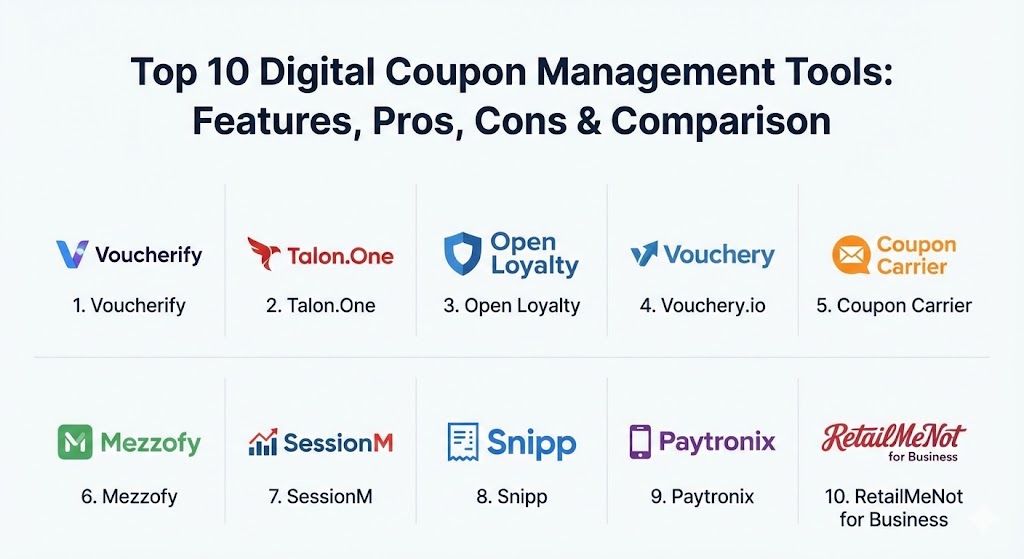
Top 10 Digital Coupon Management Tools
1 — Voucherify
Voucherify is a developer-friendly, API-first promotion engine designed for digital teams that need a flexible building block for coupons, referrals, and loyalty programs. It focuses on providing “infrastructure as a service” for marketing incentives.
- Key features:
- API-first architecture for seamless integration into web and mobile apps.
- Highly granular rule engine for setting redemption limits and eligibility.
- Support for unique, single-use codes to prevent fraud and viral sharing.
- Automated distribution manager for email, SMS, and push notifications.
- Real-time monitoring and advanced analytics dashboard.
- Built-in stacking rules to prevent customers from combining too many offers.
- Pros:
- Exceptional flexibility for developers; can be integrated into almost any tech stack.
- Handles complex logic like “Buy X, Get Y” or geography-based discounts with ease.
- Cons:
- Requires some technical knowledge to set up initially compared to “plug-and-play” apps.
- The pricing is usage-based, which can become expensive during peak holiday seasons.
- Security & compliance: SOC 2 Type II, GDPR compliant, SSO integration, and 2FA.
- Support & community: Extensive API documentation, a helpful developer portal, and dedicated enterprise support for higher tiers.
2 — Talon.One
Talon.One is a powerhouse promotion engine used by global enterprises like Adidas and Burger King. It treats promotions like programmable infrastructure, allowing for highly complex, data-driven decision trees.
- Key features:
- Visual Rule Builder that allows marketers to create logic without writing code.
- Geofencing capabilities for location-specific mobile promotions.
- Headless architecture that supports omnichannel (online + in-store) redemption.
- Staging environments for testing complex promotion logic before going live.
- High-performance infrastructure capable of handling thousands of requests per second.
- Deep integration with CRM data for ultra-personalized offers.
- Pros:
- Unmatched scalability for global brands with multi-market needs.
- The visual editor is one of the most powerful and intuitive in the enterprise space.
- Cons:
- Very steep learning curve for mastering the full breadth of the rule builder.
- High price point makes it inaccessible for small or mid-sized businesses.
- Security & compliance: ISO 27001, SOC 2, HIPAA, and GDPR compliant.
- Support & community: Enterprise-grade support with dedicated account managers and technical consulting.
3 — Open Loyalty
Open Loyalty provides a unified platform that blends digital coupons with loyalty mechanics. It is designed for brands that want to move beyond one-off discounts and into long-term customer engagement.
- Key features:
- Unified engine for coupons, loyalty points, tiers, and gamification.
- Headless and API-first design for total frontend flexibility.
- “Customer Cockpit” feature where users can manage their own rewards.
- Multi-tenant setup suitable for multi-brand conglomerates.
- POS-ready barcode generation for seamless in-store redemption.
- Real-time validation for omnichannel consistency.
- Pros:
- Stronger focus on “engagement” than pure-play coupon engines.
- Excellent for retailers with both physical stores and digital apps.
- Cons:
- Can be overly complex if you only need simple coupon code generation.
- Requires a more significant integration effort than standalone coupon tools.
- Security & compliance: Enterprise-grade security with support for GDPR and role-based access control.
- Support & community: Strong partner ecosystem and comprehensive online documentation.
4 — Vouchery.io
Vouchery.io is an automation-centric platform built for eCommerce teams that want to optimize their promotional spend using AI and predictive modeling.
- Key features:
- AI-driven coupon targeting to predict which customers need a discount to convert.
- Abuse detection and fraud scoring to flag suspicious redemption patterns.
- Automated “Coupon Lifecycle” management from creation to expiration.
- Dedicated micro-influencer dashboards for tracking affiliate-style coupons.
- Webhooks for real-time updates to third-party marketing apps.
- Tiered rewards engine (cashback, free gifts, or percentage discounts).
- Pros:
- The predictive analytics help protect margins by avoiding “unnecessary” discounts.
- Quick setup compared to heavy enterprise engines.
- Cons:
- The UI can feel slightly less polished than the top-tier competitors.
- The AI features require a significant amount of data to become truly effective.
- Security & compliance: GDPR compliant with encrypted data storage and audit logs.
- Support & community: Personalized onboarding and responsive email support.
5 — Coupon Carrier
Coupon Carrier is a specialized tool focused on the distribution and delivery of unique codes. It acts as the “bridge” between your code list and your email/SMS marketing tools.
- Key features:
- Automated code delivery via email, SMS, or directly on landing pages.
- Direct integrations with Mailchimp, Klaviyo, and ActiveCampaign.
- “Code Autofill” technology for browser-based redemptions.
- Inventory alerts to notify admins when unique codes are running low.
- Simple web-based validator for manual redemptions.
- Support for importing third-party codes (e.g., from Groupon or Amazon).
- Pros:
- Extremely easy to use; can be set up in minutes without a developer.
- Perfect for brands that already have a CRM but need a secure way to hand out codes.
- Cons:
- Limited as a standalone “promotion engine”; it manages distribution more than logic.
- Lacks advanced fraud detection or stacking rules found in other platforms.
- Security & compliance: Basic SSO and GDPR compliance; focus is on secure delivery.
- Support & community: Excellent documentation and very fast response times for small business users.
6 — Mezzofy
Mezzofy is a Hong Kong-based platform that has gained global traction for its focus on the “Digital Coupon Ecosystem,” particularly for retail and Quick Service Restaurants (QSR).
- Key features:
- Native support for QR codes and NFC “Tap-to-Get” coupon technology.
- Digital wallet integration (Apple Wallet, Google Pay).
- Paperless coupon infrastructure for eco-friendly retail.
- Merchant-to-merchant coupon exchange capabilities.
- Real-time redemption tracking across thousands of physical locations.
- API support for custom CRM and POS integrations.
- Pros:
- One of the best options for physical retail and location-based marketing.
- Innovative “Tap” technology is great for event promoters and pop-up shops.
- Cons:
- The administrative interface can be less intuitive for Western users.
- Some features are heavily optimized for the Asian retail market.
- Security & compliance: Uses non-serial unique codes to prevent brute-force guessing.
- Support & community: Robust support in the APAC region; global support is expanding.
7 — SessionM (by Mastercard)
SessionM is an enterprise-scale customer engagement platform that combines deep data analytics with offer management, now backed by Mastercard’s vast data ecosystem.
- Key features:
- Real-time customer profiles that update based on transaction data.
- Event-driven offer activation (e.g., trigger a coupon after a specific purchase).
- Deep POS integration for seamless “swipe or scan” redemptions.
- Advanced segmentation based on historical spending behavior.
- Enterprise-grade reporting on ROI and incremental lift.
- High-security infrastructure designed for the financial sector.
- Pros:
- The data integration is incredibly deep, allowing for “1-to-1” personalization.
- High reliability; designed for massive, high-concurrency environments.
- Cons:
- Very high cost and complex implementation process.
- Most effective only if you are already using Mastercard’s broader ecosystem or have massive data sets.
- Security & compliance: PCI-DSS Level 1, SOC 2, and rigorous financial-grade security standards.
- Support & community: Full-service enterprise consulting and 24/7 technical support.
8 — Snipp
Snipp is a unique player that focuses on “Receipt Validation.” It is the go-to tool for CPG (Consumer Packaged Goods) brands that don’t own their own checkout systems but need to offer rebates and coupons.
- Key features:
- Industry-leading Receipt Processing Engine (OCR) to validate purchases.
- Rebate and cashback management at scale.
- “Buy X, Get Y” campaigns that work across any retailer.
- Integrated sweepstakes and contest modules.
- Financial-grade compliance for monetary disbursements.
- Mobile-first “snap and send” redemption flow for consumers.
- Pros:
- Allows brands to run coupons even if the retailer’s POS doesn’t support them.
- Excellent for collecting first-party data from third-party retail sales.
- Cons:
- Higher friction for users who have to take a photo of a receipt.
- Not a traditional “coupon code” generator for eCommerce sites.
- Security & compliance: ISO 27001 and GDPR compliant.
- Support & community: White-glove service for campaign setup and management.
9 — Paytronix
Paytronix is specialized for the restaurant and convenience store industries, focusing on high-frequency transactions and mobile app integration.
- Key features:
- Integrated mobile app builder for branded “Reward” apps.
- Real-time guest data and visit-based coupon triggers.
- Seamless integration with major restaurant POS systems (Toast, Aloha).
- SMS and push notification marketing automation.
- Machine learning models to predict guest churn and send “win-back” offers.
- Support for “stored value” cards and gift cards alongside coupons.
- Pros:
- Specifically built for the “food and fuel” industry workflows.
- Strong emphasis on driving physical foot traffic.
- Cons:
- Less flexible for general eCommerce or B2B software companies.
- The reporting suite can be overwhelming for single-location owners.
- Security & compliance: PCI compliant and supports standard SSO.
- Support & community: Dedicated account managers and 24/7 emergency support for POS issues.
10 — RetailMeNot for Business
RetailMeNot is best known as a consumer site, but their “for Business” suite provides brands with a powerful platform for massive distribution and brand discovery.
- Key features:
- Access to a massive audience of millions of “active” shoppers.
- Verified code publishing to prevent “non-working” code complaints.
- Attribution modeling to show exactly how much revenue a coupon generated.
- Seasonal and “Flash Sale” placement opportunities on their homepage.
- Integration with affiliate networks for performance-based tracking.
- Fraud monitoring for “leaked” codes.
- Pros:
- The best tool for pure “discovery” and finding new customers.
- Leverages a highly trusted brand name to increase coupon click-through rates.
- Cons:
- You have less control over the “logic” compared to an internal engine like Voucherify.
- Commissions or fees can be high since you are paying for the audience.
- Security & compliance: Varies by contract; primarily follows standard eCommerce security.
- Support & community: Dedicated brand managers for large advertisers.
Comparison Table
| Tool Name | Best For | Platform(s) Supported | Standout Feature | Rating (Gartner) |
| Voucherify | Developer-Led Teams | API / SaaS / Cloud | API-First Flexibility | 4.7 / 5 |
| Talon.One | Large Enterprises | Headless / Cloud | Visual Rule Builder | 4.8 / 5 |
| Open Loyalty | Loyalty + Coupons | API / Headless / On-prem | Customer Cockpit | 4.8 / 5 |
| Vouchery.io | AI Optimization | SaaS / Cloud | Fraud Scoring AI | 4.5 / 5 |
| Coupon Carrier | Distribution Bridge | SaaS | CRM Code Sync | 4.6 / 5 |
| Mezzofy | Physical Retail / QSR | Mobile / POS | NFC “Tap-to-Get” | N/A |
| SessionM | Data-Heavy Brands | Enterprise / POS | Mastercard Data Sync | 4.5 / 5 |
| Snipp | CPG / Rebates | Web / OCR | Receipt Validation | N/A |
| Paytronix | Restaurants | POS / Mobile App | Guest Prediction AI | 4.6 / 5 |
| RetailMeNot | Brand Discovery | Web / App | Mass Audience Reach | N/A |
Evaluation & Scoring of Digital Coupon Management Tools
To determine the true value of a tool, we use a weighted rubric that balances the technical power with the practical reality of day-to-day marketing operations.
| Category | Weight | Evaluation Criteria |
| Core Features | 25% | Unique code generation, rule-based logic, and expiration controls. |
| Ease of Use | 15% | No-code editors for marketers and dashboard intuitiveness. |
| Integrations | 15% | Compatibility with Shopify, Salesforce, and major POS systems. |
| Security & Compliance | 10% | Fraud prevention, audit logs, and GDPR/SOC 2 standards. |
| Performance | 10% | Latency during validation and high-volume scalability. |
| Support | 10% | Documentation quality and technical support responsiveness. |
| Price / Value | 15% | Pricing transparency and ROI potential for the target market. |
Which Digital Coupon Management Tool Is Right for You?
The “perfect” coupon tool is relative to your technical maturity and your business goals.
- Solo Users vs SMBs: If you are a small team, look for “distribution bridges” like Coupon Carrier or user-friendly apps like Vouchery.io. You need something that works out of the box without requiring a software engineer.
- Mid-Market Growth: As you scale, look for platforms that offer better “stacking” rules and fraud prevention. Voucherify is the ideal middle ground for teams that have some technical resources but don’t want to build an engine from scratch.
- Enterprises: Large corporations with complex needs should look at Talon.One or SessionM. These tools offer the “programmable” logic required to run promotions across dozens of countries with different tax laws and currencies.
- Physical Retailers: If you have more stores than web visits, Mezzofy or Paytronix should be your first look. Their focus on QR codes, NFC, and POS integration is far superior to standard eCommerce coupon apps.
- Budget-Conscious: If you are trying to save on upfront costs, choose a usage-based tool like Voucherify. You only pay for what you redeem, which is perfect for testing the waters of advanced coupon strategies.
Frequently Asked Questions (FAQs)
1. How do digital coupon tools prevent fraud?
They use unique, single-use codes tied to a specific customer ID or email. This prevents “viral” sharing where one code is posted on a forum and used by thousands of unintended people.
2. Can I integrate these tools with Shopify?
Most leading tools like Voucherify and Talon.One have direct Shopify apps or simple API bridges to replace Shopify’s basic built-in discount system with more advanced logic.
3. What is a “Headless” promotion engine?
It means the tool manages the data and logic (the “head”), but you can display the coupon in any way you want—on a website, in a mobile app, or even on a smart fridge—via an API.
4. Why is “stacking” a problem?
Stacking occurs when a customer combines multiple discounts (e.g., a 20% off code plus free shipping plus a loyalty reward). Without a management tool, this can accidentally lead to selling products below cost.
5. How does location-based couponing work?
Tools like Mezzofy and Talon.One can use a customer’s phone GPS (with permission) to trigger a push notification with a coupon exactly when they walk past your physical storefront.
6. Do these tools work for B2B companies?
Yes, B2B companies often use them for account-based incentives, such as “one month free” codes for specific high-value prospects or referral bonuses for partners.
7. Can I track the ROI of a specific influencer using these tools?
Absolutely. You can generate a unique code pool for an influencer and track exactly how many redemptions came from their specific “campaign,” allowing for accurate commission payouts.
8. What is “OCR” in coupon management?
OCR stands for Optical Character Recognition. Tools like Snipp use it to “read” a photo of a receipt and confirm a specific product was bought before issuing a reward or rebate.
9. Are these tools difficult to implement?
“Plug-and-play” distribution tools take minutes. API-first enterprise engines can take 2-4 weeks of developer time to fully integrate into your checkout flow.
10. Do I need a developer to create a new coupon?
In tools like Talon.One or Voucherify, once the initial integration is done, marketers can use a visual rule builder to create thousands of new campaigns without ever touching code again.
Conclusion
Digital Coupon Management Tools have transformed from simple generators into essential business intelligence platforms. The “best” tool is the one that balances security with seamless user experience. As the market moves toward hyper-personalization, brands that rely on “save10” universal codes will struggle against competitors who can offer the right discount to the right person at the exact moment of intent. Prioritize tools that offer unique code generation, robust API support, and clear attribution to ensure every discount is an investment, not just a cost.