Introduction
Deep learning frameworks are comprehensive software libraries designed to simplify the construction and training of complex neural networks. They provide a high-level interface for mathematical operations on multi-dimensional data arrays (tensors) while handling the underlying complexities of hardware acceleration (GPUs and TPUs) and automatic differentiation. Without these frameworks, data scientists would be forced to write thousands of lines of low-level C++ or CUDA code for even the simplest models.
The importance of these tools is multifaceted. They ensure scalability, allowing a model trained on a single laptop to be ported to a massive distributed cluster with minimal changes. They promote standardization, making it easier for teams to collaborate using a shared vocabulary of layers and optimizers. Key real-world use cases include real-time language translation, medical image diagnosis, financial fraud detection, and recommendation engines that power global e-commerce.
When choosing a deep learning framework, developers typically evaluate them based on their computation graph type (dynamic vs. static), the richness of their pre-trained model ecosystem, hardware optimization, and production readiness. As we head into 2026, the focus has shifted significantly toward “interoperability”—the ability to run a model seamlessly across different backends and hardware architectures.
Best for: Machine learning engineers, data scientists, and AI researchers working in startups, large-scale technology firms, and academic institutions. These tools are essential for any organization aiming to build proprietary AI models or fine-tune existing foundation models for specific industry domains like healthcare, finance, or retail.
Not ideal for: Organizations with basic statistical needs (e.g., linear regression on small tabular data) or business analysts who prefer no-code/low-code platforms. In such cases, simpler libraries like Scikit-learn or automated ML platforms may be more efficient alternatives to the steep learning curve of a deep learning framework.
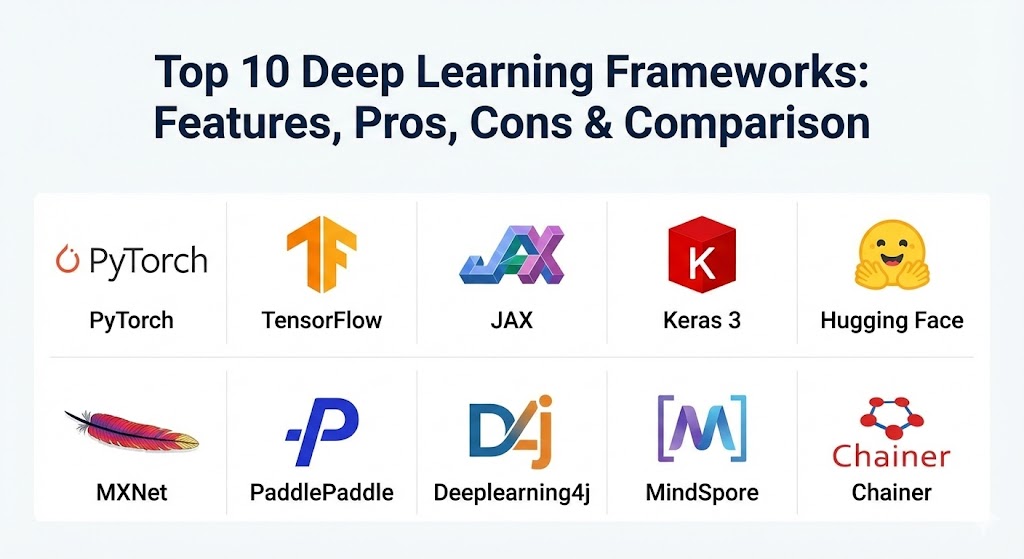
Top 10 Deep Learning Frameworks Tools
1 — PyTorch
PyTorch, developed by Meta’s AI Research lab, has become the de facto standard for AI research and increasingly for enterprise production. It is beloved for its “Pythonic” nature and dynamic computational graph, which allows for real-time changes to the network architecture.
- Key features:
- Dynamic Computation Graphs: Allows for flexible model building and easier debugging.
- TorchScript: Provides a path to move models from flexible research to high-performance C++ environments.
- Distributed Training: Strong support for data-parallel and model-parallel training across thousands of GPUs.
- Native Python Support: Integrates seamlessly with the standard Python data science stack (NumPy, SciPy).
- Rich Ecosystem: Includes libraries like TorchVision, TorchText, and TorchAudio for specialized tasks.
- Torch.compile: Advanced JIT (Just-In-Time) compiler introduced to close the performance gap with static frameworks.
- Pros:
- Extremely intuitive for developers; debugging PyTorch is as simple as debugging standard Python.
- Massive community support; almost every new AI research paper includes a PyTorch implementation.
- Cons:
- Traditionally seen as less “production-ready” than TensorFlow, though this gap has largely closed.
- Mobile and edge deployment workflows can still be more complex than dedicated competitors.
- Security & compliance: SOC 2, ISO 27001 compliant through major cloud providers; supports encrypted model weights and secure multi-party computation via extensions.
- Support & community: One of the largest open-source communities in existence. Extensive documentation, tutorials, and dedicated enterprise support available via partners like Microsoft and Amazon.
2 — TensorFlow
Developed by Google, TensorFlow is an end-to-end open-source platform for machine learning. While PyTorch dominates research, TensorFlow remains a massive force in large-scale enterprise deployments, particularly those requiring heavy-duty MLOps and specialized hardware like Google’s TPUs.
- Key features:
- TensorFlow Extended (TFX): A full production-grade MLOps platform for managing data pipelines.
- TensorFlow Lite: Best-in-class support for deploying models on mobile and IoT devices.
- XLA (Accelerated Linear Algebra): A domain-specific compiler for optimizing linear algebra operations.
- TensorBoard: The industry standard for visualizing model metrics and training progress.
- TPU Integration: Native optimization for Google’s Tensor Processing Units.
- Keras Integration: High-level API built-in to make model construction faster for beginners.
- Pros:
- Unmatched production ecosystem; the “TFX” pipeline makes it the tool of choice for global-scale apps.
- Robust support for cross-platform deployment (web, mobile, server, edge).
- Cons:
- Steep learning curve, especially for the lower-level APIs and static graph concepts.
- Recent industry shifts have seen many researchers migrate toward PyTorch or JAX, leading to a perceived “stagnation” in community innovation.
- Security & compliance: Highly secure; includes tools for privacy-preserving machine learning (TensorFlow Privacy) and robust audit logging.
- Support & community: Backed by Google; massive enterprise adoption and a wealth of certified professionals worldwide.
3 — JAX
JAX is a rising star from Google Research that is essentially “NumPy on steroids.” It is designed for high-performance numerical computing and is the engine behind many of the latest breakthroughs in large language model (LLM) training.
- Key features:
- Autograd: Native support for computing gradients of complex Python/NumPy functions.
- JIT (Just-In-Time) Compilation: Uses XLA to compile Python code into highly optimized kernels for GPU/TPU.
- Vmap: Automatic vectorization of functions, simplifying the handling of batches.
- Pmap: Seamless parallelization across multiple devices.
- Functional Programming: Encourages a stateless, pure functional approach to model building.
- Ecosystem Components: Works with Flax (neural network library) and Optax (optimizers).
- Pros:
- Blazing fast performance, particularly on TPUs; often outperforms PyTorch in raw compute tasks.
- The functional approach makes it easier to reason about complex mathematical transformations.
- Cons:
- Steep learning curve for those used to object-oriented programming (OOP).
- Smaller ecosystem of high-level pre-trained models compared to PyTorch or TensorFlow.
- Security & compliance: Varies/Cloud-dependent. Primarily a research-focused library, so it relies on the host environment’s security protocols.
- Support & community: Rapidly growing community, particularly among DeepMind and Google researchers. Documentation is excellent but geared toward advanced users.
4 — Keras 3
Keras has evolved from a simple API for TensorFlow into “Keras 3,” a multi-backend framework that can run on top of PyTorch, TensorFlow, or JAX. It offers the ultimate flexibility for developers who want to avoid vendor lock-in.
- Key features:
- Multi-Backend Support: Write code once and run it on JAX, PyTorch, or TensorFlow.
- User-Friendly API: Minimizes the number of user actions required for common tasks.
- Consistent Interface: Provides a uniform way to interact with diverse underlying frameworks.
- XLA Support: Benefits from JIT compilation across all supported backends.
- Extensive Documentation: Historically known as the most beginner-friendly framework.
- Large Model Garden: Easy access to hundreds of pre-trained architectures.
- Pros:
- Incredible flexibility; you can train a model in JAX and deploy it in a TensorFlow pipeline.
- Greatly reduces boilerplate code, allowing researchers to focus on architecture rather than plumbing.
- Cons:
- Abstracting multiple backends can occasionally lead to subtle debugging issues.
- Might not expose the very latest “bleeding edge” features of an underlying backend immediately.
- Security & compliance: Inherits the security and compliance features of the chosen backend (TF, PyTorch, or JAX).
- Support & community: Very strong community support; wide range of tutorials for beginners and professionals.
5 — Hugging Face (Accelerate & Transformers)
While technically a library ecosystem, Hugging Face has become a “meta-framework” that standardizes how we interact with PyTorch, TensorFlow, and JAX, specifically for Transformer-based models.
- Key features:
- Transformers Library: Simple API to download and fine-tune state-of-the-art pre-trained models.
- Accelerate: Simplifies the process of running PyTorch code on any distributed configuration (Multi-GPU, TPU).
- PEFT: Parameter-Efficient Fine-Tuning techniques like LoRA for large models.
- Datasets: High-speed access to petabytes of training data across text, vision, and audio.
- Hub Integration: Seamless versioning and sharing of models with a global community.
- Pros:
- The “App Store” for AI; gives you instant access to models like Llama, BERT, and Whisper.
- Dramatic reduction in the time required to take a model from “idea” to “prototype.”
- Cons:
- Highly focused on the Transformer architecture; less ideal for traditional CNNs or custom non-transformer research.
- The “magic” under the hood can make it harder for students to learn the fundamentals of backpropagation.
- Security & compliance: SOC 2 Type II compliant; features include private model hubs and rigorous security scanning for malicious weights.
- Support & community: The most vibrant community in the AI world today. Enterprise support available through “Expert Support” packages.
6 — MXNet (Apache)
Apache MXNet is a flexible and efficient deep learning library that was famously chosen by Amazon as its primary deep learning framework for AWS several years ago. It is known for its high scalability.
- Key features:
- Hybrid Frontend: Seamlessly switch between imperative (dynamic) and symbolic (static) programming.
- Scalability: Near-linear scaling across multiple GPUs and machines.
- Multi-language Support: Deep integration with Python, C++, Scala, R, Julia, and even Perl.
- Gluon API: A high-level interface that makes model building much more intuitive.
- Memory Efficiency: Highly optimized for running on low-power devices.
- Pros:
- Excellent for distributed training in large cloud environments.
- The ability to support diverse programming languages makes it a favorite for polyglot engineering teams.
- Cons:
- Significantly smaller community and ecosystem compared to PyTorch or TensorFlow.
- Documentation can be fragmented and slower to update.
- Security & compliance: Managed under the Apache Foundation; follows standard open-source security best practices.
- Support & community: Backed by the Apache Foundation and Amazon; active but relatively niche compared to the “Big Two.”
7 — PaddlePaddle (Baidu)
PaddlePaddle (PArallel Distributed Deep LEarning) is the leading framework in China, developed by Baidu. It is highly optimized for industrial applications and has a massive footprint in the Asian market.
- Key features:
- Industrial Pre-trained Models: Includes a massive library of models (PaddleHub) optimized for real-world business tasks.
- End-to-End Deployment: Strong tools for mobile, server, and web deployment.
- Distributed Training: Built from the ground up to handle high-performance distributed computing.
- Hardware Compatibility: Support for a wide range of AI chips, including specialized domestic hardware.
- NLP Focus: Exceptional support for Chinese natural language processing tasks.
- Pros:
- Very strong documentation and community support for developers in the Asian region.
- Highly “productized” models that are ready for immediate deployment in sectors like manufacturing and retail.
- Cons:
- English-language documentation and community support are not as robust as they are for PyTorch.
- Outside of its primary markets, it has lower adoption in the Western research community.
- Security & compliance: Varies; complies with major Chinese cybersecurity standards and international ISO certifications.
- Support & community: Huge community in China; Baidu provides extensive corporate support and training programs.
8 — Deeplearning4j (DL4J)
Deeplearning4j is the primary deep learning framework for the Java Virtual Machine (JVM). It is designed specifically for enterprise environments that rely heavily on Java and Scala.
- Key features:
- JVM Integration: Native support for Java, Scala, and Clojure.
- Big Data Integration: Built to work seamlessly with Apache Spark and Hadoop.
- Microservices Ready: Ideal for deployment within standard enterprise Java microservices architectures.
- GPU Acceleration: Supports CUDA via Java wrappers.
- Keras Model Import: Allows users to import models trained in Keras for deployment in a Java environment.
- Pros:
- The only viable option for enterprise environments where Python is not permitted or supported.
- Leverages the stability and performance of the JVM for long-running production tasks.
- Cons:
- Far fewer pre-trained models and tutorials compared to the Python ecosystem.
- Working with tensors in Java is inherently more verbose and less intuitive than in Python.
- Security & compliance: Strong focus on enterprise security; supports standard Java security protocols and is widely used in secure financial environments.
- Support & community: Managed by Konduit; community is smaller but highly focused on enterprise use cases.
9 — MindSpore (Huawei)
MindSpore is a newer, versatile deep learning framework developed by Huawei. It is designed to be “device-edge-cloud” synergistic, focusing on full-stack AI development.
- Key features:
- Ascend Native: Highly optimized for Huawei’s Ascend AI processors.
- Automatic Differentiation: Advanced symbolic differentiation for complex math.
- Dynamic-Static Synergy: Flexible switching between graph and eager modes.
- Privacy Preserving: Built-in support for differential privacy and secure federated learning.
- Efficient Memory Management: Designed to run on resource-constrained edge devices.
- Pros:
- Excellent performance when paired with dedicated Ascend hardware.
- Forward-thinking approach to AI privacy and security.
- Cons:
- Adoption is primarily concentrated within Huawei-partnered organizations.
- Ecosystem is still young compared to established giants.
- Security & compliance: Strong focus on security; designed for high-compliance environments.
- Support & community: Active development from Huawei; growing community in the Asia-Pacific region.
10 — Chainer
Chainer was a pioneer in the “Define-by-Run” approach (dynamic graphs) that later influenced PyTorch. While the original team shifted focus to PyTorch, it remains a respected framework for its simplicity.
- Key features:
- Define-by-Run: Allows for dynamic network architectures that can change per input.
- CuPy Integration: Seamlessly uses CuPy for GPU-accelerated NumPy-like operations.
- Pythonic Design: Very clean and easy-to-read source code.
- Flexible Link/Chain API: Unique way of structuring model layers and parameters.
- Pros:
- Historically important for researchers; very clean code for those who want to understand framework internals.
- Lightweight and easy to install.
- Cons:
- Effectively in maintenance mode; not recommended for new large-scale projects.
- Very few modern pre-trained models or integrations available.
- Security & compliance: Varies/Minimal. Standard open-source protections.
- Support & community: Small remaining community; largely surpassed by PyTorch.
Comparison Table
| Tool Name | Best For | Platform(s) Supported | Standout Feature | Rating (Gartner Peer Insights) |
| PyTorch | Research & Cutting-edge AI | Win, Linux, Mac, Cloud | Dynamic Graph / Pythonic | 4.8 / 5 |
| TensorFlow | Enterprise MLOps / Mobile | Win, Linux, Mac, Mobile | TFX & TF Lite Ecosystem | 4.6 / 5 |
| JAX | High-perf Computing / LLMs | Linux, Mac, TPU | JIT & Vectorization | 4.7 / 5 |
| Keras 3 | Multi-backend Flexibility | Cross-platform | Backend Interoperability | 4.5 / 5 |
| Hugging Face | Rapid Transformer Adoption | Cross-platform | Massive Pre-trained Hub | 4.9 / 5 |
| MXNet | Distributed Scaling | Cross-platform | Hybrid Graph Support | 4.3 / 5 |
| PaddlePaddle | Asian Industrial AI | Linux, Windows | PaddleHub Models | 4.4 / 5 |
| DL4J | Java/Enterprise Backend | JVM (Java, Scala) | Spark/Hadoop Integration | 4.2 / 5 |
| MindSpore | Ascend Hardware/Privacy | Linux, Edge | Device-Cloud Synergy | N/A |
| Chainer | Research Heritage | Linux, Mac | Define-by-Run Pioneer | N/A |
Evaluation & Scoring of Deep Learning Frameworks
Choosing a framework is a multi-dimensional problem. The following rubric provides a weighted look at how these tools compare across essential metrics.
| Criteria | Weight | Evaluation Notes |
| Core Features | 25% | Presence of dynamic graphs, JIT compilation, and high-level APIs. |
| Ease of Use | 15% | Quality of documentation, Pythonic nature, and debugging ease. |
| Integrations & Ecosystem | 15% | Availability of pre-trained models, MLOps tools, and data loaders. |
| Security & Compliance | 10% | Support for encrypted weights, private hubs, and regulatory standards. |
| Performance & Reliability | 10% | Training speed, multi-node scaling, and hardware optimization. |
| Support & Community | 10% | Size of developer base, frequency of updates, and enterprise support. |
| Price / Value | 15% | Cost of specialized hardware (TPUs) vs. general cloud compute ROI. |
Which Deep Learning Framework Tool Is Right for You?
The “best” tool is highly context-dependent. Here is how to navigate the choice:
- Solo Users & Students: Start with Keras 3 or PyTorch. Keras offers the gentlest introduction, while PyTorch is the best for understanding how deep learning actually works under the hood.
- Research & Rapid Prototyping: PyTorch and Hugging Face are non-negotiable. If you are doing highly mathematical research or LLM development, JAX is worth the extra effort for the performance gains.
- Enterprise Production (Large Teams): TensorFlow remains the gold standard for full MLOps pipelines (TFX), though PyTorch with TorchServe is a very strong runner-up.
- Mobile & Edge Applications: TensorFlow Lite and MindSpore are optimized for the constraints of low-power devices.
- Java/Scala Environments: If you are locked into a Java stack, Deeplearning4j is your only enterprise-grade option.
- Budget-Conscious Teams: Stick to PyTorch or TensorFlow on standard GPUs. Avoid JAX if you aren’t prepared to leverage (and pay for) high-end TPU or H100/H200 GPU infrastructure.
Frequently Asked Questions (FAQs)
1. Is TensorFlow better than PyTorch?
Neither is universally better. TensorFlow has a more mature production and mobile ecosystem, while PyTorch is more flexible, easier to debug, and dominates the research community.
2. Why is everyone talking about JAX in 2026?
JAX has gained traction because of its incredible speed and efficiency in training very large models (like GPT-5/6 class LLMs). It avoids the overhead of standard Python by compiling directly to machine code.
3. Can I use these frameworks for free?
Yes, all these frameworks are open-source and free to download. However, the hardware required to train them (high-end GPUs) can be expensive to rent in the cloud.
4. What is the difference between a library and a framework?
A library is a collection of functions you call. A framework (like TensorFlow) provides the structure into which you plug your code, often managing the entire lifecycle of the data.
5. How much math do I need to know?
While frameworks handle the calculus (differentiation), you need a solid grasp of linear algebra (matrices/tensors) and statistics to design effective model architectures.
6. Do I need a GPU to run these?
Technically, no. You can run them on a standard CPU, but training will be 10x to 100x slower. For any serious deep learning task, a GPU is essential.
7. Is Keras still just for TensorFlow?
No. With the release of Keras 3, it is now a multi-backend framework that works with JAX, PyTorch, and TensorFlow.
8. Which framework is best for Natural Language Processing (NLP)?
Hugging Face Transformers (running on a PyTorch backend) is currently the undisputed leader for NLP tasks.
9. Can I switch from one framework to another easily?
Models can be converted using the ONNX (Open Neural Network Exchange) format, but rewriting the actual training code between frameworks can be time-consuming.
10. What is a “tensor”?
A tensor is simply a multi-dimensional array. A scalar is 0D, a vector is 1D, a matrix is 2D, and anything higher is referred to as a tensor.
Conclusion
The evolution of deep learning frameworks has reached a point of immense maturity. While the rivalry between PyTorch and TensorFlow continues to drive innovation, the rise of JAX for high-performance research and Keras 3 for backend flexibility has created a more diverse ecosystem. Choosing a framework is no longer about which one has the “best” math, but which one fits your existing infrastructure, team skill set, and deployment goals. Whether you are building the next world-changing LLM or a simple image classifier for a local app, these frameworks provide the necessary scaffolding to turn AI theory into industrial reality.