Introduction
Debt collection software is a specialized category of financial technology designed to streamline and automate the process of recovering unpaid debts. These platforms provide a centralized system for tracking accounts, managing communications, and processing payments. They replace fragmented manual processes with intelligent workflows that can prioritize accounts based on the likelihood of recovery, ensuring that collection teams focus their efforts where they will have the most significant impact.
The importance of these tools lies in their dual ability to increase efficiency and mitigate risk. In highly regulated markets, a single compliance error—such as calling a debtor outside of legal hours or failing to send a required notice—can lead to massive fines. Key real-world use cases include financial institutions managing delinquent loans, healthcare providers handling patient billing, and specialized collection agencies working on behalf of third parties. When evaluating these tools, users should look for robust automation engines, integrated payment portals, deep reporting capabilities, and a “compliance-first” architecture that prevents accidental violations of laws like the FDCPA or GDPR.
Best for: Third-party collection agencies, law firms specializing in collections, internal accounts receivable (AR) departments in healthcare and finance, and enterprise-level utility companies. It is ideal for organizations managing a high volume of delinquent accounts that require a standardized, auditable process.
Not ideal for: Small businesses with only a handful of late invoices per year, or companies whose primary focus is relationship-based B2B sales where a personalized manual touch is more effective than automated outreach.
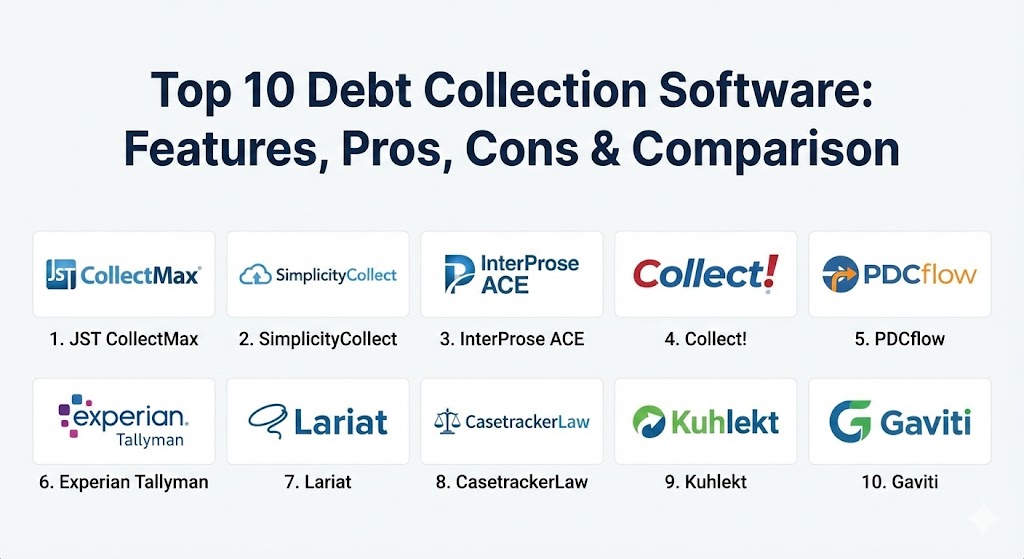
Top 10 Debt Collection Software Tools
1 — JST CollectMax
CollectMax is a powerful, comprehensive software solution designed specifically for law firms and collection agencies. It focuses on the legal aspects of debt recovery, providing tools to manage the entire litigation process alongside standard collection efforts.
- Key features:
- Integrated legal workflow management for tracking lawsuits and judgments.
- Automated document generation for legal filings and notices.
- Advanced account “chaining” to link multiple debts to a single debtor.
- Customizable action codes and automated “tickler” reminders.
- Comprehensive imaging and attachment support for evidence management.
- Robust reporting suite for client-level performance tracking.
- Pros:
- Unrivaled for legal collections; handles the complexities of the court system better than general tools.
- High level of customization allows firms to mirror their specific internal processes.
- Cons:
- The user interface feels dated compared to modern, cloud-native SaaS platforms.
- Steeper learning curve due to the complexity of legal workflow options.
- Security & compliance: SOC 2 compliance, role-based access controls, and detailed audit logs for every user action.
- Support & community: Offers dedicated phone support, regular training webinars, and a well-established user base with frequent regional user group meetings.
2 — SimplicityCollect
SimplicityCollect is a cloud-based debt collection management system known for its scalability and ease of use. It is designed to be accessible for small agencies while powerful enough to support enterprise-level operations.
- Key features:
- 100% web-based interface accessible from any device.
- Automated letter-sending and email outreach modules.
- Integrated “Debtor Portal” where individuals can view balances and make payments.
- Bulk data import/export tools for easy client onboarding.
- Real-time dashboard with key performance indicators (KPIs).
- Automated credit reporting to major bureaus.
- Pros:
- Very fast implementation; users can often be up and running in a few days.
- Transparent, tiered pricing that makes it affordable for smaller agencies to start.
- Cons:
- Customization is somewhat limited compared to on-premise “heavyweight” solutions.
- High-volume automated calling features require third-party integrations.
- Security & compliance: PCI-DSS Level 1 compliant, 256-bit SSL encryption, and HIPAA readiness for medical collections.
- Support & community: High-quality online documentation, video tutorials, and a responsive ticket-based support system.
3 — InterProse ACE
ACE (Advanced Collection Environment) by InterProse is an enterprise-grade platform that emphasizes “Virtual Agent” technology. It is designed for high-volume environments that want to automate as much of the debtor interaction as possible.
- Key features:
- Intelligent Virtual Agent for 24/7 automated debtor negotiations.
- Highly flexible workflow engine that can trigger actions based on debtor behavior.
- Native integration with various payment gateways and skip-tracing services.
- Advanced analytics for predicting the “propensity to pay.”
- Multi-tenant architecture for managing different client portfolios separately.
- Built-in compliance guardrails that restrict contact based on time/zone/frequency.
- Pros:
- Reduces the need for large headcounts by letting the “Virtual Agent” handle routine accounts.
- The modern interface is intuitive and reduces collector fatigue.
- Cons:
- The cost is on the higher end of the spectrum, suited for larger operations.
- Requires a significant initial configuration to truly leverage the automation.
- Security & compliance: SOC 2 Type II, PCI-DSS compliant, and rigorous adherence to FDCPA and CFPB guidelines.
- Support & community: Enterprise-level support with dedicated account managers and a professional services team for custom integrations.
4 — Collect!
Collect! is a versatile debt collection software that offers both on-premise and cloud deployment options. It is used globally and is known for its “Member-driven” development, where user feedback directly influences new features.
- Key features:
- Highly customizable database schema to track unique data points.
- Automated operator work queues to keep collectors focused on the next best account.
- Integrated dialer support for high-volume call centers.
- Multi-currency and multi-language support for international collections.
- Advanced letter templates with conditional logic.
- Flexible reporting engine that can export to almost any format.
- Pros:
- Extremely stable and time-tested software with a massive global footprint.
- The hybrid deployment model is great for firms with specific data residency requirements.
- Cons:
- The sheer amount of options can be overwhelming for a new administrator.
- Upgrading from older versions can be a complex process requiring technical assistance.
- Security & compliance: FIPS 140-2 compliance, detailed audit trails, and GDPR readiness for European users.
- Support & community: Very active online forum, a huge library of “how-to” videos, and a global network of certified consultants.
5 — PDCflow
While many tools are full CRM-style suites, PDCflow is a specialized tool that focuses on the “Flow” of payments and signatures. It is designed for collection agencies that need to capture payments and legally binding signatures in a single, secure workflow.
- Key features:
- Flow Technology: Send a payment request and a signature form in one link.
- Integrated e-signatures for recurring payment authorizations.
- IVR (Interactive Voice Response) and web-based payment portals.
- Credit card and ACH processing with automated reconciliation.
- “Compliance Core” that ensures all payment authorizations meet legal standards.
- API-first design for easy integration into existing collection software.
- Pros:
- Significantly reduces “promise to pay” breakage by capturing signatures immediately.
- Removes the burden of PCI compliance from the agency’s internal servers.
- Cons:
- Not a standalone collection management system; it is a payment/workflow layer.
- Transaction-based pricing can become expensive at very high volumes.
- Security & compliance: PCI-DSS Level 1, HIPAA compliant, and E-Sign Act compliant.
- Support & community: Strong developer documentation and a dedicated “success team” to help with implementation.
6 — Experian Tallyman
Tallyman is an enterprise-level debt management solution that leverages Experian’s massive data ecosystem to provide strategic insights into the collection process.
- Key features:
- Data-driven segmentation using Experian’s credit data.
- Holistic “Customer View” to manage multiple relationships across a portfolio.
- Champion/Challenger testing to refine collection strategies.
- Automated treatment paths based on risk scoring.
- High-performance engine capable of managing millions of accounts.
- Integrated skip-tracing and data enrichment.
- Pros:
- Best-in-class for predictive analytics; knows who will pay before you call.
- Ideal for large banks and utilities with extremely high volume and diverse portfolios.
- Cons:
- Implementation is a major enterprise project taking months, not days.
- The price point is out of reach for small to mid-sized agencies.
- Security & compliance: ISO 27001, SOC 2, and rigorous global data privacy compliance.
- Support & community: Global enterprise support with 24/7 availability and professional consulting services.
7 — Lariat
Lariat is a modern, cloud-based collection platform that markets itself as a “Collection Agency in a Box.” It is designed for the modern era of remote work and automated outreach.
- Key features:
- Intelligent auto-dialer and SMS integration.
- Automated skip-tracing and social media link discovery.
- Customizable “Debtor Experience” with mobile-first payment pages.
- Real-time commissions and fee calculations.
- Cloud-based document storage with OCR (Optical Character Recognition).
- Integrated skip-tracing with “waterfall” logic to find the best data at the lowest price.
- Pros:
- The most “SaaS-forward” feel on the list; very clean and modern UI.
- Excellent automation for finding updated contact info (skip-tracing).
- Cons:
- Being a newer player, it lacks some of the niche legal features found in CollectMax.
- Community resources are smaller compared to legacy competitors.
- Security & compliance: SOC 2 Type II, SSO (Single Sign-On), and HIPAA compliance.
- Support & community: Growing knowledge base and highly personalized customer onboarding.
8 — CasetrackerLaw
CasetrackerLaw is a web-based debt collection software tailored for law firms and agencies that need to track the legal lifecycle of a claim. It is known for being extremely lightweight and accessible.
- Key features:
- Web-based “Claimant” portal so clients can see progress in real-time.
- Automated interest and fee calculations based on state laws.
- Simple, one-click document generation for letters and court forms.
- Robust task management for legal assistants and paralegals.
- Integrated credit reporting tools.
- Customizable status codes and automated event triggers.
- Pros:
- Very affordable and easy to use; doesn’t require an IT department to maintain.
- Great for “Legal Forwarding,” where claims are sent between different law firms.
- Cons:
- Lacks the deep automation and AI features of platforms like ACE or Tallyman.
- Not designed for massive call center environments.
- Security & compliance: SSL encryption, role-based security, and cloud-based backups.
- Support & community: Direct access to support technicians and helpful video training.
9 — Kuhlekt
Kuhlekt is a specialized platform that focuses on “Credit Management” and internal collections. It is popular in the corporate B2B world where maintaining the customer relationship is as important as getting paid.
- Key features:
- Interactive “Collection Dashboard” that highlights at-risk accounts.
- Automated “Dunning” (payment reminder) email and letter sequences.
- Dispute management tracking to resolve billing issues quickly.
- Credit risk assessment tools integrated with the collection workflow.
- Management visibility tools for overseeing the AR team’s performance.
- Seamless integration with major ERPs like SAP and Oracle.
- Pros:
- Excellent for B2B companies that need to balance collection with customer service.
- Provides great visibility for management into the “Health” of the receivables.
- Cons:
- Not designed for high-volume, third-party consumer collection agencies.
- Fewer integrations with consumer skip-tracing services.
- Security & compliance: ISO 27001, GDPR compliant, and SSO support.
- Support & community: Professional corporate support with a focus on long-term client success.
10 — Gaviti
Gavit is a modern A/R automation platform that helps companies get paid faster by automating the “receivables” part of the business before it officially becomes “bad debt.”
- Key features:
- Automated workflow for sending reminders and following up on invoices.
- Collaborative workspace for the finance team to track notes and status.
- Customer self-service portal with integrated payment options.
- Predictive analytics on when a customer is likely to pay.
- Multi-currency and multi-entity support for global firms.
- Deep integration with accounting software like QuickBooks and NetSuite.
- Pros:
- Very easy to set up and provides an immediate ROI by reducing “Days Sales Outstanding” (DSO).
- Modern, clean interface that users actually enjoy using.
- Cons:
- Focused on “Current” receivables; not a tool for secondary or tertiary debt collection.
- Limited features for legal litigation or third-party agency needs.
- Security & compliance: SOC 2, HIPAA readiness, and end-to-end data encryption.
- Support & community: Extensive online training, regular product updates, and a proactive customer success team.
Comparison Table
| Tool Name | Best For | Platform(s) Supported | Standout Feature | Rating (TrueReviewnow) |
| CollectMax | Legal/Law Firms | On-Premise / Cloud | Litigation Workflow | 4.6 / 5 |
| SimplicityCollect | Scalable Agencies | Cloud / SaaS | Debtor Payment Portal | 4.7 / 5 |
| InterProse ACE | Enterprise Automation | Cloud / SaaS | Virtual Negotiator | 4.8 / 5 |
| Collect! | Global Agencies | Hybrid (On-Prem/Cloud) | Massive Customizability | 4.5 / 5 |
| PDCflow | Payment Workflows | SaaS / API | E-Sign + Payment Link | 4.8 / 5 |
| Experian Tallyman | High-Volume Risk | Enterprise / Cloud | Experian Data Integration | 4.3 / 5 |
| Lariat | Modern Cloud Agency | SaaS | Intelligent Skip-Tracing | 4.6 / 5 |
| CasetrackerLaw | SMB Legal Collections | Web-based | Real-time Client Portal | 4.4 / 5 |
| Kuhlekt | Corporate B2B A/R | SaaS / Cloud | Relationship-focused A/R | 4.5 / 5 |
| Gaviti | A/R Automation | SaaS | Automated Dunning Flow | 4.7 / 5 |
Evaluation & Scoring of Debt Collection Software
To help you make an objective choice, we have evaluated the general category using a weighted scoring rubric based on industry requirements.
| Category | Weight | Evaluation Criteria |
| Core Features | 25% | Workflow automation, payment portals, and account management depth. |
| Ease of Use | 15% | Intuitiveness of the UI and how quickly new collectors can be trained. |
| Integrations | 15% | Connections to dialers, skip-tracing, bureaus, and payment processors. |
| Security & Compliance | 10% | FDCPA guardrails, SOC 2/PCI compliance, and data encryption. |
| Performance | 10% | System uptime, database speed under load, and API responsiveness. |
| Support & Community | 10% | Quality of documentation, speed of support, and user community size. |
| Price / Value | 15% | Cost of ownership relative to the efficiency gains (ROI). |
Which Debt Collection Software Tool Is Right for You?
Choosing a platform is a strategic decision that depends on your specific place in the debt lifecycle.
- Solo Users & Boutique Agencies: If you are a small team, avoid the “enterprise giants.” SimplicityCollect or CasetrackerLaw offer all the features you need without the massive overhead or implementation costs.
- Mid-Market Agencies: If you are growing and need to maximize every collector’s desk, Collect! or Lariat provide the robust automation and dialer integrations needed to scale efficiently.
- Enterprise Financial Institutions: Large banks and utilities should look toward Experian Tallyman or InterProse ACE. These tools handle the massive data volumes and complex compliance requirements that smaller tools cannot manage.
- Law Firms (Litigation): If you are going to court, you need CollectMax. Its ability to track court dates, legal fees, and judgments is specifically designed for the legal recovery process.
- B2B Internal A/R Departments: If you are managing your own company’s invoices, Gaviti or Kuhlekt are superior because they focus on automation and maintaining customer goodwill rather than aggressive “third-party” collection tactics.
- Security & Compliance Needs: If you are in healthcare, ensure you pick a tool with HIPAA compliance (like SimplicityCollect). If you operate in Europe, GDPR readiness is non-negotiable (look at Collect! or F24).
Frequently Asked Questions (FAQs)
1. Is debt collection software different from a standard CRM?
Yes. While a CRM manages general relationships, debt collection software includes specific tools for interest/fee calculations, credit bureau reporting, skip-tracing integrations, and strict compliance guardrails that standard CRMs lack.
2. How does the software help with FDCPA compliance?
Most modern tools have built-in “Compliance Engines.” They can block a collector from calling a debtor outside of legal hours (based on the debtor’s area code), limit the number of contact attempts per week, and ensure all required disclosures are included in written communications.
3. What is skip-tracing integration?
Skip-tracing is the process of finding a debtor who has “skipped” town or changed their contact info. Leading software integrates directly with data providers to automatically update phone numbers and addresses with a single click.
4. Can I process payments directly through the software?
Most platforms integrate with payment gateways (like PDCflow or Repay). This allows collectors to take credit card or ACH payments over the phone or via a secure self-service portal, with the transaction automatically updating the account balance.
5. Is cloud-based software better than on-premise?
Cloud-based (SaaS) software is generally easier to maintain and update, and it supports remote work. On-premise software is preferred by some firms that require absolute control over their data for extreme security or regulatory reasons.
6. Does the software report to credit bureaus automatically?
Many platforms (like SimplicityCollect or Collect!) have built-in “Metro 2” file generators. This allows you to report delinquent accounts to Equifax, Experian, and TransUnion with a single batch process.
7. Can the software handle legal litigation?
Specialized tools like CollectMax and CasetrackerLaw are designed to track the “legal side” of collection, including filing lawsuits, managing court dates, and tracking post-judgment garnishments.
8. What is a “Debtor Portal”?
This is a secure website where a debtor can log in to view their balance, set up a payment plan, or make a one-time payment. This “self-service” option often increases recovery rates because it is less confrontational than talking to a collector.
9. How long does implementation usually take?
For cloud-based SMB tools, you can be live in 48–72 hours. For enterprise systems like Tallyman, the process involves data migration and custom workflow design, which can take 3–6 months.
10. What is “Champion/Challenger” testing in collection software?
This is a feature that allows you to test two different collection strategies (e.g., one group gets an email first, the other gets a text) to see which one results in higher recovery rates. The software then helps you adopt the “winning” strategy.
Conclusion
The evolution of debt collection software has moved the industry from a reactive “brute force” model to a proactive, data-driven strategy. By choosing the right tool, organizations can dramatically reduce their cost-to-collect, ensure they never miss a legal requirement, and provide a better experience for both the collector and the debtor. Whether you are a solo attorney or an enterprise bank, the key is to prioritize automation and compliance. The “best” tool is the one that fits your volume and your specific regulatory needs while providing a clear return on investment.