Introduction
A Deal Desk Workflow Tool is a centralized software platform designed to manage the “quote-to-cash” lifecycle of complex, non-standard, or high-value sales deals. It acts as a collaborative hub where Sales, Finance, Legal, and Product teams can structure, review, and approve deals in real time. By automating the routing of approval requests based on specific triggers—such as discount thresholds or custom contract language—these tools eliminate the internal bottlenecks that often stall momentum at the one-yard line.
The importance of these tools lies in their ability to provide “guardrails with speed.” In a typical enterprise environment, a sales representative might offer a 40% discount to win a strategic account. Without a Deal Desk tool, that request might sit in a manager’s inbox for days. With the right tool, the request is automatically routed to the VP of Finance for a one-click approval, while simultaneously notifying Legal of any non-standard indemnity clauses. Key real-world use cases include managing complex renewals, streamlining global pricing across different regions, and ensuring “tamper-proof” audit trails for public companies.
When evaluating these tools, organizations should look for deep CRM integration (usually Salesforce or HubSpot), the flexibility of the “rules engine,” the ease of the user interface for non-technical sales reps, and the ability to generate both quotes (CPQ) and contracts (CLM) within a single flow.
Best for: Mid-market and enterprise-level B2B companies, particularly those in the SaaS, manufacturing, or medical device industries where pricing is dynamic and contracts are multi-layered. It is essential for Revenue Operations (RevOps) leaders who need to scale sales processes without increasing headcount.
Not ideal for: Early-stage startups with simple, flat-rate pricing or B2C businesses where transactions are high-volume but low-complexity. For these companies, standard CRM pipelines or basic invoicing software are typically more efficient.
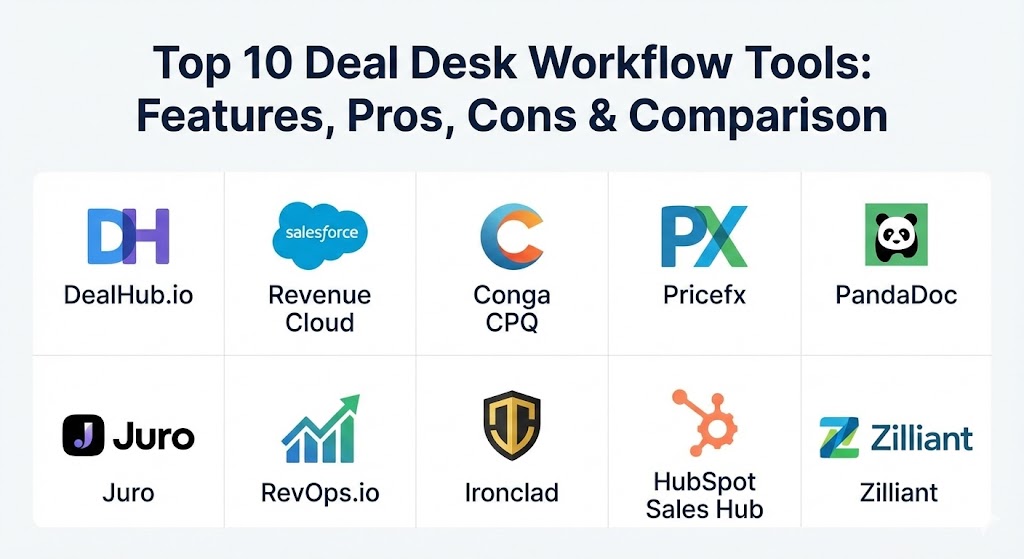
Top 10 Deal Desk Workflow Tools
1 — DealHub.io
DealHub is often cited as the most comprehensive “all-in-one” platform for the modern Deal Desk. It combines CPQ (Configure, Price, Quote), CLM (Contract Lifecycle Management), and Subscription Management into a single fluid experience.
- Key features:
- “DealStream” visual timeline for tracking the entire approval journey.
- Collaborative digital DealRoom for buyers and sellers to interact.
- No-code rules engine for managing complex discount hierarchies.
- Integrated e-signature and contract redlining.
- Automated subscription billing and renewal management.
- Native integration with Salesforce, Microsoft Dynamics, and HubSpot.
- Pros:
- Eliminates the need for separate CPQ and CLM vendors.
- The buyer-facing “DealRoom” significantly improves the customer experience.
- Cons:
- The vast feature set can be overwhelming for teams with simple deal structures.
- Initial setup of complex pricing logic requires a dedicated admin.
- Security & compliance: SOC 2 Type II, GDPR, HIPAA, and ISO 27001 compliant.
- Support & community: High-touch onboarding with dedicated customer success managers; extensive online documentation and training webinars.
2 — Salesforce Revenue Cloud (CPQ)
Salesforce CPQ is the industry benchmark for enterprise-level deal management. As a native part of the Salesforce ecosystem, it provides unmatched depth for companies already “all-in” on Salesforce CRM.
- Key features:
- Advanced product bundling and guided selling for reps.
- Dynamic pricing engines including volume and tier-based discounts.
- Automated approval workflows that live directly within the CRM.
- “Advanced Approvals” module for complex, multi-step routing.
- Seamless handoff from Sales to Finance for order orchestration.
- Integrated analytics and revenue forecasting.
- Pros:
- Single source of truth for all data—no need for external data syncing.
- Highly customizable; if you can imagine a rule, you can build it in Salesforce.
- Cons:
- Implementation is notoriously long and expensive, often requiring outside consultants.
- The user interface can feel “clunky” and slow compared to newer, cloud-native rivals.
- Security & compliance: World-class security with FedRAMP, HIPAA, SOC 1/2/3, and GDPR certifications.
- Support & community: Massive global ecosystem of certified partners, Trailhead learning paths, and local user groups.
3 — Conga CPQ
Conga (formerly Apttus) is a heavyweight in the revenue lifecycle space. It is designed for global enterprises with the most complex multi-entity, multi-currency deal desk requirements.
- Key features:
- End-to-end “Revenue Lifecycle Management” from quote to renewal.
- Robust document generation for complex proposals and legal agreements.
- AI-powered contract analysis to identify risky clauses during negotiation.
- Flexible pricing models including usage-based and hybrid subscriptions.
- Multi-channel support for direct sales and partner portals.
- High-performance calculation engine for quotes with thousands of line items.
- Pros:
- Exceptionally powerful document automation capabilities.
- Built for scale; handles the world’s most complex product configurations.
- Cons:
- Higher total cost of ownership (TCO) than mid-market solutions.
- User experience can be “expert-focused” rather than “sales-friendly.”
- Security & compliance: ISO 27001, SOC 2, and FISMA compliant.
- Support & community: 24/7 global support and an extensive “Conga University” training platform.
4 — Pricefx
Pricefx takes a “pricing-first” approach to the deal desk. While others focus on the document, Pricefx focuses on the math, using AI to ensure every deal is optimized for margin and competitiveness.
- Key features:
- AI-driven price optimization and “Deal Guidance” for reps.
- Real-time margin impact analysis during the quoting process.
- Automated rebate and claim management for channel partners.
- “Price Analyzer” to identify pricing leaks and profitability outliers.
- Fast-track approval routing based on margin performance.
- Seamless integration with major ERPs like SAP and Oracle.
- Pros:
- Best-in-class for companies where pricing volatility is high (e.g., manufacturing).
- Provides data-backed “recommendations” rather than just static rules.
- Cons:
- Not a full CLM; focuses more on the financial side than the legal side.
- Requires high-quality historical data to feed the AI models effectively.
- Security & compliance: SOC 2 Type II and GDPR compliant.
- Support & community: Strong partner network and a dedicated customer success portal.
5 — PandaDoc
PandaDoc is the go-to solution for SMBs and mid-market companies that need a “fast and beautiful” deal desk. It focuses on the document experience and speed of execution.
- Key features:
- Web-based proposal editor with interactive pricing tables.
- Automated approval triggers based on total deal value or discount.
- Real-time document analytics (see when a buyer opens a quote).
- Integrated e-signature and payment collection.
- Content library for “pre-approved” legal and marketing snippets.
- Native integrations with HubSpot, Pipedrive, and Zoho.
- Pros:
- Beautiful, modern user interface that buyers actually enjoy.
- Very low barrier to entry; teams can be up and running in days.
- Cons:
- Limited advanced CPQ logic (e.g., complex product dependencies).
- Not designed for “industrial-scale” configuration requirements.
- Security & compliance: SOC 2, HIPAA (with add-on), and GDPR compliant.
- Support & community: Excellent chat support and a rich library of templates and tutorials.
6 — Juro
Juro is a “contract-first” deal desk tool. It is designed specifically to bridge the gap between Sales and Legal, allowing the deal desk to move through the negotiation phase without manual “ping-pong.”
- Key features:
- Browser-based contract editor that replaces Microsoft Word.
- “Contract Reader” AI that summarizes key terms for non-legal teams.
- Automated routing for legal approval based on specific clause changes.
- Real-time collaborative commenting and redlining.
- Data-syncing between the contract and the CRM.
- Native e-signature and audit trails.
- Pros:
- Eliminates “version control” hell by keeping everything in a single browser link.
- Highly rated for its “clean” and minimal user experience.
- Cons:
- Less focus on the pricing/CPQ side of the deal desk.
- Best used as a companion to a CRM rather than a standalone pricing engine.
- Security & compliance: SOC 2 Type II and GDPR compliant; data hosted in the UK/EU.
- Support & community: Responsive customer success team and a community of “Legal Ops” professionals.
7 — RevOps.io
RevOps.io is a modern, developer-friendly deal desk tool that prioritizes flexibility and “product-led growth” (PLG) workflows.
- Key features:
- Integrated CPQ and CLM designed for “modern SaaS” pricing models.
- “Deal Guard” feature to prevent unauthorized pricing or terms.
- Ability to sync deal data directly into billing systems like Stripe.
- Collaborative workflows for internal team discussions on specific deals.
- Support for “Usage-based” and “Credit-based” billing structures.
- Simple, API-first architecture for custom integrations.
- Pros:
- Perfect for startups that have complex, non-standard pricing logic.
- Bridges the gap between Sales, Finance, and Engineering.
- Cons:
- Smaller ecosystem compared to giants like Salesforce or Conga.
- Advanced customization may require a bit more technical “know-how.”
- Security & compliance: SOC 2 and GDPR compliant.
- Support & community: Growing community of RevOps professionals and direct access to product experts.
8 — Ironclad
Ironclad is an enterprise-grade Digital Contracting platform that acts as the “legal brain” for the deal desk. It is the gold standard for organizations where the legal contract is the primary bottleneck.
- Key features:
- “Workflow Designer” for building complex, conditional approval paths.
- Ironclad Insights for tracking where deals are stuck in the pipeline.
- Dynamic Repository that automatically files and tags signed agreements.
- AI-powered “Playbooks” that suggest pre-approved legal language.
- Native integration with Salesforce and Slack for real-time alerts.
- Robust e-signature and versioning controls.
- Pros:
- Unrivaled legal compliance and contract management features.
- Highly scalable for thousands of agreements per month.
- Cons:
- Pricing is on the higher end, aimed at enterprise legal teams.
- Does not handle the “pricing/quoting” math as natively as a CPQ.
- Security & compliance: SOC 2 Type II, HIPAA, and GDPR compliant.
- Support & community: Elite enterprise support and a very active “Ironclad Community” for legal ops.
9 — HubSpot Sales Hub (Enterprise)
HubSpot has rapidly expanded its deal desk capabilities, moving from a simple CRM to a legitimate contender for mid-market deal management.
- Key features:
- Integrated “Quotes” tool with custom templates and e-signatures.
- Conditional logic for routing deal approvals to specific managers.
- Advanced permissions to restrict who can edit specific deal fields.
- Playbooks for guiding reps through the deal desk process.
- Robust reporting on deal velocity and weighted pipelines.
- Seamless sync between Sales, Marketing, and Service data.
- Pros:
- The best user adoption in the industry; sales reps actually like using it.
- Everything is “built-in,” meaning no messy integrations to manage.
- Cons:
- Lacks the extreme depth of “Revenue Cloud” for highly complex manufacturing.
- Contract management (CLM) features are still basic compared to Juro or Ironclad.
- Security & compliance: SOC 2 Type II, HIPAA (Enterprise only), and GDPR compliant.
- Support & community: Industry-leading support (phone/chat) and the massive HubSpot Academy.
10 — Zilliant
Zilliant is a niche powerhouse that uses data science to drive the deal desk. It is designed for large-scale distribution and B2B commerce companies with massive catalogs.
- Key features:
- AI-based “Deal Manager” for real-time pricing guidance.
- Automated negotiation guardrails based on customer segment data.
- “Campaign Manager” for pushing pricing changes to the field instantly.
- High-performance API for integration with e-commerce portals.
- Cross-sell and upsell intelligence built into the quoting flow.
- Advanced analytics on price elasticity and margin leakage.
- Pros:
- Uses “Science” rather than just “Rules” to set prices.
- Invaluable for companies managing hundreds of thousands of SKUs.
- Cons:
- High implementation complexity due to the data science requirements.
- Less focused on the “legal document” side of the deal desk.
- Security & compliance: ISO 27001 and SOC 2 Type II compliant.
- Support & community: Professional services focus with specialized industry expertise.
Comparison Table
| Tool Name | Best For | Platform(s) Supported | Standout Feature | Rating (Gartner Peer Insights) |
| DealHub.io | All-in-one Automation | Salesforce, HubSpot, MS | Interactive DealRoom | 4.8 / 5 |
| Salesforce CPQ | Enterprise Depth | Salesforce Native | Advanced Approvals | 4.4 / 5 |
| Conga CPQ | Global Scale / Documents | Salesforce, Cloud | Document Automation | 4.3 / 5 |
| Pricefx | Margin Optimization | SAP, Oracle, CRM | AI Price Guidance | 4.5 / 5 |
| PandaDoc | SMB / Proposals | HubSpot, Pipedrive | UX & Proposal Editor | 4.7 / 5 |
| Juro | Legal Collaboration | Browser-based | AI Contract Summarizer | 4.8 / 5 |
| RevOps.io | Product-Led Startups | Stripe, CRM, API | PLG Billing Support | 4.6 / 5 |
| Ironclad | Legal Compliance | Salesforce, Slack | Workflow Designer | 4.9 / 5 |
| HubSpot Sales | Integrated Simplicity | HubSpot Native | Ease of Adoption | 4.5 / 5 |
| Zilliant | High-SKU Distribution | API, ERP, CRM | Price Science Engine | 4.4 / 5 |
Evaluation & Scoring of Deal Desk Workflow Tools
To choose the right tool, organizations must weight different criteria based on their specific friction points. If “legal redlines” are your biggest delay, Security and Core Features will weigh more. If “sales adoption” is your hurdle, Ease of Use is king.
| Category | Weight | Evaluation Criteria |
| Core Features | 25% | CPQ depth, CLM integration, rules engine flexibility, and e-signature. |
| Ease of Use | 15% | Sales rep adoption, UI modernness, and mobile accessibility. |
| Integrations | 15% | Native CRM support, ERP/Billing connectivity, and API availability. |
| Security & Compliance | 10% | SOC 2, HIPAA, audit trails, and data residency options. |
| Performance | 10% | Calculation speed for large quotes and system uptime. |
| Support & Community | 10% | Implementation speed, documentation quality, and training resources. |
| Price / Value | 15% | Scalability of licensing and ROI on shortened sales cycles. |
Which Deal Desk Workflow Tool Is Right for You?
The decision-making process for a deal desk tool should follow your company’s maturity and primary “deal pain.”
- Solo Founders & Tiny Startups: You do not need a Deal Desk tool yet. Focus on a simple CRM like HubSpot (Free) or Pipedrive and use a basic e-signature tool like HelloSign.
- Small to Medium Businesses (SMBs): If your deals are getting more complex, PandaDoc or HubSpot Sales Hub offer the best ROI. They are easy to set up and focus on the document and the rep’s experience.
- High-Growth SaaS Companies: You need a tool that bridges Sales and Finance. DealHub.io or RevOps.io are ideal because they handle the “Subscription” and “Pricing” math better than simple document tools.
- Global Enterprises with Legal Bottlenecks: If your deals spend weeks in “Legal Review,” Ironclad or Juro should be your top priorities. These tools empower Legal to set guardrails so Sales can move faster without constant oversight.
- Complex Manufacturing & Distribution: If you manage 10,000+ SKUs and dynamic costs, Pricefx or Zilliant are the only tools that can handle the sheer volume of pricing logic required.
- Salesforce Shop? If your entire organization lives in Salesforce, Salesforce Revenue Cloud is the path of least resistance for data integrity, even if the UI is more challenging.
Frequently Asked Questions (FAQs)
1. What is the difference between CPQ and a Deal Desk tool? CPQ (Configure, Price, Quote) is a feature of a deal desk. A Deal Desk tool is the broader workflow that includes CPQ, contract management (CLM), and the internal approval logic between departments.
2. Can these tools help reduce “discount sprawl”? Yes. By setting “hard floors” in the rules engine, you can prevent sales reps from even submitting a quote that falls below a certain margin, or automatically escalate deep discounts to the CFO.
3. Do I need a full-time admin to manage these tools? For enterprise tools like Salesforce CPQ or Conga, yes. For mid-market tools like DealHub or PandaDoc, a RevOps manager can usually manage the tool as part of their broader duties.
4. How long does implementation typically take? Implementation can range from 2 weeks for PandaDoc or HubSpot to 6+ months for a full Salesforce Revenue Cloud rollout involving multiple business units.
5. Is e-signature always included? Most modern deal desk tools (DealHub, PandaDoc, Juro) include native e-signature. Others (Salesforce, Ironclad) integrate deeply with industry leaders like DocuSign or Adobe Sign.
6. How does a deal desk tool improve the customer experience? It reduces “buyer’s fatigue” by ensuring quotes are accurate the first time and by providing digital “DealRooms” where all documents, videos, and questions live in one place.
7. Can these tools handle international deals? Yes. Top-tier tools support multi-currency, multi-language documents, and can route approvals based on regional tax laws or local management structures.
8. What is “Margin Leakage”? Margin leakage occurs when deals are closed with hidden costs, unauthorized discounts, or outdated pricing. Deal desk tools stop this by enforcing real-time pricing “guardrails.”
9. Do these tools integrate with Slack or Teams? Almost all modern tools (Ironclad, DealHub, Salesforce) offer Slack/Teams integrations to alert managers instantly when a deal is waiting for their approval.
10. Why is the Deal Desk often called the “Revenue Command Center”? Because it is the one place where every strategic department—Sales, Finance, Legal, and Product—must agree on the value of a transaction before it becomes revenue.
Conclusion
The “Best” Deal Desk tool is rarely the one with the most features; it is the one that your Sales team will actually use and your Finance team will actually trust. If your goal is speed and beauty, look toward the modern SaaS innovators. If your goal is bulletproof compliance and enterprise-wide data integrity, the legacy CRM-native platforms remain the standard. Ultimately, your choice should empower your team to focus on the relationship with the customer, while the software handles the rules of the transaction.