Introduction
DDI Platforms are integrated solutions that manage the Domain Name System (DNS), Dynamic Host Configuration Protocol (DHCP), and IP Address Management (IPAM). Instead of treating these as three separate silos, DDI platforms synchronize them. For example, when a new device is assigned an IP address via DHCP, the IPAM inventory is updated instantly, and the DNS record is created or modified simultaneously. This automation is no longer just a convenience; it is the foundation of network reliability.
Why It Is Important
The importance of DDI lies in visibility and automation. Without a unified platform, network teams often struggle with “IP conflicts” or “ghost DNS records” that point to non-existent resources—a primary cause of application failure. In the era of hybrid work and edge computing, DDI platforms act as the gatekeepers of network access. They ensure that as thousands of virtual machines and IoT sensors spin up and down, the network infrastructure adjusts in real-time without human intervention, significantly reducing the “Mean Time to Repair” (MTTR) for connectivity issues.
Key Real-World Use Cases
- Cloud Migration: Automatically managing IP address space across AWS, Azure, and on-premise data centers.
- IoT Deployment: Provisioning and tracking thousands of connected devices in smart factories or hospitals.
- Zero Trust Security: Using DNS as a security filter to block malicious domains before they can establish a connection.
- Audit & Compliance: Maintaining a historical log of every IP assignment for forensic and regulatory purposes.
Evaluation Criteria
When choosing a DDI platform, you should evaluate API robustness (for DevOps automation), scalability (handling millions of queries), security features (built-in DNSSEC and firewalling), and vendor-agnosticism (does it play well with Microsoft, Cisco, and various cloud providers?).
Best for: Large-scale enterprises, healthcare organizations, financial institutions, and managed service providers (MSPs). It is critical for Network Architects and Site Reliability Engineers (SREs) who oversee complex, distributed infrastructures.
Not ideal for: Small startups or local businesses with a single office and fewer than 100 devices. For these users, simple cloud-based DNS and basic DHCP built into a router are usually sufficient.
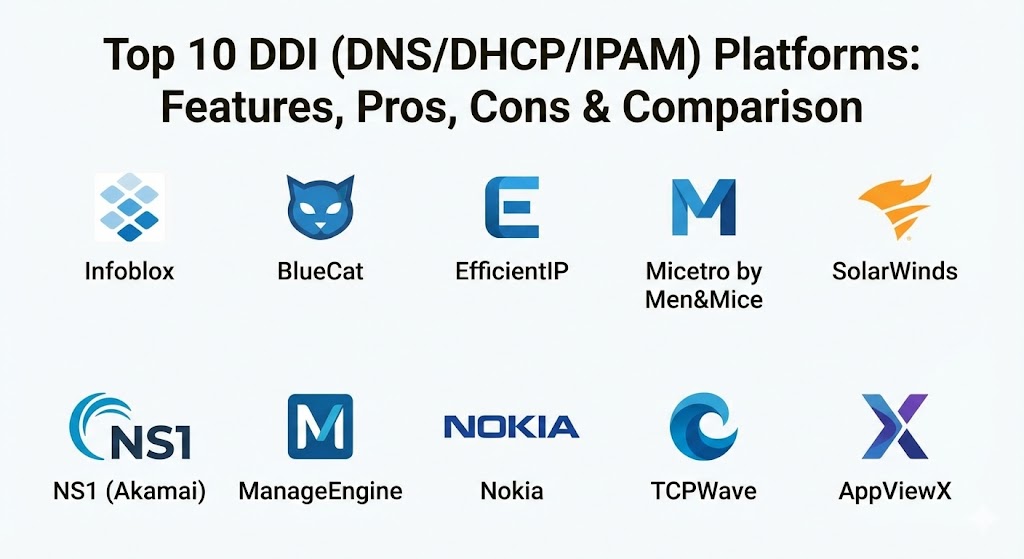
Top 10 DDI (DNS/DHCP/IPAM) Platforms
1 — Infoblox BloxOne
Infoblox is the long-standing market leader in the DDI space. Their BloxOne platform represents the shift toward cloud-native DDI, providing a unified experience that bridges the gap between traditional data centers and edge locations.
- Key Features:
- Grid Technology: A unique architecture that allows for highly resilient, distributed management across global sites.
- BloxOne Threat Defense: Uses DNS-level intelligence to identify and block malware and data exfiltration.
- Cloud-Managed DDI: Centralized control from the cloud with local survivability at remote sites.
- Extensive API Library: Designed for deep integration with CI/CD pipelines and security orchestration tools.
- Automated Discovery: Real-time visibility into all connected devices, regardless of vendor.
- Ecosystem Integration: Native connectors for ServiceNow, Splunk, and major cloud platforms.
- Pros:
- Unmatched reliability; their “Grid” architecture ensures that even if the connection to the controller is lost, local services stay up.
- The most comprehensive security features in the DDI category.
- Cons:
- One of the most expensive solutions on the market.
- The complexity of the platform often requires specialized training for IT staff.
- Security & Compliance: SOC 2 Type II, HIPAA, GDPR, ISO 27001, and FIPS 140-2. Includes robust audit trails and SSO.
- Support & Community: Industry-leading technical support, “Infoblox University” for certification, and a very active professional user group.
2 — BlueCat Integrity
BlueCat is known for its focus on “Adaptive DNS.” Their platform is designed to handle the dynamic nature of modern networks, where IPs change frequently and automation is the priority.
- Key Features:
- Unified Service Assurance: Integrated DNS, DHCP, and IPAM for both public and private clouds.
- Gateway Automation: A specialized layer that allows for custom automation workflows via Python.
- Service Discovery: Automatically maps out the relationships between applications and network infrastructure.
- Global IPAM: A single source of truth that spans across multiple cloud VPCs and on-prem networks.
- DNS Edge: A client-side DNS security tool that provides visibility even for devices off the main network.
- Pros:
- Exceptional for developers; the Gateway makes it very easy to build custom integrations.
- Strong focus on “software-first” management, making it highly flexible for virtualized environments.
- Cons:
- The user interface can feel more technical and less “polished” than Infoblox.
- Initial setup can be labor-intensive due to the high degree of customizability.
- Security & Compliance: SOC 2, ISO 27001, and GDPR compliant. Supports encrypted DNS traffic and detailed audit logs.
- Support & Community: High-touch customer success teams and detailed technical documentation.
3 — EfficientIP SOLIDserver
EfficientIP is a European leader that has gained global traction by focusing on “Smart DDI.” Their SOLIDserver appliance is designed for high-performance environments that require absolute DNS security.
- Key Features:
- DNS Guardian: A patented technology that provides deep packet inspection to stop DNS-based attacks without blocking legitimate traffic.
- SmartArchitecture: Simplifies the deployment of complex DNS/DHCP architectures (like stealth slaves or high-availability clusters).
- Cloud Observer: Provides real-time visibility into resources across AWS, Azure, and Google Cloud.
- NetChange: A dedicated tool for automating network switch configuration alongside IPAM updates.
- Zero-Touch Provisioning: Speeds up the deployment of hardware and virtual appliances.
- Pros:
- Best-in-class security features specifically for DNS-targeted attacks (like DDoS and tunneling).
- The platform is highly performant and can handle massive query volumes with low latency.
- Cons:
- Brand recognition is slightly lower in North America compared to Infoblox or BlueCat.
- The integrated “Network Change” features may overlap with other tools you already own.
- Security & Compliance: Common Criteria, GDPR, and ISO 27001 compliant. Strong focus on data privacy.
- Support & Community: Reliable technical support and a growing ecosystem of European and Global partners.
4 — Micetro by Men&Mice
Micetro (formerly known as Men&Mice Suite) takes a different approach. Instead of replacing your existing DNS/DHCP servers (like Microsoft or BIND), it acts as an overlay, providing a unified management layer on top of them.
- Key Features:
- Overlay Architecture: Manage Microsoft DNS/DHCP, Linux BIND, and cloud DNS from one interface.
- API-First Design: Built specifically to be managed via code and integrated into DevOps workflows.
- Granular RBAC: Highly sophisticated permissions, perfect for large, multi-tenant environments.
- Workflow Management: Built-in “Approval” flows for IP and DNS changes.
- Cloud-Native Integration: Unified management for Azure, AWS, and GCP DNS zones.
- Pros:
- The least “disruptive” tool; you don’t have to rip and replace your existing servers to get unified DDI.
- Incredibly lightweight and fast compared to traditional “all-in-one” appliances.
- Cons:
- Because it is an overlay, it lacks some of the deep “hardware-level” control of Infoblox.
- You are still responsible for patching the underlying DNS/DHCP servers (e.g., Windows updates).
- Security & Compliance: GDPR and ISO 27001 compliant. Leverages existing AD/LDAP security for authentication.
- Support & Community: Very high ratings for customer support; strong presence in the technical Linux/UNIX community.
5 — SolarWinds IP Address Manager (IPAM)
While SolarWinds is known for general monitoring, their IPAM product (often paired with their DNS/DHCP modules) is a powerhouse for mid-market companies that need reliability without the enterprise price tag.
- Key Features:
- Integrated DNS/DHCP Management: Centralized management for Microsoft, Cisco, and ISC BIND.
- IP Request Wizard: A self-service portal for developers to request IP addresses.
- Subnet Allocation: Intelligent tools for planning and resizing subnets.
- Conflict Detection: Alerts you immediately if two devices are trying to use the same IP.
- Cloud DNS Sync: Monitors and manages records in Amazon Route 53 and Azure DNS.
- Pros:
- Great user interface that is consistent with the rest of the SolarWinds Orion ecosystem.
- Very cost-effective for companies that primarily need IPAM and basic service management.
- Cons:
- Not as robust for high-end “Core” DNS/DHCP (e.g., service providers or global banks).
- The dependency on the Orion platform can be a drawback for teams looking for a standalone DDI tool.
- Security & Compliance: FIPS 140-2, SOC 2, HIPAA, and GDPR compliant. Includes detailed history logs.
- Support & Community: Massive “THWACK” community and an extensive library of video training.
6 — Akamai (NS1) Connect
NS1, acquired by Akamai, has redefined DDI for the modern software-defined era. It is built for companies that operate at “internet scale” and need DNS that acts more like a traffic-steering engine.
- Key Features:
- Filter Chain Technology: Allows for complex, modular routing rules (e.g., “route to the cheapest cloud that has capacity”).
- Software-Defined DDI: Deployable on any hardware, virtual machine, or container.
- Real-Time Data Feeds: Use external data (like server load or network latency) to make DNS routing decisions.
- Integrated IPAM: High-performance IP tracking that scales to millions of endpoints.
- DDI on the Edge: Deploy DNS/DHCP services closer to the users for lower latency.
- Pros:
- The best choice for high-traffic SaaS applications and global web properties.
- Extremely modern API that makes it a favorite for automation-heavy “Infrastructure as Code” teams.
- Cons:
- May feel “too advanced” for organizations with a traditional internal office network.
- Pricing is based on volume, which can scale quickly with high traffic.
- Security & Compliance: SOC 2 Type II, ISO 27001, and GDPR compliant.
- Support & Community: Premium support backed by Akamai’s global infrastructure; technical documentation is top-tier.
7 — ManageEngine OpUtils (DDI Suite)
ManageEngine provides an integrated suite that covers IP address management and switch port mapping. It is the “value leader,” providing essential DDI features at a price point that SMBs can afford.
- Key Features:
- IP Address Management: Tracks IPv4 and IPv6 addresses across the entire network.
- Switch Port Mapper: Shows exactly which device is plugged into which physical port.
- DHCP Server Management: Centralized control for Microsoft and Linux DHCP servers.
- Rogue Device Detection: Alerts you to unauthorized hardware connecting to the network.
- Detailed Reporting: Over 20 pre-built reports for audit and capacity planning.
- Pros:
- Incredible value; provides many “Enterprise” features at a fraction of the cost.
- Very easy to install and get running in under an hour.
- Cons:
- Lacks the advanced “Anycast DNS” and “Traffic Steering” of high-end tools.
- The UI can feel a bit dated and less intuitive for very complex architectures.
- Security & Compliance: GDPR and ISO 27001 compliant. Includes basic SSO and audit logs.
- Support & Community: Strong global support network and a large user base across various ManageEngine products.
8 — Nokia VitalQIP
Nokia VitalQIP is a veteran in the DDI industry. It is known for its extreme scalability and is the platform behind some of the world’s largest telecommunications networks.
- Key Features:
- Carrier-Grade Performance: Designed to handle millions of IP addresses and billions of DNS queries.
- Flexible Deployment: Supports centralized or highly distributed management models.
- IPv6 Readiness: One of the most mature IPv6 implementations in the market.
- Multi-Vendor Support: Manages Lucent, Microsoft, and BIND DNS/DHCP.
- Extensive Customization: Can be tailored to the specific needs of massive service providers.
- Pros:
- Proven reliability at a scale that few other platforms can match.
- Excellent for ISPs and global telecom operators with deep technical requirements.
- Cons:
- The interface and configuration workflow can feel very “legacy” compared to modern SaaS tools.
- Not suitable for small or mid-sized enterprises due to its complexity and footprint.
- Security & Compliance: Varies / N/A (Highly dependent on the custom enterprise implementation).
- Support & Community: Professional services-led support; documentation is technical and comprehensive.
9 — TCPWave
TCPWave is a specialized DDI provider that focuses on security and performance. They have built their platform from the ground up on a modern architecture, avoiding the “legacy baggage” of older tools.
- Key Features:
- AI-Driven Insights: Uses machine learning to detect anomalies in DNS traffic and predict IP exhaustion.
- REST API-Centric: Every single function in the platform is accessible via an API.
- Anycast DNS Support: Built-in tools for managing high-availability Anycast networks.
- Zero-Trust DDI: Enforces strict security policies for all internal and external DNS queries.
- Cloud Integration: Native support for managing hybrid environments across all major cloud providers.
- Pros:
- Very modern, fast UI that simplifies complex networking tasks.
- Excellent performance and security posture for modern, cloud-first organizations.
- Cons:
- Smaller market share means fewer “community-made” templates or guides.
- May require a mindset shift for teams used to traditional appliance-based DDI.
- Security & Compliance: SOC 2, HIPAA, and GDPR compliant. Strong focus on NIST security standards.
- Support & Community: High-quality technical support and detailed video-based onboarding.
10 — AppViewX ADC+ (DDI Management)
While AppViewX is often associated with Certificate Management, their ADC+ platform includes a powerful DDI management layer focused on Service Orchestration.
- Key Features:
- Visual Workflow Automation: Create DDI changes using a drag-and-drop visual builder.
- Unified Inventory: A single view of IPs, DNS records, and SSL/TLS certificates.
- Self-Service Provisioning: Allows app owners to request infrastructure changes without contacting NetOps.
- Compliance Guardrails: Ensures all manual and automated changes follow company policy.
- Multi-Cloud Orchestration: Synchronizes DDI across diverse cloud and on-prem environments.
- Pros:
- The best tool for teams that want to “Orchestrate” rather than just “Manage.”
- Uniquely links DDI to identity and certificate management for a more secure environment.
- Cons:
- Lacks the “Core” DHCP server capability (it manages other DHCP servers).
- Pricing can be high for organizations that only need basic DDI.
- Security & Compliance: SOC 2, ISO 27001, and HIPAA compliant. High-standard audit logging.
- Support & Community: Excellent professional services and a dedicated technical account manager for most clients.
Comparison Table
| Tool Name | Best For | Platform(s) Supported | Standout Feature | Rating (Gartner / TrueReview) |
| Infoblox BloxOne | Enterprises / Security | SaaS / Appliance | Grid Resilience Technology | 4.6 / 5 |
| BlueCat Integrity | Developer-Led Automation | SaaS / Virtual | Python-Based Gateway | 4.4 / 5 |
| EfficientIP | Performance / DNS Security | Appliance / Virtual | DNS Guardian Protection | 4.5 / 5 |
| Micetro (Men&Mice) | Overlay Management | SaaS / Linux / Win | Manage Existing Servers | 4.7 / 5 |
| SolarWinds IPAM | Mid-Market / Microsoft Shops | Windows / SaaS | Integrated Orion Dashboards | 4.1 / 5 |
| NS1 (Akamai) | Internet-Scale SaaS | SaaS / Software | Filter Chain Routing Logic | 4.8 / 5 |
| ManageEngine | SMBs / Value | SaaS / Windows | Integrated Switch Port Map | 4.2 / 5 |
| Nokia VitalQIP | Telecoms / ISPs | Linux / Unix | Carrier-Grade Scalability | 3.9 / 5 |
| TCPWave | Modern / AI-Ops | SaaS / Virtual | AI-Driven Threat Detection | 4.3 / 5 |
| AppViewX | Service Orchestration | SaaS / Virtual | Visual Workflow Builder | 4.5 / 5 |
Evaluation & Scoring of DDI Platforms
The scoring rubric below is weighted to reflect the needs of modern, high-velocity IT departments where security and automation are paramount.
| Criteria | Weight | Evaluation Logic |
| Core Features | 25% | Integration of DNS/DHCP/IPAM, IPv6 support, and failover. |
| Ease of Use | 15% | Intuitiveness of the UI, discovery speed, and setup complexity. |
| Integrations | 15% | API quality, cloud native support, and ecosystem connectors. |
| Security & Compliance | 10% | DNSSEC, encryption, audit trails, and global certifications. |
| Performance | 10% | Query latency, scalability to millions of IPs, and uptime. |
| Support & Community | 10% | Documentation, user forums, and 24/7 technical assistance. |
| Price / Value | 15% | Overall ROI and transparency of the licensing model. |
Which DDI Platform Is Right for You?
Selecting a DDI platform is a long-term commitment that impacts the very foundation of your network.
Solo Users vs SMB vs Mid-Market vs Enterprise
- Solo Users: Generally do not need a DDI platform. A standard registrar like Cloudflare and a local router will suffice.
- SMBs: ManageEngine or SolarWinds are the strongest contenders. They provide a manageable entry point into professional IP management without requiring a dedicated engineer.
- Mid-Market: Micetro is an excellent choice if you already have Microsoft or Linux servers and want a unified layer. EfficientIP is great if you prioritize performance and security.
- Enterprise: Infoblox and BlueCat are the standard-bearers. They provide the compliance, global scale, and specialized security required by Fortune 500 companies.
Budget-Conscious vs Premium Solutions
If budget is the primary driver, ManageEngine provides incredible value. However, if the cost of an hour of downtime is measured in the millions, the “Premium” investment in Infoblox‘s Grid technology is essentially an insurance policy for your network availability.
Feature Depth vs Ease of Use
If you want depth, look at NS1 or Infoblox—you can tune every single packet and routing rule. If you want ease of use, look at AppViewX or Micetro, which prioritize the workflow and user experience over low-level protocol manipulation.
Frequently Asked Questions (FAQs)
1. What is the difference between IPAM and DDI?
IPAM is just the management of IP addresses (like a database). DDI is the integration of that database (IPAM) with the actual services that assign IPs (DHCP) and translate them into names (DNS).
2. Can I use a DDI platform with my existing Microsoft servers?
Yes, tools like Micetro and SolarWinds are designed specifically to “overlay” or manage Microsoft DNS/DHCP servers from a central console.
3. Is DDI necessary for a cloud-only company?
Yes. Even if you don’t have physical hardware, you still need to manage IP ranges (CIDR blocks) across multiple VPCs and ensure your cloud DNS records are synchronized and secure.
4. How does DDI help with security?
DNS is the most common vector for data exfiltration and malware. DDI platforms like Infoblox and EfficientIP use DNS intelligence to block malicious traffic at the source.
5. What is “Anycast DNS”?
Anycast allows multiple servers to share the same IP address. DDI platforms use this to ensure that a user always resolves their DNS from the closest (and fastest) possible server.
6. Can DDI platforms handle IPv6?
Yes. In 2026, most professional DDI tools provide full “Dual-Stack” support, helping organizations transition from IPv4 to the massive address space of IPv6.
7. Does DDI integrate with ServiceNow?
Most enterprise-level DDI tools have native plugins for ServiceNow, allowing network changes to be triggered by a helpdesk ticket or an automated workflow.
8. Is a DDI appliance better than a virtual machine?
Hardware appliances offer the highest performance and “hardened” security. Virtual appliances offer better flexibility and are easier to scale in cloud environments.
9. What is “DNSSEC”?
DNSSEC is a security extension that adds digital signatures to your DNS records, ensuring that the information users receive hasn’t been tampered with by an attacker.
10. How long does it take to implement a DDI platform?
For an SMB, it can take a few days. For a global enterprise, migration and synchronization can take several months of careful planning and execution.
Conclusion
The evolution of DDI Platforms in 2026 has moved them from simple administrative tools to critical components of the “Operational Backbone.” The right tool for you is the one that bridges the gap between your existing infrastructure and your future cloud goals.
If you are a high-traffic SaaS company, the software-defined intelligence of NS1 is likely your best bet. If you are a high-security global enterprise, the proven “Grid” of Infoblox remains the gold standard. Regardless of your choice, moving away from manual spreadsheets and siloed management is the most important step you can take toward a resilient, future-proof network.