Introduction
Data quality tools are specialized software solutions designed to monitor, cleanse, and manage the health of an organization’s data throughout its lifecycle. These tools go far beyond simple spell-checking; they utilize advanced machine learning (ML) and artificial intelligence (AI) to profile data, identify anomalies, remove duplicates, and ensure compliance with global standards. By automating the process of maintaining “trusted data,” these platforms allow data engineers and business analysts to focus on extracting value rather than fixing broken pipelines.
The importance of these tools is underscored by the rise of Generative AI. An AI model is only as good as the data it is trained on; poor data quality leads to “hallucinations” and biased outputs that can damage a brand’s reputation. Real-world use cases include financial institutions verifying customer identities for anti-money laundering (AML) compliance, healthcare providers ensuring patient records are unified across systems, and e-commerce giants standardizing product descriptions to improve search relevance. When choosing a tool, users should evaluate its ability to scale, its ease of integration with modern data stacks like Snowflake or Databricks, and the robustness of its automated “self-healing” capabilities.
Best for: Medium to large enterprises with complex data ecosystems, data stewards, CDOs (Chief Data Officers), and any organization relying heavily on AI, machine learning, or high-stakes business intelligence.
Not ideal for: Early-stage startups with very limited datasets or companies where data is entirely static and managed in a single, simple spreadsheet environment.
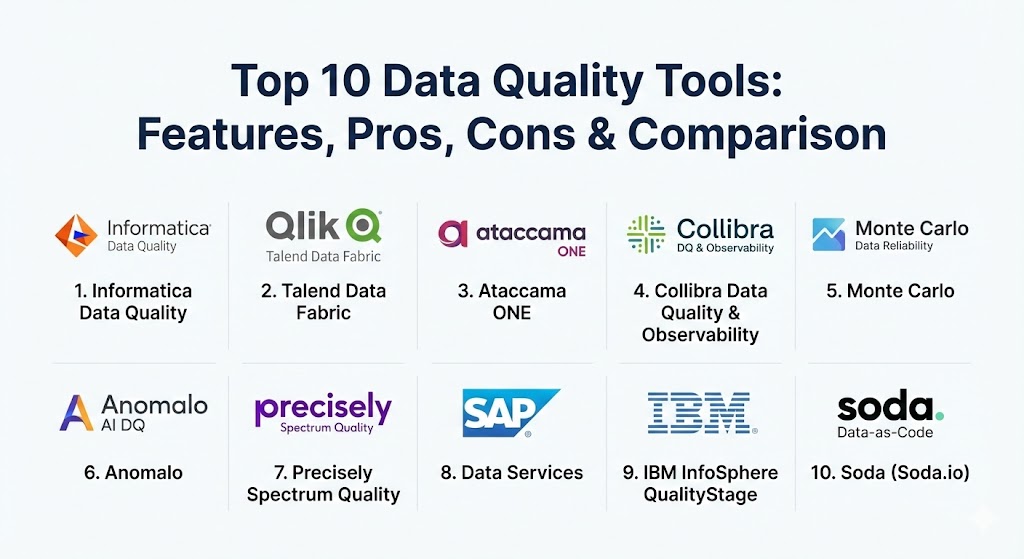
Top 10 Data Quality Tools
1 — Informatica Data Quality
Informatica is a long-standing leader in the data management space. Their Data Quality solution is part of the Intelligent Data Management Cloud (IDMC), offering a highly sophisticated, AI-powered platform for profiling and cleansing data at scale.
- Key features:
- CLAIRE AI engine for automated data discovery and rule recommendation.
- Comprehensive data profiling and visualization of quality scores.
- Pre-built accelerators for common domains like “Customer” and “Product.”
- Deep integration with cloud warehouses like Snowflake and Google BigQuery.
- Rule-based and ML-based cleansing and standardization.
- Unified governance and metadata management.
- Pros:
- Powerful automation features that significantly reduce manual rule writing.
- Excellent scalability for the most demanding global enterprise environments.
- Cons:
- One of the most expensive solutions on the market.
- Higher complexity requires specialized training to master all features.
- Security & compliance: SOC 2 Type II, HIPAA, GDPR, and FIPS 140-2 compliant. Includes granular role-based access control (RBAC).
- Support & community: Extensive enterprise-grade support, a vast global partner network, and a mature user community through Informatica University.
2 — Talend Data Fabric (now part of Qlik)
Talend, recently integrated with Qlik, offers a versatile “Data Fabric” that combines data integration, quality, and governance. It is highly regarded for its “Trust Score,” which provides an immediate visual health check for any dataset.
- Key features:
- Native “Talend Trust Score” to instantly assess data health.
- Self-service data preparation tools for non-technical business users.
- Robust deduplication and fuzzy matching logic.
- Over 1,000 connectors for seamless integration into any tech stack.
- Machine learning-based data masking for privacy protection.
- Collaborative workflows for data stewards and engineers.
- Pros:
- Intuitive GUI makes it accessible to both technical and business teams.
- Strong open-source roots offer a flexible and extensible foundation.
- Cons:
- Transitioning to Qlik’s ecosystem has caused some temporary licensing confusion for legacy users.
- Can be resource-heavy for smaller on-premise installations.
- Security & compliance: ISO 27001, SOC 2, HIPAA, and GDPR certified. Data-in-transit and at-rest encryption.
- Support & community: Strong community support (Talend Exchange) and comprehensive documentation with 24/7 enterprise support tiers.
3 — Ataccama ONE
Ataccama ONE is an automated, AI-driven data management platform that excels in unifying data quality, master data management (MDM), and data governance into a single “self-driving” experience.
- Key features:
- Self-driving data quality that automatically detects issues and suggests fixes.
- Integrated data catalog with automated metadata discovery.
- Powerful matching and merging for complex MDM use cases.
- Collaborative “Data Stories” for reporting quality metrics to stakeholders.
- Real-time monitoring and alerting for data drift.
- Browser-based interface for easy deployment and access.
- Pros:
- The unified nature of the platform reduces the need for multiple disparate tools.
- High degree of automation makes it a “force multiplier” for small data teams.
- Cons:
- Initial implementation and configuration can be complex for large legacy estates.
- Pricing is opaque and tends toward the premium enterprise end.
- Security & compliance: SOC 2, GDPR, and HIPAA compliant. Supports SSO (Okta, Azure AD) and full audit logging.
- Support & community: Responsive technical support and a focus on customer-led product enhancements.
4 — Collibra Data Quality & Observability
Collibra, originally known for its data governance and cataloging, has expanded aggressively into data quality and observability. It focuses on finding data issues before they impact business outcomes.
- Key features:
- Predictive data quality using ML to baseline “normal” data behavior.
- Natural language rule builder for business users.
- End-to-end data lineage to trace quality issues to their source.
- Automated anomaly detection (outliers, schema changes, null spikes).
- Integrated “Data Citizens” portal for collaborative stewardship.
- High-level quality dashboards for executive reporting.
- Pros:
- Best-in-class for organizations where data governance is the primary driver.
- Excellent at visualizing the “blast radius” of a data quality failure.
- Cons:
- Can feel “over-engineered” for teams that only need simple cleansing.
- Onboarding is notoriously time-consuming for large organizations.
- Security & compliance: ISO 27001, SOC 2, GDPR, and HIPAA. Strong focus on data privacy and residency.
- Support & community: World-class documentation and “Collibra University” for formal certifications.
5 — Monte Carlo
Monte Carlo is the pioneer of the “Data Observability” category. While traditional tools focus on cleansing, Monte Carlo focuses on “Data Reliability,” treating data health similarly to how DevOps treats application uptime.
- Key features:
- Automatic, no-code monitoring for data freshness, volume, and schema.
- Automated field-level lineage mapping.
- “Incident IQ” for root-cause analysis of data breaks.
- ML-based anomaly detection with automated sensitivity tuning.
- Native integrations with dbt, Airflow, and Snowflake.
- Alerting via Slack, PagerDuty, and Microsoft Teams.
- Pros:
- Zero-config setup allows teams to see value in minutes, not weeks.
- Exceptional at reducing “data downtime” in fast-moving pipelines.
- Cons:
- Focused more on observability (finding problems) than on manual cleansing (fixing them).
- Can generate high alert volume if not carefully tuned.
- Security & compliance: SOC 2 Type II, HIPAA, and GDPR. Data remains within the customer’s VPC (Virtual Private Cloud).
- Support & community: Highly responsive support team and an influential community of “Data Reliability” practitioners.
6 — Anomalo
Anomalo is an AI-powered data quality platform that specializes in monitoring structured and unstructured data without requiring users to write manual rules.
- Key features:
- AIDA (Anomalo Intelligent Data Analyst) for natural language querying of data health.
- Deep monitoring of unstructured data (documents, transcripts) using LLMs.
- Automatic baseline creation for every table in a data warehouse.
- Automated root cause analysis and impact assessment.
- Native “Snowflake Native App” deployment option.
- Visual anomaly history for every column.
- Pros:
- Superior at finding “hidden” issues that humans wouldn’t think to write rules for.
- The unstructured data monitoring is a unique and timely feature for AI-heavy companies.
- Cons:
- Can be computationally expensive as it scans large volumes of data for statistics.
- Smaller partner ecosystem compared to legacy vendors.
- Security & compliance: SOC 2 Type II, HIPAA, and support for in-VPC or hybrid cloud deployment.
- Support & community: Fast-growing, high-touch support for enterprise clients.
7 — Precisely Spectrum Quality
Precisely is the result of the merger between Syncsort and Pitney Bowes Software. Their Spectrum Quality tool is a veteran solution, particularly powerful for geographic and customer data.
- Key features:
- Industry-leading global address verification and geocoding.
- Sophisticated entity resolution and matching algorithms.
- Drag-and-drop visual flow designer for complex data pipelines.
- High-performance batch processing for massive datasets.
- Integrated data enrichment (adding demographic or location data).
- Real-time and batch-mode operations.
- Pros:
- Unrivaled accuracy for location-based and postal data quality.
- Extremely stable and reliable for high-volume legacy environments.
- Cons:
- The interface can feel traditional compared to modern cloud-native startups.
- Less focus on the “observability” and “AI-first” trends of newer competitors.
- Security & compliance: ISO 27001, GDPR, and HIPAA compliant.
- Support & community: Deep domain expertise and dedicated professional services for complex implementations.
8 — SAP Data Services
For organizations running on SAP, SAP Data Services provides a powerful, integrated environment for data integration, transformation, and quality management.
- Key features:
- Seamless integration with SAP S/4HANA and SAP SuccessFactors.
- Advanced profiling and cleansing of master data.
- Multi-domain support (Material, Customer, Vendor, Financials).
- Impact analysis and data lineage within the SAP ecosystem.
- Integrated masking and encryption for data privacy.
- Unified cockpit for monitoring integration and quality jobs.
- Pros:
- The obvious and most effective choice for SAP-centric organizations.
- Extremely robust for managing complex, multi-lingual master data.
- Cons:
- Not as “friendly” to non-SAP environments as platform-agnostic tools.
- Requires a significant investment in specialized SAP skills.
- Security & compliance: Meets all major global standards including SOC 2, GDPR, and ISO 27001.
- Support & community: Backed by SAP’s massive global support infrastructure and partner network.
9 — IBM InfoSphere QualityStage
IBM InfoSphere QualityStage is a cornerstone of IBM’s data integration portfolio, designed to help organizations create and maintain a “single view of the truth.”
- Key features:
- Investigation and profiling of complex, disparate data sources.
- Probabilistic and deterministic matching logic.
- Standardization of diverse fields into a unified business format.
- Native integration with IBM Knowledge Catalog and Watson.
- Machine learning-powered auto-assignment of business terms.
- Deployment flexibility (on-premise, public cloud, or hybrid).
- Pros:
- Highly reliable for massive-scale data cleansing in regulated industries.
- Strong integration with the broader IBM Watson AI ecosystem.
- Cons:
- Can be difficult to navigate for teams outside the IBM ecosystem.
- Slower innovation cycle compared to the “agile” observability startups.
- Security & compliance: FIPS 140-2, HIPAA, GDPR, and SOC 2 compliant.
- Support & community: World-class enterprise support and deep technical documentation.
10 — Soda (Soda.io)
Soda is a developer-centric data quality tool that uses a “Data-as-Code” approach. It allows engineers to define data quality checks using a simple, human-readable language (SodaCL) that lives inside their Git workflows.
- Key features:
- SodaCL: A declarative language for defining data quality tests.
- Integration with dbt (data build tool) and Airflow.
- Collaborative “Soda Cloud” for visualizing test results and incidents.
- Automated anomaly detection and “what-if” impact analysis.
- Data Contracts to enforce quality agreements between teams.
- CLI-first interface for data engineers.
- Pros:
- Excellent for teams following modern “DataOps” or “Software Engineering for Data” practices.
- Transparent, dataset-based pricing is more predictable than many enterprise models.
- Cons:
- Lacks the deep “manual cleansing” and “standardization” features of tools like Informatica.
- Requires some technical proficiency (CLI/YAML) to get the most out of it.
- Security & compliance: SOC 2 Type II, RBAC, and encrypted data handling.
- Support & community: Very active Slack community and excellent developer-focused documentation.
Comparison Table
| Tool Name | Best For | Platform(s) Supported | Standout Feature | Rating (Gartner/TrueReview) |
| Informatica DQ | Global Enterprise | Multi-cloud, On-prem | CLAIRE AI Engine | 4.4 / 5 |
| Talend Data Fabric | Hybrid Cloud | Cloud, On-prem | Talend Trust Score | 4.3 / 5 |
| Ataccama ONE | Unified DQ & MDM | Cloud, Hybrid | Self-driving DQ | 4.6 / 5 |
| Collibra DQ | Governance-led | Cloud, Hybrid | Predictive Observability | 4.2 / 5 |
| Monte Carlo | Data Reliability | Cloud-native | Automated Lineage | 4.5 / 5 |
| Anomalo | AI & Unstructured | Cloud-native | Unstructured Data DQ | 4.7 / 5 |
| Precisely Spectrum | Geocoding & Postal | Multi-platform | Address Verification | 4.4 / 5 |
| SAP Data Services | SAP Ecosystem | SAP, Multi-cloud | S/4HANA Integration | 4.3 / 5 |
| IBM QualityStage | Regulated Industries | Multi-platform | Probabilistic Matching | 4.2 / 5 |
| Soda | Data-as-Code Teams | Cloud-native | SodaCL Language | 4.5 / 5 |
Evaluation & Scoring of Data Quality Tools
To help you compare these solutions objectively, we have used a weighted rubric that reflects the priorities of a modern data team in 2026.
| Category | Weight | Evaluation Criteria |
| Core Features | 25% | Profiling, cleansing, deduplication, standardization, and matching. |
| Ease of Use | 15% | Intuitiveness of UI, self-service capabilities, and setup speed. |
| Integrations | 15% | Support for Snowflake, Databricks, dbt, Airflow, and major SaaS apps. |
| Security & Compliance | 10% | Encryption, SOC 2, GDPR, HIPAA, and role-based access control. |
| Performance | 10% | Scalability for petabyte-scale data and low latency for real-time checks. |
| Support & Community | 10% | Documentation quality, training resources, and community activity. |
| Price / Value | 15% | Transparency of pricing and ROI for the specific target market. |
Which Data Quality Tool Is Right for You?
The “best” tool isn’t a universal truth; it is a match between your technical maturity and your business goals.
- Solo Users & Small Teams: If you are just starting out, a developer-friendly tool like Soda or a SaaS-native observability platform like Monte Carlo allows you to implement “checks” without a massive upfront investment.
- SMBs to Mid-Market: Organizations in this tier often benefit from the user-friendly interfaces of Talend or Ataccama ONE, which offer a broad set of features without requiring a 10-person dedicated storage and data team.
- The “DataOps” Enterprise: If your team treats data like code, Soda or Monte Carlo are essential. They integrate into your existing CI/CD pipelines and ensure that a “bad” commit doesn’t break your downstream dashboards.
- The Highly Regulated Enterprise: For banking, healthcare, or government, the legacy stability and deep compliance features of Informatica, IBM, or Precisely are often worth the premium price tag.
- The AI-First Organization: If your focus is training LLMs or high-stakes predictive models, Anomalo is a standout choice due to its ability to monitor the quality of unstructured text and its automated, deep statistical monitoring.
Frequently Asked Questions (FAQs)
1. What is the difference between Data Quality and Data Observability?
Data Quality traditional focus is on cleansing and standardizing data (fixing what is broken). Data Observability focuses on reliability and monitoring (knowing when and why it broke), treating data health like an engineering discipline.
2. Can these tools fix my data automatically?
Some can. Tools like Ataccama and Informatica offer “self-healing” or automated cleansing rules. However, for critical business data, human “stewards” usually review automated changes to ensure accuracy.
3. Do I need a Data Quality tool if I use a modern warehouse like Snowflake?
Yes. While Snowflake is excellent for storing and processing data, it does not inherently know if your “Customer Name” field is garbage or if a sudden spike in null values is an error in an upstream API.
4. How much do these tools typically cost?
Pricing is broad. Cloud-native observability tools often start at $15k–$30k/year, while massive enterprise suites like Informatica can exceed $250k/year depending on volume and modules.
5. How long does it take to see ROI?
Observability tools (Monte Carlo, Soda) can show value in days by catching broken pipelines. Deep cleansing platforms (Informatica, IBM) may take months to fully configure but save millions in operational efficiency over time.
6. Is “Data-as-Code” better than a GUI interface?
It depends on who is using it. Data engineers usually prefer code (Soda), as it can be version-controlled in Git. Business analysts and data stewards usually prefer a GUI (Talend, Collibra) for ease of use.
7. Can these tools handle unstructured data?
Historically, no. However, 2026 leaders like Anomalo are now using Large Language Models (LLMs) to score the quality of text, documents, and transcripts.
8. What are the “6 dimensions” of data quality?
Most experts evaluate data based on: Accuracy, Completeness, Consistency, Timeliness, Validity, and Uniqueness.
9. Do I need a specialized “Data Steward” to run these tools?
For large companies, yes. While the tools automate the finding, a human steward often defines the business rules for what “good” data actually looks like for that specific company.
10. Can I build my own data quality checks instead of buying a tool?
Yes, using SQL or Python. However, as your data grows to hundreds of tables and thousands of columns, maintaining custom scripts becomes a full-time job that is often more expensive than a dedicated tool.
Conclusion
In the data-driven world of 2026, the cost of poor data quality is no longer just a “minor inconvenience”—it is a major business risk. Choosing the right tool requires an honest assessment of your current data stack, your team’s technical skills, and your long-term goals. Whether you prioritize the AI-driven automation of Informatica, the developer-first simplicity of Soda, or the high-speed observability of Monte Carlo, the most important step is simply to start. Trusted data is the only foundation upon which a successful modern enterprise can be built.