Introduction
Data governance is the comprehensive framework of people, processes, and technology that ensures an organization’s data is available, usable, secure, and accurate. A Data Governance Platform acts as the central command center for this framework. It goes beyond simple storage to provide a unified environment where data policies are defined, data catalogs are maintained, and data lineage is mapped. It transforms raw information into “data intelligence,” allowing businesses to comply with increasingly strict global privacy laws while simultaneously fueling AI and machine learning models with high-quality, trusted inputs.
Choosing the right platform is critical because it dictates how easily your team can discover data and how effectively you can mitigate risk. Key evaluation criteria include the platform’s ability to automate metadata harvesting, the depth of its data lineage visualization, the intuitiveness of its business glossary, and how well it integrates with your existing “Modern Data Stack” (e.g., Snowflake, dbt, Databricks). Real-world use cases range from streamlining HIPAA compliance in healthcare to accelerating customer 360 initiatives in retail by ensuring a “single version of truth.”
Best for: Large, highly regulated enterprises (finance, healthcare, government), mid-market companies scaling their AI initiatives, and Data Protection Officers (DPOs) who need to prove compliance. It is essential for organizations where data is distributed across multiple cloud providers and departments.
Not ideal for: Early-stage startups with a single data source and a small team where informal communication handles data ownership. Organizations that have not yet defined a data strategy may find these platforms too complex or expensive; they might be better served by a simple data catalog or basic documentation in a wiki until their needs mature.
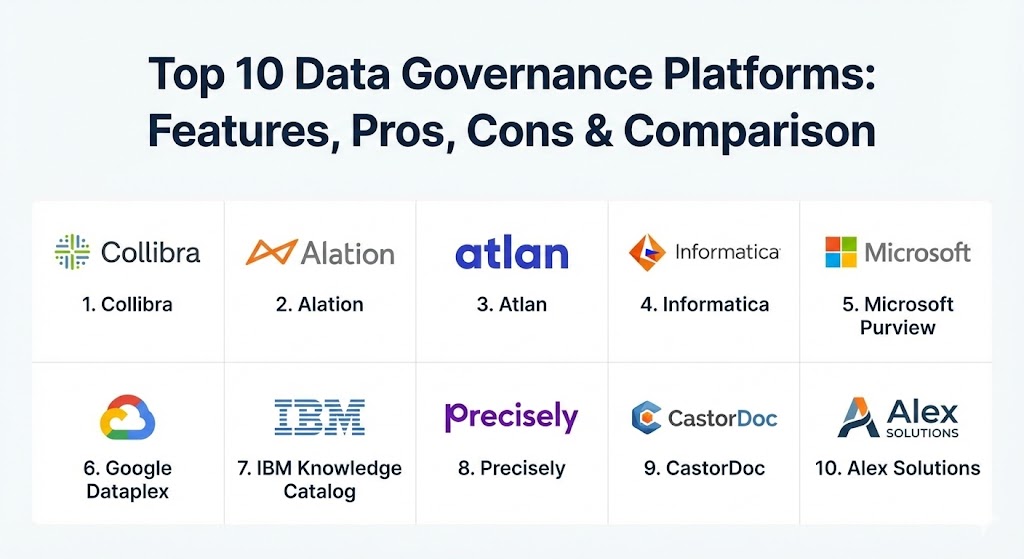
Top 10 Data Governance Platforms Tools
1 — Collibra
Collibra is widely recognized as the market leader in the data governance space. It provides a comprehensive “Data Intelligence Cloud” that bridges the gap between the technical data team and business users, focusing heavily on policy management and stewardship.
- Key features:
- Data Stewardship: Automated workflows for data access requests and ownership assignments.
- Policy Manager: Centralized repository to define and enforce data usage rules across the enterprise.
- Business Glossary: A shared vocabulary that links technical terms to business concepts.
- End-to-End Lineage: Visual mapping of data from the source system to the final report.
- Data Privacy Module: Built-in templates for GDPR, CCPA, and other global regulations.
- Collibra Everywhere: Integration that brings data context directly into Slack, Excel, and BI tools.
- Pros:
- Unmatched depth in governance features and regulatory compliance.
- Highly scalable for the world’s largest and most complex organizations.
- Cons:
- Significant learning curve; usually requires a dedicated administrator.
- One of the most expensive solutions in the market.
- Security & compliance: SOC 2 Type II, ISO 27001, HIPAA, GDPR, FedRAMP, and encryption at rest and in transit.
- Support & community: Gold-standard enterprise support; “Collibra University” offers extensive certifications; very active user community.
2 — Alation
Alation pioneered the modern data catalog and has expanded into a full governance platform. Its “Data Culture” approach emphasizes collaboration and uses machine learning to suggest data owners and flag popular datasets.
- Key features:
- Behavioral Analysis Engine: Learns from user behavior to surface the most trusted data.
- Intelligent SQL Editor: Provides real-time governance warnings to analysts as they write queries.
- Governance App: A specialized module to manage stewardship, policies, and workflows.
- Automated Profiling: Provides snapshots of data quality and distribution automatically.
- Open Connector Framework: Connects to nearly any data source, from legacy mainframes to modern cloud warehouses.
- Pros:
- Exceptionally user-friendly; high adoption rates among non-technical analysts.
- AI-driven automation significantly reduces the manual work of data stewards.
- Cons:
- Less focus on “hard” policy enforcement compared to Collibra.
- Can become pricey as you add more users and modules.
- Security & compliance: SOC 2 Type II, HIPAA, GDPR, and SSO integration (SAML/OpenID).
- Support & community: Robust documentation and a strong focus on “customer success” with dedicated account managers.
3 — Atlan
Atlan is the “cool kid” of the data governance world, built specifically for the modern data stack. It focuses on “Active Metadata,” where governance context is pushed back into the tools where users already work.
- Key features:
- Active Metadata: Metadata is not just stored; it triggers actions (e.g., Slack alerts on schema changes).
- Playbooks: Automated workflows to bulk-update descriptions or owners across thousands of tables.
- Column-Level Lineage: Extremely granular visibility into how specific fields are transformed.
- Persona-Based Access: Tailors the UI and permissions based on whether the user is a CFO or an Engineer.
- GitHub-Style UI: Very modern, intuitive interface that data teams love.
- Pros:
- Fast time-to-value; implementation takes weeks rather than months.
- Seamless integration with modern tools like Snowflake, dbt, and Looker.
- Cons:
- Not as strong for legacy on-premise infrastructure (Mainframes/Legacy SQL).
- The feature set is evolving rapidly, which can lead to frequent UI updates.
- Security & compliance: SOC 2 Type II, HIPAA, GDPR, and ISO 27001. Native support for Okta/Azure AD.
- Support & community: High-touch support via Slack and email; very active “Modern Data Stack” community.
4 — Informatica Intelligent Data Management Cloud (IDMC)
Informatica is the elder statesman of data management. Its IDMC platform is a massive, AI-powered suite that handles everything from ETL to governance, making it a “one-stop-shop” for giant enterprises.
- Key features:
- CLAIRE AI Engine: Uses AI to automate data discovery, classification, and lineage mapping.
- Universal Connectivity: Thousands of connectors for hybrid cloud environments.
- Integrated Data Quality: Governance and quality are managed in a single pane of glass.
- Data Marketplace: An Amazon-like shopping experience for users to “buy” (request) data.
- Axon Data Governance: The specialized module for defining business goals and policies.
- Pros:
- The most feature-complete platform for hybrid cloud (on-prem + multiple clouds).
- Deep integration with Informatica’s industry-leading data integration tools.
- Cons:
- Complex pricing and modular structure can be confusing.
- Can feel “heavy” and traditional compared to cloud-native startups.
- Security & compliance: FIPS 140-2, SOC 2, HIPAA, GDPR, and extensive global certifications.
- Support & community: World-class global enterprise support; vast network of certified implementation partners.
5 — Microsoft Purview
Microsoft Purview is the unified data governance solution for the Microsoft ecosystem. It is the natural choice for organizations that are heavily invested in Azure, Power BI, and Microsoft 365.
- Key features:
- Azure Native Integration: Automatically catalogs and governs Azure SQL, Synapse, and Data Factory.
- Sensitivity Labeling: Applies Microsoft 365 sensitivity labels to data in the cloud.
- Unified Map: A scalable metadata store that maps your entire data estate.
- Data Estate Insights: Dashboards for C-suite leaders to track governance progress and gaps.
- Managed Lineage: Automated lineage capture for Microsoft-based data movements.
- Pros:
- Extremely cost-effective if you are already on an Azure Enterprise Agreement.
- Deepest possible integration with Power BI and Microsoft 365 compliance tools.
- Cons:
- Less robust connectivity for non-Microsoft clouds (GCP/AWS).
- The user interface is functional but lacks the collaborative “social” features of Alation.
- Security & compliance: FedRAMP, HIPAA, SOC 2, and integrated with Microsoft Entra ID.
- Support & community: Standard Microsoft enterprise support; extensive online documentation.
6 — Google Cloud Dataplex
Dataplex is Google Cloud’s answer to data governance. It provides an “intelligent data fabric” that helps organizations manage, monitor, and govern data across BigQuery and Google Cloud Storage.
- Key features:
- Data Discovery: Automated metadata harvesting and cataloging for the GCP ecosystem.
- Centralized Security: Consistent access control across all your Google data lakes and warehouses.
- Data Quality Monitoring: Built-in checks to ensure data in BigQuery is accurate.
- Intelligence-Driven Tiering: AI suggests how to organize data for better governance.
- Serverless Execution: No infrastructure to manage; it scales automatically.
- Pros:
- The best choice for pure GCP shops; zero-effort integration with BigQuery.
- Leverages Google’s world-class search and AI capabilities.
- Cons:
- Very limited support for data outside of the Google Cloud environment.
- Lacks a sophisticated business-facing “stewardship” UI like Collibra.
- Security & compliance: HIPAA, GDPR, ISO 27001, and backed by Google’s core security infrastructure.
- Support & community: Standard GCP support; active developer forums and Google Cloud documentation.
7 — IBM Knowledge Catalog
IBM Knowledge Catalog (part of Cloud Pak for Data) is an AI-powered data catalog that is deeply integrated with IBM’s Watson AI capabilities, focusing on data privacy and quality.
- Key features:
- Automated Data Discovery: Uses AI to classify data and identify PII (Personally Identifiable Information).
- Policy Enforcement: Real-time data masking and filtering based on user roles.
- AI Factsheets: Specifically governs AI models, tracking where they get their training data.
- Enterprise Business Glossary: Highly structured business term management.
- Hybrid Deployment: Can run on-premise, in the cloud, or as a managed service.
- Pros:
- Superior features for AI governance and model transparency.
- Strong “security-first” approach with built-in data masking.
- Cons:
- Can be complex to set up if you aren’t already using IBM Cloud Pak.
- The interface is powerful but can be intimidating for casual users.
- Security & compliance: FIPS 140-2, SOC 2, HIPAA, GDPR, and ISO 27001.
- Support & community: Extensive enterprise support and a large network of IBM professional services.
8 — Precisely (Data360)
Precisely (which acquired Infogix) focuses on the intersection of data integrity, quality, and governance. It is highly regarded for its ability to manage data across legacy mainframes and modern clouds.
- Key features:
- Data Integrity Suite: A modular approach to governance, quality, and location intelligence.
- Automated Lineage: Specialized in “mainframe-to-cloud” lineage mapping.
- 3D Data Governance: Focuses on the “3 Ds”: Discovery, Definition, and Delivery.
- Business Value Tracking: Links governance initiatives to actual business outcomes.
- Self-Service Portal: Allows business users to find and understand data without IT help.
- Pros:
- Exceptional for “bridge” organizations moving from legacy systems to the cloud.
- Deep focus on data accuracy and quality as a part of governance.
- Cons:
- The platform can feel disjointed due to various acquisitions.
- Smaller community compared to the “Big Three” (Collibra/Alation/Informatica).
- Security & compliance: SOC 2, HIPAA, and GDPR compliant.
- Support & community: Strong technical support and a dedicated customer success portal.
9 — CastorDoc
CastorDoc is a newcomer that has taken the market by storm by focusing on the “Google Search” experience for data. It is aimed at democratizing data access for every employee.
- Key features:
- Social Discovery: Shows which datasets are trending and used by peers.
- Automated Documentation: Uses query logs to automatically describe what a table does.
- Chrome Extension: Brings catalog data directly into your BI tool (Tableau/Looker).
- Slack Integration: Search for data definitions directly from your Slack search bar.
- Lineage on Autopilot: Automatically maps dependencies from SQL history.
- Pros:
- The easiest tool to use in this list; virtually zero training required.
- Implementation is incredibly fast (can be done in a few days).
- Cons:
- Lacks the deep “policy enforcement” and “regulatory workflow” of Collibra.
- Limited support for complex, non-cloud legacy systems.
- Security & compliance: SOC 2 Type II, GDPR, and encryption at rest.
- Support & community: Very responsive support; popular with startups and tech-forward mid-market firms.
10 — Alex Solutions
Alex Solutions is a high-performance metadata management platform that focuses on “agnostic” connectivity. It is favored by technical architects who need a deep, unfiltered view of their data estate.
- Key features:
- Universal Metadata Harvesting: Scans anything from COBOL to Kafka streams.
- Policy & Privacy Engine: Automated identification of sensitive data across the stack.
- Impact Analysis: Shows exactly what will break if a system is changed.
- Stewardship Dashboards: Clear views of which data is governed and which is “orphan.”
- Intelligent Tagging: Uses machine learning to classify data assets based on content.
- Pros:
- Extremely powerful “technical” governance and impact analysis.
- Very flexible; doesn’t force a specific cloud vendor on the user.
- Cons:
- The interface is more “technical” and less “consumer-friendly.”
- Not as widely known as other platforms, resulting in a smaller community.
- Security & compliance: ISO 27001, SOC 2, GDPR, and HIPAA compliant.
- Support & community: Solid documentation and a growing presence in the Asia-Pacific and EMEA markets.
Comparison Table
| Tool Name | Best For | Platform(s) Supported | Standout Feature | Rating (Gartner) |
| Collibra | Large Enterprise / Compliance | Hybrid Multi-Cloud | Robust Policy Manager | 4.6 / 5 |
| Alation | Data Culture & Discovery | Hybrid Multi-Cloud | Behavioral Search Engine | 4.5 / 5 |
| Atlan | Modern Data Teams / Agile | Cloud-Native | Active Metadata Alerts | 4.7 / 5 |
| Informatica | Complex Hybrid Environments | Hybrid Multi-Cloud | CLAIRE AI Engine | 4.3 / 5 |
| Microsoft Purview | Azure/Microsoft Ecosystem | Azure, Multi-Cloud | Native Azure Integration | 4.2 / 5 |
| Google Dataplex | Google Cloud / BigQuery | Google Cloud | GCP Data Fabric | 4.1 / 5 |
| IBM Catalog | AI Governance / Watson | Hybrid Cloud | AI Model Factsheets | 4.4 / 5 |
| Precisely | Legacy-to-Cloud Migration | On-Prem + Cloud | Mainframe Connectivity | 4.2 / 5 |
| CastorDoc | High Usability / SMBs | Cloud-Native | Chrome Ext. Context | 4.8 / 5 |
| Alex Solutions | Technical Metadata / Agnostic | Universal / Agnostic | Deep Impact Analysis | 4.4 / 5 |
Evaluation & Scoring of Data Governance Platforms
Choosing a platform requires balancing the need for rigorous control with the need for team agility. The following rubric illustrates how we score these platforms:
| Category | Weight | Evaluation Criteria |
| Core Features | 25% | Lineage, Business Glossary, Policy Management, and Metadata Harvesting. |
| Ease of Use | 15% | Intuitiveness for business users, search speed, and collaborative features. |
| Integrations | 15% | Support for Snowflake, Databricks, dbt, and major cloud ecosystem native tools. |
| Security & Compliance | 10% | Encryption, SSO, audit logs, and certifications (SOC 2, GDPR, HIPAA). |
| Performance | 10% | Speed of metadata syncing and stability under large enterprise loads. |
| Support & Community | 10% | Quality of documentation, training resources, and active user forums. |
| Price / Value | 15% | Predictability of cost vs. the efficiency gains and risk reduction provided. |
Which Data Governance Platform Tool Is Right for You?
Selecting a platform is a long-term commitment. Here is a practical guide to help you make the final call:
- Solo Users vs SMB vs Mid-Market vs Enterprise:
- SMBs: Focus on CastorDoc or the free tier of Atlan. You need speed and ease of use over complex policy workflows.
- Mid-Market: Alation or Atlan are the sweet spots. They offer enough governance to grow without drowning your team in bureaucracy.
- Enterprise: Collibra or Informatica are the standards for a reason. They have the administrative controls that legal and security teams demand at a massive scale.
- Budget-Conscious vs Premium Solutions:
- Budget-Conscious: If you are a single-cloud shop, use Microsoft Purview (Azure) or Google Dataplex (GCP). They are often much cheaper than third-party platforms.
- Premium: Collibra and Alation are premium investments. You are paying for the “Data Intelligence” and “Data Culture” expertise baked into the product.
- Feature Depth vs Ease of Use:
- Feature Depth: If your primary goal is “Hard Compliance” (e.g., banking audits), choose Collibra or Informatica.
- Ease of Use: If your primary goal is “Data Discovery” (helping analysts find tables), choose CastorDoc or Alation.
- Integration and Scalability Needs:
- Organizations using dbt and Snowflake should look closely at Atlan.
- Organizations with 40 years of Mainframe data should prioritize Precisely or IBM.
Frequently Asked Questions (FAQs)
1. What is the difference between a Data Catalog and Data Governance?
A Data Catalog is an inventory of your data (the “what”). Data Governance is the set of policies, owners, and rules (the “who, how, and why”). Modern platforms usually include both.
2. How long does a typical implementation take?
For cloud-native tools like CastorDoc or Atlan, it can be weeks. For enterprise-wide rollouts like Collibra or Informatica, it often takes 6 to 18 months to reach full maturity.
3. Do these tools automatically clean my data?
No. They identify quality issues and govern the process, but you usually need a separate “Data Quality” tool or an ETL process to physically clean the data.
4. Can I use these for HIPAA or GDPR compliance?
Yes. These platforms are designed specifically to help you identify PII, track data residency, and manage access requests, which are core pillars of these regulations.
5. How much do these platforms cost?
Pricing ranges from $20,000/year for basic SaaS setups to over $250,000/year for full-scale enterprise deployments with hundreds of users.
6. What is “Active Metadata”?
It is metadata that does work. Instead of just sitting in a catalog, it triggers alerts, updates permissions automatically, or populates descriptions using AI.
7. Do I need a Data Governance platform if I only use Snowflake?
Snowflake has built-in governance features, but a dedicated platform provides a “business layer” and lineage that covers what happens before and after the data is in Snowflake.
8. Who is responsible for managing these tools?
Usually a “Data Governance Lead” or a “Data Steward.” It is a collaborative effort between IT (who sets it up) and business units (who provide the definitions).
9. Can these tools help with AI governance?
Yes. In 2026, tools like IBM and Alation have specific features to track the training data and bias of AI models, ensuring your AI is ethical and trusted.
10. What is a “Business Glossary”?
It is a central dictionary of business terms (e.g., “Active Customer”) ensuring everyone in the company uses the same definition, linked to the actual technical tables.
Conclusion
Data governance is no longer an optional “IT project”; it is a survival requirement in 2026. The “best” platform is not the one with the most features, but the one that your team will actually use. Whether you choose the rigorous control of Collibra, the AI-driven culture of Alation, or the modern agility of Atlan, the goal remains the same: transforming your data from a liability into a trusted strategic asset. Start small, focus on high-value data, and let your governance maturity grow with your business.